THE MUSLIM ARSENAL
1st June, 2026 CE ~ 15th Dhul Hijjah (Month of Pilgrimage) 1447 H
Bismillah. So, this is not about Pakistan’s nuclear bomb: rather, here are some reflections after almost half a century of being a Muslim Gooner, with the last day of the Hajj (Pilgrimage to Mecca) and Eid al-Adha (Festival of Sacrifice) being followed by yesterday’s Arsenal Champions Parade celebrating a very successful 2025-26 season.
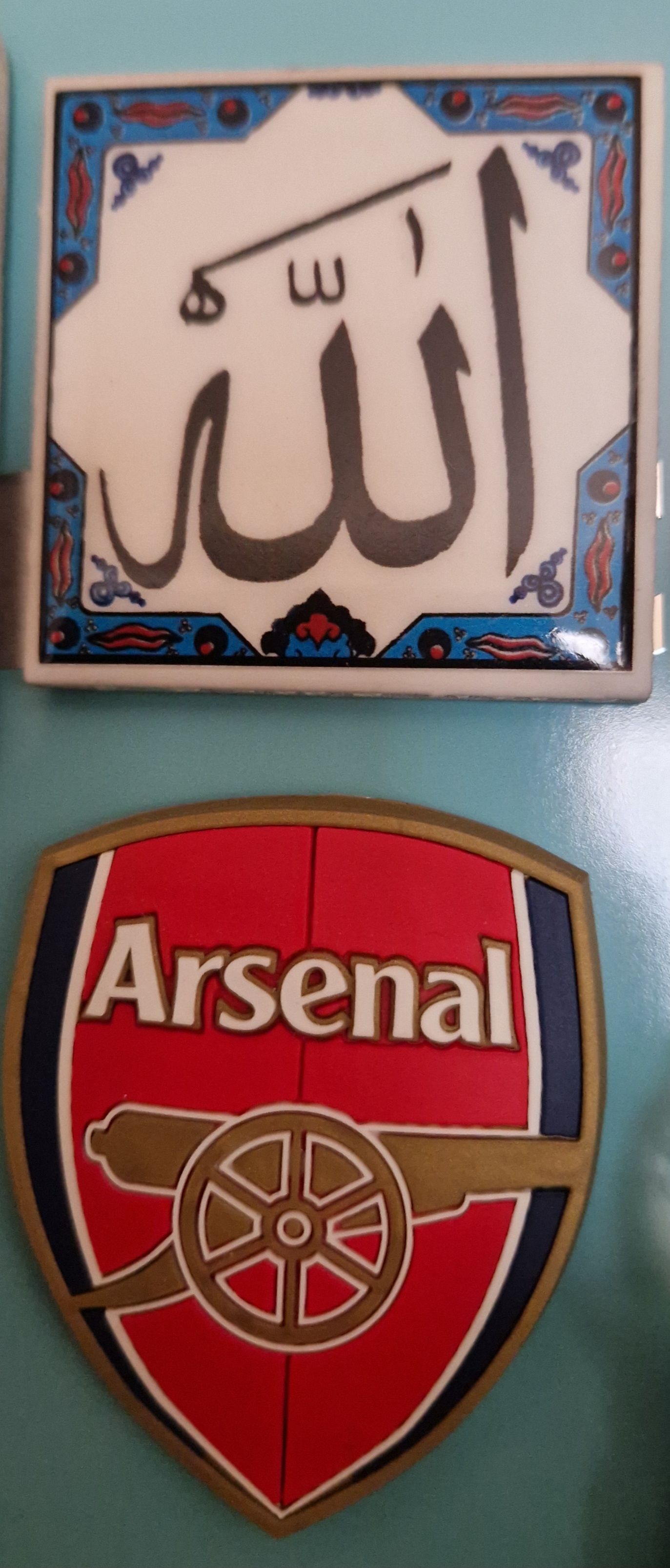
Above: Allah, then Arsenal (Photo: Usama Hasan)
Contents
1 A is for Allah, and then for The Arsenal
2 “Arsenal” is derived from Arabic.
4 Is Football analogous to Religion?
5 Football reflects human emotions, life-lessons and even spirituality.
6 Love vs. Hate: we shouldn’t hate Tottenham.
7 Some Muslim Arsenal players, and the meanings of their names.
Some childhood memories
Our parents moved to the UK in July 1976 (and I’ve followed every FA Cup Final since then) and the vast majority of their children, children-in-law and grandchildren support The Arsenal. (The outliers include a couple of Liverpool fans and a quartet who support Chelsea.) Thus, the 2026 Premier League title marks a glorious celebration of 50 years in this country for the Gooners in our family.
We lived in North London for two over two decades, 1976-1997, before most of us moved to the East End of London to be near the Al-Tawhid (Unification) Mosque in Leyton. In North London, we actually lived in the Wood Green / Tottenham area for over 20 years. At our local primary school, most kids were Spurs fans, but a substantial minority were Arsenal. At my secondary schools in Muswell Hill and Friern Barnet, it was pretty even between Arsenal and Spurs, whilst Arsenal support dominated at my sixth-form at the City of London School for boys, although there was also substantial Liverpool support. As our father once commented, we should have been supporting our local club, Tottenham Hotspur aka Spurs, but thanks to reasons about which I’m not entirely clear, related to my older brothers and their friends, we ended up choosing the “red” (and “right”) half of North London.
Some of my best friends at primary and secondary schools were Spurs fans. At secondary school, I once needed a new sports/PE kit bag. My dear Mum, not knowing quite how seriously we took our football rivalries, bought me a Spurs PE bag from a local shop – we lived in Tottenham, remember! It felt embarrassing and shameful to take this school weekly for a couple of years, since I had no choice, although I did minimise the damage by ‘accidentally’ spilling some white paint over the Spurs logo on the bag.
For many years at the end of the 1970s and beginning of the 1980s, our father would bring my older brothers and me to the Asian Centre on the Seven Sisters’ Road, next to the Finsbury Park tube station entrance/exit, on Saturday mornings for Arabic, Qur’an and Urdu lessons. This building is now occupied by ‘Halal House’ and a bookshop for the adjoining Muslim Welfare House. From the top floor of the building, we could actually see the Clock End shed and southeastern corner of the nearby Highbury pitch, and I would sometimes climb up there and gaze longingly at that ‘hallowed turf’: we weren’t allowed to go to football matches because that wasn’t done in devout Muslim families at the time; furthermore, we always went home (to Tottenham!) around 1pm, otherwise we could have had a free, albeit extremely limited, view of 3pm home games on Saturday afternoons. We did, however, witness streams of fans driving past the Asian Centre with Arsenal and Wembley flags on the day of the 1980 FA Cup Final, that we lost 1-0 to West Ham.
We had to go shopping with parents that afternoon, and I listened on the car radio to the first part of the final, including Trevor Brooking’s headed goal. We watched the second half on TV at home: this ended in a heartbreaking defeat. Dad then announced that he had to give a lecture at a mosque somewhere, and that his sons had to accompany him, as usual. As luck would have it, this mosque was in East Ham, next to West Ham, and on our drive to the mosque, to compound our misery, we got stuck in a traffic jam consisting of Hammers fans blaring their horns loudly and waving their flags, ecstatic at their well-deserved, giant-killing victory. Just days later, we lost on penalties to Valencia in a European cup final, after a 0-0 draw aet. Parallels between 1980 and 2026 then, in terms of two cup-final defeats, except that this time we clinched a glorious league title to compensate.
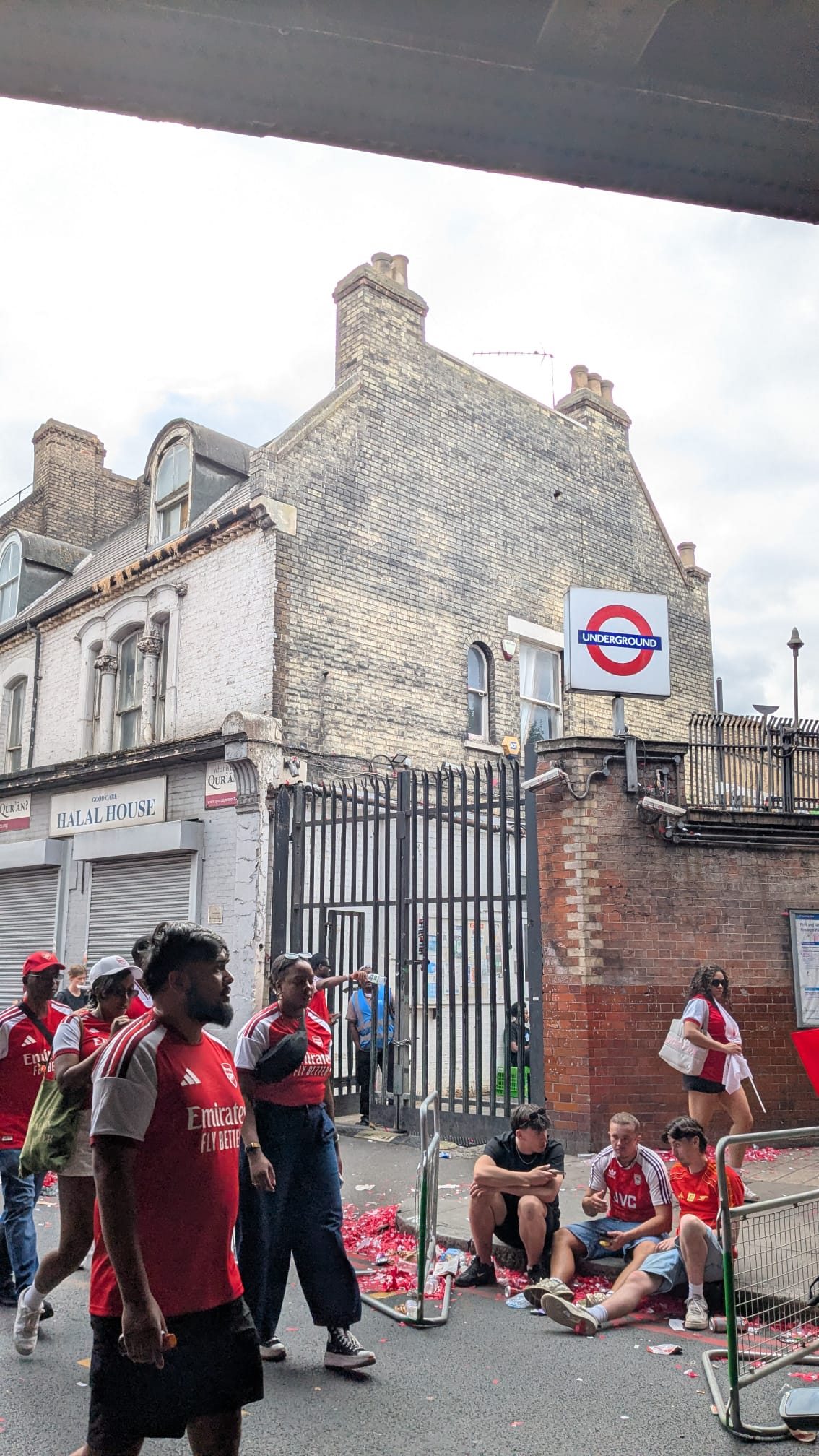
Above: Fans walk past Halal House, next to the iron gates of the Muslim Welfare House, Seven Sisters Road, EPL Title Parade, 2026. Next door used to be the Asian Centre in the 1980s. From the top floor windows, a corner of the Highbury pitch was visible. (Photo: Usman Hasan)
In 1989 during the George Graham era, I went to my first Arsenal match. A Jewish friend from school, Eddie, showed me the ropes: he waited for me with his dad outside the tube station and I accompanied them to Highbury. Entrance was £3. We lost 3-1 to Nottingham Forest. I later went to our penultimate home game, since we were in pole position to win the league: five points ahead of Liverpool, although having played a game more. However, we lost 2-1 to Derby. Dean Saunders scored both of Derby’s goals, and later signed for Liverpool. Derby’s goalkeeper was the legendary Peter Shilton. Simultaneously, Liverpool came from behind to beat Wimbledon 2-1 away. The opposing sets of fans at Highbury, glued to their radios, let the opposing fans know each time a goal was scored by chanting the name of the team scoring in the other game. In midweek, Liverpool won their game whilst we drew 2-2 at home to Wimbledon, who thus had a major influence on the title trajectory at the end of the season. Liverpool also won their game in hand.
The league title that season (1988/89) was decided fatefully at Anfield: Liverpool v Arsenal, the last game of the season, being played days after all the other final-round fixtures, on a Friday evening. (Due to the Hillsborough disaster, Liverpool’s matches had been rescheduled, leading to this unusual slot). The match would kick-off around 8pm; the second half around 9pm. Sunset would be at around half-time. This posed a problem for Jews observing Shabbat (Sabbath), since the more devout ones would not be allowed to watch the match, due to Shabbat being reserved for worship. There were two Jewish lads in my sixth-form tutor group who were also football fans: Andrew (Liverpool) and Stacey, a keen Gooner who regularly went to away matches, even on school nights. Andrew told me that due to Shabbat beginning at sunset, coinciding at half-time of the title decider, he would watch the first half and put the second half to record on the VCR timer, only to watch it 24 hours later at the end of the Sabbath. Throughout Saturday until sunset, he would avoid going out or talking to anyone who might tell him the score. Andrew was far more Orthodox than Stacey, and in fact I didn’t even know that Stacey was Jewish. I asked Stacey whether he would be with the away fans at Anfield. “No, I’m Jewish,” he replied. “Oh,” I asked him, “so you’ll watch the first half, record the second half and watch it back a day later?” “No, I’m not that Jewish!” came Stacey’s hilarious reply.
Liverpool were now three points clear of us, with a goal difference better by four goals. However, we had scored more goals, so we needed to win by two goals to become league champions for the first time since the League/FA Cup double-winning season of 1971. The title decider in 1989 was 0-0 at half-time. Alan Smith scored midway through the second half, and Michael Thomas scored in injury time at the end of the game to earn us a remarkable and deserved title, since we had led the table for most of the season. Just as our victory over Man U in the 1979 FA Cup “three-minute” Final was the greatest FA Cup Final ever in my eyes, our last-gasp title in 1989 was the greatest top-flight title of all time.
1 A is for Allah, and then for The Arsenal
‘Alphabet’ of course is derived from alpha-beta, the first two letters of the Greek alphabet. A comes from alpha; in Hebrew and Arabic, Semitic sister-languages, the first letter of the alphabet is aleph and alif respectively. Both aleph and alif are written as a simple vertical stroke, like the English capital I, which is also how the foundational number 1 is written. One is also written with a simple vertical stroke in English: no surprise, since numerals in English are Arabic numerals. Here is how Alif and the Arabic number 1 appear on my wordprocessor: ﺍ , ١
Thus, aleph, alif, alpha and a are primary, in the sense of being the first letter of the alphabet. Aleph and Alif are primary and foundational in terms of mathematics also, since they also denote the number One. It is no coincidence that in Arabic, the name Allah for the One Source of Everything begins with alif, the primal letter and number.
English alphabet books for kids usually begin with a is for apple.
In Urdu, it’s usually: alif is for anar – pomegranate.
In Arabic, it’s: alif is for asad – lion.
In the 1980s or 90s, Yusuf Islam, the pop singer formerly known as Cat Stevens, released a song and album entitled A is for Allah.
That A (or Alif) is for Allah is intuitive to devout Muslims. My love for the Arsenal was always increased by the cool fact that our team name also began with A, so that we have always been the first team listed alphabetically in the top division during my lifetime. Luckily, R occurs just before S in the English alphabet, so Aston Villa always come after us in this list. Arsenal’s alphabetic prominence is likely to remain for a long time, unless Aldershot Town FC somehow make it to the Premier League. (The Scottish team I picked to support from childhood is Aberdeen, simply because of their similar alphabetical leadership.)
Hence, for Muslim Gooners: A is for Allah, and then for The Arsenal.
2 “Arsenal” is derived from Arabic
Talking of Arabic, the English word Arsenal is actually derived from Arabic, possibly via Ottoman Turkish.
The origin is dar sina’ah (or sina’at) al-aslihah, meaning ‘house of weapons manufacture’, i.e. a weapons factory. This three-word phrase became contracted to Arsenal by the dropping of the initial d, contraction of the middle word and eliminating the final word whilst retaining its definite article al- (the). Thus:
dar sina’at al-aslihah → ar-sina-al → Arsenal.
Thus, the Arabic for ‘weapons factory’ became transformed into the English for ‘weapons store.’
Given this Arabic origin of the name Arsenal, it is entirely appropriate that we have (or had) official Arabic calligraphy on our new stadium since 2006, announcing its name: the Emirates (al-imārāt), referring to our sponsor, the national airline of the emirate of Dubai from the United Arab Emirates.
3 A tongue-in-cheek fatwa: All North London Muslims should support the Arsenal. It is haram to support certain other teams.
Given that (i) the name Arsenal is derived from classical Arabic, the sacred language of Islam;
(ii) our neighbours and biggest rivals are Spurs: being a team with strong Jewish (Israelite) roots leading to them being dubbed a ‘Jewish club,’ the physical and spiritual cousins of Arabs (Ishmaelites) and Muslims;
We can imagine a fatwa: All North London Muslims should support the Arsenal. This is wajib (obligatory). Furthermore, it is prohibited (haram) to support Spurs, since they are a different, albeit related and neighbourly, tribe. It is also prohibited to support any team with an emblem or nickname that is blasphemous, such as The Red Devils (Manchester United) because of its clear Satanist connotations.
4 Is Football analogous to Religion?
Talking of fatwas, it should be obvious that football (and sports in general) has many similarities with religion. The tribalism of supporters. The “sacred rituals.” Football stadia stimulate the local economy, just as mosques do on a smaller, although more regular, basis: there are over 2,000 mosques in the UK, and I estimate that the average attendance for weekly Friday prayers is about a thousand people: thus, businesses near mosques have a total, potential market of about two million people every Friday lunchtime. The pitches in major stadia are regularly described as “hallowed (holy) turf.” The pilgrimages to the home stadium. On the latter, two examples stand out: Anfield became a shrine and a “holy” site of pilgrimage after the dreadful Hillsborough disaster, 1989; the Emirates stadium, when Arsenal clinched the title coincidentally during the Islamic “Month of Pilgrimage” (Dhul Hijjah) to Mecca, the holiest days of the year. At Paddington station last week, I bumped into three young Saudi men who had flown over for their first visit to the UK “because of Arsenal.” On the train two days later, after our trophy-lift at Crystal Palace, an Indian man sat next to me on the train – he had flown in that morning from Houston, Texas. Gooners were said to be flying in from New York City and elsewhere for the parade yesterday. There were hundreds of thousands of Gooners celebrating at the Emirates stadium on the night we clinched the title, I estimated, and the crowd sizes beneath the elevated stadium were reminiscent of the crowds in Mecca, with the Grand Mosque and its minarets towering over them. (Nearly 60,000 attend every fortnight for home games; multiply this by many times to account for all the fans who came for a free celebration.) At the parade today, there were anywhere between half a million and two million fans, depending on various estimates. When I mentioned the international nature of these celebrations to my father, he commented, “It’s like Hajj!” Indeed, in more ways than one, given that this has all coincided precisely with the actual Hajj season.
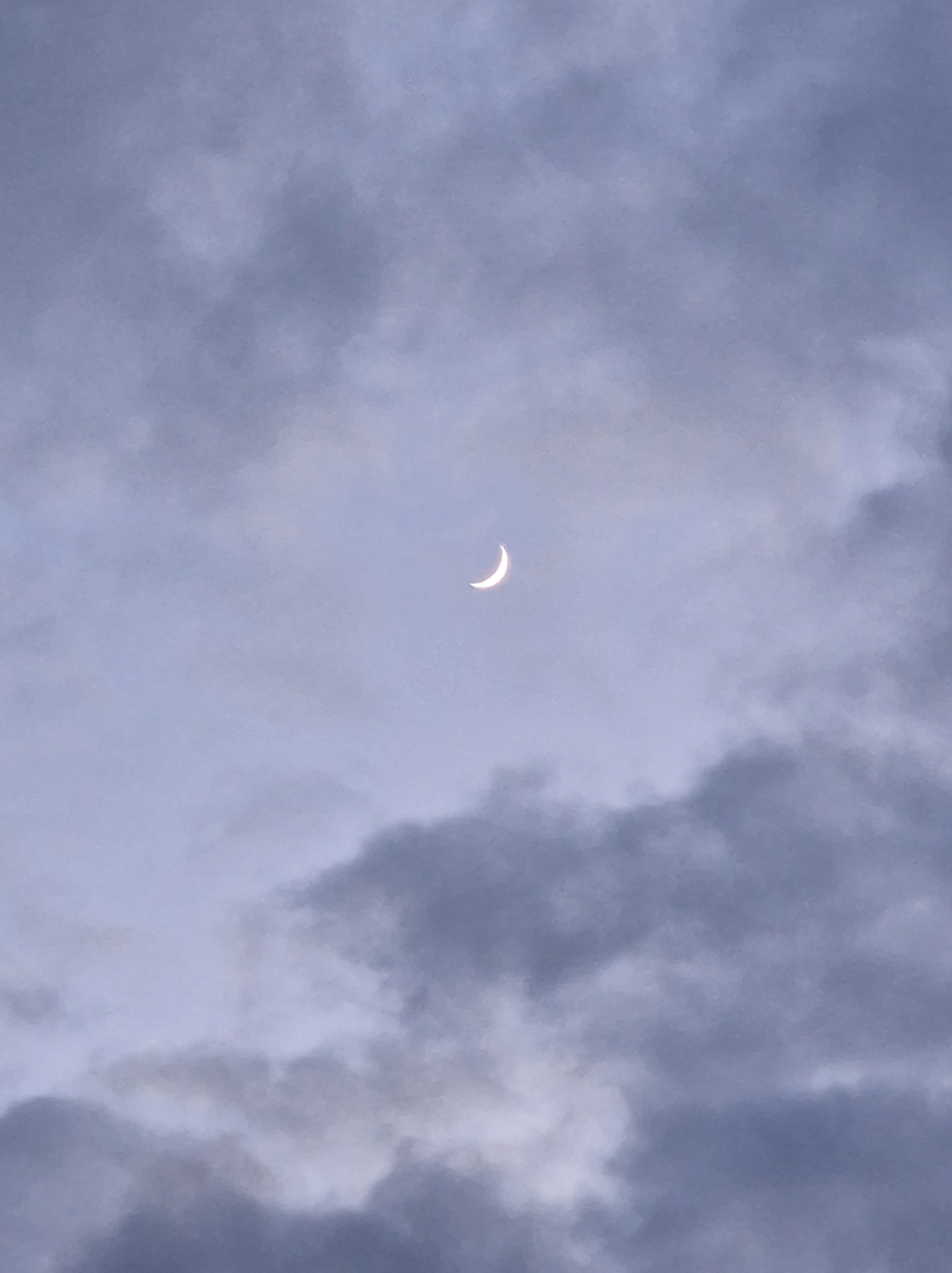
Above: the waxing crescent moon (3rd night hilal) of Dhul Hijjah 1447, the Month of Pilgrimage to Mecca, over the skies of London, 19 May 2026. The first 13 days of this month, especially the first 10, are the holiest days of the Islamic calendar. We beat Burnley on the 2nd night and were confirmed champions the next night. The Champions League final began just after sunset in Mecca on the 13th. The blessings did not quite last for Arsenal, who lost the penalty-shootout. (Photo: Usama Hasan)
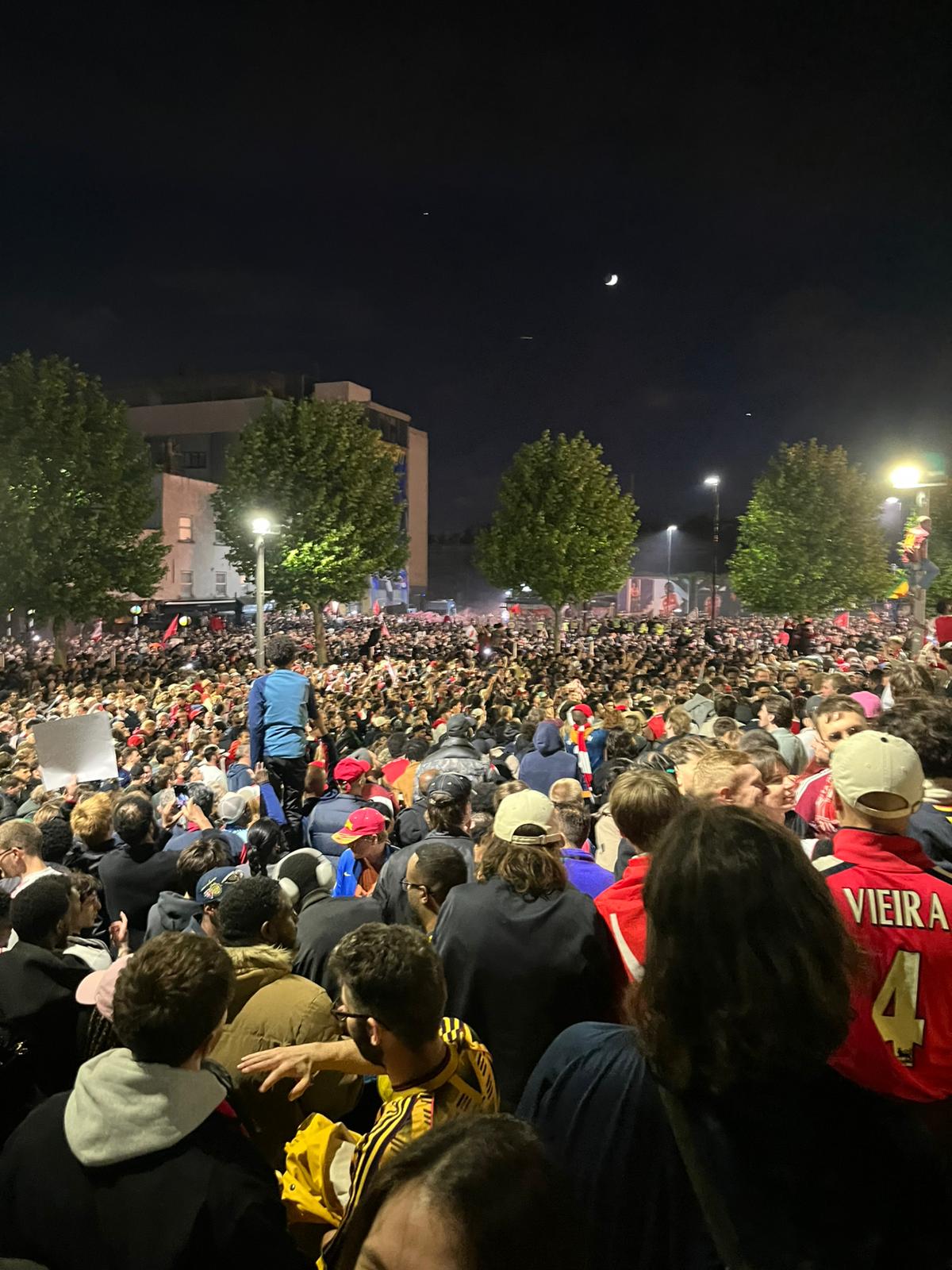
Above: Jupiter, the waxing crescent moon (hilal) of Dhul Hijjah 1447 and Venus over Arsenal fans outside the Emirates Stadium on the 3rd night of the lunar month (19 May 2026), when we were confirmed as Premier League Champions.
Talking of parades, the daily and nightly scenes of celebration around the Emirates Stadium over the past fortnight have showcased London’s diverse and multicultural scene. People of all faiths and none have come together in a spirit of harmony. Images from Africa of fans in Arsenal thobes (Arab robes) have gone viral, as has the Mayor of NYC Zohran Mamdani’s Indian-style Arsenal kurta at Eid Prayers. (The latter was blue, probably because Mamdani is a Democrat and Arsenal’s home colour of red is associated with Republicans, Trump and the MAGA movement.) Muslim women in red headscarves were prominent at the celebrations. This is a powerful rejoinder to divisive, far-right groups such as the so-called “Football Lads’ Alliance.”
I once gave a Friday prayers sermon (khutbah) on this topic at Imperial College Islamic Society, c. 1997. It was generally well-received, especially by football fans. Some years earlier, I’d talked to a Cambridge University lecturer in English Literature about this topic, after discovering that he was passionately following Arsenal’s title-winning campaign in 1990/1. “Do you think football is like religion?” I asked him. “Yes, it’s my religion substitute!” he replied.
Many football players who are believers regularly pray before or after matches, or invoke their faith in God. In the current Arsenal setup, it is said that Saka, Eze and Madueke participate in Bible study groups together. Eze makes the sign of the cross when he scores, and Saka points to heaven. In previous years, Arsenal had many Muslim players, of whom a bit more later. Mesut Ozil would always lift his hands in prayer before matches, palms facing the heavens, in keeping with Islamic tradition that is interestingly shared by many African Christian players, unlike the Western Christian tradition of putting hands together in prayer.
Many Muslim football players place their foreheads on the ground in prayer, in a pose of prostration (sajdah) upon scoring a goal. Demba Ba did this every time he scored for Newcastle United, before leaving the club after refusing to wear the shirt, since their main sponsor was now a gambling firm. When Egypt scored first against England at Wembley once, the entire team placed their heads on the ground in prostration. Prostration is done for gratitude in this context and brings about humility. “Be Humble!” has now become a phrase associated with football players as well as religious leaders. I was disappointed when a leading English footballer-turned-presenter once mocked the practice as “eating grass”, although it is clear that he wasn’t aware of its significance. In contrast, English cricket commentators have always been aware that Pakistani cricketers’ prostrations, eg after the 1992 World Cup Final, were gestures of prayer and gratitude.
Ultimately, true religious pilgrimage in all religions connects with the Sacred, the Transcendental, the Immanent. It would be easy to dismiss football, but its power to unite (and divide) people cannot be ignored. “Football represents controlled aggression,” Chief Rabbi Jonathan Sacks once said on a BBC TV documentary about Arsenal bringing Muslim and Jewish children to play football together. “Rather than fighting physically, we compete sportingly.” (Sacks, and the former Archbishop of Canterbury, George Carey, were both Arsenal fans.)
Sacks’ comment applies to many (all?) sports, especially team sports like football, cricket and rugby. Centuries ago, our ancestors would wage physical battles against invaders; modern team sports have evolved from the same human passions for conquest and defence, victory and revenge. Even the nature of many team sports involves invading and conquering territory (rugby, football) or applying well-timed blows (cricket). In the past, non-combatants would encourage their armies by loud cheering and waving banners, practices that continue in modern team sports.
One of the reasons that World Cups in various sports arouse so much passion is precisely because international matches are a controlled version of war. National sentiment reaches epic proportions, and there was even the “Soccer War” between Honduras and El Salvador in 1969.
After the recent 2026 title win, the Arsenal legend Thierry Henry, in a social media post, addressed Gooners worldwide as “Dear Arsenal Nation, …” In Arabic/Islamic terms, this is equivalent to saying: ya ummat al-Arsnal, as opposed to the more usual, ya ummat al-Islam (O Nation of Islam!).
There is a question here for Muslim Gooners: is it possible to be a member of both the Arsenal Nation (ummah) and Muslim Nation (ummah)?
If so, let’s widen the question: is it possible to be a member of both the British [or insert your political nationality here] Nation (ummah) and Muslim Nation (ummah)?
Thus, football illustrates a crucial question about the loyalties of believers in contemporary nation-states.
5 Football reflects human emotions, life-lessons and even spirituality
“Be Humble!” is an important religious and spiritual lesson that has recently become popularised by top football players. Football mirrors many human emotions: joy and sadness, happiness and sorrow, love and hate. It also teaches life-lessons, such as the cycles of success and defeat. For me, three memorable examples stick out:
Firstly, the Manchester City “bottle guy” who surely regrets mocking us with his stunt now.
Secondly, In 1995, David Seaman was the goalkeeping hero in a European semi-final penalty shootout against Sampdoria but conceded the winning goal scored by Real Zaragoza from the halfway line in the final in the last minute of extra time; to top the irony, the goalscorer was a former Spurs player, Nayim!
Thirdly, In 2006, Jens Lehmann was another goalkeeping hero in the Champions League semi-final, saving a last-minute penalty from Villareal to ensure victory, but was sent off early in the final against Barcelona – a major factor in our eventual, heroic defeat.
But the fruits of patience and perseverance are arguably visible in our triumph now after a raft of second-place finishes over the past decade, including three-in-a-row before this year.
6 Love vs. Hate: We Shouldn’t Hate Tottenham
Because our approach to life should be based on the essential Qur’anic message of mercy and love, there should be no room for hate. Chants of “we hate Tottenham and we hate Tottenham … we are the Tottenham-haters” and “Stand up if you hate Tottenham,” ubiquitous at Arsenal matches are utterly wrong. Why are Spurs living rent-free in our heads, anyway? Pity them, maybe, and even respect them where appropriate, eg they’ve won two European trophies in the past half-century whilst we’ve only won one. On the other hand, we’ve reached two Champions League finals to their one, although North London has lost all three. We should have confidence in the values of our own club, and not be obsessed with others. This is analogous to the spiritual teaching of looking inwardly and not pointing fingers at others outwardly. I thus request Arsenal fans to stop such unbecoming chants. They got Jack Wilshere into serious trouble in 2015!
I once met two Jewish brothers, who supported Arsenal and Spurs respectively. I mentioned the above point to the Gooner brother, saying that we shouldn’t chant hate against Spurs, since Abrahamic believers should focus on love, not hate. “Well yes, but there have to be some exceptions!” he replied.
As a part-time imam, I often conduct nikah ceremonies: Islamic wedding blessings. I once came across a brother and sister, both passionate Arsenal fans, who had amazingly and independently ended up marrying passionate Spurs fans! Football rivalries evoke powerful emotions – witness the well-known spikes in domestic abuse after Old Firm derbies (Glasgow, Celtic v Rangers) and last year’s employment tribunal ruling that bosses can reject applicants who support rival football team to existing staff – so I was inspired by meeting these couples who showed that love can indeed conquer hate.
Respect is important, as is healthy rivalry. North London Derbies, much like India-Pakistan cricket matches, become very boring when they’re one-sided.
This section could be added to the fatwa above!
7 Some Muslim Arsenal & Spurs players, and the apt meanings of their names
William Saliba – his surname roughly means “The Crucifier.”
Mesut Ozil – Mesut is the Turkish form of the Arabic Mas’ud, meaning “One Made Happy.”
Marouane (Marwan) Shamakh – “Towering Rock”
Jehad Montasser (Jihad Muntasir) – “Victorious Jihad”. This was a youth player who played a few minutes for our first team during one of those weird “Simod Cup” tournaments in the 1980s. Perhaps it’s just as well that he didn’t become an Arsenal legend, because 35,000 Highbury fans chanting “Jihad” every week would have been interesting, although it would have fit somewhat with our militant logo of a military cannon. (Cf. Ten Truths About Military Jihad)
Finally, a couple of Muslim Spurs players with interesting names:
Nayim (Na’eem): “a blessing.” Nayim is a practising Muslim from the Spanish enclave of Ceuta (Sibtah) in Morocco. I’m sure he’d claim divine blessings for that European-trophy winning-goal from the halfway line against us in 1995.
Nacer Chadli: his surname is the French spelling of Shadhili, indicating a family allegiance to a major Sufi order (tariqa), the Shadhiliyyah.
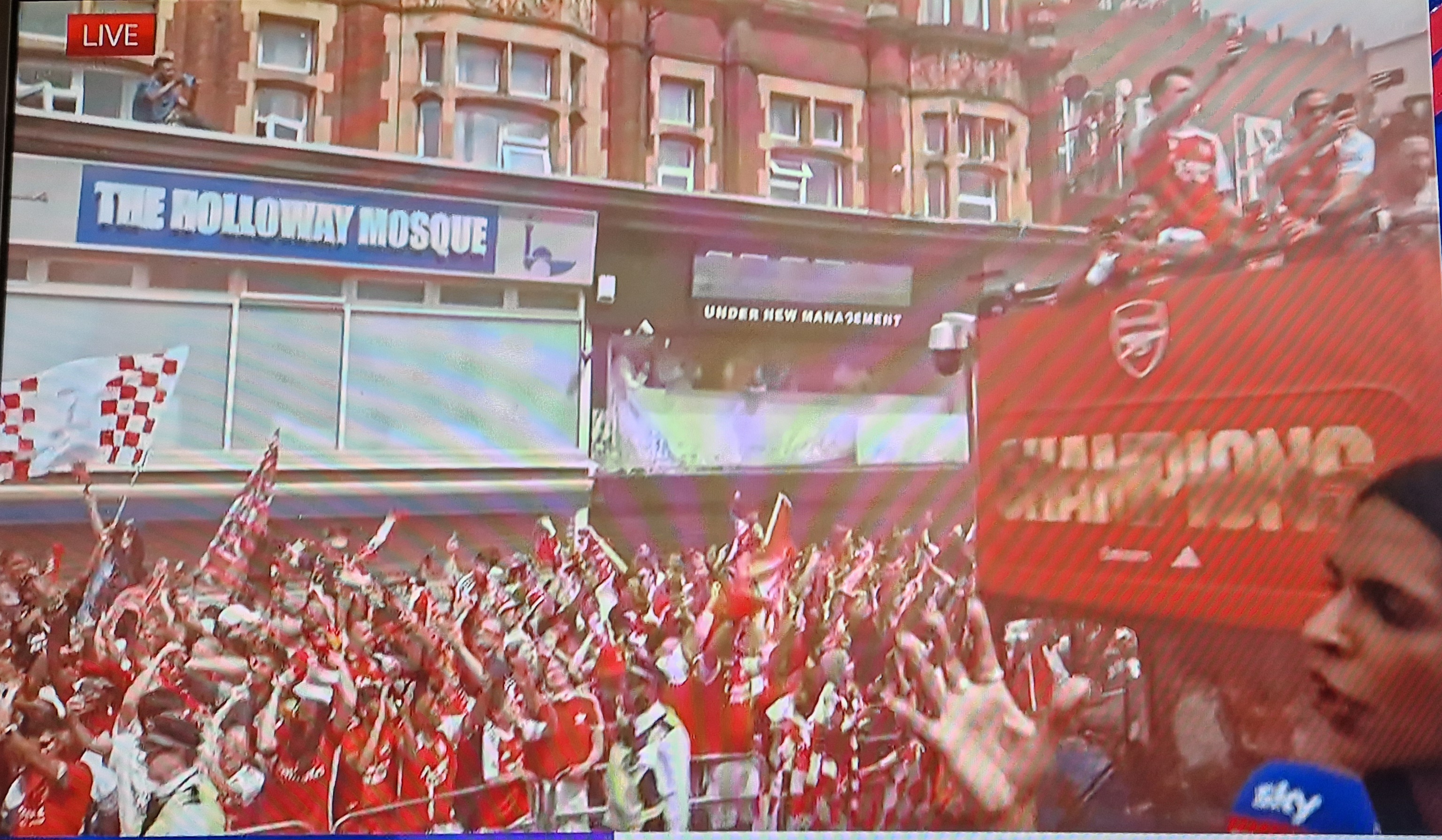
Above: The Arsenal Team Bus passing Holloway Mosque, Champions Parade, 31st May 2026. There were a number of mosques on the parade route around the Emirates Stadium, reflecting Arsenal’s significant Muslim support. These include the Holloway Mosque, the Muslim Welfare House, the Finsbury Park Mosque on St. Thomas’s Road (off Blackstock Road) and perhaps others.
Tags: Arsenal, Arsenal Football Club, football, Gooners, Muslim, premier-league, soccer, sports


Leave a Reply