Archive for the ‘Ramadan’ Category

WHO ARE THE MU’ALLAFATU QULUBUHUM (THOSE WHO ARE GIVEN ZAKAT TO BRING THEIR HEARTS NEAR) ?

April 22, 2024

WITH THE NAME OF GOD, ALL-MERCIFUL, MOST MERCIFUL

WHO ARE THE MU’ALLAFATU QULUBUHUM
(THOSE WHO ARE GIVEN ZAKAT/ALMS TO BRING THEIR HEARTS NEAR) ?

Allah (God) says in the Qur’an:

إِنَّمَا الصَّدَقـٰتُ لِلفُقَراءِ وَالمَسـٰكينِ وَالعـٰمِلينَ عَلَيها وَالمُؤَلَّفَةِ قُلوبُهُم وَفِى الرِّقابِ وَالغـٰرِمينَ وَفى سَبيلِ اللَّهِ وَابنِ السَّبيلِ ۖ فَريضَةً مِنَ اللَّهِ ۗ وَاللَّهُ عَليمٌ حَكيمٌ

Truly, the [compulsory] alms are only for: the poor; the needy;
those who work upon them (in alms-collection);
those whose hearts are brought near;
those whose necks are under the yoke;
those who have taken on a major debt;
in the path of God; and the child of the path [i.e. the traveller]:
an obligation from God: for God is Knowing, Wise.

(Surah al-Tawbah, Repentance, 9:60 Hafs)

TAFSIR TABARI ON THIS VERSE (SUMMARISED)

Imam Tabari (224-310 H / 839-923 CE) said:

As for “those whose hearts are brought near”: they were a group of people who were brought closer to Islam (through the incentive of being given wealth), who could not be (openly) supported. The alms benefited themselves and their close families. Such people were: Abu Sufyan bin Harb, ‘Uyaynah bin Badr, Aqra’ bin Habis and similar heads of tribes.

Similar to what we have said, has been said by the People of Interpretation.

Mention of those who said that: Ibn ‘Abbas, Yahya bin Abi Kathir, Zuhri, Mujahid, Hasan [Basri] and Qatadah. Yahya bin Abi Kathir said that such heads of tribes were given a hundred she-camels[1] each by the Prophet, may God bless him and grant him peace; a few others were given fifty each. Zuhri added that this phrase includes Jews and Christians who submit to God (via Islam), even if they are rich.

The people of knowledge differed about whether or not this category exists today, and whether anyone today may be given charity to bring them closer to Islam?

Some of them said: The category of “those whose hearts are brought together” is invalid today: there is no share in the compulsory alms except for those in need, those in the path of God and those who work upon them (in alms-collection).

Mention of those who said that: Hasan [Basri], ‘Amir [bin Sharahil al-Sha’bi] and ‘Umar bin al-Khattab.

When ‘Uyaynah bin Hisn came to [Caliph] ‘Umar bin al-Khattab [seeking to be given alms], ‘Umar said, “The Truth (has come) from your Lord: so whoever wishes to, may have faith; and whoever wishes to, may deny!” [Surah al-Kahf, The Cave, 18:29 Hafs] That is, there is no bringing near today.

‘Amir [bin Sharahil al-Sha’bi] said: Those whose hearts were brought near, were only during the time of the Prophet, may God bless him and grant him peace: when Abu Bakr, may God Exalted’s Mercy be upon him, came to power, incentives stopped.

Others said: “Those whose hearts are brought near” exist in every age, and they have a right to some alms.

Mention of those who said that: Abu Ja’far [i.e. Imam Muhammad bin ‘Ali al-Baqir].

Abu Ja’far [i.e. Imam Tabari, who had his own, independent Madhhab] said:

The correct saying from amongst those, in my view, is that God has made alms to serve two purposes. One of them is to fill any gaps (of need) amongst the Muslims. The other is to aid and strengthen Islam. Whatever charity is to aid Islam and strengthen its means, this is given to both rich and poor. This is because it is not given to a person due to his need for it, but is given to him in order to aid the religion. This is just like what is given to a person for the sake of sacred war (Jihad) in the way of God, for that is given to him whether he is rich or poor, and not to fill his gap (of need). Similar are those whose hearts are brought near: they are given that charity even if they are rich: such giving to them seeks to benefit the matter of Islam and seeks to strengthen and fortify it.

The Prophet, may God bless him and grant him peace, gave to whomever amongst those whose hearts were to be brought near, after God opened the victories for him: Islam spread and its people increased in honour. Thus, there is no proof in the argument of the one who says that “Today, no-one is to be brought near to Islam (via alms), because the people of Islam, by their great number, are prevented from being reached by anyone who wishes to give them alms.” The Prophet, may God bless him and grant him peace, gave to those whom he gave whilst they were in the condition that has been described.

TAFSIR IBN KATHIR ON THIS VERSE (SUMMARISED)

Imam Ibn Kathir (700-774 H / 1300-1373 CE) said:

As for “those whose hearts are brought near”:

[1] Some were those who were given (alms) that they may submit (in Islam).

An example is that the Prophet, may God bless him and grant him peace, gave to Safwan bin Umayyah out of the spoils (of war) at Hunayn, a battle that the latter had witnessed as a polytheist. Imam Ahmad, Muslim and Tirmidhi narrated that Safwan bin Umayyah said, “The Messenger of God, may God bless him and grant him peace, gave me (wealth) on the Day of Hunayn whilst he was the most hated of people to me, but he continued giving me (wealth) until he became the most beloved of people to me.”

[2] Some were given (alms) in order that they improve their Islam (having already submitted) and for their hearts to become firm.

An example is that he distributed (wealth), on the Day of Hunayn, to a group of tribal chiefs and nobles amongst the released captives: a hundred camels each. He said, “Truly, I give to a man whilst another is more beloved to me, fearing that God will upend him (the former) on his face in the Fire of Jahannam.”

In the two Sahihs (of Bukhari and Muslim), there is on the authority of Abu Sa’id that ‘Ali sent a small nugget of gold, (encased) in its rock, to the Prophet, may God bless him and grant him peace, from Yemen: he divided it amongst four people: Aqra’ bin Habis, ‘Uyaynah bin Badr, ‘Alqamah bin ‘Ulathah and Zayd al-Khayr, and said, “I bring them near.”

[3] Some were given (wealth) because of the hope that their peers would submit (in Islam).

[4] Some were given (wealth) in order to elicit alms from those around them, or

[5] To ward off harm from the border lands around the territory of the Muslims.

The place for detailed explanation of this is the books of jurisprudential rulings (furu’).

And God knows best.

Can alms be given to those being brought closer to Islam, after the (time of) the Prophet, may God bless him and grant him peace ?

There is difference of opinion in this matter.

It is narrated from ‘Umar, ‘Amir al-Sha’bi and a group (of authorities) that they are not to be given (alms) after his time, because God has honoured Islam and its people, established them firmly in the land and made the necks of others subservient to them.

Others said: Rather, they are to be given (alms) because he, Blessings and Peace be upon him, gave to such people after the Opening of Mecca [i.e. when Islam had already become established] and the Breaking of (the Tribe of) Hawazin [at Hunayn]: this was a situation where alms might be needed, so these could be diverted to them.

IMAM ABU BAKR AL-JASSAS (HANAFI) & QADI ABU BAKR IBN AL-‘ARABI (MALIKI)[2]

Imam Abu Bakr al-Jassas (305-370 H / 917-981 CE) said in his Ahkam al-Qur’an (Rulings of the Qur’an), whilst discussing the premise that alms are essentially for the poor:

If it is said that “those whose hearts were brought near” would receive alms without being poor, it would be said in reply: they would not receive it as alms; rather, alms would be collected for the poor, but some of it would be given to those whose hearts are brought near, in order to repel their harm against the poor amongst the Muslims, and that the former might submit in Islam, thus strengthening the poor amongst the Muslims. Thus, they would not receive it as alms; rather, alms were collected and used for the benefit (masalih) of the Muslims. This is because wealth given for the poor may be diverted for their benefit (masalih) if the Imam [i.e. the Caliph] rules over them and decides about matters beneficial to them (masalih).

[Summarised] Qadi Abu Bakr ibn al-‘Arabi (468-543 H / 1076-1148 CE) said in his Ahkam al-Qur’an (Rulings of the Qur’an):

THE NINTH ISSUE [regarding this verse of the Qur’an]

About “those whose hearts are brought near,” there are four views:

  1. They were given alms because of the weakness of their certainty, until this became strong. Those who said that they were Muslims, cited the examples of Abu Sufyan bin Harb, Aqra’ bin Habis and ‘Abbas bin Mirdas. Those who said that they were non-Muslims, cited the example of ‘Amir bin Tufail. Those who said that they were polytheists with an inclination towards Islam, cited the example of Safwan bin Umayyah.

  2. Yahya bin Abi Kathir named them as leaders of the following [ten] tribes or clans: Banu Umayyah, Banu Jumah, Banu ‘Amir, Banu Asad, Banu Hashim, Banu Fazarah, Banu Tamim, Banu Nasr, Banu Sulaym and Thaqif.

  3. Ibn Wahb narrated from Malik that he said: Safwan bin Umayyah, Hakim bin Hizam, Aqra’ bin Habis, ‘Uyaynah bin Badr, Suhayl bin ‘Amr and Abu Sufyan were amongst “those whose hearts were brought near,” and that on the day [of Hunayn] when Safwan was given alms, he was a polytheist.

    Asbagh said, on the authority of Ibn al-Qasim: “Those whose hearts were brought near” were Safwan bin Umayyah and certain men of Quraysh.

  4. The Shaykh Abu Ishaq named them to be forty men of the Quraysh and other tribes, including leaders and others.

THE TENTH ISSUE

There has been a difference of opinion as to whether [the category of] “those whose hearts are brought near” persisted.

Some of them said: They [i.e. this category of people] disappeared. This view was expressed by a group (of authorities), and was held by Malik.

Some said: They remain, because the Imam [i.e. the Caliph] may need to bring people near to Islam. [Caliph] ‘Umar discontinued them [i.e. this category of people] because of what he saw of the might of the religion.

My view is that if Islam is strong, this category disappears; but if such people are needed, they are given their share, just as the Messenger of God, may God bless him and grant him peace, used to give the share. For it is narrated in the Sahih (authentic hadiths): “Islam began as a stranger, and will return as a stranger, as it began.” [Sahih Muslim]

THE ELEVENTH ISSUE

If we say that this category of people has disappeared, then their share returns to all the (other) categories, or to whichever (category or categories) the Imam decides, according to the previous explanation regarding the root of the disagreement.

Zuhri said: Half of their share is to be given to those who frequent the mosques. There is no evidence for this view. The first view (mentioned above) is more correct.


[1] A hundred camels represents a lot of wealth: it is the same as the diyah (blood-money) for murder. In today’s financial terms, it would approximate up to a hundred thousand US dollars or UK pounds, or even more. (AQS)

[2] The Hanafi and Maliki schools are complementary, in the sense that they represent the schools of Reason (Ahl al-Ra’y) and Tradition (Ahl al-Hadith) respectively. A holistic approach to the Sunnah combines these complementary approaches, as per Imam Shatibi (cf. Al-Shanqiti, On Madhhabs & Taqlid, AQS, 1445/2023)

DO WE FOLLOW THE AUTHENTIC HADITH, OR THE CONTRARY VIEWS OF IMAM, ABOUT FASTING SIX DAYS OF SHAWWAL, THE MONTH THAT FOLLOWS RAMADAN ?

April 11, 2024

Imam Nawawi said in his Commentary upon the hadith of Sahih Muslim about fasting the six days of Shawwal:

“In it is a clear indication to support the position of Shafi’i, Ahmad, Dawud and those who agreed with them in recommending the fasting of these six days. Malik and Abu Hanifah said that it is disliked. Malik said in al-Muwatta’ , ‘I never saw any of the people of knowledge fasting these days … They said: It is disliked, in case people think it is obligatory.’ The evidence of Shafi’i and those who agree with him is this clear, authentic hadith: if the Sunnah is established, it is not to be abandoned because some people abandon it, and not even if most or all of them abandon it. Their saying, ‘in case people think it is obligatory’ is disproven by the fast of ‘Arafah, ‘Ashura and other recommended fasts.”

Shaykh Muhammad al-Amin al-Shanqiti said:

There is no doubt that in the compiled Madhhab of Imam Malik, there are derived rulings (furu’) that oppose some texts of the revelation. It is apparent that some of these texts did not reach him, may Allah have mercy upon him: had they reached him, he would have acted upon them. Other texts did reach him, but he chose not to act upon them due to another indication that he believed was stronger evidence.

An example of a text not reaching him is the hadith about fasting six days of Shawwal, after the fast of Ramadan. He, may Allah have mercy upon him, said in his Muwatta’ (The Well-Trodden Path),

“Truly, I never saw any of the people of knowledge and understanding fasting these days, and nothing has reached me regarding this on the authority of the predecessors (Salaf). The people of knowledge dislike this practice and fear that it is an innovation, and that ignorant and coarse people will add to Ramadan what is not part of it if they see the people of knowledge allowing it and practising it.”

Here, Malik says explicitly that fasting six days of Shawwal reached him neither on the authority of the Prophet, nor on that of any of the Salaf. There is no doubt that had encouragement from the Prophet, may Allah bless him and grant him peace, to fast these days reached him, he would have fasted them and recommended others to fast them – it goes without saying that he would not have disliked the practice. This is because Malik would not have doubted that the Prophet, may Allah bless him and grant him peace, was more kind and merciful towards the community than he was, for Allah has described the Prophet in the Qur’an as being kind and merciful.

If fasting those six days necessitated the problem because of which Malik disliked the practice, the Prophet would not have encouraged it and he would have considered the problem that Malik identified. But the Prophet, may Allah bless him and grant him peace, avoided and dismissed the problem because he knew that the month of Ramadan is too well-known to be confused with any of Shawwal. This is similar to the recommended prayers before and after the obligatory prayers: none of the people of knowledge ever disliked them for fear that the ignorant would add to the obligatory prayers. This is due to the five compulsory prayers being well-known and not confused with others.

Anyhow, it is not for any Imam to say that a matter that has been approved by the Prophet, may Allah bless him and grant him peace, is disliked for fear of the ignorant thinking that it is obligatory. Fasting of the aforementioned six days, and the Prophet’s encouragement of this, is established authentically from him. The hadith was transmitted by Ahmad, Muslim, Abu Dawud, Tirmidhi and Ibn Majah via several Companions, including Thawban, Jabir, Ibn ‘Abbas, Abu Hurayrah and Bara’ bin ‘Azib, as explained by [Imam Shawkani,] the author of Nayl al-Awtar.

(Shaykh Muhammad al-Amin al-Shanqiti, Lights of Eloquence: Commentary on Qur’an, Surah Muhammad, 47:24)

NB: Both the Hafiz Ibn ‘Abdul Barr and Imam Nawawi, leading Hadith scholars from the Maliki and Shafi’i schools of jurisprudence respectively, approved fasting six days of Shawwal due to the authentic hadith, and preferred this over the view of Imam Malik.

Ramadan Dates 1443 (2022)

April 1, 2022

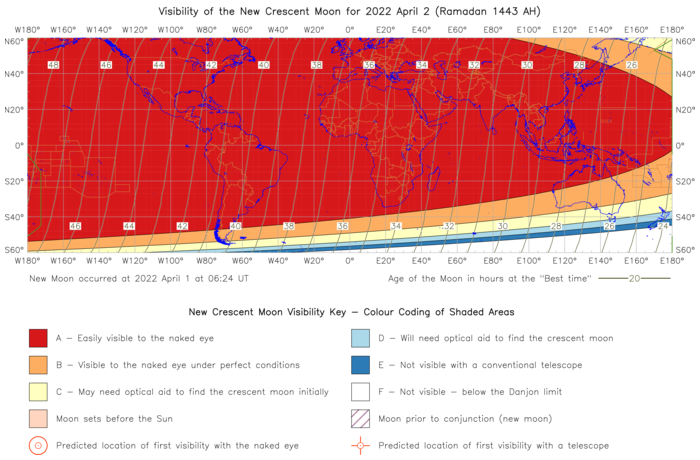
SUMMARY: Naked-eye moonsighting gives the 1st day of Ramadan 1443 as Sunday 3 April 2022 for the whole world except for North America where Saturday 2 April 2022 is a possibility. Moonsighting with a telescope gives the 1st day of Ramadan 1443 as Saturday 2 April 2022: some authorities and countries have already announced Ramadan for then. (Naked-eye moonsighting in Antarctica & New Zealand might give the 1st day as Monday 4 April 2022!)

Astronomical new moon occurred at 06:24 UT (GMT) today, on Friday 1 April 2022 (29 Sha’ban 1443).

Crescent (lunar) visibility diagrams, courtesy of the UK HMNAO/IOP Moonwatch project, now hosted by UKHO:

Friday 1 April 2022 / 29 Sha’ban 1443, evening
(around the optimal time for moonsighting, about 20 minutes after sunset):

Global new (crescent) moon visibility for the evening of Friday 1 April, 2022 (29th Sha’ban 1443) – UK Moonwatch model

Global new (crescent) moon visibility for the evening of Friday 1 April, 2022 (29th Sha’ban 1443):

Not visible anywhere in the world, with the exception of the Americas.

The new crescent moon will be visible by naked eye in California, Mexico & parts of Central America, and by telescope in parts of South America. Given the ISNA Fiqh Council’s very reasonable judgment since the 1990s that North America is to be regarded as one horizon (matla’), this would lead to the 1st day of Ramadan 1443 being Saturday 2 April 2022 throughout North & Central America. If sighting by telescope is deemed acceptable, the same start date would apply to South America. However, I defer to the judgments of the relevant authorities in the Americas.

Saturday 2 April 2022 / 30 Sha’ban 1443, evening
(around the optimal time for moonsighting, about 20 minutes after sunset):

Global new (crescent) moon visibility for the evening of Saturday 2 April, 2022 (30th Sha’ban 1443)

Global new (crescent) moon visibility for the evening of Saturday 2 April, 2022 (30th Sha’ban 1443):

Visible throughout the whole populated world, with the exception of Antarctica & most of New Zealand, where it will be visible the following evening.

Thus, for Oceania (with the possible exception of New Zealand), Asia, Africa & Europe,
the 1st day of Ramadan 1443, based on local moonsighting, is Sunday 3rd April 2022.

Have a blessed & peaceful Ramadan: let us pray for, and serve, our brothers and sisters in humanity!

(Imam Dr) Usama Hasan,

Fellow of the Royal Astronomical Society, London, UK

29th Sha’ban 1443 / 1st April 2022


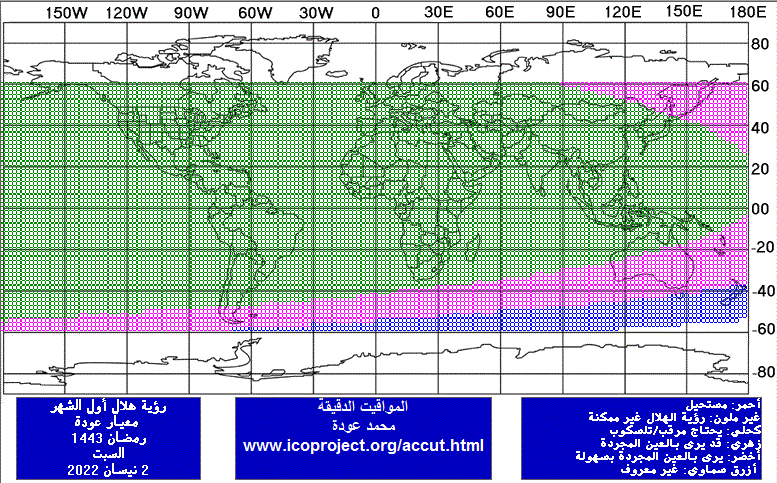
Postscript: The European Council for Fatwa & Research announced on 16/02/2022 that the 1st day of Ramadan for the whole world would be on Saturday 2nd April 2022, based on “detailed astronomical calculations.” They claim that these showed that the new crescent moon (hilal) would be visible “by telescope in West Africa and the Americas” after sunset on Friday 1st April 2022. This seems to be based on the Odeh model. I agree with their approach of determining Islamic lunar dates via astronomical calculations, but we need to agree which ones we are using. ECFR are accepting telescope observations, whereas many of us prefer naked-eye sighting. NB: the Odeh model predicts a narrower range of territory for naked-eye sighting, as is clear from the following visibility maps:

Global new (crescent) moon visibility for the evening of Friday 1 April, 2022 (29th Sha’ban 1443) – Odeh model
Global new (crescent) moon visibility for the evening of Saturday 2 April, 2022 (30th Sha’ban 1443) – Odeh model

Laylat-ul-Qadr (The Night of Majesty and Destiny) and simple astronomy – some reflections

May 22, 2020

Laylat-ul-Qadr (The Night of Glory and Destiny)

& simple astronomy – some reflections

Bismillah.

Laylat-ul-Qadr (LQ – The Night of Glory, Majesty, Decree and Destiny, etc.) is in one sense the climax of the month of Ramadan / Ramzan (R).

* Some of the hadiths about its exact date, even the allegedly authentic ones, are mutually contradictory, which is why scholars try to reconcile them.

* It is night-time for half the earth at any moment; the other half is in daytime. Day and night are relative to each person’s location on earth.

* It is presumably possible for the Angels & the Spirit to descend around the half of the earth that’s in night-time for a period of exactly 24 hours, thus giving a specific date for LQ. Presumably, this would start at sunset for the first location on earth from where the new crescent moon was visible.

* Since Muslims have differed for decades about the beginning of R, and hence about its odd nights, this presents a difficulty in finding LQ in the last 5 odd nights. One solution is to look for it throughout the last 10 nights. But what if LQ falls just before your last 10 nights or just after, i.e. on your Eid night whilst others are still observing R?

* Do the Angels & the Spirit descend throughout the last 10 nights?

* MY SOLUTION: Due to considerations like these, I follow the view of the Companion, Abdullah bin Mas’ood: LQ can be on any night of the year. Or we could say: it is on every night of the year. Every night is LQ!

* This is why the hadiths say: SEEK IT in the last 10 nights of R, etc., because it would be too difficult to seek it all year long. We are prepared with fasting & worship for a whole month to help find LQ during the last 10 nights, preferably in i’tikaf (spiritual retreat). Remember, the Prophet pbuh once did i’tikaf for the whole month of R in order to find LQ.

* These are some of the many wisdoms behind the spiritual practice of Ramadan/Ramzan. May ours have been blessed, and may we have found our Night of Powerful, Glorious Destiny, had all our prayers answered and been illuminated by The Light for at least another year!

PS “Better than a thousand months” means “Better than all of time.”

(khayrun min al-dahri kullihi – Tafsir Qurtubi)

In other words, Laylat-ul-Qadr is an opportunity to transcend Time, or experience Eternity or Timelessness.

I alluded to some of these lessons about Ramadan (Ramzan) & LQ in this poem, based on the famous opening of William Blake’s Auguries of Innocence:

To break your fast with a wholesome date
And recite noble verses of Light.
To seek Infinity in your unfolding Fate
And Eternity in One Night.

Usama Hasan

22 May 2020 / 28 Ramadan 1441

Tadworth, UK.

ليلة القدر و علم الفلك:

الليل والنهار أمران نسبيان لمكان كل شخص في الأرض، وهما آيتان من آيات الله تعالى.

والأحاديث في تحديد تاريخ ليلة القدر متناقضة، حتى الصحيحة منها، ولذالك حاول علماء الحديث الجمع بينها دائماً.

فنصف الأرض في أي وقت في ظلمة اليل، والنصف الآخر في ضوء النهار.

قد تنزّل الملائكة والروح لمدة ٢٤ ساعة كل عام، فتكون لليلة القدر تاريخ معيّن. ولكن عندنا مشكلة: الاختلاف في بداية شهر رمضان يؤدي الى اختلاف في اليالي العشرة الأخيرة.

من أجل هذه الاعتبارات وغيرها، أرى برأي عبد الله بن مسعود رضي الله عنه أن ليلة القدر قد تقع في أي ليلة في السنة. ولذالك جاء في الأحاديث «إلتمسوا ليلة القدر في العشرة الأخيرة من شهر رمضان» لأن إلتماسها طول العام أمر محرج وصعب جداً على المسلمين.

فشرع شهر العبادة من صوم وصلاة وزكاة وإطعام المساكين وإعتكاف وغيرها من أعمال الخير ليسهل إلتماس الليلة العظمى في العام:

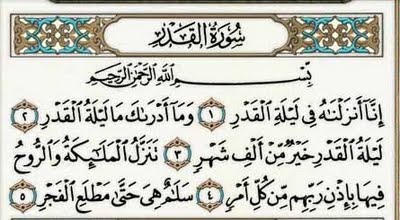
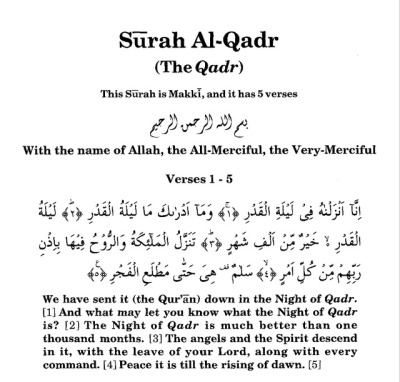
إنا أنزلناه في ليلة القدر، وما أدرىٰك ما ليلة القدر؟ ليلة القدر خير من ألف شهر، تنزّل الملائكة والروح فيها بإذن ربهم من كل أمر، سلام هي حتى مطلع الفجر.

ومعنى «خير من ألف شهر» يعنى: «خير من الدهر كله» كما ذكره الإمام القرطبي في تفسيره. فإن وجدت ليلة القدر، فكأنما خرجت من حدود الزمان ولمست قدسية الدهر وذقت معنى الخلود في جنات النعيم.

اللهم بارك لنا في شهرنا و أيامنا وليالينا، آمين.

APPENDIX: A GLIMPSE OF SOME OF THE VIEWS ABOUT THE DATE OF LQ, TO SHOW THE IMMENSE DIVERSITY ABOUT THIS IN THE ISLAMIC TRADITION

NB: where “[odd nights of the] last 10” is mentioned, even this was disagreed about, e.g.: Ibn Hazm stated that if the month has 30 days, then these odd nights are 21, 23, 25, 27 & 29 but if the month has 29 days, then the last 10 nights are nights 20-29 and hence the odd nights are 20, 22, 24, 26 & 28! This was another argument for seeking LQ in all of the last 10 nights, because in the past, we were unable to know for sure in advance how many days the month would have.

IBN KATHIR

Hadith (Tayalisi): 27 or 29

Hadith (Ahmad): LQ in last 10, odd nights: 29 or 27 or 25 or 23 or the last night of the month.  The hadith has other details.  IK: the isnad is hasan, but the matn has strange, weak content (gharabah) and in some versions, rejected (nakarah) content or meaning.

Hadith (Ibn Abi Asim): LQ in last 10.

Hadith (Ahmad): Seek it in the first 10 or last 10 … Seek it in the last 10 … Seek it in the last 7.

Narration: from Ibn Mas’ood and those who followed him of the people of knowledge of Kufa that it is found throughout the year, and is hoped for in every month equally. (IK disagrees with this view)  Ibn Mas’ood used to say, “If you stand in prayer at night all year long, you will find LQ.”

Hadith (Abu Dawud): LQ may be throughout R.

Narration: from Abu Hanifa: LQ is hoped for throughout R.  This is also a view quoted by Ghazzali [i.e. in the Shafi’i madhhab? – UH] Rafi’i declared this to be an extremely strange view.

LQ is the 1st night of R: Abu Razin.

LQ is 17th R, because it was the night before the Battle of Badr, described as being on the “Day of Decision” (Yawm al-Furqan) in the Qur’an, hence it relates to LQ as the night of decision, decree and destiny: narrated from the Prophet, Ibn Mas’ood, Zayd bin Arqam, ‘Uthman bin Abil-‘Aas, Imam Shafi’i & Hasan Basri.

LQ is 19th R: narrated from ‘Ali & Ibn Mas’ood.

LQ is 21st R: Hadith of Abu Sa’id al-Khudri in Bukhari & Muslim.  Imam Shafi’i said that this was the most authentic narration on the subject.

LQ is 23rd R: Hadith of Abdullah bin Anees in Sahih Muslim – it is a very similar narration to the previous hadith (21 R).

LQ is 24th R: Hadith of Abu Sa’id al-Khudri in Tayalisi. IK: the narrators are trustworthy.  Also narrated as a hadith by Bilal, but a weak isnad. Also contradicted by the next consideration:

LQ is in the first 7 of the last 10 nights: more authentic view of Bilal rA, narrated by Bukhari.  Also narrated as the view of Ibn Mas’ood, Ibn Abbas, Jabir, Hasan, Qatadah & Ibn Wahb, and from the Prophet by Wathilah bin al-Asqa’.

LQ is 25th R: based on the hadith of Bukhari from Ibn Abbas from the Prophet: Seek it in the last 10 nights: in the 9 remaining, 7 remaining, 5 remaining.

IK: Most people of knowledge understood this to mean the odd nights, but others understood it to mean the even nights, e.g. Abu Sa’id (Sahih Muslim). IK: Allah knows best.

LQ is 27th R: narrated from the Prophet, several Companions, a group of the Salaf, the preferred view in the madhhab of Imam Ahmad and quoted also from Imam Abu Hanifa.

LQ is the 7th of last 10 (i.e. 27) or with 7 remaining (i.e. 22 or 23): narrated from Ibn Abbas.

LQ is 21, 23, 25, 27, 29 or last night of the month: Hadith of Imam Ahmad.

LQ is 27 or 29: Hadith of Imam Ahmad.

LQ is the last night of R: Hadith of Ahmad, Tirmidhi, Nasa’i.


UK Ramadan fasting times for 2020

April 26, 2020

ASTRONOMICAL DATA FOR RAMADAN 2020


– by Imam Dr Usama Hasan, Fellow of the Royal Astronomical Society


Ramadan & Eid Dates 2020-2025 (approx.)

Based on Crescent Moon Visibility data for London from HMNAO’s Websurf 2.0 website

(Moon Visibility is estimated on a scale of A-F. The following dates are based on the approximation that A-C represent a visible crescent moon; D-F represent an invisible moon.)

YEAR Beginning of Ramadan (+/- 1 day) Eid al-Fitr
(+/- 2 days)
2020 25 April 25 May
2021 14 April 14 May
2022 03 April 02 May
2023 23 March 22 April
2024 12 March 10 April
 2025 02 March 31 March


Examples of dawn/sunset timings for the UK (four UK capital cities), 2020

Dates used are: 25th April (~1st Ramadan), 9th May (~15th Ramadan) & 23rd May (~29th Ramadan)

Date City Dawn
(18°)
Dawn (15°) Dawn (12°) Sunrise
(SR)
Sunset
(SS)
Fasting length (18°) Fasting length (15°) Fasting length (12°) Fasting length SR-SS
25 April London 03:23 03:53 04:19 05:43 20:15 16:52 16:22 15:56 14:32  
9 May   02:32 03:12 03:44 05:18 20:37 18:05 17:25 16:53 15:19  
23 May   *** 02:31 03:13 04:58 20:58 *** 18:27 17:45 16:00  
25 April Edin-burgh 02:45 03:28 04:03 05:42 20:41 17:56 17:13 16:38 14:59  
9 May   *** 02:23 03:15 05:11 21:09 *** 18:46 17:54 15:58  
23 May   *** *** 02:19 04:46 21:34 *** *** 19:15 16:48  
25 April Cardiff 03:35 04:05 04:31 05:56 20:27 16:52 16:22 15:56 14:31  
9 May   02:44 03:24 03:57 05:30 20:50 18:06 17:26 16:53 15:20  
23 May   *** 02:43 03:25 05:10 21:10 *** 18:27 17:45 16:00  
25 April Belfast 03:15 03:52 04:23 05:57 20:47 17:32 16:55 16:24 14:50  
9 May   *** 02:58 03:40 05:28 21:13 *** 18:15 17:33 15:45  
23 May   *** *** 02:57 05:05 21:37 *** *** 18:40 16:32  


KEY:

18° refers to astronomical twilight, which begins or ends when the sun is 18 degrees below the horizon

15° refers to when the sun is 15 degrees below the horizon

12° refers to nautical twilight, which begins or ends when the sun is 12 degrees below the horizon

The astronomical definition of “dawn” is disputed, with various Muslim religious authorities adopting one of the three possible definitions given above.

*** in the above table means that the timing is not available, because the sun does not reach that far below the horizon. This happens every year during the summer at high latitudes, such as the UK.


NOTES:

  1. We must emphasise that the actual dates of the beginning of Ramadan and Eid, given above, are subject to vary by one or two days, within Muslim communities in the UK, due to different community approaches to determining these dates.
  2. If we use 18° astronomical twilight (Sun’s depression = 18 degrees) as the start of dawn, the fasting start time and fasting length are undefined for most of Ramadan 2020 in Edinburgh & Belfast. They are defined for most of the month, except towards its end, in Cardiff & London, where the fasting length is around 17-18 hours.
  3. If we use 15° (Sun’s depression = 15 degrees) as the start of dawn, the fasting start time and fasting length are undefined for most of Ramadan 2020 in Edinburgh & Belfast, except towards its end, where the fasting length is 17-19 hours. However, dawn does occur throughout the month in both London and Cardiff, giving fasting lengths of 16.5-18.5 hours.
  4. If we use 12° nautical twilight (Sun’s depression = 12 degrees) as the start of dawn, this results in fasting hours during Ramadan 2020 in London and Cardiff of 16-18 hours, in Belfast of 16.5-18.5 hours, and in Edinburgh of 16.5-19 hours.
  5. If we use Sunrise as the start of fasting, this results in fasting hours during Ramadan 2020 in London and Cardiff of 14.5-16 hours, in Belfast of 15-16.5 hours, and in Edinburgh of 15-17 hours.

The HMNAO data portal is: http://astro.ukho.gov.uk/ – please note that there is no www. prefixing this resource address.

REFLECTIONS FROM KUNAR 1990 AND HELMAND 2010 – THE TRAGEDY OF AFGHANISTAN’S WARS

November 10, 2017

With the Name of God, All-Merciful, Most Merciful

REFLECTIONS FROM KUNAR 1990 & HELMAND 2010

– THE TRAGEDY OF AFGHANISTAN’S WARS

Introduction

I am publishing this partly because I am tired of telling the same story about Kunar to dozens of journalists and academic researchers, partly because I am fed up of questions about my one-minute video message in support of British troops (2010), and partly because I hope that people may benefit and learn from the story.

I began writing this on the last day of Ramadan 1433/2012, and completed the bulk of it shortly after Eid.  The recent death of two British soldiers in Nad Ali in Helmand (Matthew Smith http://www.bbc.co.uk/news/uk-19228325 and Robert Chesterman http://www.bbc.co.uk/news/uk-19227317 ) brought back vivid memories of our FCO-sponsored four-man delegation’s “Projecting British Muslims” trip to Helmand during Ramadan in August 2010, a visit that included ISAF’s Forward Operating Base at Nad Ali.  As I finalise it, I’m reading about the 2,000th US soldier to die in Afghanistan since 2001.

*Update: I am finalising and publishing this on 10th November 2017 – it has been sitting in my draft folder for five years.*


Memories from the Jihad in Kunar, 1990-1

This was my second 10-day visit to Afghanistan: the first had been in December-January 1990-1991, during my second-year Cambridge University holidays, as part of a three-man fact-finding mission of senior JIMAS (www.jimas.org ) figures to Kunar.  The other two people were up to a decade older than me: Abu Muntasir and Abu Aaliyah.  I was fortunate to have the strongest Arabic at the time, and served as interpreter for much of the trip, although of course other mujahideen helped also.

We drove to Afghanistan from Islamabad via Peshawar and Bajaur, and spent a week at a training camp near Asadabad, Kunar, for Arab fighters run by Jama’ah al-Da’wah ila l-Qur’an wa l-Sunnah (JDSQ, “Group of Calling to the Qur’an and Sunnah”), the major Salafi organisation that controlled large parts of Kunar province as well as of neighbouring Nuristan.  There were separate training camps for Arab, Afghan and Pakistani fighters – we chose the Arab one, for access to more Arabic-speaking scholars.  The camp rules stated that disagreements would be solved in a last resort by referring to the fatwas of Sheikhs Ibn Baz and Albani. On our introduction to the camp, I introduced myself with my first name, upon which I was immediately corrected by a Kuwaiti mujahid: “In Jihad, we only use aliases.” Specifically, he meant aliases of the kunya type that take the form of “Abu X” meaning “Father of X.”  My colleagues were fathers and already had kunyas, so I used, for the first time, my middle name that my grandfather had given me when he named me upon birth: Abu Dharr, after an austere, ascetic Companion of the Prophet.  The emir of the training camp was a tall, well-built, muscular, fair-skinned, charismatic and learned Palestinian fighter called Abu Asim.  In appearance and character, he reminded me of Abdur-Raheem Green, then also a senior JIMAS figure.  I shed many tears upon hearing about Abu Asim’s reported death in a training accident some years later, when a weapon exploded accidentally.

Upon joining the training camp, we had to fill in a registration form, giving personal details and skills that might be useful for the jihad. The three of us all put down our computer/IT skills, and I also mentioned my mathematics and physics knowledge. A quarter of a century later, ISIS, who had turned defensive, liberating jihad into bloodthirsty terrorism, had similar registration forms, with one striking addition: asking registrants whether they wanted to be regular fighters, suicide-bombers or suicidal attackers (inghimasi).

This was Abu Muntasir’s second trip to the same region: he had trained and fought at the front line in 1989 or early 1990 also, with a close companion known as Brother Mushtaq.  JIMAS’ contacts with the Afghan mujahideen had come about via salafi scholars in Holland and meetings in London that had involved Dawood Burbank (d. during Hajj 2011, may Allah have mercy on his soul) and Brother Mushtaq.  Abu Muntasir later fought in Kashmir and even in Burma with Rohingya militia in the early 1990s.

Note that JIMAS (Jamiat Ihyaa’ Minhaaj al-Sunnah: The Society for the Revival of the Way of the Messenger) had earlier been called HISAM (Harakatu Islahish Shabab al-Muslim: The Movement to Reform the Muslim Youth) but had recently had a name-change after an offshoot insisted on retaining the name HISAM.  During this episode, one of the suggestions for the name of JIMAS was in fact JDQS – this was directly copied from the Afghan group.  The current Pakistani salafi/Ahl-e-Hadith jihadi group Jama’at-ud-Da’wah, linked to Lashkar-e-Taiba, may also have based its name on the Afghan one.

We also met and interviewed Sheikh Jameel-ur-Rahman, an Afghan salafi/Ahle-e-Hadith muhaddith-mujahid (scholar of Hadith and warrior), founder and emir of JDQS.  Sheikh Jameel was an elderly, learned man with a long beard, dyed with henna.  He was accompanied by elders who constituted his shura and by a group of younger, heavily-armed men who served as his bodyguards.  Abu Muntasir conducted the interview in English: Sheikh Jameel replied in Arabic.  One of the questions was whether or not the Jihad in Afghanistan was fard ‘ayn or fard kifaya, i.e. an individual or collective obligation: his reply was the former.  The interview was recorded and it was many months before Dawood Burbank translated it into English for the benefit of other JIMAS members.  Abu Muntasir may still have this material in his possession.

The Arab mujahidin credit Sheikh Jameel with having begun the “Jihad against the communists” in 1973, way before the Soviet invasion.  Sheikh Jameel gave a talk after dawn prayers on one occasion whilst we were at the training camp, during which the camp generator failed, leaving the prayer tent in darkness.  At the end of that talk, he took questions.  One of the questions was about whether or not there was any dhikr to be recited during the prostration of gratitude (sajdah al-shukr) – this was related to the story of The Prophet’s disciples Ka’b bin Malik, Murara bin Rabi’ah and Hilal bin Umayyah and their missing a military expedition followed by their subsequent ostracism and eventual repentance recounted in the long hadith of Bukhari and Muslim in reference to Qur’an 9:118 (Surah al-Tawbah or Chapter: Repentance).  In this heart-rending story that had been recounted by one of the younger scholar-warriors at the camp after dawn prayers the day before, Ka’b performs such a prostration of gratitude.  Sheikh Jameel replied that no specific dhikr had been narrated about this prostration, and therefore any dhikr would suffice, but a young Saudi mujahid argued vehemently with him that there was no dhikr in this prostration for the same reason.  Salafism in a nutshell!

Sheikh Jameel had announced an “Islamic emirate” (imarat-e-Islami) in Kunar. One day at the training camp, one of the commanders gave us the “good news” of the full establishment of Sharia in the emirate: predictably, this involved the hudud, with which islamists are obsessed: a thief’s hand had been amputated as corporal punishment for his crime.

We were holy warriors: ascetic monks and soldiers, simultaneously. With regular congregational prayer, scriptural study, physical exercise and weapons training. Being halfway up a valley, there wasn’t much food: on one day, the camp had run out of food and all we had for 24 hours was a glass of milk and an orange. Soldiers know all about the rationing of supplies. At the firing range, Abu Muntasir embarrassed our instructor by being the only one to hit the target during a sniping contest. (This reminds me of a story about Caliph Omar: he came across some people practising archery and found that they weren’t very good at hitting their target. When he enquired as to why this was the case, they replied in ungrammatical Arabic that they were learners. “Your Arabic is even worse than your archery,” the Caliph quipped!)

Around 1993/94 we heard the awful news that Sheikh Jameel had been assassinated by an Arab fighter – many salafis blamed this on forces loyal to Gulbuddin Hekmatyar (Hizb-e-Islami), who was backed by the Jamat-e-Islami of Pakistan and the Arab Muslim Brotherhood.  Hekmatyar denied these accusations, but the incident was one of the many causes of tension between salafis and the Brotherhood, a tension that continues all over the world until today.  A few years later at Imperial College London, I asked the Riyadh-based Syrian salafi Sheikh Adnan Arour, who had taken part in Saudi-sponsored mediation amongst the warring mujahidin groups after the fall of Kabul in 1992, about Hekmatyar’s denial of being behind Sheikh Jameel’s assassination.  He replied, “Who killed him then, Ibn Baz and Albani??!”

With hindsight, it was probably for the best that the Kunar emirate had fizzled out with the death of Sheikh Jameel, otherwise the obsession with hudud might have led to a situation similar to ISIS.

Around 2004, I briefly met one of Sheikh Jameel’s sons who was studying at the Islamic University of Madinah during my only visit there, facilitated by Yasir Qadhi.

Back to Kunar: we spent a day and night at the front line, taking part in the Jihad against forces loyal to President Najibullah.  The Soviets had of course withdrawn in early 1990, but most mujahideen groups fought on, firstly against Najib’s communists, and then against each other during the vicious civil war of 1992-6.  The latter war helped me realise the emptiness of the Islamist dream that the mujahideen were going to establish the ideal “Islamic state” after taking Kabul in 1992.

The Saudis subsidised half the cost of mujahidin’s flights to Pakistan, but kept a record of all names. There was, of course, close co-operation amongst the US, Saudis and Pakistanis during the anti-USSR Jihad.  We met a couple of Libyans at the front line who had burnt their passports, since returning mujahideen were not too welcome in Gaddafi’s police-state.

The training camp’s courtyard had a disused Soviet tank in the centre and was covered in snow: many of the Arabs, religious scholars and committed warriors, had never seen snow before and thoroughly enjoyed their first snowball fights whilst we, the British trio, looked on bemused.  The Arabs were from various countries, including Saudi Arabia, Kuwait, Libya, Egypt and Palestine.  There was also a trio of Indonesian or Filipino fighters who kept to themselves since they didn’t know Arabic.  At the camp, we received basic weapons training: Kalashnikov/M16 and also studied scripture after regular, congregational prayers.  In between the prayer rows would be lines of AK-47s belonging to the warrior-worshippers. At the front line, we exchanged artillery fire with invisible communist forces, as several mountain ridges separated us.  Our guns were 76mm cannon.  One enemy shell, fired from several miles away, landed a hundred feet from us but we were quite safe: this taught me about the fragility of life, but not to be afraid of the ever-present danger of death.  A disturbing scene throughout Kunar was the sight of large cemeteries in place of villages.

At the front line, I had hoped to use my expert Further Mathematics A-level knowledge of precise mathematical calculations of projectile motion to help with the accuracy of our shelling. (18 months earlier, I had been the only one to score 100% in our Lower Sixth Form mathematics examination at the City of London School for Boys, where I held the John Carpenter Scholarship, 1987-9, and been awarded the Mathematics Prize in the Upper Sixth Form, although a couple of Jewish friends were better mathematicians than me.) But we were only there for a day, and there were no PCs or calculators. The mujahideen’s method to ensure shelling accuracy was simple: it was piety – we were encouraged to mention and remember God in dhikr every time we fired a shell!

There were many funny incidents during our stay: a sense of humour helps in tough situations.  The Kuwaiti who stopped the jeep to pick up snow for the first time: “This is not like the snow in our freezer!” (Snow and ice are synonyms in Arabic: thalj.)  The young Saudi who had studied English “whilst he wasn’t religious” in Cambridge some years ago and knew the Pakistani-run Nasreen Dar store there, famous amongst Fitzwilliam and Churchill College students for selling cheap, out-of-date biscuits.  This was a surreal moment for me: I had travelled thousands of miles from Cambridge to meet an Arab mujahid in the mountains of Afghanistan and talk about a shop back home.  (Partly due to our salafist influence in Cambridge, Nasreen Dar eventually stopped selling alcohol. And it finally closed recently.)  Abu Muntasir nicknaming the Indonesian or Filipino mujahid, “Brother One-Bullet” since he could only afford one bullet for his M16 gun (these bullets were much more scarce and therefore expensive, compared to AK-47 bullets). Abu Muntasir saying to Abul Qa’qa’ (named after a Companion of the Prophet), “They’re calling you,” when a flock of crows crowed loudly: caw! caw! The 007-style “pen gun,” disguised as a heavy ink pen that housed a bullet instead of an ink cartridge, with the pen clip as the trigger, and used for close-range assassinations.  The Arabs called it the “ben gun” since there is no “p” in Arabic, and this made me think of my primary-school days spent reading Treasure Island.  At the front line, I described the “man in the moon” that I could see in the full moon through binoculars.  Our Arab guide there, unfamiliar with the nuances of the English language, rebuked me gently although unfairly with the teaching of the Prophet (pbuh), “Tell the truth, even if you are joking.”

My parents, siblings and extended family, plus the JIMAS group in the UK, were very supportive of our jihad trip and very proud of us. My grandfather, Sheikh Abdul Ghaffar Hasan, a very senior salafi scholar of India, Pakistan and Saudi Arabia, quoted to me the hadith of the Prophet, peace be upon him, upon my return, “There are two eyes that will not be touched by the Fire: an eye that watches guard at night in the path of God [esp. holy war], and an eye that weeps from the awe of God.” My grandfather added, “I hope that you will qualify on both counts.” It was a quarter of a century later, prompted by a journalist’s question, that I asked my dear mother how she felt whilst I was away for a fortnight – I had remembered her tears upon both my departure and return. She told me that there were some days when she couldn’t eat, out of worry. The FATE video showing a family of a jihadi fighter at a dinner table gives some idea of how she must have felt.

JIMAS and other UK groups later sent dozens of fighters to Afghanistan and hundreds to Bosnia (1992-5).  One young man from Southall spent months in Afghanistan and described fishing in the river by use of hand-grenades: the explosion would blast the fish onto the banks.  One Londoner I know, currently a primary schoolteacher, spent a year or so in Afghanistan in the mid-90s, having gone there with the intention of a “sacred migration to the Islamic state” (hijrah), but became disillusioned when he heard talk of plans to attack western countries: some of the mujahideen were of course building Al-Qaeda.

So, fast-forward 20 years to 2010, almost a decade after 9/11 and the whole idea of Jihad had become utterly confused, including in the UK after the 7/7 attacks.  British involvement in the war in Afghanistan was deeply unpopular amongst UK Muslims, so when the FCO offered me a trip to the country to project British Muslims, I jumped at the chance, deciding that I would also treat it as a fact-finding mission again as to what was going on there.


Ex-Taliban Mullahs at the UK Embassy in Kabul, August 2010

We flew from London to Kabul via Dubai, after having undergone two days of “Hostile Environment Training” in Shropshire provided by ex-army people.  The training included practice in wearing the body armour (with ceramic plates) and helmet that we would need everywhere in Afghanistan, a simulated roadside bomb attack on the armoured jeeps in which we would travel and advice on what to do if we got kidnapped (co-operate with your kidnappers, don’t try anything silly, and hope to get rescued).  Whenever I wore the body armour, I thought of the Qur’anic story of Prophet Sulayman, or King Solomon, manufacturing iron armour under divine inspiration for protection in war: modern body armour, with its light but strong material that is ever-improving due to science and technology, is the latest manifestation of the Solomonic Sunnah.

At the heavily-fortified UK embassy in Kabul, we had iftar with a couple of ex-Taliban, including Mullah Ishaq Nizami, who had once served as a junior communications minister for Mullah Omar.  Nizami spoke of the need for human rights and corruption-free institution-building in Muslim-majority countries, something much stronger in western ones. He was also working with other, higher-profile ex-Taliban, including Mullah Mutawakkil and Mullah Zaeef (author of My Life With The Taliban, http://www.hurstpublishers.com/book/my-life-with-the-taliban/), in negotiations between Karzai’s government and Taliban leaders.  The iftar was hosted by Ambassador Sir William Patey and his staff.


Lashkar Gah ISAF Base, Helmand

The next day we flew to Lashkar Gah (“Lash”) via the formidable Kandahar Air Base.  At Lash we met the Commander of Task Force Helmand, Brigadier Felton.  (He had the England v Pakistan cricket test match from Lord’s on TV in the background via satellite: Sky Sports, but switched it off when we entered. This was the test match when Mohammed Amir bowled “those no-balls.”) I led the delegation in that meeting and my first question to him was about civilian casualties: his reply was that the Taliban were now killing more civilians than ISAF were, and that the new strategy under US General Petraeus was to minimise civilian casualties.

The head of the civilian mission here was Arthur Snell, formerly head of UK Prevent and now (2012) our High Commissioner in Barbados.  At the Lash command centre, one poster showed a big gun with the caption: “One size fits all: Taliban, Al-Qaeda, Haqqanis and HIGs” – the latter referring to Hezb-e-Islami Gulbuddin, i.e. the fighters still loyal to our old friend-or-foe Hekmatyar.  (Hekmatyar finally laid down his arms in 2017, after almost 40 years of fighting.) Another striking recruitment poster read, “Who is fighting in place of your son?”

One striking feature at Lash was the presence of a handful of young, female soldiers. I saw a couple of male soldiers pumping iron whilst staring lustfully at a young female who was jogging in her shorts, and looking quite scared. I felt an air of fear and tension, as these young, British men and women had been transplanted into the midst of a war against a ferocious enemy: they were thousands of miles from home, and millions of miles away from any understanding of the surrounding Afghan Muslim culture. I asked the base chaplain about sexual ethics in the camp. His reply was that the soldiers were advised “not to have sex” but that if a female soldier became pregnant, she could return home immediately.

We also met the local mullahs at Lash’s rebuilt Central Mosque, including the Chief Mullah. A few years ago, a suicide-bomber had destroyed the mosque and killed the previous Chief Mullah: his shrine was next door.  There was a long queue of local men waiting to apply for the Hajj programme.  All of the mullahs were anti-Taliban; most were vehemently anti-Pakistan also, blaming the country for supporting insurgents.  The day before we eventually left Helmand, the Chief Mullah was arrested on charges of corruption relating to the embezzlement of Hajj application fees.


Nad Ali and the death of a young, British soldier

We also spent a few days in Nad Ali, where facilities were much more primitive compared to the relative luxuries of Lash (nicknamed “Lash Vegas” by soldiers).  We flew there and back by helicopter (RAF Merlin and Chinook, respectively): my first rides in a chopper.

We again met local mullahs in the main Nad Ali mosque.  There was almost a riot outside because two ISAF soldiers, both Muslim (one British male, one American female), had entered the mosque: a mob became very angry at the fact that foreign soldiers and a woman had “desecrated” their place of worship: they found it very difficult to comprehend that NATO soldiers could be Muslim.  Some of the mullahs accompanied us back to the base to show the public that NATO were not anti-Islam.

A Scottish army major here told me that many of the young Taliban recruits were clearly very devoted and brave fighters who believed in their Jihad, attacking NATO posts in their flip-flops, armed only with AK-47s: they stood no earthly chance against NATO’s superior firepower.

During our stay in Nad Ali, Lance Corporal Jordan Bancroft (http://www.bbc.co.uk/news/uk-england-11068103 ) was killed.  All private communications by troops were disabled whilst the MoD officially informed the family, rather than them receiving the news via friends.  Back at Lash, almost everyone turned out for a moving memorial service.  Bancroft’s commanding officer read a tribute to him and the chaplain read from Psalm 23 and the Lord’s Prayer.  The service happened to occur at the time of the late afternoon Muslim prayer, so throughout the ceremony, the Islamic call to prayer rang out from the speakers of local mosques.  The total effect was something like:

The Lord is my shepherd

God is Greatest! God is Greatest!

I shall not be in want

He makes me lie down in green pastures

I bear witness that there is no god but God

He leads me beside quiet waters

He restores my soul.

I bear witness that Muhammad is the Messenger of God

He guides me in paths of righteousness for his name’s sake.

Come to life-giving prayer!

Even though I walk through the valley of the shadow of death, I will fear no evil

Come to life-giving success!

For you are with me; your rod and staff they comfort me.

God is Greatest! God is Greatest!

There is no god but God.

God is Greatest! God is Greatest!

Our Father, who art in heaven

Hallowed be thy name

I bear witness that there is no god but God

Thy kingdom come, thy will be done

On earth as it is in heaven

I bear witness that Muhammad is the Messenger of God

Give us this day our daily bread

And forgive us our trespasses

Come to life-giving prayer!

As we forgive those who trespass against us

And lead us not into temptation

Come to life-giving success!

But deliver us from evil

God is Greatest! God is Greatest!

For thine is the kingdom, the power and the glory

For ever and ever, amen!

There is no god but God!


A friend commented that many of Bancroft’s comrades would have been offended by the Islamic prayers, that they associated with the Taliban, throughout his memorial service, but this was a poignant moment for me: here we had thousands of western soldiers and Jihadist insurgents fighting each other, with no understanding at all of their shared, Abrahamic, religious heritage that is utterly devoted to the Glory of God.  As a Muslim believer in the divine origin of the Torah, Psalms, Gospel and Qur’an, the futility of the war was summed up for me in this scriptural and liturgical encounter: when will the Children of Abraham ever stop killing each other, I wondered?


Visit to a British-run training camp for Afghan police recruits

 We visited a British-run camp training Afghan police to take over security roles.  Helmand has a very high illiteracy rate, and the literacy levels of these police officers after training was that of 5-year-old children.  As may be expected, “unlettered” nations like this rely heavily on oral tradition and word-of-mouth means of communication and education.


Visit to the British-built Lashkar Gah Prison, and the would-be suicide-bomber aged 16

We also visited a relatively state-of-the-art British-built prison, where a significant minority of the inmates were Taliban or Pakistani and there was a separate wing for women, who were probably in the safest place for them.  Here we met 18-year-old Umar, a madrasa graduate from Pakistan who had served two years of his sentence ever since being intercepted before he could carry out a suicide-bombing attack.  “I came for Jihad,” he told me, “… The people who sent me are not good.  I won’t return to them when I’m released.”  I also asked him whether or not he got to exchange letters with his parents in Pakistan.  (Twenty years earlier, I had met a Pakistani fighter at the front line of the Jihad whose family home happened to be near my parents’ one in Karachi.  He had given me a letter and message to convey to his family, since he hadn’t seen them for years: my mother had accompanied me when I did so, feeling the pain of another woman whose son was at war in a far-off land.)  But Umar’s reply was a sign of the times: “I speak to them via mobile phone, two or three times a week.”

Another tragic story at the prison was that of the child imprisoned, mainly for his own safety, after he shot dead his own father in a fit of rage after the latter had shot dead the family’s pet goat in a fit of anger.  The authorities said that there was no drug problem in the prison, but we noticed a discarded hypodermic needle lying in the yard.  They also told us that they had procured TVs for the prisoners, and that all of the Taliban had gratefully accepted these, despite Mullah Omar’s fatwa banning television.


Other visits in Lashkar Gah

We met officials dealing with the problem of poppy-farming and opium-production: most of the world’s heroin supply originates in Helmand.  We were shown official UN figures to this effect, which also recorded the remarkable anomaly of near-zero poppy production in summer 2001 after Mullah Omar’s decree prohibiting it: 9/11 followed soon afterwards and narcotics production resumed.  Instability and war are clearly in the interests of the drug-traffickers, and the drugs trade is of course a massive source of income for warlords and insurgents.

We met a senior local judge whose work was supported by British officials: a traditional version of Hanafi Sharia law was applied, but the penal code consisted of fines, imprisonment or the death penalty by hanging: there were no floggings, amputations or stonings to death.  The judge maintained that Sharia embodied justice in all matters.

We had iftar at the official residence of the Governor of Helmand, a humble and educated man who served us personally.  Governor Mangal has come to the UK several times on FCO-sponsored trips.  He was himself not from Helmand but from one of the other 33 provinces: bringing outsiders to govern provinces is a common practice in Afghanistan due to the tribal rivalries everywhere.  I discussed with him the importance of education for the future of Afghanistan, having noticed the fledgling Helmand University in Lash, occupying two floors of a multi-storey building and reminding me of universities similarly-housed in simple surroundings in Pakistan.

We also had suhur (the pre-dawn meal in preparation for fasting) with the local head of the Afghan National Army, after which I remember seeing the familiar and reassuring sight of the Pleiades, Taurus, Orion and Sirius rising in the eastern sky.  In the middle of war-torn Helmand, it was nice to be reminded that we were actually still on the same planet as our comfortable homes in the UK.

Our scheduled 3-day stay in Helmand was extended to a week due to a large sandstorm that grounded all flights – a common occurrence, during which insurgent attacks are more dangerous since air cover is not available.  Back in the UK, families and civil servants were desperately worried about an official delegation being stranded in a war-zone, but we took the opportunity to benefit as much as possible from the experience.  I even did a half-hour interview by phone for Edinburgh’s Radio Ramadan, discussing lunar visibility, Islamic dates and prayer-times etc.


Reflection: three decades of brutal war in Afghanistan

During this trip, talking to many experienced people helped me build up a picture of the tragic story of Afghanistan over the past century, a story of which I had been entirely oblivious when joining the Jihad as a well-intentioned but naïve undergraduate in 1990. Here is a rough timeline:

1919-1973: A monarchy rules Afghanistan.  (In the mid-90s, I saw the copy of the Qur’an used in the early 20th-century initiation ceremony of the King of Afghanistan into Freemasonry on public display at the United Grand Lodge near Holborn – and no, I am not a freemason!)  By the end of this phase of history, the royals are living in obscene luxury whilst most of the people are in abject poverty.  Hence, it is no surprise when …

1973: A coup overthrows King Zahir Shah.  Many of the various political factions and warlords are in touch with the neighbouring Communist superpower USSR, vying for influence and funding.

1979: The USSR invades to support the Marxist-Communist coup of 1978.  Warlords and tribal leaders announce a Jihad against the “atheist, communist enemy.”  The Jihad is backed heavily by the Pakistani, Saudi and US governments.  Thousands of Jihad fighters (mujahideen) flock to Afghanistan from all over the Muslim-majority world.  The Soviets commit many massacres: between 600,000 and 2 million Afghans, mainly civilians, die in the war.

1989: The Soviets withdraw, defeated by a combination of mujahideen operations and US-supplied Stinger anti-aircraft missiles that erase Soviet mastery of Afghan airspace; the Jihad continues against Afghan communist forces.

1992: Kabul falls to the mujahideen.

1992-6: A vicious civil war ensues, as the various Afghan mujahideen warlords fight for power: Hekmatyar (backed by Pakistan’s Jamat-e-Islami), Massoud, Mujaddedi, Rabbani, Sayyaf, Dostum, etc.  The Saudis attempt to broker peace, with limited success.  The warlords commit many massacres, notably including the regular, heavy shelling of Kabul by Hekmatyar’s forces, said to be far worse than any Soviet bombardment.

1996-2001: The Taliban emerge and rapidly take over most of the country, disarming the warlords.  Civil war continues as the Northern Alliance fights the Taliban.  Both sides commit atrocities.  Massacres of Afghan Shias almost lead to war between the Taliban and Iran. (Religious sectarianism is a serious problem in Afghanistan, as in many countries: in the Lash prayer-room, I found a polemical Shia text deeply offensive to Sunnis; no doubt, reverse cases are in abundance too.)

2001-12: The US-led invasion force removes the Taliban from power after 9/11 and  continues fighting Al-Qaeda.  NATO and the Taliban (the latter allied with Al-Qaeda, the Haqqani Network and remnants of Hekmatyar’s fighters) commit many atrocities in over a decade of fighting.


Conclusion: hope from Helmand?

Back in the UK, I was asked by a video-wall company to record a short message of support for British troops in Afghanistan who were obviously missing their families back home.  I obliged, wording it carefully with the hope that we could help end the war, leave the Afghans with the peace and freedom to rebuild their devastated country, and bring our troops home as soon as possible.  With UK combat troops set to withdraw by 2014, that hope is closer to fruition.  And with it being an open secret that NATO is negotiating with the Taliban and GIROA (Government of the Islamic Republic of Afghanistan), the talks being hosted in Qatar, the seeds of peace and mediation efforts that we saw in 2010 seem to have also borne some fruit.

But what next for the Afghans?  I had asked many people this question whilst in the country, and of course everyone was very uncertain.  One thing they generally agreed upon was that the country was caught between brutal, religious extremists and corrupt, secular politicians, with most people simply wishing to get on with their lives in peace: sadly, a familiar story in Muslim-majority nations.

Wherever we had driven in Helmand, children had mostly waved at our prominent, armoured jeeps but a few boys would always hurl pebbles at the convoys.  During one of our excursions in Lash, I had watched a very old woman slowly cross a busy road. (She reminded me of my Indian-Pakistani grandmothers and great-grandmothers).  It struck me that this woman had probably been in Helmand all her life, and would have lived through most of the history described above, including three decades of near-constant war.  What’s more, there were probably millions of men and women like her in Afghanistan: all touched by war and death, yet determined to achieve the best for themselves and their families.  The old woman’s enduring, wrinkled face was a tribute to humanity’s courage, faith and perseverance in the midst of constant tragedy: a message of hope from Helmand.

© Usama Hasan

London, UK

30th September 2012 (minor edits & publication: 10th November 2017)

UK Ramadan fasting times for 2017

May 22, 2017

Bismillah. As I’ve written about before, there are different views on excessive fasting hours in the summer at high latitudes such as the UK. I am not going to repeat those, but try to provide the scientific, astronomical data, information and knowledge to help support others to come to their own conclusions.

In this post, I give the dawn, sunset & possible fasting times for 2017, when mid-summer occurs towards the end of Ramadan: the average fasting times are slightly shorter than last year (2016), when they were maximum in the 33-year lunar/solar cycle, but not by much.

*I urge mosque timekeepers (muwaqqits) or others who develop fasting timetables to be transparent about the method they are using, and not vague references like “fiqh according to Madhhab X” because there are many views in every Madhhab. E.g. using an 18-degree or even 15-degree rule gives no timings for most of the UK. Fasting timetables in the UK summer should clearly state what method is used to arrive at the beginning time of fasting. Many timetables have excessive gaps between ‘dawn’ and sunrise of 2-3 hours with no sensible justification, since this is merely one possibility amongst many others and is indeed the most difficult for people. Indeed, with the summer midnight being at 1am BST, some of these timetables are forcing people to fast from soon after midnight. With the sunset-sunrise night length being 6-8 hours across the UK, the most reasonable view within this paradigm in my view is that of the last 1/6th, 1/7th or 1/8th of the night, giving a fasting time beginning an hour before dawn. However, other approaches are even more preferable. Over to others for discussion and to arrive at their own conclusions.*

Examples of dawn/sunset timings for the UK, 2017 (four UK capital cities)

This data is taken from HMNAO’s Websurf 2.0 website, and was reproduced with permission by the ASCL in their Ramadan 2017 guidelines. I have used the four UK capital cities, with three dates for each, roughly corresponding to the beginning, middle & end of Ramadan.

Date City Dawn (AST) Dawn (15D) Dawn (NAUT) Sunrise Sunset Fasting length (AST) Fasting length (15D) Fasting length (NAUT)
27 May London *** 0220 0305 0454 2103 *** 18:43 17:58
10 June   *** 0139 0245 0444 2117 *** 19:38 18:32
25 June   *** 0122 0243 0444 2122 *** 20:00 18:39
27 May Ed’burgh *** *** 0201 0441 2140 *** *** 19:39
10 June   *** *** *** 0428 2157 *** *** ***
25 June   *** *** *** 0428 2203 *** *** ***
27 May Cardiff *** 0232 0318 0506 2115 *** 18:43 17:57
10 June   *** 0152 0257 0456 2129 *** 19:36 18:32
25 June   *** 0136 0255 0457 2134 *** 19:58 18:39
27 May Belfast *** *** 0245 0500 2143 *** *** 18:58
10 June   *** *** 0159 0448 2158 *** *** 19:59
25 June   *** *** 0134 0448 2204 *** *** 20:30


AST
refers to astronomical twilight, when begins or ends when the sun is 18 degrees below the horizonKey:

15D refers to when the sun is 15 degrees below the horizon

NAUT refers to nautical twilight, when begins or ends when the sun is 12 degrees below the horizon

The astronomical definition of “dawn” is disputed, with various Muslim religious authorities adopting one of the three possible definitions given above.

*** in the above table means that the timing is not available, because the sun does not reach that far below the horizon. This happens every year during the summer at high latitudes, such as the UK.


NOTES:

  1. As confirmed by HMNAO, there is always a possible error of 1-2 minutes in sunrise and sunset timings: although we can calculate exactly the position of the sun relative to our horizons, refraction of the sun’s rays can introduce an error: the sun may be below the horizon but we see it just above, due to refraction.  (This does not always happen, of course: hence the error will be zero, one or two minutes.) This means that technically, mosque prayer timetables may wish to add 2 minutes to sunset timings and subtract 2 minutes from sunrise timings, just to be safe about the timings of the sunset and dawn prayers, and for breaking the fast.  However, this might also be hair-splitting: I recommend making these adjustments, but would not worry if they are not made.
  2. If we use astronomical twilight (Sun’s depression = 18 degrees) as the start of dawn, this does not occur at all during Ramadan 2017 in any of the four capital cities. Therefore, the fasting start time and fasting length would be undefined.
  3. If we use (Sun’s depression = 15 degrees) as the start of dawn, this does not occur at all during Ramadan 2017 in Edinburgh or Belfast. Therefore, the fasting start time and fasting length would be undefined in those cities. However, it does occur in London and Cardiff, giving fasting lengths of 19.5-20 hours during the month.
  4. If we use nautical twilight (Sun’s depression = 12 degrees) as the start of dawn, this results in fasting hours during Ramadan 2017 in London and Cardiff of 18-19 hours, and in Belfast of 19-20.5 hours. We only get defined fasting hours at the beginning of Ramadan for Edinburgh, of 19.5-20 hours.
  5. Hence, it should be obvious that some ijtihad is required, eg a fraction of the night or a lower angle of the Sun below the horizon to designate the “beginning” of dawn. Another option is sunrise-sunset fasting rather than dawn-sunset, as done by some of the Sahaba (Tafsir Ibn Kathir & Ibn Hazm’s Al-Muhalla), or other, non-literalist options that I have described elsewhere.

NB: Our local latitude determines the lowest angle the Sun will dip below the horizon at mid-summer (~22 June). This angle can easily be calculated by subtracting 66.5 degrees (the latitude of the Arctic & Antarctic Circles) from the local latitude.

E.g.:

Within the Arctic Circle (66.5 deg or higher latitude), lowest Sun angle = zero or higher: the sun doesn’t set at all in the “land of the midnight sun.”

Edinburgh (56.0 deg lat): lowest Sun angle at midsummer = 56.0 – 66.5 = 10.5 deg below the horizon

Belfast (54.6 deg lat): lowest Sun angle at midsummer = 54.6 – 66.5 = 11.9 deg below the horizon

London & Cardiff (both 51.5 deg lat): lowest Sun angle at midsummer = 51.5 – 66.5 = 15 deg below the horizon

*NB: even using these angles of 10.5 deg, ~12 deg, 15 deg & 15 deg for Edinburgh, Belfast, London & Cardiff respectively will give very long fasting hours, as the table of timings above demonstrates.

Btw for Paris (48.9 deg lat): lowest Sun angle at midsummer = 48.9 – 66.5 = 17.6 deg below the horizon, so using the 18-degree rule gives no timings for Paris or anywhere north of it either at midsummer.

Have a blessed Ramadan 1438 / 2017!

Usama Hasan, Fellow of the Royal Astronomical Society, UK

UK Ramadan fasting times for last year (2016)

May 22, 2017

Bismillah. As I’ve written about before, there are different views on excessive fasting hours in the summer at high latitudes such as the UK. I am not going to repeat those, but try to provide the scientific, astronomical data, information and knowledge to help support others to come to their own conclusions.

In the first of these posts, I am including the dawn, sunset & possible fasting times from last year (2016) because then, mid-Ramadan coincided with mid-summer, hence giving the longest average fasting lengths in the 33-year cycle as the lunar years move through solar years.

Examples of dawn/sunset timings for the UK, 2016
(four UK capital cities)

This data is taken from HMNAO’s Websurf 2.0 website, and was reproduced with permission by the ASCL in their Ramadan 2016 guidelines. I have used the four UK capital cities, with three dates for each, roughly corresponding to: beginning, middle & end of Ramadan.

Date City Dawn (AST) Dawn (15D) Dawn (NAUT) Sunrise Sunset Fasting length (AST) Fasting length (15D) Fasting length (NAUT)
07 June London *** 0147 0248 0445 2114 *** 19:27 18:26
22 June (midsummer)   *** 0117 0241 0443 2122 *** 20:05 18:41
06 July   *** 0156 0256 0452 2118 *** 19:22 18:22
07 June Ed’burgh *** *** *** 0429 2154 *** *** ***
22 June (midsummer)   *** *** *** 0427 2203 *** *** ***
06 July   *** *** *** 0437 2158 *** *** ***
07 June Cardiff *** 0159 0300 0457 2126 *** 19:27 18:26
22 June (midsummer)   *** 0131 0254 0456 2134 *** 20:03 18:40
06 July   *** 0209 0308 0504 2130 *** 19:21 18:22
07 June Belfast *** *** 0209 0450 2156 *** *** 19:47
22 June (midsummer)   *** *** *** 0447 2204 *** *** ***
06 July   *** *** 0219 0457 2200 *** *** 19:41

Key:

AST refers to astronomical twilight, when begins or ends when the sun is 18 degrees below the horizon

15D refers to when the sun is 15 degrees below the horizon

NAUT refers to nautical twilight, when begins or ends when the sun is 12 degrees below the horizon

The astronomical definition of “dawn” is disputed, with various Muslim religious authorities adopting one of the three possible definitions given above.

*** in the above table means that the timing is not available, because the sun does not reach that far below the horizon. This happens every year during the summer at high latitudes, such as the UK.


NOTES:

  1. As confirmed by HMNAO, there is always a possible error of 1-2 minutes in sunrise and sunset timings: although we can calculate exactly the position of the sun relative to our horizons, refraction of the sun’s rays can introduce an error: the sun may be below the horizon but we see it just above, due to refraction.  (This does not always happen, of course: hence the error will be zero, one or two minutes.) This means that technically, mosque prayer timetables may wish to add 2 minutes to sunset timings and subtract 2 minutes from sunrise timings, just to be safe about the timings of the sunset and dawn prayers, and for breaking the fast.  However, this might also be hair-splitting: I recommend making these adjustments, but would not worry if they are not made.
  2. If we use astronomical twilight (Sun’s depression = 18 degrees) as the start of dawn, this did not occur at all during Ramadan 2016 in any of the four capital cities. Therefore, the fasting start time and fasting length were undefined.
  3. If we use (Sun’s depression = 15 degrees) as the start of dawn, this did not occur at all during Ramadan 2017 in Edinburgh or Belfast. Therefore, the fasting start time and fasting length were undefined in those cities. However, it did occur in London and Cardiff, giving fasting lengths of 19.5-20 hours during the month.
  4. If we use nautical twilight (Sun’s depression = 12 degrees) as the start of dawn, this resulted in fasting hours during Ramadan 2016 in London and Cardiff of ~18.5 hours, and in Belfast of just under 20 hours at the beginning and end of Ramadan, but not in mid-Ramadan (mid-summer). We had no defined fasting hours throughout Ramadan 2016 for Edinburgh.
  5. Hence, it should be obvious that some ijtihad is required, eg a fraction of the night or a lower angle of the Sun below the horizon to designate the “beginning” of dawn.

NB: Our local latitude determines the lowest angle the Sun will dip below the horizon at mid-summer (~22 June). This angle can easily be calculated by subtracting 66.5 degrees (the latitude of the Arctic & Antarctic Circles) from the local latitude.

E.g.:

Within the Arctic Circle (66.5 deg or higher latitude), lowest Sun angle = zero or higher: the sun doesn’t set at all in the “land of the midnight sun.”

Edinburgh (56.0 deg lat): lowest Sun angle at midsummer = 56.0 – 66.5 = 10.5 deg below the horizon

Belfast (54.6 deg lat): lowest Sun angle at midsummer = 54.6 – 66.5 = 11.9 deg below the horizon

London & Cardiff (both 51.5 deg lat): lowest Sun angle at midsummer = 51.5 – 66.5 = 15 deg below the horizon

*NB: even using these angles of 10.5 deg, ~12 deg, 15 deg & 15 deg for Edinburgh, Belfast, London & Cardiff respectively will give very long fasting hours, as the table of timings above demonstrates.

Btw for Paris (48.9 deg lat): lowest Sun angle at midsummer = 48.9 – 66.5 = 17.6 deg below the horizon, so using the 18-degree rule gave no timings for Paris or anywhere north of it either, at midsummer.

Usama Hasan, Fellow of the Royal Astronomical Society, UK

UK Ramadan dates, 2017-2025

May 22, 2017

Bismillah.

Ramadan dates 2017-2025 (approx.) for the UK

Based on Crescent Moon Visibility data for London from HMNAO’s Websurf 2.0 website

(Moon Visibility is now calculated very accurately on a scale of A-F. The following dates are based on the approximation that A-C represent a visible crescent moon; D-F represent an invisible moon.)

NB: The following dates may vary by 1 or 2 days because even with a visible crescent moon, there are intra-Muslim disagreements over how far this applies geographically.

YEAR Beginning of Ramadan Eid al-Fitr
2017 27 May 26 June
2018 17 May 16 June
2019 07 May 05 June
2020 25 April 25 May
2021 14 April 14 May
2022 03 April 02 May
2023 23 March (~ Spring equinox) 22 April
2024 12 March 10 April
2025 02 March 31 March


Difficulties with fasting: Al Azhar Fatwas and other resources

June 6, 2016

Bismillah.  Here are some relevant resources:


  1. The Association of School and College Leaders (ASCL) has worked with Islamic scholars, imams, chaplains and leaders to produce an information paper for schools and colleges over the observance of Ramadan during this summer’s exams.
  2. The Practice of Fasting in the Modern World – seminar abstracts from Al Mahdi Institute
  3. Al Azhar fatwa from 2010 on “Fasting in Countries where the Nights are Short [and the Days are Long]” – detailed jurisprudence, worth a read. Mentions the 18-hour example as definitely constituting harm: “People living in countries with extreme variations in daylight hours and nights face an 18-hour fast or more (more than three-quarters of the entire day), which is certainly a difficult feat. Expert opinions determined the inability of the human body to tolerate such extended periods of fasting which definitely poses harm. Therefore, we cannot maintain that harm is the objective of Islamic law.” Their conclusion is to follow the timings of Mecca and Medina, or what is known as the Hijazi timetable.  For practical advice on following this in the UK, see Hafiz Naveed’s work at http://www.al-rukn.com
  4. Al Azhar Fatwa (2015): “Fasting For Those Working in Strenuous Jobs”
  5. Fatwa on breaking the fast during Ramadan for students revising for exams (see below for Arabic text)

    Source: http://www.elwatannews.com/news/details/36353, 09/08/2012

    Question: Is it permitted for the student to break his/her fast in Ramadan to be able to revise in preparation to take exams?

     Answer: Dr. Ali Goma, the Mufti of Egypt, replied:

    It is appropriate to distinguish between a student who can handle revising with some degree of hardship and one who cannot do so at all because of fasting. It is also appropriate to distinguish between students who finds someone to sponsor him and one who works to support himself and his dependants and whose working life, essential for him to support them, will be affected as a consequence of his failure in the exam.

    If student who is mature and responsible under Sharia is in a desperate and real need to revise during the days of Ramadan such that it will affect his and his dependants’ livelihood, and he knows that most probably – by any sign or experience – that his fasting will lead to his failure due to physical weakness or will impair his academic education which is necessary to generate his income and his essential expenditure or the livelihood of his dependants, in this case it permitted for him to break his fast. This is based on what Ibn ‘Abdin and other jurists stated where they allowed bakers and people with similar occupations of manual labour to break their fast.

    It is mandatory on these students in this case to make up the missed days, because of this necessity (darurah) or the need (hajah) that is effectively a case of necessity, as soon as this emergency situation comes to an end.  It should be noted that this fatwa is based on necessity (darurah), which is always evaluated in terms of its extent and degree. The necessity here is conditional upon (i) the student being forced to revise during Ramadan and it not being possible to postpone the exams.  It is again conditional upon (ii) the near-certainty on the part of the student that he will fail if he cannot study and (iii) upon the conviction that this failure will impair or deprive him from completing his education where he will not be able to find work except through it or he will not be able to provide for his and his family’s basic needs except by obtaining it (the education). If one of these conditions is not met, fasting becomes obligatory on him and it is not allowed for him to break the fast.

    Translation by Salah al-Ansari & Usama Hasan

    اسأل والمفتى يجيب.. هل يجوز للطالب أن يُفطر فى رمضان ليتقوَّى على المذاكرة فى أيام الامتحان؟

    هل يجوز للطالب أن يُفطر فى رمضان ليتقوَّى على المذاكرة فى أيام الامتحان؟ يقول الدكتور على جمعة مفتى الجمهورية: ينبغى أن يُفرّق هنا بين من يستطيع المذاكرة مع نوع من المشقة وبين من لا يمكنه المذاكرة أصلاً بسبب الصوم، وأن نفرق أيضاً بين مَن يجد عائلاً يعوله وينفق عليه وبين من ينفق هو على نفسه أو عياله بحيث إن رسوبه سيؤثر على حياته العملية التى لا بد له منها لكسب قوته وقوت عياله؛ فإذا احتاج الطالب المكلَّف شرعاً احتياجاً أكيداً يؤثر على معيشته أو معيشة من يعوله إلى المذاكرة فى نهار رمضان، وغلب على ظنه بأمارة أو تجربة أن صومه يُفضِى إلى رسوبه المستلزم لضعفه أو عجزه عن إكمال مسيرته التعليمية التى لا بد له منها لاكتساب معيشته ونفقته الأساسية أو نفقة عياله: فإنه فى هذه الحالة يباح له الفطر؛ أخذاً بما استظهره ابن عابدين وغيره من إباحة الفطر للخبّاز ونحوه من أرباب الحِرَف الشاقة، والواجب على هؤلاء الطلاب قضاء ما أفطروه بسبب هذه الضرورة أو الحاجة التى تُنَزَّل منزلتها فور زوال هذا الظرف الطارئ عنهم. ويجب التنبه إلى أنّ هذه الفتوى إنما هى فتوى ضرورة، والضرورة تقدر بقدرها، وأنها مشروطة بكون مذاكرة الطالب مضطرّا إليها فى شهر رمضان ولا يمكن تأجيلها، ثم هى مشروطة أيضاً بأنه يغلب على ظنه الرسوب إن لم يذاكر، وهى مشروطة ثالثاً بأن هذا الرسوب سيضعفه أو يحرمه من استكمال دراسته التى لا عمل له إلا بها، أو من توفير الاحتياجات التى لا قوام له أو لعياله إلا بها. فإن عُدِم شرط من هذه الشروط فالصوم واجب عليه ولا يجوز له الإفطار.