Posts Tagged ‘charity’

WHO ARE THE MU’ALLAFATU QULUBUHUM (THOSE WHO ARE GIVEN ZAKAT TO BRING THEIR HEARTS NEAR) ?

April 22, 2024

WITH THE NAME OF GOD, ALL-MERCIFUL, MOST MERCIFUL

WHO ARE THE MU’ALLAFATU QULUBUHUM
(THOSE WHO ARE GIVEN ZAKAT/ALMS TO BRING THEIR HEARTS NEAR) ?

Allah (God) says in the Qur’an:

إِنَّمَا الصَّدَقـٰتُ لِلفُقَراءِ وَالمَسـٰكينِ وَالعـٰمِلينَ عَلَيها وَالمُؤَلَّفَةِ قُلوبُهُم وَفِى الرِّقابِ وَالغـٰرِمينَ وَفى سَبيلِ اللَّهِ وَابنِ السَّبيلِ ۖ فَريضَةً مِنَ اللَّهِ ۗ وَاللَّهُ عَليمٌ حَكيمٌ

Truly, the [compulsory] alms are only for: the poor; the needy;
those who work upon them (in alms-collection);
those whose hearts are brought near;
those whose necks are under the yoke;
those who have taken on a major debt;
in the path of God; and the child of the path [i.e. the traveller]:
an obligation from God: for God is Knowing, Wise.

(Surah al-Tawbah, Repentance, 9:60 Hafs)

TAFSIR TABARI ON THIS VERSE (SUMMARISED)

Imam Tabari (224-310 H / 839-923 CE) said:

As for “those whose hearts are brought near”: they were a group of people who were brought closer to Islam (through the incentive of being given wealth), who could not be (openly) supported. The alms benefited themselves and their close families. Such people were: Abu Sufyan bin Harb, ‘Uyaynah bin Badr, Aqra’ bin Habis and similar heads of tribes.

Similar to what we have said, has been said by the People of Interpretation.

Mention of those who said that: Ibn ‘Abbas, Yahya bin Abi Kathir, Zuhri, Mujahid, Hasan [Basri] and Qatadah. Yahya bin Abi Kathir said that such heads of tribes were given a hundred she-camels[1] each by the Prophet, may God bless him and grant him peace; a few others were given fifty each. Zuhri added that this phrase includes Jews and Christians who submit to God (via Islam), even if they are rich.

The people of knowledge differed about whether or not this category exists today, and whether anyone today may be given charity to bring them closer to Islam?

Some of them said: The category of “those whose hearts are brought together” is invalid today: there is no share in the compulsory alms except for those in need, those in the path of God and those who work upon them (in alms-collection).

Mention of those who said that: Hasan [Basri], ‘Amir [bin Sharahil al-Sha’bi] and ‘Umar bin al-Khattab.

When ‘Uyaynah bin Hisn came to [Caliph] ‘Umar bin al-Khattab [seeking to be given alms], ‘Umar said, “The Truth (has come) from your Lord: so whoever wishes to, may have faith; and whoever wishes to, may deny!” [Surah al-Kahf, The Cave, 18:29 Hafs] That is, there is no bringing near today.

‘Amir [bin Sharahil al-Sha’bi] said: Those whose hearts were brought near, were only during the time of the Prophet, may God bless him and grant him peace: when Abu Bakr, may God Exalted’s Mercy be upon him, came to power, incentives stopped.

Others said: “Those whose hearts are brought near” exist in every age, and they have a right to some alms.

Mention of those who said that: Abu Ja’far [i.e. Imam Muhammad bin ‘Ali al-Baqir].

Abu Ja’far [i.e. Imam Tabari, who had his own, independent Madhhab] said:

The correct saying from amongst those, in my view, is that God has made alms to serve two purposes. One of them is to fill any gaps (of need) amongst the Muslims. The other is to aid and strengthen Islam. Whatever charity is to aid Islam and strengthen its means, this is given to both rich and poor. This is because it is not given to a person due to his need for it, but is given to him in order to aid the religion. This is just like what is given to a person for the sake of sacred war (Jihad) in the way of God, for that is given to him whether he is rich or poor, and not to fill his gap (of need). Similar are those whose hearts are brought near: they are given that charity even if they are rich: such giving to them seeks to benefit the matter of Islam and seeks to strengthen and fortify it.

The Prophet, may God bless him and grant him peace, gave to whomever amongst those whose hearts were to be brought near, after God opened the victories for him: Islam spread and its people increased in honour. Thus, there is no proof in the argument of the one who says that “Today, no-one is to be brought near to Islam (via alms), because the people of Islam, by their great number, are prevented from being reached by anyone who wishes to give them alms.” The Prophet, may God bless him and grant him peace, gave to those whom he gave whilst they were in the condition that has been described.

TAFSIR IBN KATHIR ON THIS VERSE (SUMMARISED)

Imam Ibn Kathir (700-774 H / 1300-1373 CE) said:

As for “those whose hearts are brought near”:

[1] Some were those who were given (alms) that they may submit (in Islam).

An example is that the Prophet, may God bless him and grant him peace, gave to Safwan bin Umayyah out of the spoils (of war) at Hunayn, a battle that the latter had witnessed as a polytheist. Imam Ahmad, Muslim and Tirmidhi narrated that Safwan bin Umayyah said, “The Messenger of God, may God bless him and grant him peace, gave me (wealth) on the Day of Hunayn whilst he was the most hated of people to me, but he continued giving me (wealth) until he became the most beloved of people to me.”

[2] Some were given (alms) in order that they improve their Islam (having already submitted) and for their hearts to become firm.

An example is that he distributed (wealth), on the Day of Hunayn, to a group of tribal chiefs and nobles amongst the released captives: a hundred camels each. He said, “Truly, I give to a man whilst another is more beloved to me, fearing that God will upend him (the former) on his face in the Fire of Jahannam.”

In the two Sahihs (of Bukhari and Muslim), there is on the authority of Abu Sa’id that ‘Ali sent a small nugget of gold, (encased) in its rock, to the Prophet, may God bless him and grant him peace, from Yemen: he divided it amongst four people: Aqra’ bin Habis, ‘Uyaynah bin Badr, ‘Alqamah bin ‘Ulathah and Zayd al-Khayr, and said, “I bring them near.”

[3] Some were given (wealth) because of the hope that their peers would submit (in Islam).

[4] Some were given (wealth) in order to elicit alms from those around them, or

[5] To ward off harm from the border lands around the territory of the Muslims.

The place for detailed explanation of this is the books of jurisprudential rulings (furu’).

And God knows best.

Can alms be given to those being brought closer to Islam, after the (time of) the Prophet, may God bless him and grant him peace ?

There is difference of opinion in this matter.

It is narrated from ‘Umar, ‘Amir al-Sha’bi and a group (of authorities) that they are not to be given (alms) after his time, because God has honoured Islam and its people, established them firmly in the land and made the necks of others subservient to them.

Others said: Rather, they are to be given (alms) because he, Blessings and Peace be upon him, gave to such people after the Opening of Mecca [i.e. when Islam had already become established] and the Breaking of (the Tribe of) Hawazin [at Hunayn]: this was a situation where alms might be needed, so these could be diverted to them.

IMAM ABU BAKR AL-JASSAS (HANAFI) & QADI ABU BAKR IBN AL-‘ARABI (MALIKI)[2]

Imam Abu Bakr al-Jassas (305-370 H / 917-981 CE) said in his Ahkam al-Qur’an (Rulings of the Qur’an), whilst discussing the premise that alms are essentially for the poor:

If it is said that “those whose hearts were brought near” would receive alms without being poor, it would be said in reply: they would not receive it as alms; rather, alms would be collected for the poor, but some of it would be given to those whose hearts are brought near, in order to repel their harm against the poor amongst the Muslims, and that the former might submit in Islam, thus strengthening the poor amongst the Muslims. Thus, they would not receive it as alms; rather, alms were collected and used for the benefit (masalih) of the Muslims. This is because wealth given for the poor may be diverted for their benefit (masalih) if the Imam [i.e. the Caliph] rules over them and decides about matters beneficial to them (masalih).

[Summarised] Qadi Abu Bakr ibn al-‘Arabi (468-543 H / 1076-1148 CE) said in his Ahkam al-Qur’an (Rulings of the Qur’an):

THE NINTH ISSUE [regarding this verse of the Qur’an]

About “those whose hearts are brought near,” there are four views:

  1. They were given alms because of the weakness of their certainty, until this became strong. Those who said that they were Muslims, cited the examples of Abu Sufyan bin Harb, Aqra’ bin Habis and ‘Abbas bin Mirdas. Those who said that they were non-Muslims, cited the example of ‘Amir bin Tufail. Those who said that they were polytheists with an inclination towards Islam, cited the example of Safwan bin Umayyah.

  2. Yahya bin Abi Kathir named them as leaders of the following [ten] tribes or clans: Banu Umayyah, Banu Jumah, Banu ‘Amir, Banu Asad, Banu Hashim, Banu Fazarah, Banu Tamim, Banu Nasr, Banu Sulaym and Thaqif.

  3. Ibn Wahb narrated from Malik that he said: Safwan bin Umayyah, Hakim bin Hizam, Aqra’ bin Habis, ‘Uyaynah bin Badr, Suhayl bin ‘Amr and Abu Sufyan were amongst “those whose hearts were brought near,” and that on the day [of Hunayn] when Safwan was given alms, he was a polytheist.

    Asbagh said, on the authority of Ibn al-Qasim: “Those whose hearts were brought near” were Safwan bin Umayyah and certain men of Quraysh.

  4. The Shaykh Abu Ishaq named them to be forty men of the Quraysh and other tribes, including leaders and others.

THE TENTH ISSUE

There has been a difference of opinion as to whether [the category of] “those whose hearts are brought near” persisted.

Some of them said: They [i.e. this category of people] disappeared. This view was expressed by a group (of authorities), and was held by Malik.

Some said: They remain, because the Imam [i.e. the Caliph] may need to bring people near to Islam. [Caliph] ‘Umar discontinued them [i.e. this category of people] because of what he saw of the might of the religion.

My view is that if Islam is strong, this category disappears; but if such people are needed, they are given their share, just as the Messenger of God, may God bless him and grant him peace, used to give the share. For it is narrated in the Sahih (authentic hadiths): “Islam began as a stranger, and will return as a stranger, as it began.” [Sahih Muslim]

THE ELEVENTH ISSUE

If we say that this category of people has disappeared, then their share returns to all the (other) categories, or to whichever (category or categories) the Imam decides, according to the previous explanation regarding the root of the disagreement.

Zuhri said: Half of their share is to be given to those who frequent the mosques. There is no evidence for this view. The first view (mentioned above) is more correct.


[1] A hundred camels represents a lot of wealth: it is the same as the diyah (blood-money) for murder. In today’s financial terms, it would approximate up to a hundred thousand US dollars or UK pounds, or even more. (AQS)

[2] The Hanafi and Maliki schools are complementary, in the sense that they represent the schools of Reason (Ahl al-Ra’y) and Tradition (Ahl al-Hadith) respectively. A holistic approach to the Sunnah combines these complementary approaches, as per Imam Shatibi (cf. Al-Shanqiti, On Madhhabs & Taqlid, AQS, 1445/2023)
A FATWA ON ZAKAT AL-FITR AND FOOD BANKS IN THE UK

July 16, 2015

WITH THE NAME OF GOD, MOST GRACIOUS, MOST MERCIFUL

A FATWA ON ZAKAT AL-FITR (“FAST-BREAKING ALMS-GIVING” AT THE END OF RAMADAN) & FOOD BANKS IN THE UK

Measuring foodstuffs for zakat al-fitr

(Please click here for a PDF of this fatwa: Zakat al-Fitr and food banks)

All Praise be to God, Lord of the Worlds.  Peace and Blessings of God be upon His Noble Messengers.

  1. The “fast-breaking alms-giving” (zakat al-fitr or sadaqat al-fitr) is a confirmed Islamic tradition at the end of Ramadan, of donating food (in the form of staple foodstuffs) to poor people before Eid prayer in the morning of the day of Eid. The majority of jurists hold that zakat al-fitr is compulsory (fard), whilst a minority hold that it is a highly-recommended tradition (sunna); a small minority even argued that it was abrogated by the full obligation of zakat.
  2. Any charitable donation may be sent abroad. However, it is a basic Islamic principle, in common with other religions, that “Charity begins at home,” or as the Prophet Muhammad, peace be upon him, expressed it repeatedly, “Begin with your dependants.” (ibda’ bi man ta’ul, a sound hadith with several narrations)  Thus, it is recommended for Muslims in Britain to distribute their zakat al-fitr offerings locally.  Furthermore, God and His Prophets repeatedly recommend the rights of neighbours: regarding food, the Prophet Muhammad, peace be upon him, emphatically taught, “By God, they are not trustworthy believers: those who spend the night with stomachs full whilst their neighbours go hungry!”
  3. Zakat al-fitr is usually given as food items; the Hanafi jurists allowed the giving of cash, but this was with the intention that the poor recipients may use the cash to buy food or other essential items. Therefore, it remains an option to donate zakat al-fitr as either food items or cash.
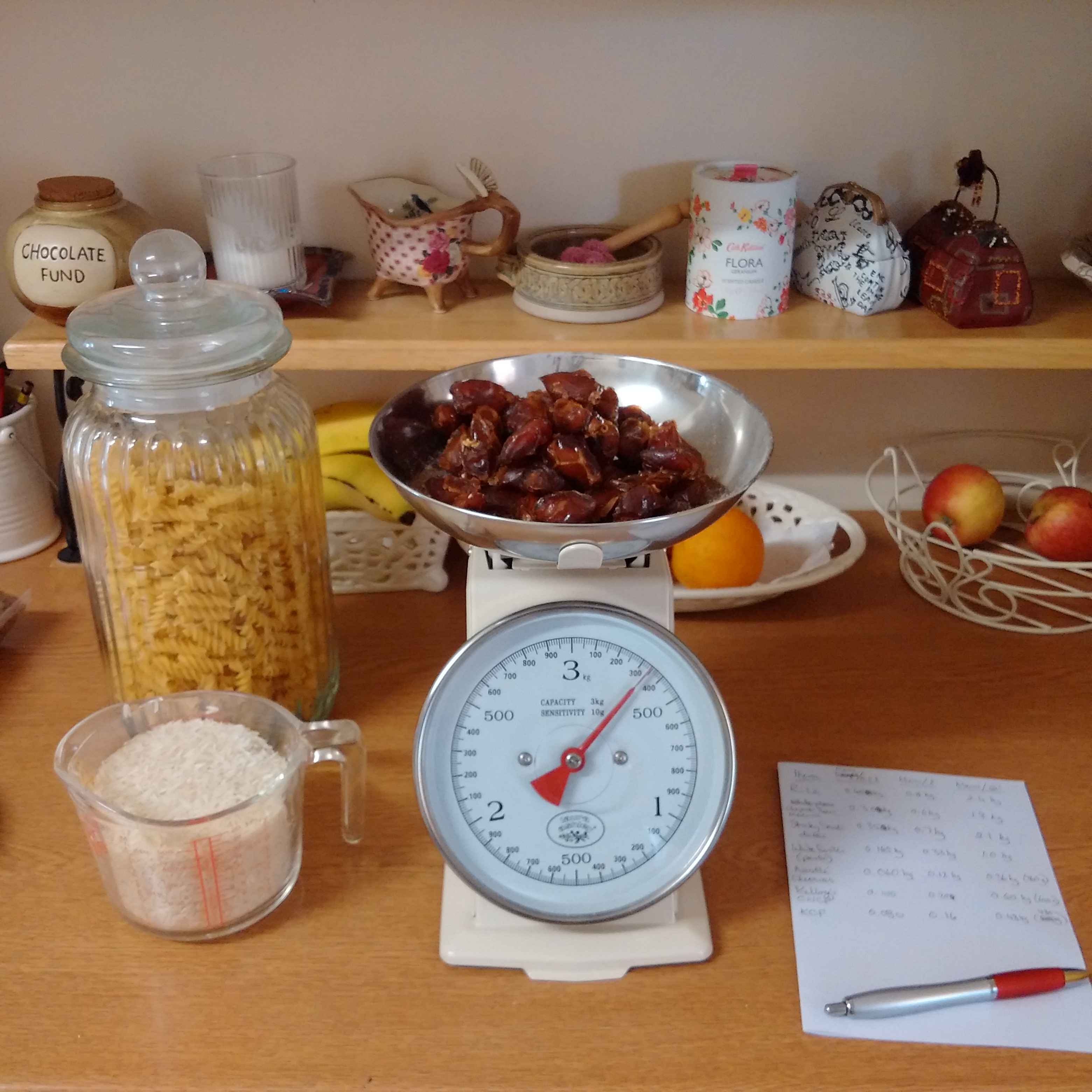
  4. The amount of zakat al-fitr payable is, per wealthy Muslim head (adult or child), traditionally equal to one saa’ (approximately 3 litres in volume[1]) of the staple food item, or possibly half of one saa’ (approximately 1.5 litres) for more expensive foodstuffs.[2] One saa’ equates to the following approximate weight of common UK staple foods: rice 2.5kg, flour 2kg, pasta 1kg, porridge (porage) oats 1kg; by comparison, one saa’ of dates (not a UK staple food) weighs approximately 2kg.[3]
  5. The retail prices of the above items imply that UK zakat al-fitr is approximately £3-£5 per person. Some jurists recommend, to be safe, giving 3kg of staple food, which would be more than one saa’ in the vast majority of cases of staple food.
  6. Alternatively, the zakat al-fitr amount was traditionally understood to be the equivalent of food for one or two meals, each meal consisting of one or two mudds (one saa’ = four mudds). Since an average, filling meal costs roughly £2.50-5.00 in the UK currently, this approach gives us a similar answer, i.e. zakat al-fitr at £2.50-5.00 or £5-10.
  7. Traditionally, zakat al-fitr was mostly given to poor Muslims: most jurists held that poor people who were not Muslim were not eligible to receive zakat al-fitr, since both poverty and Islam were conditions for recipients. But Imam Abu Hanifa and others held that poor dhimmis (non-Muslim People of Scripture, protected by Muslim authorities) were eligible to receive it, since poverty was the only condition for recipients.
  8. Since the category of dhimmis was abolished by the Ottoman caliph in 1856 in favour of equal citizenship (muwatana) irrespective of faith or religion, and since Muslims comprise only 4-5% of the population of Britain where all citizens are equal, zakat al-fitr in the UK may simply go to poor people, irrespective of their religion, faith or belief (or lack thereof).
  9. With up to a million annual estimated uses of food banks by people in the UK to complement their situation of poverty, an obvious way for Muslims to distribute their zakat al-fitr locally is via their local food banks. Since the recipients do not have to be Muslim, based on the view of Imam Abu Hanifa, this should pose no problem religiously.  Food banks based in areas of the UK with Muslim-majority populations, or those run by mosques, are likely to have recipients who are mainly Muslim.
  10. Suggestions for the staple foodstuffs of people in the UK include, but are not limited to: bread, potatoes, rice, pasta, cereals, flour, couscous, etc. (Traditionally, zakat al-fitr has been given in solid staple foodstuffs, whereas for fidya and kaffara, bread was prominently given, accompanied by oil, fat, vinegar, meat, etc. – cf. Tafsir Ibn Kathir on Qur’an 5:89 & 5:95. Long-life milk and juice is in demand at UK foodbanks, and it is arguable that these liquids are also UK staple foods.)
  11. It is thus recommended for wealthy Muslims in the UK who wish to distribute their zakat al-fitr to do so either directly to needy families, else via their local food bank, else via cash to a local, national or international charity.
  12. May God accept and bless our worship during Ramadan, Eid and all year round, and guide us towards helping to eliminate poverty and unnecessary hunger.

(Sheikh Dr) Usama Hasan: London (UK), 29th Ramadan 1436 / 16th July 2015

APPENDIX: SOME BACKGROUND RESEARCH


  1. EXTRACTS FROM THE BOOK OF ZAKAT AL-FITR (“FAST-BREAKING ALMSGIVING”) by IBN RUSHD / AVERROES[4]

Its ruling: The majority of jurists hold that zakat al-fitr is compulsory (fard).

The ‘Iraqi jurists and some of the later Maliki ones hold that it is a recommended tradition (sunna).

Some said that it was abrogated by the obligation of zakat, based on the hadith of Qays bin Sa’d bin ‘Ubadah, who said, “The Messenger of God, may God bless him and grant him peace, used to order us to give it [zakat al-fitr] before the obligation of zakat was revealed.  When the verse of zakat was revealed, we were neither commanded to, nor forbidden from, giving it [zakat al-fitr], but we continue doing so.”[5]


When does zakat al-fitr become obligatory?

Abu Hanifa and Malik via Ibn al-Qasim: At dawn on the day of Eid al-Fitr.

Shafi’i and Malik via Ashhab: At sunset on the last day of Ramadan.

Thus, for a newborn baby between these two times, there is disagreement as to whether or not zakat al-fitr is due on his/her behalf.


Recipients

Poor Muslims may receive it, by consensus (ijma’).

As for poor dhimmis [protected non-Muslims], most of the jurists say that they may not receive it. Imam Abu Hanifa said that they may receive it. Some said that only monks amongst dhimmis may receive it.


  1. EXTRACT FROM FATH AL-BARI, IBN HAJAR AL-‘ASQALANI’S COMMENTARY ON SAHIH AL-BUKHARI, CHAPTERS ON SADAQAH AL-FITR, HADITHS NOS. 1503-1512 (translations of these hadiths widely available)

http://hadith.al-islam.com/Page.aspx?pageid=192&TOCID=965&BookID=33&PID=2783

Ja’far al-Firyabi narrated in his Kitab Sadaqat al-Fitr (Book of Fast-Breaking Almsgiving) that when Ibn ‘Abbas was the governor of Basra, he ordered the giving of zakat al-fitr: a saa’ of dates etc. or half a saa’ of wheat. When ‘Ali came and saw the cheap prices, he commanded that a saa’ measure be used for all foodstuffs, indicating that he considered the value of the food, whilst Abu Sa’id considered the volume of the food.

ويدل على أنهم لحظوا ذلك ما روى جعفر الفريابي في ” كتاب صدقة الفطر ” أنابن عباس لما كان أمير البصرة أمرهم بإخراج زكاة الفطر وبين لهم أنها صاع من تمر ، إلى أن قال : أو نصف صاع من بر . قال : فلما جاء علي ورأى رخص أسعارهم قال : اجعلوها صاعا من كل ، فدل على أنه كان ينظر إلى القيمة في ذلك ، ونظرأبو سعيد إلى الكيل كما سيأتي .


  1. ABOUT UK FOOD BANKS

In the UK, the Trussell Trust (http://www.trusselltrust.org/) runs a network of foodbanks, although there are many other independent foodbanks and collection points run by churches, mosques, synagogues, temples, community centres, etc.  Trussell can help community and faith organisations to begin a foodbank, and also have a partnership with Tesco, such that every Tesco store is potentially a foodbank collection point.  Many foodbanks distribute food parcels to the needy on one day each week.

Trussell’s recommended items for foodbanks, based on http://www.trusselltrust.org/resources/documents/foodbank/website-shopping-list.pdf and variations in printed leaflets from Trussell:

  • Milk (long-life/UHT or powdered)
  • Sugar
  • Fruit Juice (long-life or carton)
  • Soup / Hot Chocolate
  • Pasta Sauces
  • Sponge Pudding (tinned)
  • Cereals
  • Rice pudding / Custard
  • Tea Bags / Instant Coffee
  • Instant Mashed Potato
  • Rice / Pasta
  • Tinned Meat / Fish
  • Tinned Fruit, incl. tomatoes
  • Jam
  • Biscuits or Snack Bars
  1. APPROXIMATE WEIGHT (MASS) OF ONE SAA’ (THREE LITRES) OF VARIOUS FOODSTUFFS, THE RECOMMENDED AMOUNT OF ZAKAT AL-FITR TO BE GIVEN PER PERSON

This is based on simple measuring out and weighing using a measuring container and scales found in an average kitchen, by the author on the date of the fatwa. (This is a fun, instructive and educational activity for adults and children towards a religious, humanitarian objective.)

  • Rice 2.4kg
  • Flour (medium chapatti) 1.8kg
  • Dates (sticky Saudi ones) 2.1kg
  • Pasta (white fusilli) 1.0kg
  • Porridge / porage oats (Scott’s) 1.1kg
  • Corn Flakes (Kellogg’s) 480g
  • Crunchy Nut Corn Flakes (Kellogg’s) 600g
  • Cheerios (Nestle) 360g


  1. EXAMPLE OF DIY ZAKAT AL-FITR IN ACTION IN THE UK

On this date, the author and his wife are blessed with four children, so the following foodstuffs, all in 500g packets, were bought from a local supermarket and delivered to a local foodbank collection point, by the grace of God:

Rice 5kg

Pasta 3kg

Porridge oats 2.5kg

Total cost: £20, working out at just under £3.50 per head for a family of six

May Allah (God) accept and bless our Ramadan and Eid!

FOOTNOTES / REFERENCES

[1] Cf. http://www.bakkah.net/en/zakat-fitr-measurements-saa-three-litres-mudd.htm

[2] Cf. Sahih al-Bukhari, Book of Zakat, Chapters on Sadaqat al-Fitr, Hadiths nos. 1503-1512

[3] Note that 3 litres of water weigh exactly 3kg, so this implies that all these foods are less dense (“lighter”) than water. In fact, they are denser than water but the air trapped between the food particles means that 3 litres of food generally weighs less than 3 litres of water (3kg).

[4] Extracted from: Ibn Rushd al-Qurtubi al-Andalusi [Averroes], Bidayat al-Mujtahid [The Distinguished Jurist’s Primer], Dar al-Kutub al-‘Ilmiyyah, Beirut, 1418/1997, vol. 1, pp. 413-420; a full English translation of this work is available, by Prof. Imran Ahsan Khan Nyazee

[5] Nasa’i, Ibn Majah, Hakim & Bayhaqi

Ibn Tulun, the Fatimids and feeding the poor during Ramadan

August 17, 2013

Bismillah. I have just returned from a brief visit to Israel & the West Bank. The visit was the first half of the excellent Study Tour organised by FODIP UK (www.fodip.org) with Mejdi Tours of Jerusalem. More on that later, but here is a short extract from a 2013 publication by the White Mosque, Nazareth (al-Jami’ al-Abyad, al-Nasirah), that we came across during our travels:

It is said that the Emir Ahmad bin Tulun, founder of the Tulunid state in Egypt, initiated the Dining-Spread of the Merciful (Ma’idat al-Rahman) in Egypt during the fourth year of his reign. He invited leaders, merchants and notables to an iftar party during the first days of Ramadan and addressed them thus:

“The only reason I have gathered you here is to teach you how to be kind to people. I know that you do not need the food and drink that I have prepared for you, but I find that you have forgotten your duty of kindness during Ramadan. Thus, I command you to open up your houses, extend your dining-spreads and stock these with your favourite foods so that deprived poor people may also taste them, throughout Ramadan.”

Others say that the Fatimid Caliph al-Mu’izz
Li Dinilllah was the initiator of charitable banquets: he established a daily Ramadan dining-spread for the congregation of the ‘Amr bin ‘As Mosque to break their fasts: 1100 pots of different foods would be sent from his palace daily to be distributed amongst the poor.

(From Jami’una al-Abyad or Our White Mosque, Nazareth, 2013)

Sent from my BlackBerry® smartphone http://www.blackberry.com