Posts Tagged ‘moon’

When will Ramadan & Eid al-Fitr be in 1447 H (2026 CE) ?

February 16, 2026

Bismillah. Based on the accurate astronomical calculations & the Odeh Criterion (that have proven to be over 99% accurate based on 20+ years of monthly observations), available online for Ramadan 1447 H (2026 CE) & Shawwal 1447 H (2026 CE), we can state the following:

  1. The geocentric conjunction (Geocentric New Moon) just before Ramadan will occur on Tuesday 17th February 2026 at 12:01 UT, God-willing, i.e. just after midday GMT.
  2. The Ramadan new crescent moon (hilaal) will not be visible from anywhere in the world on Tuesday 17th February 2026, with the exception of telescope-only sightings from California & Alaska:


  3. The Ramadan new crescent moon (hilaal) will be easily visible after sunset on Wednesday 18th February 2026 from most of Europe, Africa, North America & South America, as well as West Asia & South Asia. (Telescopes, or perfect visibility conditions for naked-eye sighting, will be required for East Asia & Australasia.)
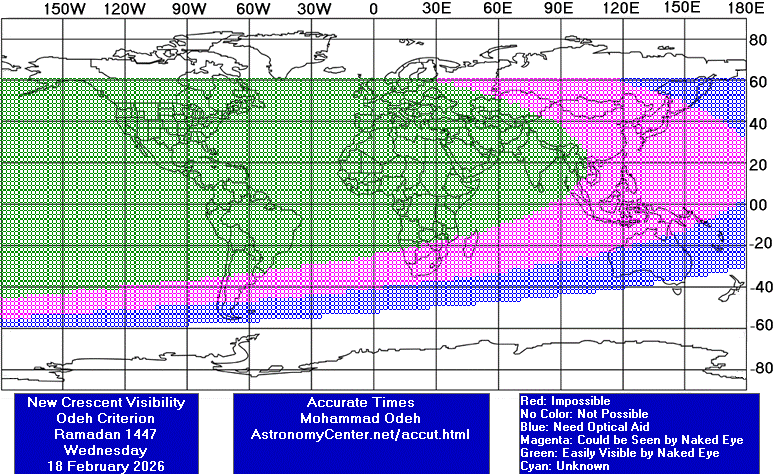

  4. Accordingly, an appropriate date for the 1st day of Ramadan 1447 H worldwide is Thursday 19th February 2026 CE (since the day begins after the night before, when the hilaal is seen after sunset).
  5. The geocentric conjunction (Geocentric New Moon) just before Shawwal will occur on Thursday 19th March 2026 at 01:23 UT, God-willing, i.e. 83 minutes after midnight GMT.
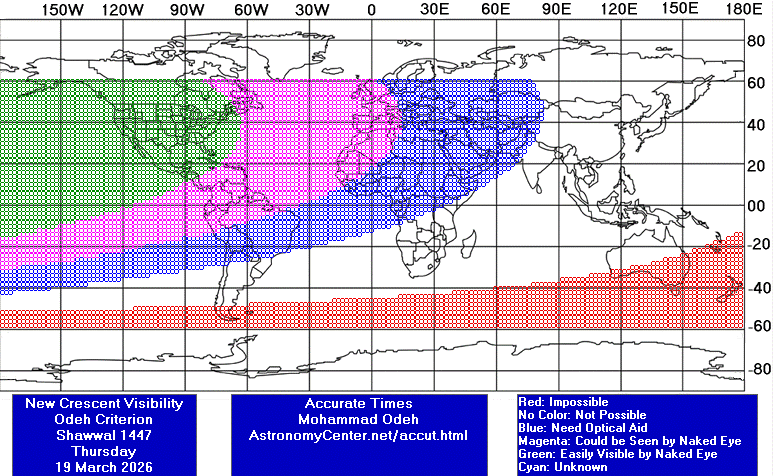
  6. The Shawwal new crescent moon (hilaal) will be easily-visible by naked-eye after sunset on Thursday 19th March 2026 from North America, and via telescope and/or perfect naked-eye visibility conditions across most of Europe, Africa & South America, as well as West Asia & Central Asia, and parts of South Asia (Pakistan & Afghanistan). In these countries, an appropriate date for Eid al-Fitr (1st Shawwal 1447 H) is Friday 20th March 2026 CE, giving a 29-day Ramadan:

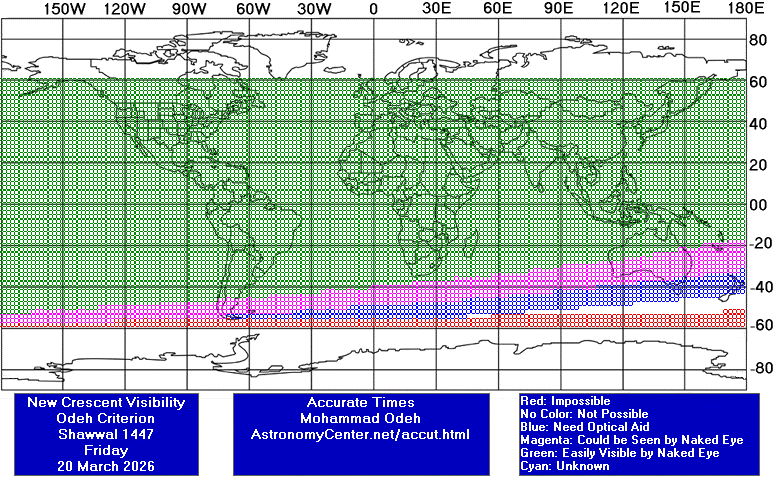
  7. The Shawwal new crescent moon (hilaal) will be easily-visible by naked-eye after sunset on Friday 20th March 2026 from the rest of the world, including southern areas of South America, Southern Africa, the rest of South Asia (India eastwards), South-East Asia, East Asia & Australasia. In these countries, an appropriate date for Eid al-Fitr (1st Shawwal 1447 H) is Saturday 21st March 2026 CE, giving a 30-day Ramadan:

  8. SUMMARY FOR THE UK, by sighting of the new crescent moon:

    1st day of Ramadan 1447 H = Thursday 19th February 2026 CE

    Ramadan will have 29 days, in sha’ Allah (God-willing).

    Eid al-Fitr (1st day of Shawwal 1447 H) = Friday 20th March 2026 CE

  9. May Allah shower the blessings of Ramadan & Eid upon us all!


    (Imam Dr) Usama Hasan
    Fellow of the Royal Astronomical Society
    London, UK

    24th Rajab 1447 H ~ 13th January 2026 CE

UK Ramadan dates, 2017-2025

May 22, 2017

Bismillah.

Ramadan dates 2017-2025 (approx.) for the UK

Based on Crescent Moon Visibility data for London from HMNAO’s Websurf 2.0 website

(Moon Visibility is now calculated very accurately on a scale of A-F. The following dates are based on the approximation that A-C represent a visible crescent moon; D-F represent an invisible moon.)

NB: The following dates may vary by 1 or 2 days because even with a visible crescent moon, there are intra-Muslim disagreements over how far this applies geographically.

YEAR Beginning of Ramadan Eid al-Fitr
2017 27 May 26 June
2018 17 May 16 June
2019 07 May 05 June
2020 25 April 25 May
2021 14 April 14 May
2022 03 April 02 May
2023 23 March (~ Spring equinox) 22 April
2024 12 March 10 April
2025 02 March 31 March


Moon Clocks – Mediaeval & Modern

September 5, 2009
Bismillah.  For a description of a mediaeval Islamic moon-clock in Toledo, Andalusia, see below.
Firstly, a modern moon-clock project.  From the team at Aluna:
Dear All,

We were thrilled that Aluna was featured on BBC Radio 4’s Today programme and also on the BBC website on September 1st 2009. Thanks to those of you who heard it and have already been in touch.

The radio piece, by BBC Science Correspondent Pallab Ghosh, features contributions from David Rooney, former curator of Timekeeping at the Royal Observatory, Greenwich (now at the Science Museum), Dr. Usama Hasan, Imam and Islamic Astronomer and Aluna’s Laura Williams.

Do take a look at the article on the BBC news website – http://news.bbc.co.uk/1/hi/sci/tech/8226735.stm

You can also listen again to the Today Programme on the BBC iplayer for the next few days – http://www.bbc.co.uk/iplayer/episode/b00m9nxp/Today_01_09_2009/


(The story starts at 44 mins 30 secs but you can skip straight there by dragging the cursor along)
For those of you who are not already aware, we’re very pleased that The Aluna Foundation has received its charitable status – granted on the July 20th, the 40th anniversary of the Moon landings!
Secondly, thanks to Mohammad Baig, an astronomer and writer, for drawing my attention to the following:
Al-Zarqali and his lunar chronograph or moon-clock
Extracts:

Abu Ishaq Ibrahim Ibn Yahya Al-Zarqali (Arzachel in Latin), was a famous Andalusian scholar known also as Al-Zarqalluh and Al-Zarqallah. He was born in 1029 and died in 1087. His life corresponded exactly to that dramatic period when the Muslim realm of Spain completely disintegrated, and nearly collapsed, only to be saved in 1089, when the Almoravids of Morocco crossed into Spain, crushed the Christians at Zalaqa, and unified Spain once more. They were followed later by the Almohads, who kept Spain under Muslim rule for another two centuries, until the middle of the 13th century, when Muslim Spain, with the exception of Granada, was lost for good.

Al-Zarqali constructed the famed clocks of Toledo, which al-Zuhri has described in a Castilian translation, published by J.M. Millas-Vallicrosa. The clocks were in use until 1135, when King Alphonso VI tried to discover how they worked and asked Hamis Ibn Zabara to dismantle them. Once they were taken apart, nobody could reassemble them. They constituted a very precise lunar calendar and were, to some extent, the predecessors of the clocks or planetary calendar devices that became fashionable six centuries later in Europe.

Ahmad Thomson has given a vivid account of the intricate working of the clocks. The clocks consisted of two basins, which filled with water or emptied according to the increasing or waning of the moon. At the moment when the new moon appeared on the horizon, water would begin to flow into the basins by means of subterranean pipes, so that there would be at day-break the fourth of a seventh part, and at the end of the day half a seventh part, of the water required to fill the basins. In this proportion the water would continue to flow until seven days and as many nights of the month had elapsed, by which time both basins would be half filled. The same process during the following seven days and nights would make the two basins quite full, at the same time that the moon was at its full. However, on the fifteenth night of the month, when the moon would begin to wane, the basins would also begin to lose every day and night half a seventh part of their water, until by the twenty-first of the month they would be half empty, and when the moon reached her twenty-ninth night not a drop of water would remain in them. It is worthy of remark that, should anyone go to any of the basins when they were not filled, and poured water into them with a view to quicken its filling, the basins would immediately absorb the additional water and retain no more than the just quantity; and, on the contrary, were anyone to try, when they were nearly filled, to extract any or the whole of their water, the moment he raised his hands from the work the basins would pour out sufficient water to fill the vacuum in an instant.