Bismillah. Based on the accurate astronomical calculations & the Odeh Criterion (that have proven to be over 99% accurate based on 20+ years of monthly observations), available online for Ramadan 1447 H (2026 CE) & Shawwal 1447 H (2026 CE), we can state the following:
The geocentric conjunction (Geocentric New Moon) just before Ramadan will occur on Tuesday 17th February 2026 at 12:01 UT, God-willing, i.e. just after midday GMT.
The Ramadan new crescent moon (hilaal) will not be visible from anywhere in the world on Tuesday 17th February 2026, with the exception of telescope-only sightings from California & Alaska:
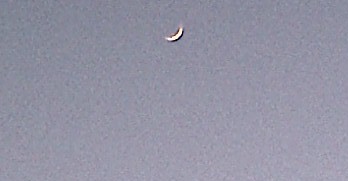
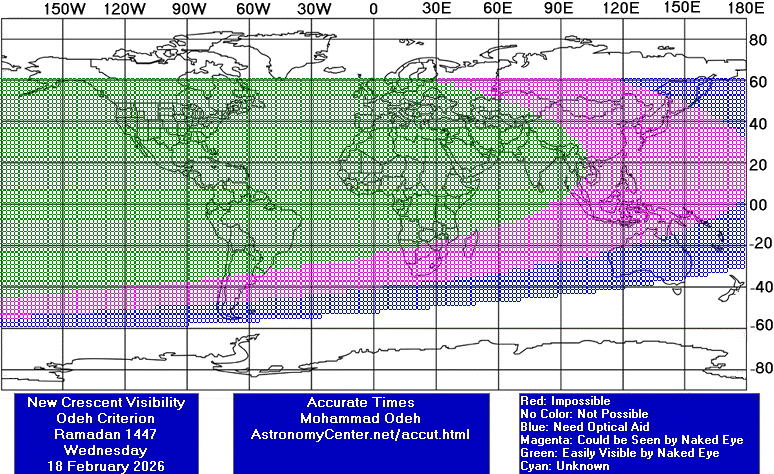
The Ramadan new crescent moon (hilaal) will be easily visibleafter sunset on Wednesday 18th February 2026 from most of Europe, Africa, North America & South America, as well as West Asia & South Asia. (Telescopes, or perfect visibility conditions for naked-eye sighting, will be required for East Asia & Australasia.)
Accordingly, an appropriate date for the 1st day of Ramadan 1447 H worldwide is Thursday 19th February 2026 CE (since the day begins after the night before, when the hilaal is seen after sunset).
The geocentric conjunction (Geocentric New Moon) just before Shawwal will occur on Thursday 19th March 2026 at 01:23 UT, God-willing, i.e. 83 minutes after midnight GMT.
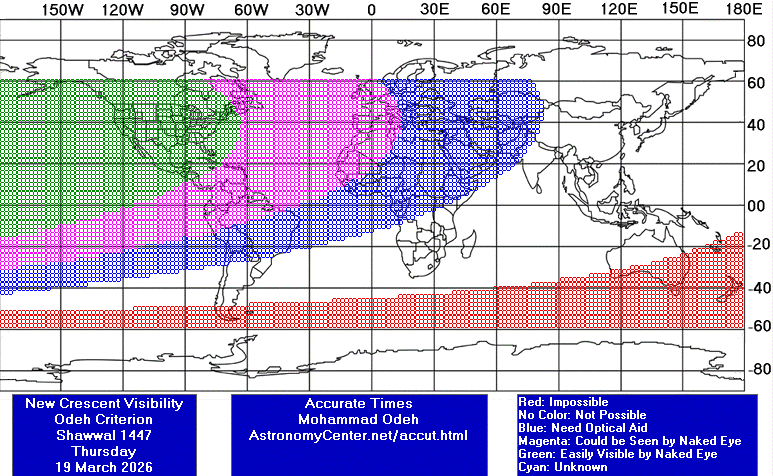
The Shawwal new crescent moon (hilaal) will be easily-visibleby naked-eye after sunset on Thursday 19th March 2026 from North America, and via telescope and/or perfect naked-eye visibility conditions across most of Europe, Africa & South America, as well as West Asia & Central Asia, and parts of South Asia (Pakistan & Afghanistan). In these countries, an appropriate date for Eid al-Fitr (1st Shawwal 1447 H) is Friday 20th March 2026 CE, giving a 29-day Ramadan:
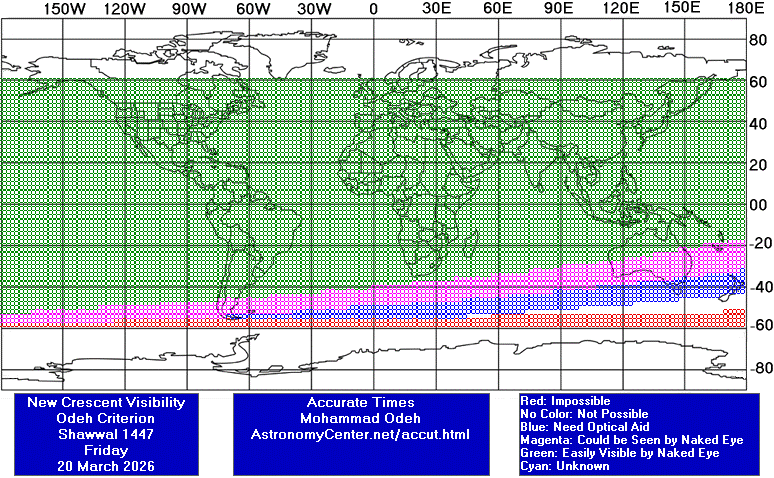
The Shawwal new crescent moon (hilaal) will be easily-visibleby naked-eye after sunset on Friday 20th March 2026 from the rest of the world, including southern areas of South America, Southern Africa, the rest of South Asia (India eastwards), South-East Asia, East Asia & Australasia. In these countries, an appropriate date for Eid al-Fitr (1st Shawwal 1447 H) is Saturday 21st March 2026 CE, giving a 30-day Ramadan:
SUMMARY FOR THE UK, by sighting of the new crescent moon:
1st day of Ramadan 1447 H = Thursday 19th February 2026 CE
Ramadan will have 29 days, in sha’ Allah (God-willing).
Eid al-Fitr (1st day of Shawwal 1447 H) = Friday 20th March 2026 CE
May Allah shower the blessings of Ramadan & Eid upon us all!
(Imam Dr) Usama Hasan Fellow of the Royal Astronomical Society London, UK
Truly, the [compulsory] alms are only for: the poor; the needy; those who work upon them (in alms-collection); those whose hearts are brought near; those whose necks are under the yoke; those who have taken on a major debt; in the path of God; and the child of the path [i.e. the traveller]: an obligation from God: for God is Knowing, Wise.
(Surah al-Tawbah, Repentance, 9:60 Hafs)
TAFSIR TABARI ON THIS VERSE (SUMMARISED)
Imam Tabari (224-310 H / 839-923 CE) said:
As for “those whose hearts are brought near”: they were a group of people who were brought closer to Islam (through the incentive of being given wealth), who could not be (openly) supported. The alms benefited themselves and their close families. Such people were: Abu Sufyan bin Harb, ‘Uyaynah bin Badr, Aqra’ bin Habis and similar heads of tribes.
Similar to what we have said, has been said by the People of Interpretation.
Mention of those who said that: Ibn ‘Abbas, Yahya bin Abi Kathir, Zuhri, Mujahid, Hasan [Basri] and Qatadah. Yahya bin Abi Kathir said that such heads of tribes were given a hundred she-camels[1] each by the Prophet, may God bless him and grant him peace; a few others were given fifty each. Zuhri added that this phrase includes Jews and Christians who submit to God (via Islam), even if they are rich.
The people of knowledge differed about whether or not this category exists today, and whether anyone today may be given charity to bring them closer to Islam?
Some of them said: The category of “those whose hearts are brought together” is invalid today: there is no share in the compulsory alms except for those in need, those in the path of God and those who work upon them (in alms-collection).
Mention of those who said that: Hasan [Basri], ‘Amir [bin Sharahil al-Sha’bi] and ‘Umar bin al-Khattab.
When ‘Uyaynah bin Hisn came to [Caliph] ‘Umar bin al-Khattab [seeking to be given alms], ‘Umar said, “The Truth (has come) from your Lord: so whoever wishes to, may have faith; and whoever wishes to, may deny!” [Surah al-Kahf, The Cave, 18:29 Hafs] That is, there is no bringing near today.
‘Amir [bin Sharahil al-Sha’bi] said: Those whose hearts were brought near, were only during the time of the Prophet, may God bless him and grant him peace: when Abu Bakr, may God Exalted’s Mercy be upon him, came to power, incentives stopped.
Others said: “Those whose hearts are brought near” exist in every age, and they have a right to some alms.
Mention of those who said that: Abu Ja’far [i.e. Imam Muhammad bin ‘Ali al-Baqir].
Abu Ja’far [i.e. Imam Tabari, who had his own, independent Madhhab] said:
The correct saying from amongst those, in my view, is that God has made alms to serve two purposes. One of them is to fill any gaps (of need) amongst the Muslims. The other is to aid and strengthen Islam. Whatever charity is to aid Islam and strengthen its means, this is given to both rich and poor. This is because it is not given to a person due to his need for it, but is given to him in order to aid the religion. This is just like what is given to a person for the sake of sacred war (Jihad) in the way of God, for that is given to him whether he is rich or poor, and not to fill his gap (of need). Similar are those whose hearts are brought near: they are given that charity even if they are rich: such giving to them seeks to benefit the matter of Islam and seeks to strengthen and fortify it.
The Prophet, may God bless him and grant him peace, gave to whomever amongst those whose hearts were to be brought near, after God opened the victories for him: Islam spread and its people increased in honour. Thus, there is no proof in the argument of the one who says that “Today, no-one is to be brought near to Islam (via alms), because the people of Islam, by their great number, are prevented from being reached by anyone who wishes to give them alms.” The Prophet, may God bless him and grant him peace, gave to those whom he gave whilst they were in the condition that has been described.
TAFSIR IBN KATHIR ON THIS VERSE (SUMMARISED)
Imam Ibn Kathir (700-774 H / 1300-1373 CE) said:
As for “those whose hearts are brought near”:
[1] Some were those who were given (alms) that they may submit (in Islam).
An example is that the Prophet, may God bless him and grant him peace, gave to Safwan bin Umayyah out of the spoils (of war) at Hunayn, a battle that the latter had witnessed as a polytheist. Imam Ahmad, Muslim and Tirmidhi narrated that Safwan bin Umayyah said, “The Messenger of God, may God bless him and grant him peace, gave me (wealth) on the Day of Hunayn whilst he was the most hated of people to me, but he continued giving me (wealth) until he became the most beloved of people to me.”
[2] Some were given (alms) in order that they improve their Islam (having already submitted) and for their hearts to become firm.
An example is that he distributed (wealth), on the Day of Hunayn, to a group of tribal chiefs and nobles amongst the released captives: a hundred camels each. He said, “Truly, I give to a man whilst another is more beloved to me, fearing that God will upend him (the former) on his face in the Fire of Jahannam.”
In the two Sahihs (of Bukhari and Muslim), there is on the authority of Abu Sa’id that ‘Ali sent a small nugget of gold, (encased) in its rock, to the Prophet, may God bless him and grant him peace, from Yemen: he divided it amongst four people: Aqra’ bin Habis, ‘Uyaynah bin Badr, ‘Alqamah bin ‘Ulathah and Zayd al-Khayr, and said, “I bring them near.”
[3] Some were given (wealth) because of the hope that their peers would submit (in Islam).
[4] Some were given (wealth) in order to elicit alms from those around them, or
[5] To ward off harm from the border lands around the territory of the Muslims.
The place for detailed explanation of this is the books of jurisprudential rulings (furu’).
And God knows best.
Can alms be given to those being brought closer to Islam, after the (time of) the Prophet, may God bless him and grant him peace ?
There is difference of opinion in this matter.
It is narrated from ‘Umar, ‘Amir al-Sha’bi and a group (of authorities) that they are not to be given (alms) after his time, because God has honoured Islam and its people, established them firmly in the land and made the necks of others subservient to them.
Others said: Rather, they are to be given (alms) because he, Blessings and Peace be upon him, gave to such people after the Opening of Mecca [i.e. when Islam had already become established] and the Breaking of (the Tribe of) Hawazin [at Hunayn]: this was a situation where alms might be needed, so these could be diverted to them.
IMAM ABU BAKR AL-JASSAS (HANAFI) & QADI ABU BAKR IBN AL-‘ARABI (MALIKI)[2]
Imam Abu Bakr al-Jassas (305-370 H / 917-981 CE) said in his Ahkam al-Qur’an (Rulings of the Qur’an), whilst discussing the premise that alms are essentially for the poor:
If it is said that “those whose hearts were brought near” would receive alms without being poor, it would be said in reply: they would not receive it as alms; rather, alms would be collected for the poor, but some of it would be given to those whose hearts are brought near, in order to repel their harm against the poor amongst the Muslims, and that the former might submit in Islam, thus strengthening the poor amongst the Muslims. Thus, they would not receive it as alms; rather, alms were collected and used for the benefit (masalih) of the Muslims. This is because wealth given for the poor may be diverted for their benefit (masalih) if the Imam [i.e. the Caliph] rules over them and decides about matters beneficial to them (masalih).
[Summarised] Qadi Abu Bakr ibn al-‘Arabi (468-543 H / 1076-1148 CE) said in his Ahkam al-Qur’an (Rulings of the Qur’an):
THE NINTH ISSUE [regarding this verse of the Qur’an]
About “those whose hearts are brought near,” there are four views:
They were given alms because of the weakness of their certainty, until this became strong. Those who said that they were Muslims, cited the examples of Abu Sufyan bin Harb, Aqra’ bin Habis and ‘Abbas bin Mirdas. Those who said that they were non-Muslims, cited the example of ‘Amir bin Tufail. Those who said that they were polytheists with an inclination towards Islam, cited the example of Safwan bin Umayyah.
Yahya bin Abi Kathir named them as leaders of the following [ten] tribes or clans: Banu Umayyah, Banu Jumah, Banu ‘Amir, Banu Asad, Banu Hashim, Banu Fazarah, Banu Tamim, Banu Nasr, Banu Sulaym and Thaqif.
Ibn Wahb narrated from Malik that he said: Safwan bin Umayyah, Hakim bin Hizam, Aqra’ bin Habis, ‘Uyaynah bin Badr, Suhayl bin ‘Amr and Abu Sufyan were amongst “those whose hearts were brought near,” and that on the day [of Hunayn] when Safwan was given alms, he was a polytheist.
Asbagh said, on the authority of Ibn al-Qasim: “Those whose hearts were brought near” were Safwan bin Umayyah and certain men of Quraysh.
The Shaykh Abu Ishaq named them to be forty men of the Quraysh and other tribes, including leaders and others.
THE TENTH ISSUE
There has been a difference of opinion as to whether [the category of] “those whose hearts are brought near” persisted.
Some of them said: They [i.e. this category of people] disappeared. This view was expressed by a group (of authorities), and was held by Malik.
Some said: They remain, because the Imam [i.e. the Caliph] may need to bring people near to Islam. [Caliph] ‘Umar discontinued them [i.e. this category of people] because of what he saw of the might of the religion.
My view is that if Islam is strong, this category disappears; but if such people are needed, they are given their share, just as the Messenger of God, may God bless him and grant him peace, used to give the share. For it is narrated in the Sahih (authentic hadiths): “Islam began as a stranger, and will return as a stranger, as it began.” [Sahih Muslim]
THE ELEVENTH ISSUE
If we say that this category of people has disappeared, then their share returns to all the (other) categories, or to whichever (category or categories) the Imam decides, according to the previous explanation regarding the root of the disagreement.
Zuhri said: Half of their share is to be given to those who frequent the mosques. There is no evidence for this view. The first view (mentioned above) is more correct.
[1] A hundred camels represents a lot of wealth: it is the same as the diyah (blood-money) for murder. In today’s financial terms, it would approximate up to a hundred thousand US dollars or UK pounds, or even more. (AQS)
[2] The Hanafi and Maliki schools are complementary, in the sense that they represent the schools of Reason (Ahl al-Ra’y) and Tradition (Ahl al-Hadith) respectively. A holistic approach to the Sunnah combines these complementary approaches, as per Imam Shatibi (cf. Al-Shanqiti, OnMadhhabs & Taqlid, AQS, 1445/2023)
SUMMARY: Naked-eye moonsighting gives the 1st day of Ramadan 1443 as Sunday 3 April 2022 for the whole world except for North America where Saturday 2 April 2022 is a possibility. Moonsighting with a telescope gives the 1st day of Ramadan 1443 as Saturday 2 April 2022: some authorities and countries have already announced Ramadan for then. (Naked-eye moonsighting in Antarctica & New Zealand might give the 1st day as Monday 4 April 2022!)
Astronomical new moon occurred at 06:24 UT (GMT) today, on Friday 1 April 2022 (29 Sha’ban 1443).
Crescent (lunar) visibility diagrams, courtesy of the UK HMNAO/IOP Moonwatch project, now hosted by UKHO:
Friday 1 April 2022 / 29 Sha’ban 1443, evening (around the optimal time for moonsighting, about 20 minutes after sunset):
Global new (crescent) moon visibility for the evening of Friday 1 April, 2022 (29th Sha’ban 1443) – UK Moonwatch model
Global new (crescent) moon visibility for the evening of Friday 1 April, 2022 (29th Sha’ban 1443):
Not visible anywhere in the world, with the exception of the Americas.
The new crescent moon will be visible by naked eye in California, Mexico & parts of Central America, and by telescope in parts of South America. Given the ISNA Fiqh Council’s very reasonable judgment since the 1990s that North America is to be regarded as one horizon (matla’), this would lead to the 1st day of Ramadan 1443 being Saturday 2 April 2022 throughout North & Central America. If sighting by telescope is deemed acceptable, the same start date would apply to South America. However, I defer to the judgments of the relevant authorities in the Americas.
Saturday 2 April 2022 / 30 Sha’ban 1443, evening (around the optimal time for moonsighting, about 20 minutes after sunset):
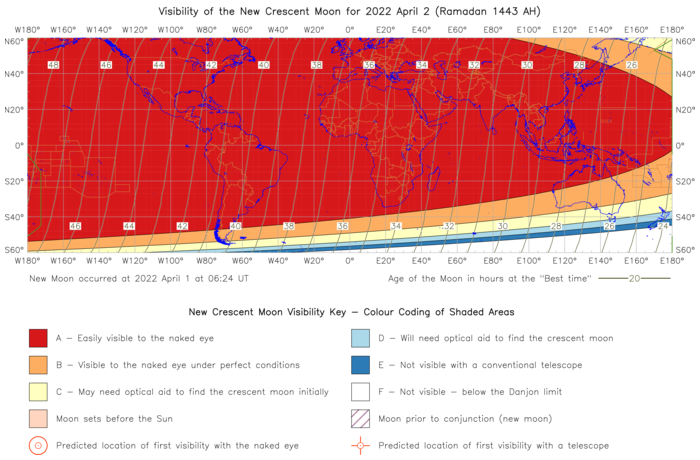
Global new (crescent) moon visibility for the evening of Saturday 2 April, 2022 (30th Sha’ban 1443)
Global new (crescent) moon visibility for the evening of Saturday 2 April, 2022 (30th Sha’ban 1443):
Visible throughout the whole populated world, with the exception of Antarctica & most of New Zealand, where it will be visible the following evening.
Thus, for Oceania (with the possible exception of New Zealand), Asia, Africa & Europe, the 1st day of Ramadan 1443, based on local moonsighting, is Sunday 3rd April 2022.
Have a blessed & peaceful Ramadan: let us pray for, and serve, our brothers and sisters in humanity!
(Imam Dr) Usama Hasan,
Fellow of the Royal Astronomical Society, London, UK
29th Sha’ban 1443 / 1st April 2022
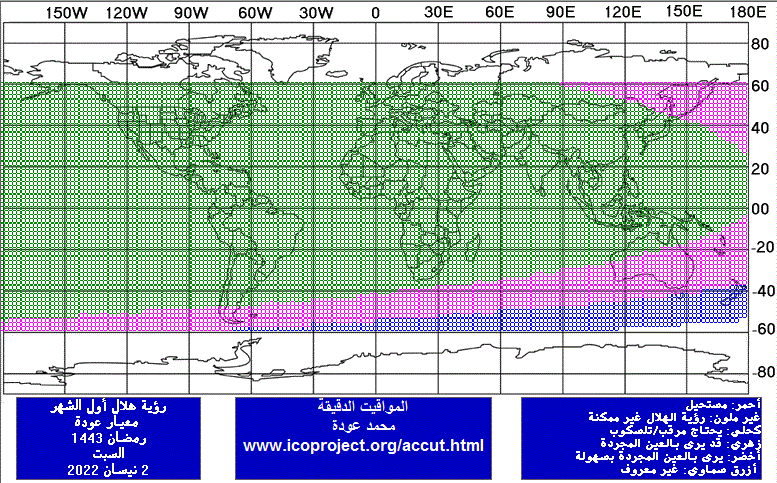
Postscript: The European Council for Fatwa & Research announced on 16/02/2022 that the 1st day of Ramadan for the whole world would be on Saturday 2nd April 2022, based on “detailed astronomical calculations.” They claim that these showed that the new crescent moon (hilal) would be visible “by telescope in West Africa and the Americas” after sunset on Friday 1st April 2022. This seems to be based on the Odeh model. I agree with their approach of determining Islamic lunar dates via astronomical calculations, but we need to agree which ones we are using. ECFR are accepting telescope observations, whereas many of us prefer naked-eye sighting. NB: the Odeh model predicts a narrower range of territory for naked-eye sighting, as is clear from the following visibility maps:
Global new (crescent) moon visibility for the evening of Friday 1 April, 2022 (29th Sha’ban 1443) – Odeh model
Global new (crescent) moon visibility for the evening of Saturday 2 April, 2022 (30th Sha’ban 1443) – Odeh model
Laylat-ul-Qadr (LQ – The Night of Glory, Majesty, Decree and Destiny, etc.) is in one sense the climax of the month of Ramadan / Ramzan (R).
* Some of the hadiths about its exact date, even the allegedly authentic ones, are mutually contradictory, which is why scholars try to reconcile them.
* It is night-time for half the earth at any moment; the other half is in daytime. Day and night are relative to each person’s location on earth.
* It is presumably possible for the Angels & the Spirit to descend around the half of the earth that’s in night-time for a period of exactly 24 hours, thus giving a specific date for LQ. Presumably, this would start at sunset for the first location on earth from where the new crescent moon was visible.
* Since Muslims have differed for decades about the beginning of R, and hence about its odd nights, this presents a difficulty in finding LQ in the last 5 odd nights. One solution is to look for it throughout the last 10 nights. But what if LQ falls just before your last 10 nights or just after, i.e. on your Eid night whilst others are still observing R?
* Do the Angels & the Spirit descend throughout the last 10 nights?
* MY SOLUTION: Due to considerations like these, I follow the view of the Companion, Abdullah bin Mas’ood: LQ can be on any night of the year. Or we could say: it is on every night of the year. Every night is LQ!
* This is why the hadiths say: SEEK IT in the last 10 nights of R, etc., because it would be too difficult to seek it all year long. We are prepared with fasting & worship for a whole month to help find LQ during the last 10 nights, preferably in i’tikaf (spiritual retreat). Remember, the Prophet pbuh once did i’tikaf for the whole month of R in order to find LQ.
* These are some of the many wisdoms behind the spiritual practice of Ramadan/Ramzan. May ours have been blessed, and may we have found our Night of Powerful, Glorious Destiny, had all our prayers answered and been illuminated by The Light for at least another year!
PS “Better than a thousand months” means “Better than all of time.”
(khayrun min al-dahri kullihi – Tafsir Qurtubi)
In other words, Laylat-ul-Qadr is an opportunity to transcend Time, or experience Eternity or Timelessness.
I alluded to some of these lessons about Ramadan (Ramzan) & LQ in this poem, based on the famous opening of William Blake’s Auguries of Innocence:
To break your fast with a wholesome date
And recite noble verses of Light.
To seek Infinity in your unfolding Fate
And Eternity in One Night.
Usama Hasan
22 May 2020 / 28 Ramadan 1441
Tadworth, UK.
ليلة القدر و علم الفلك:
الليل والنهار أمران نسبيان لمكان كل شخص في الأرض، وهما آيتان من آيات الله تعالى.
والأحاديث في تحديد تاريخ ليلة القدر متناقضة، حتى الصحيحة منها، ولذالك حاول علماء الحديث الجمع بينها دائماً.
فنصف الأرض في أي وقت في ظلمة اليل، والنصف الآخر في ضوء النهار.
قد تنزّل الملائكة والروح لمدة ٢٤ ساعة كل عام، فتكون لليلة القدر تاريخ معيّن. ولكن عندنا مشكلة: الاختلاف في بداية شهر رمضان يؤدي الى اختلاف في اليالي العشرة الأخيرة.
من أجل هذه الاعتبارات وغيرها، أرى برأي عبد الله بن مسعود رضي الله عنه أن ليلة القدر قد تقع في أي ليلة في السنة. ولذالك جاء في الأحاديث «إلتمسوا ليلة القدر في العشرة الأخيرة من شهر رمضان» لأن إلتماسها طول العام أمر محرج وصعب جداً على المسلمين.
فشرع شهر العبادة من صوم وصلاة وزكاة وإطعام المساكين وإعتكاف وغيرها من أعمال الخير ليسهل إلتماس الليلة العظمى في العام:
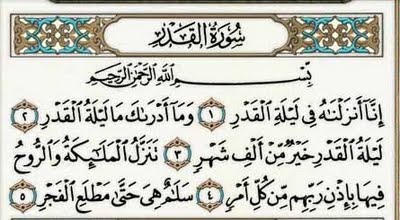
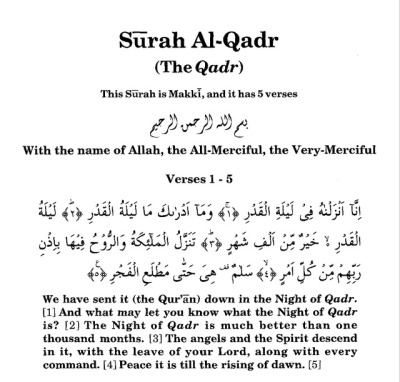
إنا أنزلناه في ليلة القدر، وما أدرىٰك ما ليلة القدر؟ ليلة القدر خير من ألف شهر، تنزّل الملائكة والروح فيها بإذن ربهم من كل أمر، سلام هي حتى مطلع الفجر.
ومعنى «خير من ألف شهر» يعنى: «خير من الدهر كله» كما ذكره الإمام القرطبي في تفسيره. فإن وجدت ليلة القدر، فكأنما خرجت من حدود الزمان ولمست قدسية الدهر وذقت معنى الخلود في جنات النعيم.
اللهم بارك لنا في شهرنا و أيامنا وليالينا، آمين.
APPENDIX: A GLIMPSE OF SOME OF THE VIEWS ABOUT THE DATE OF LQ, TO SHOW THE IMMENSE DIVERSITY ABOUT THIS IN THE ISLAMIC TRADITION
NB: where “[odd nights of the] last 10” is mentioned, even this was disagreed about, e.g.: Ibn Hazm stated that if the month has 30 days, then these odd nights are 21, 23, 25, 27 & 29 but if the month has 29 days, then the last 10 nights are nights 20-29 and hence the odd nights are 20, 22, 24, 26 & 28! This was another argument for seeking LQ in all of the last 10 nights, because in the past, we were unable to know for sure in advance how many days the month would have.
IBN KATHIR
Hadith (Tayalisi): 27 or 29
Hadith (Ahmad): LQ in last 10, odd nights: 29 or 27 or 25 or 23 or the last night of the month. The hadith has other details. IK: the isnad is hasan, but the matn has strange, weak content (gharabah) and in some versions, rejected (nakarah) content or meaning.
Hadith (Ibn Abi Asim): LQ in last 10.
Hadith (Ahmad): Seek it in the first 10 or last 10 … Seek it in the last 10 … Seek it in the last 7.
Narration: from Ibn Mas’ood and those who followed him of the people of knowledge of Kufa that it is found throughout the year, and is hoped for in every month equally. (IK disagrees with this view) Ibn Mas’ood used to say, “If you stand in prayer at night all year long, you will find LQ.”
Hadith (Abu Dawud): LQ may be throughout R.
Narration: from Abu Hanifa: LQ is hoped for throughout R. This is also a view quoted by Ghazzali [i.e. in the Shafi’i madhhab? – UH] Rafi’i declared this to be an extremely strange view.
LQ is the 1st night of R: Abu Razin.
LQ is 17th R, because it was the night before the Battle of Badr, described as being on the “Day of Decision” (Yawm al-Furqan) in the Qur’an, hence it relates to LQ as the night of decision, decree and destiny: narrated from the Prophet, Ibn Mas’ood, Zayd bin Arqam, ‘Uthman bin Abil-‘Aas, Imam Shafi’i & Hasan Basri.
LQ is 19th R: narrated from ‘Ali & Ibn Mas’ood.
LQ is 21st R: Hadith of Abu Sa’id al-Khudri in Bukhari & Muslim. Imam Shafi’i said that this was the most authentic narration on the subject.
LQ is 23rd R: Hadith of Abdullah bin Anees in Sahih Muslim – it is a very similar narration to the previous hadith (21 R).
LQ is 24th R: Hadith of Abu Sa’id al-Khudri in Tayalisi. IK: the narrators are trustworthy. Also narrated as a hadith by Bilal, but a weak isnad. Also contradicted by the next consideration:
LQ is in the first 7 of the last 10 nights: more authentic view of Bilal rA, narrated by Bukhari. Also narrated as the view of Ibn Mas’ood, Ibn Abbas, Jabir, Hasan, Qatadah & Ibn Wahb, and from the Prophet by Wathilah bin al-Asqa’.
LQ is 25th R: based on the hadith of Bukhari from Ibn Abbas from the Prophet: Seek it in the last 10 nights: in the 9 remaining, 7 remaining, 5 remaining.
IK: Most people of knowledge understood this to mean the odd nights, but others understood it to mean the even nights, e.g. Abu Sa’id (Sahih Muslim). IK: Allah knows best.
LQ is 27th R: narrated from the Prophet, several Companions, a group of the Salaf, the preferred view in the madhhab of Imam Ahmad and quoted also from Imam Abu Hanifa.
LQ is the 7th of last 10 (i.e. 27) or with 7 remaining (i.e. 22 or 23): narrated from Ibn Abbas.
LQ is 21, 23, 25, 27, 29 or last night of the month: Hadith of Imam Ahmad.
LQ is 27 or 29: Hadith of Imam Ahmad.
LQ is the last night of R: Hadith of Ahmad, Tirmidhi, Nasa’i.
Thought For The Day, BBC Radio 4, 15th June 2018 (1st Shawwal 1439, Eid al-Fitr)
Imam Dr Usama Hasan
Eid Mubarak! Over the next few days, beginning today, more than a billion people around the world will be celebrating Eid al-Fitr, the Muslim festival that ends the month-long fasting during Ramadan.
For an entire month very year, hundreds of millions of Muslims abstain from all food and drink, including water, during daylight hours: that’s up to sixteen or eighteen hours without eating or drinking, every day. Ramadan, especially during the summer, is a gruelling physical and spiritual ordeal, and mirrors the tradition of fasting in other religions, such as the original Christian observance of Lent. In fact, we know of Jews and Christians in Britain who fast for some of Ramadan, and Muslims who fast during Lent. Despite many conflicts, the world’s great religions have so much in common!
Fasting can have numerous health benefits, although it is not recommended for pregnant women or those with certain medical conditions. The BBC Horizon programme, Eat, Fast & Live Longer, broadcast in 2012, documented healthy weight loss and increased neuron growth in the brain caused by periods of hunger. The episode looked at the 5:2 diet, involving fasting two days a week, and also at several days of consecutive fasting. Well, Ramadan involves 30 days of consecutive fasting. And outside of Ramadan, the Islamic tradition recommends fasting precisely two days per week, or at least three days per month.
On a spiritual level, fasting represents patience, whilst eating and drinking should involve gratitude: after a long fast, even a glass of water feels like a luxury. The Prophet Muhammad taught that “one who eats gratefully is like one who fasts patiently,” and that the best form of fasting was that of King David, or Prophet Dawud, who would fast on alternate days. This is ideal, partly because it represents the ultimate balance of patience and gratitude.
In the Qur’an, there is much praise of those who are “extremely patient and extremely grateful,” especially in response to the vicissitudes of time. Patience and gratitude are two intertwined halves, two sides of the same coin of faith: we are required to have patience through troubled times, and show gratitude in good times.
For Muslims, showing gratitude to God includes being grateful to people through whom we receive God’s favours. Gratitude also includes using our God-given talents, skills and faculties for good and noble purposes, rather than for engaging in mischief and evil.
Fasting is a metaphor for life: difficulties are followed by ease. Breaking the fast at the end of each day, and at the end of the month, is a foretaste of heavenly bliss. So go on, treat yourself for Eid: you’ve probably deserved it!
Bismillah. As I’ve written about before, there are different views on excessive fasting hours in the summer at high latitudes such as the UK. I am not going to repeat those, but try to provide the scientific, astronomical data, information and knowledge to help support others to come to their own conclusions.
In this post, I give the dawn, sunset & possible fasting times for 2017, when mid-summer occurs towards the end of Ramadan: the average fasting times are slightly shorter than last year (2016), when they were maximum in the 33-year lunar/solar cycle, but not by much.
*I urge mosque timekeepers (muwaqqits) or others who develop fasting timetables to be transparent about the method they are using, and not vague references like “fiqh according to Madhhab X” because there are many views in every Madhhab. E.g. using an 18-degree or even 15-degree rule gives no timings for most of the UK. Fasting timetables in the UK summer should clearly state what method is used to arrive at the beginning time of fasting. Many timetables have excessive gaps between ‘dawn’ and sunrise of 2-3 hours with no sensible justification, since this is merely one possibility amongst many others and is indeed the most difficult for people. Indeed, with the summer midnight being at 1am BST, some of these timetables are forcing people to fast from soon after midnight. With the sunset-sunrise night length being 6-8 hours across the UK, the most reasonable view within this paradigm in my view is that of the last 1/6th, 1/7th or 1/8th of the night, giving a fasting time beginning an hour before dawn. However, other approaches are even more preferable. Over to others for discussion and to arrive at their own conclusions.*
Examples of dawn/sunset timings for the UK, 2017 (four UK capital cities)
This data is taken from HMNAO’s Websurf 2.0 website, and was reproduced with permission by the ASCL in their Ramadan 2017 guidelines. I have used the four UK capital cities, with three dates for each, roughly corresponding to the beginning, middle & end of Ramadan.
Date
City
Dawn (AST)
Dawn (15D)
Dawn (NAUT)
Sunrise
Sunset
Fasting length (AST)
Fasting length (15D)
Fasting length (NAUT)
27 May
London
***
0220
0305
0454
2103
***
18:43
17:58
10 June
***
0139
0245
0444
2117
***
19:38
18:32
25 June
***
0122
0243
0444
2122
***
20:00
18:39
27 May
Ed’burgh
***
***
0201
0441
2140
***
***
19:39
10 June
***
***
***
0428
2157
***
***
***
25 June
***
***
***
0428
2203
***
***
***
27 May
Cardiff
***
0232
0318
0506
2115
***
18:43
17:57
10 June
***
0152
0257
0456
2129
***
19:36
18:32
25 June
***
0136
0255
0457
2134
***
19:58
18:39
27 May
Belfast
***
***
0245
0500
2143
***
***
18:58
10 June
***
***
0159
0448
2158
***
***
19:59
25 June
***
***
0134
0448
2204
***
***
20:30
AST refers to astronomical twilight, when begins or ends when the sun is 18 degrees below the horizonKey:
15D refers to when the sun is 15 degrees below the horizon
NAUT refers to nautical twilight, when begins or ends when the sun is 12 degrees below the horizon
The astronomical definition of “dawn” is disputed, with various Muslim religious authorities adopting one of the three possible definitions given above.
*** in the above table means that the timing is not available, because the sun does not reach that far below the horizon. This happens every year during the summer at high latitudes, such as the UK.
NOTES:
As confirmed by HMNAO, there is always a possible error of 1-2 minutes in sunrise and sunset timings: although we can calculate exactly the position of the sun relative to our horizons, refraction of the sun’s rays can introduce an error: the sun may be below the horizon but we see it just above, due to refraction. (This does not always happen, of course: hence the error will be zero, one or two minutes.) This means that technically, mosque prayer timetables may wish to add 2 minutes to sunset timings and subtract 2 minutes from sunrise timings, just to be safe about the timings of the sunset and dawn prayers, and for breaking the fast. However, this might also be hair-splitting: I recommend making these adjustments, but would not worry if they are not made.
If we use astronomical twilight (Sun’s depression = 18 degrees) as the start of dawn, this does not occur at all during Ramadan 2017 in any of the four capital cities. Therefore, the fasting start time and fasting length would be undefined.
If we use (Sun’s depression = 15 degrees) as the start of dawn, this does not occur at all during Ramadan 2017 in Edinburgh or Belfast. Therefore, the fasting start time and fasting length would be undefined in those cities. However, it does occur in London and Cardiff, giving fasting lengths of 19.5-20 hours during the month.
If we use nauticaltwilight (Sun’s depression = 12 degrees) as the start of dawn, this results in fasting hours during Ramadan 2017 in London and Cardiff of 18-19 hours, and in Belfast of 19-20.5 hours. We only get defined fasting hours at the beginning of Ramadan for Edinburgh, of 19.5-20 hours.
Hence, it should be obvious that some ijtihad is required, eg a fraction of the night or a lower angle of the Sun below the horizon to designate the “beginning” of dawn. Another option is sunrise-sunset fasting rather than dawn-sunset, as done by some of the Sahaba (Tafsir Ibn Kathir & Ibn Hazm’s Al-Muhalla), or other, non-literalist options that I have described elsewhere.
NB: Our local latitude determines the lowest angle the Sun will dip below the horizon at mid-summer (~22 June). This angle can easily be calculated by subtracting 66.5 degrees (the latitude of the Arctic & Antarctic Circles) from the local latitude.
E.g.:
Within the Arctic Circle (66.5 deg or higher latitude), lowest Sun angle = zero or higher: the sun doesn’t set at all in the “land of the midnight sun.”
Edinburgh (56.0 deg lat): lowest Sun angle at midsummer = 56.0 – 66.5 = 10.5 deg below the horizon
Belfast (54.6 deg lat): lowest Sun angle at midsummer = 54.6 – 66.5 = 11.9 deg below the horizon
London & Cardiff (both 51.5 deg lat): lowest Sun angle at midsummer = 51.5 – 66.5 = 15 deg below the horizon
*NB: even using these angles of 10.5 deg, ~12 deg, 15 deg & 15 deg for Edinburgh, Belfast, London & Cardiff respectively will give very long fasting hours, as the table of timings above demonstrates.
Btw for Paris (48.9 deg lat): lowest Sun angle at midsummer = 48.9 – 66.5 = 17.6 deg below the horizon, so using the 18-degree rule gives no timings for Paris or anywhere north of it either at midsummer.
Have a blessed Ramadan 1438 / 2017!
Usama Hasan, Fellow of the Royal Astronomical Society, UK
Bismillah. As I’ve written about before, there are different views on excessive fasting hours in the summer at high latitudes such as the UK. I am not going to repeat those, but try to provide the scientific, astronomical data, information and knowledge to help support others to come to their own conclusions.
In the first of these posts, I am including the dawn, sunset & possible fasting times from last year (2016) because then, mid-Ramadan coincided with mid-summer, hence giving the longest average fasting lengths in the 33-year cycle as the lunar years move through solar years.
Examples of dawn/sunset timings for the UK, 2016
(four UK capital cities)
This data is taken from HMNAO’s Websurf 2.0 website, and was reproduced with permission by the ASCL in their Ramadan 2016 guidelines. I have used the four UK capital cities, with three dates for each, roughly corresponding to: beginning, middle & end of Ramadan.
Date
City
Dawn (AST)
Dawn (15D)
Dawn (NAUT)
Sunrise
Sunset
Fasting length (AST)
Fasting length (15D)
Fasting length (NAUT)
07 June
London
***
0147
0248
0445
2114
***
19:27
18:26
22 June (midsummer)
***
0117
0241
0443
2122
***
20:05
18:41
06 July
***
0156
0256
0452
2118
***
19:22
18:22
07 June
Ed’burgh
***
***
***
0429
2154
***
***
***
22 June (midsummer)
***
***
***
0427
2203
***
***
***
06 July
***
***
***
0437
2158
***
***
***
07 June
Cardiff
***
0159
0300
0457
2126
***
19:27
18:26
22 June (midsummer)
***
0131
0254
0456
2134
***
20:03
18:40
06 July
***
0209
0308
0504
2130
***
19:21
18:22
07 June
Belfast
***
***
0209
0450
2156
***
***
19:47
22 June (midsummer)
***
***
***
0447
2204
***
***
***
06 July
***
***
0219
0457
2200
***
***
19:41
Key:
AST refers to astronomical twilight, when begins or ends when the sun is 18 degrees below the horizon
15D refers to when the sun is 15 degrees below the horizon
NAUT refers to nautical twilight, when begins or ends when the sun is 12 degrees below the horizon
The astronomical definition of “dawn” is disputed, with various Muslim religious authorities adopting one of the three possible definitions given above.
*** in the above table means that the timing is not available, because the sun does not reach that far below the horizon. This happens every year during the summer at high latitudes, such as the UK.
NOTES:
As confirmed by HMNAO, there is always a possible error of 1-2 minutes in sunrise and sunset timings: although we can calculate exactly the position of the sun relative to our horizons, refraction of the sun’s rays can introduce an error: the sun may be below the horizon but we see it just above, due to refraction. (This does not always happen, of course: hence the error will be zero, one or two minutes.) This means that technically, mosque prayer timetables may wish to add 2 minutes to sunset timings and subtract 2 minutes from sunrise timings, just to be safe about the timings of the sunset and dawn prayers, and for breaking the fast. However, this might also be hair-splitting: I recommend making these adjustments, but would not worry if they are not made.
If we use astronomical twilight (Sun’s depression = 18 degrees) as the start of dawn, this did not occur at all during Ramadan 2016 in any of the four capital cities. Therefore, the fasting start time and fasting length were undefined.
If we use (Sun’s depression = 15 degrees) as the start of dawn, this did not occur at all during Ramadan 2017 in Edinburgh or Belfast. Therefore, the fasting start time and fasting length were undefined in those cities. However, it did occur in London and Cardiff, giving fasting lengths of 19.5-20 hours during the month.
If we use nauticaltwilight (Sun’s depression = 12 degrees) as the start of dawn, this resulted in fasting hours during Ramadan 2016 in London and Cardiff of ~18.5 hours, and in Belfast of just under 20 hours at the beginning and end of Ramadan, but not in mid-Ramadan (mid-summer). We had no defined fasting hours throughout Ramadan 2016 for Edinburgh.
Hence, it should be obvious that some ijtihad is required, eg a fraction of the night or a lower angle of the Sun below the horizon to designate the “beginning” of dawn.
NB: Our local latitude determines the lowest angle the Sun will dip below the horizon at mid-summer (~22 June). This angle can easily be calculated by subtracting 66.5 degrees (the latitude of the Arctic & Antarctic Circles) from the local latitude.
E.g.:
Within the Arctic Circle (66.5 deg or higher latitude), lowest Sun angle = zero or higher: the sun doesn’t set at all in the “land of the midnight sun.”
Edinburgh (56.0 deg lat): lowest Sun angle at midsummer = 56.0 – 66.5 = 10.5 deg below the horizon
Belfast (54.6 deg lat): lowest Sun angle at midsummer = 54.6 – 66.5 = 11.9 deg below the horizon
London & Cardiff (both 51.5 deg lat): lowest Sun angle at midsummer = 51.5 – 66.5 = 15 deg below the horizon
*NB: even using these angles of 10.5 deg, ~12 deg, 15 deg & 15 deg for Edinburgh, Belfast, London & Cardiff respectively will give very long fasting hours, as the table of timings above demonstrates.
Btw for Paris (48.9 deg lat): lowest Sun angle at midsummer = 48.9 – 66.5 = 17.6 deg below the horizon, so using the 18-degree rule gave no timings for Paris or anywhere north of it either, at midsummer.
Usama Hasan, Fellow of the Royal Astronomical Society, UK
Based on Crescent Moon Visibility data for London from HMNAO’s Websurf 2.0 website
(Moon Visibility is now calculated very accurately on a scale of A-F. The following dates are based on the approximation that A-C represent a visible crescent moon; D-F represent an invisible moon.)
NB: The following dates may vary by 1 or 2 days because even with a visible crescent moon, there are intra-Muslim disagreements over how far this applies geographically.
Al Azhar fatwa from 2010 on “Fasting in Countries where the Nights are Short [and the Days are Long]” – detailed jurisprudence, worth a read. Mentions the 18-hour example as definitely constituting harm: “People living in countries with extreme variations in daylight hours and nights face an 18-hour fast or more (more than three-quarters of the entire day), which is certainly a difficult feat. Expert opinions determined the inability of the human body to tolerate such extended periods of fasting which definitely poses harm. Therefore, we cannot maintain that harm is the objective of Islamic law.” Their conclusion is to follow the timings of Mecca and Medina, or what is known as the Hijazi timetable. For practical advice on following this in the UK, see Hafiz Naveed’s work at http://www.al-rukn.com
Question: Is it permitted for the student to break his/her fast in Ramadan to be able to revise in preparation to take exams?
Answer: Dr. Ali Goma, the Mufti of Egypt, replied:
It is appropriate to distinguish between a student who can handle revising with some degree of hardship and one who cannot do so at all because of fasting. It is also appropriate to distinguish between students who finds someone to sponsor him and one who works to support himself and his dependants and whose working life, essential for him to support them, will be affected as a consequence of his failure in the exam.
If student who is mature and responsible under Sharia is in a desperate and real need to revise during the days of Ramadan such that it will affect his and his dependants’ livelihood, and he knows that most probably – by any sign or experience – that his fasting will lead to his failure due to physical weakness or will impair his academic education which is necessary to generate his income and his essential expenditure or the livelihood of his dependants, in this case it permitted for him to break his fast. This is based on what Ibn ‘Abdin and other jurists stated where they allowed bakers and people with similar occupations of manual labour to break their fast.
It is mandatory on these students in this case to make up the missed days, because of this necessity (darurah) or the need (hajah) that is effectively a case of necessity, as soon as this emergency situation comes to an end. It should be noted that this fatwa is based on necessity (darurah), which is always evaluated in terms of its extent and degree. The necessity here is conditional upon (i) the student being forced to revise during Ramadan and it not being possible to postpone the exams. It is again conditional upon (ii) the near-certainty on the part of the student that he will fail if he cannot study and (iii) upon the conviction that this failure will impair or deprive him from completing his education where he will not be able to find work except through it or he will not be able to provide for his and his family’s basic needs except by obtaining it (the education). If one of these conditions is not met, fasting becomes obligatory on him and it is not allowed for him to break the fast.
Translation by Salah al-Ansari & Usama Hasan
اسأل والمفتى يجيب.. هل يجوز للطالب أن يُفطر فى رمضان ليتقوَّى على المذاكرة فى أيام الامتحان؟
هل يجوز للطالب أن يُفطر فى رمضان ليتقوَّى على المذاكرة فى أيام الامتحان؟ يقول الدكتور على جمعة مفتى الجمهورية: ينبغى أن يُفرّق هنا بين من يستطيع المذاكرة مع نوع من المشقة وبين من لا يمكنه المذاكرة أصلاً بسبب الصوم، وأن نفرق أيضاً بين مَن يجد عائلاً يعوله وينفق عليه وبين من ينفق هو على نفسه أو عياله بحيث إن رسوبه سيؤثر على حياته العملية التى لا بد له منها لكسب قوته وقوت عياله؛ فإذا احتاج الطالب المكلَّف شرعاً احتياجاً أكيداً يؤثر على معيشته أو معيشة من يعوله إلى المذاكرة فى نهار رمضان، وغلب على ظنه بأمارة أو تجربة أن صومه يُفضِى إلى رسوبه المستلزم لضعفه أو عجزه عن إكمال مسيرته التعليمية التى لا بد له منها لاكتساب معيشته ونفقته الأساسية أو نفقة عياله: فإنه فى هذه الحالة يباح له الفطر؛ أخذاً بما استظهره ابن عابدين وغيره من إباحة الفطر للخبّاز ونحوه من أرباب الحِرَف الشاقة، والواجب على هؤلاء الطلاب قضاء ما أفطروه بسبب هذه الضرورة أو الحاجة التى تُنَزَّل منزلتها فور زوال هذا الظرف الطارئ عنهم. ويجب التنبه إلى أنّ هذه الفتوى إنما هى فتوى ضرورة، والضرورة تقدر بقدرها، وأنها مشروطة بكون مذاكرة الطالب مضطرّا إليها فى شهر رمضان ولا يمكن تأجيلها، ثم هى مشروطة أيضاً بأنه يغلب على ظنه الرسوب إن لم يذاكر، وهى مشروطة ثالثاً بأن هذا الرسوب سيضعفه أو يحرمه من استكمال دراسته التى لا عمل له إلا بها، أو من توفير الاحتياجات التى لا قوام له أو لعياله إلا بها. فإن عُدِم شرط من هذه الشروط فالصوم واجب عليه ولا يجوز له الإفطار.
Fatwa concernant le jeûne du mois de Ramadan au cours de l’été en Angleterre
Un certain nombre de personnes m’ont questionné sur la durée excessive du jeune pendant les mois estivaux en Angleterre.
Parmi celles-ci figurent ceux qui se sont mis récemment au jeûne, ainsi les personnes dans la force de l’âge ou âgées qui désirent jeûner mais ne parviennent pas à supporter les trop longs jours.
La durée d’une journée en Angleterre est d’à peu près 17 heures, du lever au coucher de soleil.
Puisqu’il n’y a pas de consensus quant au lever du soleil, la durée varie entre 19 heures et 20H05.
Cette durée augmente au fur et à mesure que l’on progresse vers le nord, spécialement en Écosse et Irlande du nord.
a/ Par exemple, j’ai visité Dublin en Juin 2000 : les prières du soir au Centre Islamique de Dublin (Mosquée de Clonskeagh) avaient lieu à 22H30, suivies par les prières nocturnes à minuit et celles de l’aube à 02 heures. En partant du principe que l’aube est à 01h du matin, cela donne une période de jeune de 21H30, de l’aube au coucher de soleil.
b/ En revanche, j’ai visité Stockholm en décembre 99 : le lever de soleil était à 10H30 et le coucher à 15H30. En hiver, la période de jeune est de seulement 06 ou 07 heures (alors qu’elle est de 09 ou 10 heures dans le sud de l’Angleterre).
Afin de réduire la période de jeune, notez que certains des Sahaba (Compagnons du Prophète), dont Hudayfa bin al-Yaman et ses héritiers mangeaient jusqu’au lever du soleil ou juste avant. Tabari et Ibn Kathir mentionnent plusieurs récits rapportant ce fait sous Coran 2:187, bien que les 2 rejettent cette pratique basée sur une lecture trop littérale (ils vivaient dans des pays aux climats modérés). Ibn Hazm approuve cette pratique dans son Al-Muhalla.
Les juristes ont discuté de ce point de droit concernant les latitudes élevées (tout ce qui est supérieur à 45 degrés selon Mustapha ZARQA, soit à mi distance entre l’Équateur et les Pôles). Ainsi que le Sheikh Muhammad Abduh, Grand Mufti d’Égypte le mentionne dans le Tafsir al-Manar, ils mentionnent de façon classique deux possibilités afin d’avoir des périodes plus modérées:
a/ Suivre les périodes des pays de la Révélation (La Mecque et Médine), tout au long de l’année, la période de jeûne y étant de 12 à 15 heures de l’aube au coucher du soleil
b/ Suivre les périodes du “pays modéré” le plus proche.
Abduh ajoute : “Ces deux options sont toutes deux valides puisque c’est une question de jugement (itjihad) et qu’il n’y a aucun texte équivoque à ce sujet.”
Vous noterez que se référer aux périodes du “pays modéré le plus proche” est équivalent au fait de suivre les “périodes modérées” de votre propre pays, c’est à dire le printemps ou l’automne, pendant lesquelles jour et nuit sont de durées similaires.
Abduh n’est pas le seul à prendre pareille fatwa. Il se réfère à des juristes plus anciens de plusieurs siècles. Après lui, sa fatwa a trouvé un écho chez Mustapha Zarqa, Ali Tantawi et Jad al-Haqq, parmi d’autres. Les textes et les discussions afférents à ces fatwas peuvent être trouvés sur Internet.
La fatwa ci-dessus implique de séparer le jeûne de la période aube/ coucher de soleil.
L’esprit du jeûne est clairement “du matin au soir” et se focalise sur les aspects intérieurs sans couper les cheveux en quatre quant aux aspects externes.
Le fameux passage du Coran sur le jeûne 2:183-7 commence et finit avec taqwa (la conscience de Dieu) et inclut ce passage d’une sagesse mémorable: “Dieu désire que cela soit facile pour vous et non pénible … que vous arriviez au terme, magnifiez Dieu de vous avoir guidé et remerciez-le”.
Ce verset est en fait la base de nombreux hadiths dont le propos est de faciliter la pratique religieuse suivant le principe classique Hanafi (atteindre le bien même en opposition avec le raisonnement analogique) en accord avec 39:17-18 (cf. la première page du Kitab al-Istihsan dans le Al-Mabsut de al-Saraksi ainsi que les précisions des juristes contemporains sur Taysir (sujet facilitant), composant de l’esprit Prophétique et principe de la sharia.
Dans des circonstances exceptionnelles, le Prophète (la Paix soit sur lui) comprenait que “matin” et “soir” étaient relatifs aux habitudes et cultures des gens.
Hadith: Safwan bin Mu’attal, qui, vierge, fut impliqué avec Aïsha, mère des croyants, dans les scandaleuses rumeurs qui firent trembler Médine postérieurement à l’expédition de Mustaliq, fini par se marier. Sa femme rendit visite au Prophète et reprocha trois choses à son mari (Le Prophète défendit celui-ci et pardonna concernant les trois reproches). Une de celles-ci était que celui-ci “ne se levait pas pour la prière de l’aube et ne priait qu’après le lever du soleil quand il se levait”. Quand le prophète le questionna à ce sujet, il lui répondit que sa tribu ne se levait traditionnellement qu’après le lever du soleil et non à l’aurore. La sage réponse du Prophète fut la suivante: “Dans ce cas, prie quand tu te réveilles” (Fa idha-stayqazta fa salli, une hadith censée dans le Sunan, considérée comme authentique par Albani dans son évaluation des hadiths de Mishkat al-Masabih).
Ainsi, par exemple, ceux qui travaillent de nuit, œuvrant de nuit et dormant la journée, devraient jeûner pendant la nuit, la nuit étant devenu le jour pour eux et inversement. Le Coran qui encourage le jeune pendant la journée déclare de la même façon que la nuit est réservée au sommeil et le jour au travail (exemple: 78:9-11).
Un sheikh Azhari me suggéra récemment que 12 heures de jeûne étaient suffisantes, cela étant fondé sur la durée moyenne d’une journée: Ceci est vrai pour une journée durant du lever au coucher du soleil, quel que soit l’endroit sur Terre. Si on utilise la durée aube-coucher du soleil, on a des périodes de jeune de 13-14 heures. Notez que cette approche implique de conserver un jeune de même durée, sans rapport avec la saison pendant laquelle tombe le ramadan. En hiver, le jeûne serait bien plus long que si on se conformait à la période aube-coucher du soleil et certain d’entre nous suivent cette approche. Ceci fait référence au “jeune continuel” (sawm al-wisal où le jeûne continue la nuit): le Prophète le pratiquait pendant plusieurs jours d’affilée mais ne l’autorisait pas à ses disciples, à moins que ceux-ci soient certains d’en être capables.
Je suis informé que les musulmans de Norvège utilisent une période de 14 heures pendant l’été.
Un cas à part devra être fait du jeûne de 16 heures, fondé sur le point de vue de l’Imam Ghazzali suivant lequel le maximum qu’une personne soit dormir pendant une nuit est un tiers de la journée et de la nuit, à savoir 08 heures.
Insister sur le fait que ceux qui sont incapables de compléter de longs jeûnes devraient les faire à un autre moment est équivalent à déplacer le Ramadan de l’été vers l’automne, l’hiver ou le printemps.
CONCLUSION / FATWA
Que toutes nos louanges soient adressées à Dieu, La Paix et les bénédictions soient sur les Messagers de Dieu.
1/ Ceux qui veulent se conformer à la période aube-coucher du soleil, soit des jeûnes de 18 à 21 heures et peuvent le faire sans risque sont libres de le faire.
2/ Ceux pour qui cela est insupportable ou qui sont d’avantage convaincus par une approche non littérale de “matin jusqu’au soir” que par une approche littérale “aube jusqu’au coucher de soleil” peuvent jeûner pendant 12 ou de façon préférable 14 à 16 heures, commençant à l’aube, lever du soleil ou même leur déjeuner matinal habituel (petit déjeuner!). Ces horaires modérés sont fondés sur des fatwas de juristes vieilles de plusieurs siècles pour des latitudes élevées.
3/ Quelle que soit la période pendant laquelle une personne jeûne, elle ne doit pas se sentir supérieure aux autres. L’esprit du ramadan et du jeûne incluent la conscience de l’existence de Dieu, la patience, la persévérance, la gratitude, la prière, la vénération, la charité, la générosité, l’humilité, la purification de soi, le développement personnel, le fait d’aider les autres, la pitié, la compassion, le pardon, le fait de baisser les yeux (de ne pas adresser de regards lubriques à d’autres et n’avoir dans le cœur que Dieu), et le souvenir et l’amour de Dieu.
Puisse Allah le seul et l’unique possesseur d’une infinité de beaux noms, bénir l’humanité pendant ce mois et nous couvrir de sa grâce.






 UNITY
UNITY 