Tackling extremism in UK universities and mosques

March 3, 2013

Bismillah.  The recent cases of the “Birmingham terrorist trio”, one of whom was a university graduate, and the resurfacing of underlying problems at City University, both from the end of February 2013, as well as that of four young men from Luton pleading guilty to terrorism on 1st March, show that the problems of extremism and terrorism amongst British Muslims still persist.  Note that the men from Birmingham and Luton were all influenced by Anwar Awlaki, who lived for a while in the UK, c. 2002-3.  Campus connections to extremism and terrorism are well-documented, and the two “Undercover Mosque” programmes on Channel 4 embarrasingly exposed the same problems in a small number of UK mosques, although some of these mosques were, worryingly, major ones in London and Birmingham.

These problems continue to need to be tackled by Muslims themselves, as well as by others.  A good start would be for Muslims to stop being in denial about the small number of would-be terrorists in their midst, whose crazy actions could lead to catastrophe in this country.  Conspiracy theories must end, given the overwhelming evidence against such people, including their own “martyrdom videos” and guilty pleas, and the well-documented details of their plots, e.g. photos of unexploded bomb material from the failed 21/7 attacks and the police’s secret footage of the liquid-bomb plotters’ “bomb factory” in Forest Road, Walthamstow, screened some years ago on BBC Panorama.

Another step would be open, honest discussion about the underlying, extremist, Islamist ideology that underpins, justifies and legitimises Al-Qaeda-linked terrorism in the minds of its proponents.

Below is a relevant and, I hope, useful article reproduced from the end of 2009, i.e. just over 3 years ago.  A slightly-edited version of it was published in the print edition of the Daily Telegraph on 31st December 2009, within a week of the failed attack by the “underpants bomber” Mutallab on Christmas Day, 2009.  (Mutallab had earlier served for a year as President of the UCL Islamic Society.)  The article has never been published online before.

Following publication of this piece, a leading UK salafi scholar criticised me for it after the next Friday prayers that I led at Al-Tawhid Mosque in January 2010.  (It later turned out that Mutallab had named him as one of his major religious influences, although there is no proof that this cleric knew about the underwear-bomber’s terrorist plans.) Since most of the speakers banned from university campuses over the last few years and exposed in the mosques have been of a salafi background (with a significant number also from extremist Deobandi backgrounds), he said that I should not criticise “our brothers in creed” (ikhwanuna fi l-‘aqidah).  Of course, I did not accept this sectarian suggestion to avoid opposing people preaching hatred and extremism on the grounds that they pay lip-service to the “creed of the Companions and the Salaf” whilst having almost no sense of the latter’s spirituality: as Imam Ibn al-Qayyim stated, all the early Sufis such as Hasan Basri, Junayd, Ma’ruf, Sari and Bistami were also amongst the generations and followers of the Salaf.

Tackling Extremism on UK Campuses

Usama Hasan

(an edited version of this was published in the print edition of the Daily Telegraph on 31st December 2009, within a week of the failed attack by the “underpants bomber” Mutallab on Christmas Day of that year)


Students’ Islamic societies on UK campuses are dominated by fundamentalist ideas and overly-politicised interpretations of Islam.  During the 80’s and 90’s, when I spent eight years as a student at three of this country’s leading universities, serving as Islamic society president at each, I saw at close hand, and took part in, the radical activism myself. The energy was partly provided by events overseas: the Islamist revolution in Iran; the Afghan jihad against the Soviets; the Israeli invasion of Lebanon; the first Palestinian intifada; the first US-led war against Saddam; the wars in Bosnia and Chechnya. Countless Friday sermons on UK campuses, mirroring those around the world, were devoted to reinforcing the idea that all these events proved that there was a worldwide conspiracy of godless infidels (non-Muslims of all faiths and none) against Islam and Muslims everywhere.  Meanwhile, events that challenged this melodramatic worldview, such as the long and brutal Iran-Iraq war or the vicious civil war amongst the Afghan mujahedin groups after their victory over the communists, were conveniently ignored.


University students have a long history of radical, political activism around the world, and this is not wrong in itself.  One thinks of the French student revolts, or the brave student dissidents in Tianamen Square and Tehran.  And fundamentalism, by which I mean the reading of scripture out of context and failing to apply its universal and timeless principles faithfully to modernity, infects many religions.  But whilst those students and graduates from British universities who went off to Afghanistan and Bosnia for military training and action in the early 90’s were arguably participating in just causes, those involved in terrorist plots since 9/11, such as Umar Abdulmutallab, have lost their moral bearings completely, under the influence of Al-Qaeda and its apologists worldwide.  Part of the solution to this problem should involve providing safe alternatives to young men with an understandable desire for military training and adventure, perhaps involving the British armed forces and their reserves.


Alternative theological and intellectual narratives also need to be provided.  In my time on campus, there was intense rivalry between different fundamentalist factions, but all the Islamist groups agreed on the objective of a single, worldwide caliphate, governed by a strict interpretation of Islamic law or Sharia, and most of them were opposed to any form of democracy or secularism.  Vehement rhetoric against “the West” was commonplace.  Liberal and rational interpretations of Islam, inspired by Averroes, Ibn Khaldun or Iqbal were rarely heard.  The promotion of authentic Sufism on campus will help, but true religious experience will never be apolitical, so it is a question of balancing faith, politics and spirituality.


But the problem is not all about theory and politics: social realities have a major impact.  With traditional, devout Muslim societies being teetotal and gender-segregated and some religious authorities prohibiting music, many believers find it difficult to integrate, since British student social life is based around the bar and often seems to be a “sex, drugs and rock’n’roll” culture.  In the face of this, it is easy for believers to withdraw into cult-like social circles that reinforce a narrow worldview.  Many bodies provide advice to students regarding alcohol, drugs and sex, of course – greater cultural awareness is the key here.


Promoting more individual and social cohesion and balance is not easy.  A firmer emphasis at university on “higher education” of the whole person may help, such as termly meetings with mentors who help with students’ personal and social development; schemes like these are already in place at many universities, and Muslim chaplains could play an important role here.  A stronger sense of the student body, such as your batch or cohort studying the same subject, may also provide a safety-net for would-be terrorists.  Other countries seem to have a stronger tradition of this approach compared to Britain.


Increased interaction amongst different student communities and the open exchange of ideas are paramount.  Muslim-Jewish relations on campus are especially important: they have been poor historically, largely because of the Israeli-Arab conflict which continues to provoke religious and political extremism on both sides.  In this respect, work like that of the Lokahi Foundation and the Coexistence Trust, who organise joint campus tours by Muslim and Jewish leaders and role-models, deserves to be supported and expanded.
 

A 13th-century Moroccan Sufi on the Hadith of the 73 Sects

February 24, 2013

Bismillah.  An important explanation of what is meant by “What I and my Companions are upon” in the hadith of the 73 sects, a phrase often abused nowadays by un-Islamic, sectarian mindsets.  With thanks to Arnold Yasin Mol for digging this out.

In the tafsir by the 12-13th century Moroccan Sufi, Abu al-’Abbas al-Subti, he makes a very interesting exegesis on Qur’an verse 16:90 and the famous 72-sects Hadith. Through Asbab al-Nuzul he sees that 16:90 was revealed about the brotherhood pact between the first Muslims from Mecca (Muhajirun) and the helping community in Medina (Ansar) through which they obliged each other to share everything equally. The word ‘adl (عدل) in 16:90 means ‘equal value/weight/justice’, and so al-Subti understands that true justice means sharing everything equally among everybody. Later he sees that the famous 72-sects Hadith (72 Muslim sects go to Hell, 1 sect is saved) which is abused by many groups and sects to declare themselves the ‘saved sect’ and all others as condemned, was said the day after the ‘equal sharing pact’ was made, and thus equal sharing is what the Prophet and the first Muslims followed. The Hadith isn’t about following detailed sectarian rules concerning creed and ritual; to be saved is to share equally among mankind.

“I found a verse in the Book of God that had a great effect on both my heart and my tongue. It was, ‘Verily, God commands justice and the doing of good.’ I pondered this and said [to myself], ‘Perhaps [finding] this is no coincidence and I am the one who is meant by this verse.’ I continued to examine its meaning in the books of exegesis until I found Gharib at-Tafsir, which stated that [the verse] was revealed when the Prophet established brotherhood between the Emigrants (Muhajirun) and the Helpers (Ansar). They had asked the Prophet to establish a pact of brotherhood between them, so he commanded them to share among themselves. In this way, they learned that the justice commanded [by God] was through sharing. Then I looked into the saying of the Prophet: ‘My community will be divided into seventy-two sects, all of which will be in the Fire except the one followed by me and my companions,’ and found that he said this on the morning of the day that he had ordered the pact of brotherhood [to be established] between the Emigrants and the Helpers … So I understood that what he and his companions adhered to were the practices of equal sharing (mushatara) and favouring others (ithar). Then I swore to God Most High that when anything came to me I would share it with my believing brethren among the poor. I followed this practice for twenty years, and this rule affected my ideas to the point where nothing dominated my thoughts more than uncompromising honesty (sidq).”

[translation: Vincent J. Cornell, “Realm of the Saint: Power and Authority in Moroccan Sufism”]

Cornell also mentions that to Abu ‘l-‘Abbas, every act of human mercy (rahma) evoked a merciful response from the all-merciful God (ar-Rahim). He summed up his theory of reciprocity with the maxim: “[Divine] Being is actualised by generosity” (al-wujud yanfa’ilu bi ‘l-jud).

City University and the Islamic Society Prayer Room

February 22, 2013

Bismillah.  UPDATE 24/2/13: Some readers have reasonably asked about more recent activities of City Isoc – the signs are not encouraging.  One commenter below mentions that, in November 2012, the Isoc hosted a preacher known for his extremist views.  The “Muslim Voices on Campus” (MVOC) group also promoted an event addressed by a Hizb-ut-Tahrir speaker just 3 days ago (the speaker was opposed to gender-equality and freedom, both of which are fundamental maqasid of the Sharia, understood in its most generous sense as opposed to the narrow reading that dominates much of contemporary Muslim thinking).  Furthermore, MVOC now have a lawyer representing them: no surprise that it is Saghir Hussain, who worked for the Awlaki-supporting CagePrisoners group for many years and also closely-advised the extremist group that took over Al-Tawhid Mosque in 2011-12, as detailed elsewhere on this blog and admitted by the man himself during the 2012 Islam Channel discussion on the topic.  Hilariously, Hussain is promoting “freedom of expression” on campus whilst denying it at mosques, where he supports takeovers by fanatics.  Furthermore, extremist Muslim groups have no right to continue spouting fascist views and support for terrorism yet scream “Islamophobia!” and retreat into victimhood and a siege-mentality when others, including Muslims, very reasonably oppose their excesses!

Bismillah.  According to City University, they withdrew Friday Prayer facilities for Muslim students in November 2012 after the Islamic Society (ISoc) failed to respond to several letters, over a period of several months from Summer 2012, requesting a list of Friday preachers and the topics or contents of the sermons.  The issue has only appeared in the media today, 3 months on, because of a new campaign by Wasif Sheikh of “Muslim Voices on Campus,” who incidentally pulled out of a live radio debate with me tonight on the BBC World Service radio station, for reasons unknown to me – Newshour went ahead by interviewing just me.

Rather ridiculously, some people have today tried to blame others for the University’s drastic decision, which they would easily reverse if the Isoc co-operated, rather than recognise the root of the problem: the  extremist activities of City University Islamic Society and its President, Saleh Patel, 2009-10, some of which are detailed below.

(Patel’s father and two uncles were part of the extremist group that forcibly took over Al-Tawhid Mosque in 2011-12 – we still await the decision of the Charity Commission’s investigation into that case.)

The extremist activities included promoting the terrorist preacher Anwar Awlaki and threatening two of the university lecturers after they criticised the Islamic Society’s disgraceful behaviour:

1) Islamic students at top university ‘are preaching hard-line extremism,’ terror experts warn (Daily Mail, 18/10/10)

http://www.dailymail.co.uk/news/article-1321264/University-urged-action-Islamic-extremists.html

2) Claims of Islamic Extremism at London University (LBC Radio 18/10/10)

http://www.lbc.co.uk/claims-of-islamic-extremism-at-london-university-31352

3) Islamic extremism, intimidation at London’s City University  (Jewish Chronicle 18/10/10)

http://www.thejc.com/news/uk-news/39929/islamic-extremism-intimidation-londons-city-university

4) The report on Islamic extremism at City University London, and how it will affect student relations (18/10/10)

http://jonrossswaby.com/20101018-city-university-isoc-islamic-extremism/ (link no longer available)

5) James Brandon: Exposing Islamic extremism on British university campuses – and what we can do about it (Conservative Home 30/10/10)

http://conservativehome.blogs.com/platform/2010/10/james-brandon-exposing-islamic-extremism-on-british-university-campuses-and-what-we-can-do-about-it.html

6) Storm over extremist preachers (City Inquirer, 18/11/09)

http://cityinquirer.com/?p=1156 (link no longer available)

7) City Islamic Society defends radical preacher and threatens the Inquirer (City Inquirer, 2/1/10)

http://cityinquirer.com/?p=1787 (link no longer available)

8) Rosie Waterhouse: Universities must take action on Muslim extremism (The Independent, Thursday, 18 March 2010)

http://www.independent.co.uk/news/education/higher/rosie-waterhouse-universities-must-take-action-on-muslim-extremism-1922730.html

9) Rosie Waterhouse: Will the voice of moderate Muslims be heard at City?  (The Independent, Thursday, 1 July 2010)

http://www.independent.co.uk/news/education/higher/rosie-waterhouse-will-the-voice-of-moderate-muslims-be-heard-at-city-2014822.html

Some of the highlights from the above episode, exposing the ignorance and superficial understanding of the extremists involved, are:

1) The counter-extremism think-tank, Quilliam, said they had evidence of the president of City University’s Islamic Society, (ISoc) openly preaching extremism during a prayers held on the campus during the 2009/10 academic year, led by the president, Saleh Patel.

They said the president, Saleh Patel, was recorded saying:

When they say to us ‘the Islamic state teaches to cut the hand of the thief’, yes it does!

And it also teaches us to stone the adulterer.

When they tell us that the Islamic state tells us and teaches us to kill the apostate, yes it does!

Because this is what Allah and his messenger have taught us and this is the religion of Allah and it is Allah who legislates and only Allah has the right to legislate.

When a person leaves one prayer, one prayer intentionally, he should be imprisoned for three days and three nights and told to repent.

And if he doesn’t repent and offer his prayer then he should be killed. And the difference of opinion lies with regards to how he should be killed not as to what he is – a kafir or a Muslim.

When they say to us that Islam was spread by the sword, and there is no such thing as jihad, we say to them ‘no’. Islam believes in defensive and offensive jihad. The Qur’an is the proof, as is the Sunnah.

According to students interviewed for the report, the actions of leading members of the ISoc made members of the Lesbian, Gay, Bisexual and Transgender Society (LGBT) feel “scared.”

Some Jewish students felt “intimidated”, and the group’s actions forced ordinary Muslim students to adopt hard-line Islamic practices which led to some Muslim students publishing an open letter complaining that their religion had been “hijacked” by the ISoc.

Report author Lucy James, said:

“It is deeply shocking that such extremism is being openly promoted on a university campus in central London.”

2) Rosie Waterhouse (1/7/10):

A colleague, Paul Anderson, wrote an article on his blog saying universities were secular institutions and supporting my stance against the potential promotion of violent extremism on campus (although he was not in favour of a niqab ban).

In May, while on holiday overseas, I received a text message from Anderson saying my photograph and his had been posted on the Islamic Society website together with a diatribe accusing us of being Islamaphobic and harbouring “outright hatred” of all Muslims. To me, this was a deeply disturbing and palpable threat. I contacted Anderson and the acting vice-chancellor, Professor Julius Weinberg, to instruct the Islamic Society to remove my photograph and the offending article.

Anderson telephoned the Islamic Society president Saleh Patel. He explained how upset I was at this perceived threat, and wanted the items removed, but Patel refused. When I returned to university, I felt all eyes were on me. To my distress, the Islamic Society continued to refuse to remove my photograph or the article. They might not have contained any overt personal threat but they were intimidating, at the very least.

It took almost two weeks and the intervention of the vice-chancellor, the students’ union and, eventually, the police before my photograph and Anderson’s were removed. The article stayed. Relations deteriorated and the Islamic Society was deregistered as a recognised society of the students’ union. Their website has been taken down.

“Such extremism can create dangerous divisions on campuses and, if not tackled, may even lead to terrorism.”

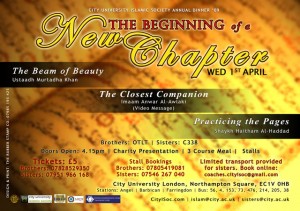
3) In April 2009, City Islamic Society organisers invited three radical Islamist preachers to address the society’s annual dinner, with the “brothers” and “sisters” segregated, and the latter forbidden to ask questions. One preacher, Anwar al-Awlaki , was to speak by video-link from Yemen, because he was banned from Britain for alleged links to terrorists. But the then vice-chancellor Malcolm Gilles intervened and the video-link was banned.

The above evidence speaks for itself.  Over the past decade, dozens of British university graduates have been convicted of terrorist offences, including several ISoc Presidents, the most notorious one of which was the 2009 “underpants-bomber.”  Clearly, universities cannot allow Isocs and Friday Prayers to continue to promote hate-preachers and terrorism-sympathisers.  (The “Birmingham 3” terrorists convicted yesterday included a graduate of Aston University.)

Here is the poster advertising the scheduled talk in April 2009, i.e. less than four years ago, at City Isoc via tele-link by Awlaki, the late Al-Qaeda preacher:

awlaki-city-u-4-09-300x211

And here is a post on the City Isoc website from December 2009, i.e. just over three years ago only, in praise of Awlaki and the “Al-Qaeda soldiers”: awlakicityisoc

The answer to the current impasse is quite simple: the Isoc needs to co-operate with the university authorities, who are concerned about the welfare of all their students, including the Muslims.  The Isoc should be able to ensure and guarantee that the vicious activities of 2009-10 are not repeated, in which case the university would surely reinstate the Friday Prayer facilities, since all UK universities are required to cater for the religious needs of all their students, and many universities provide very generous prayer-rooms for Muslim students.  I pray that the City University and its Isoc are granted the honesty, humility and courage to make the right decisions and arrive at a win-win situation for all sides.

Islam and Science Workshop – London 2013 – A Summary

February 22, 2013

Bismillah.  This is a cross-post from http://www.quilliamfoundation.org/events/islam-science-workshop-2013/

Quilliam, in association with the Université Interdisciplinaire de Paris, the American University of Sharjah and Muslim-Science.com, organised and hosted an international workshop entitled “Islam and Science: A Reasoned Approach” for students and young researchers, 18th-20th January 2013 at the Institute of Education, University of London, UK.

The participants consisted of 23 people selected by submission of essays on Science-Religion topics and/or their suitability as “disseminators of ideas” following on from the workshop. These 23 participants included three people from France, the USA and Egypt. There were a total of seven speakers at the workshop: three from the UK, two from France and one each from the UAE and Pakistan.

Introduction – Friday 18th January 2013

The workshop began with a screening of the 1-hour documentary film, Science and Islam – Dialogues for the 21st Century, which was produced by the Université Interdisciplinaire de Paris and featuring interviews with 22 leading scientists, theologians, philosophers and thinkers about the interfaces between religion and science in general, and focusing on Islam in particular.

This was followed by a presentation by Ehsan Masood, author of the BBC series-accompanying book, Islam and Science: A History, a presentation entitled Ibn Sina (Avicenna) – The Man Who Knew Everything, about the life, work and influence throughout Islamic and Christian history of this early Muslim polymath. A lively discussion followed about Ibn Sina’s philosophy and methodology and the scientific rationalisation of miracles.

Saturday 19th January 2013

Prof. Jean Staune (Université Interdisciplinaire de Paris) started with presentation on Science and Religion in the World today & New Paradigms of Science, in which he summarised the major developments in 20th-century science such as relativity and quantum theories in physics, Godel’s theorem in mathematical epistemology, and De Duve and Conway-Morris’ ideas of direction, non-randomness, and convergence in biological evolution. He showed how these “new paradigms” have influenced the discourse in “Science and Religion”, and how this field has become a growing academic discipline in its own right with chairs at Oxford, Cambridge and Harvard. This was followed by Prof. Nidhal Guessoum (American University of Sharjah), who gave a general overview of the main topic, Islam and Science, showing why “modern science” (particularly “methodological naturalism”) poses a challenge for traditional religious views and discussing the various contemporary Muslim responses to the challenge, ranging from Nasr’s “Sacred Science” and Sardar’s “Islamic/Ethical Science” to Salam’s “Universal Science”, ending with his own “Averroesian Harmonization.”

Yasmin Khan (former curator at both the Science Museum and the British Library) spoke on The 1001 Inventions Exhibition at the Science Museum, London: Engaging the Public in a Multicultural History of Science, a behind-the-scenes look at the challenges of commissioning the most successful touring exhibition in the history of the Science Museum, with a screening of the exhibition’s central 15-minute film, 1001 Inventions and The Library of Secrets, starring Sir Ben Kingsley as Al-Jazari.

Dr. Athar Osama (of Muslim-Science.com) complemented the day’s philosophical, theological, historical, civilisational and public-outreach themes with a sobering presentation on Science Policy in the Muslim World Today: Challenges and Prospects, focusing on governmental public policy and investment in science education and research and an analysis of the funding and work of COMSTECH, the OIC’s arm for science and technology.

Sunday 20th January 2013

Dr. Jean Staune gave a fascinating presentation on the Theories of Evolution. The philosopher of science showed multiple lines of evidence that evolution is an indisputable fact, but one that should not be confused with Darwinism. Based on the research of leading palaeontologists such as Conway-Morris and on the work of Nobel laureate De Duve and others, Staune insisted that the current Darwinian theory of evolution is incompatible at best, and presented ideas implying that evolution is a process leading, sooner or later, to beings like us with a consciousness of their own existence and the ability to seek God.

This was followed by a joint presentation on Islam and the Theory/Fact of Evolution by Prof. Nidhal Guessoum and Dr. Usama Hasan (Quilliam). The presentations included theological and scriptural arguments supporting evolution as well as a history of evolutionary ideas within Muslim civilisation since the 9th century CE from Al-Jahiz and the Brethren of Purity through to Rumi and Ibn Khaldun, a history recognised by a number of historians, Muslim and non-Muslim ones. Also covered was the acceptance of biological evolution by 19th/20th-century Muslim theologians such as Husain al-Jisr (nicknamed “the Ash’ari of our times” by Afghani), and ‘Abd al-Sabur Shahin, a well-known scholar of Al-Azhar. Current Muslim resistance to scientific facts was illustrated with historical precedents of misreading the Qur’an to make inflexible but erroneous assertions about scientific matters, such as Ibn Kathir and Shanqiti’s insistence that the earth was created before the heavens, Suyuti’s insistence that the earth is flat and Ibn Taymiyyah’s assertion that cattle (sheep, goats, cows and camels) were created in heaven (which would imply that modern-day followers of Ibn Taymiyyah who insist that humans were created in heaven and descended from there must also believe the same about those four species of mammals).

The sessions by Staune, Guessoum and Hasan illustrated well the irony that whilst modern biology, built on evolution, has succeeded in mapping the entire human genome as well as the DNA of thousands of other species, and new fields emerge such as astrobiology and the origin-of-life research looking at deep-sea volcanoes, many Muslims (and Christians) continue to debate whether or not evolution (including that of humans) is a fact, despite the overwhelming scientific evidence.

Dr. Bruno Abdelhaq Guiderdoni (Director of the Lyon Observatory) gave a fascinating presentation on Islam & Cosmology: Yesterday and Today, based on the mind-boggling discoveries of modern astronomy, including the existence of exo-planets in earth-like habitable orbits around stars other than the sun. In his lecture, Dr. Guiderdoni stressed the need to read the “Book of Nature” along with the “Book of God” and to maintain the inseparability of science and ethics. The discussion included topics such as the possibility of a multiverse and the question of extra-terrestrial intelligence and life-forms.

Dr. Guiderdoni’s emphasis on ethics led nicely to the session by Dr. Usama Hasan on Islam, Science and Ethics, in which he presented the theory of Maqasid al-Sharia (The Universal, Higher Objectives of Islamic Law) as an Islamic framework for ethics suitable for “Universal Science.” The framework is based on the Islamic principles of justice as minimum, compassion as maximum, promoting benefit and avoiding harm. The theory was illustrated with reference to ethical questions around family planning, abortion and organ transplants.

The workshop concluded with an open and long discussion session involving all participants, further exploring the ideas presented at the workshop and possible next steps to take the exciting conversations forward.

Islam and Science Workshop 2013

November 27, 2012
Bismillah.  This is a cross-post from http://www.quilliamfoundation.org/events/islam-science-workshop-2013/

Islam & Science Workshop 2013

FINAL CALL: Deadline extended to 9am on Monday 14th January 2013

Quilliam, in association with the American University of Sharjah, Université Interdisciplinaire de Paris and Muslim-Science.com, are pleased to announce a workshop entitled, “Islam and Science: A Reasoned Approach” for students and young researchers to be held on 18th-20th January 2013 at a prestigious location in Central London, UK.

This event will be the latest in a series of educational workshops that have previously been held in Algiers, Paris and other locations. A “reasoned approach” will be taken to Islam and Science: one that is well informed, balanced and constructive. The workshop will represent a unique opportunity for Muslim students and young researchers to discover the contemporary field of ‘science and religion’ through lectures by, and in-depth discussions with, internationally-recognised thinkers and experts in this field, including Prof. Nidhal Guessoum, Prof. Jean Staune, Prof. Bruno Guiderdoni, Ehsan Masood, Dr. Athar Osama and Dr. Usama Hasan.

Participants can attend the workshop by invitation only. There will be 20 invitations and in order to be selected, potential participants must complete and submit this application form (also below) and an accompanying essay on a subject that directly relates to the general theme of the workshop and to the topic of ‘Islam and Science.’

The eligibility criteria to apply for an invitation to the workshop are as follows:

• Participants must be either senior undergraduate students, graduate students, or young researchers (post-doctoral fellows or equivalent).
• The essays submitted by potential participants must be 1000-2000 words in English with an abstract of roughly 150 words.
• The essays must present an argument representative of the author’s opinion. They must be written in an academic style and include bibliographic references for every citation or factual statement, while avoiding being a summary or compilation of ideas expressed by other people.
• Potential participants should try to be consistent with the “reasoned approach” of this workshop and project on the theme of “Islam and Science.” In their essays, potential participants must avoid excessively focusing on “separationist” approaches which relegate religion to people’s private lives and science to the material world, or “concordist” approaches which “find” specific science in the scriptures and end up merely trivialising Islamic culture and its relationship to science.
• All essays must be submitted by email to workshop@QuilliamFoundation.org by 9am on Monday 14th January 2013. Essays received after this time will not be considered.

• Telephone interviews may be conducted to complete the selection process and to verify participants’ interest in, and familiarity with, the subject.
• The best essays may either be presented verbally by their authors during the workshop or published on the project website.The 20 participants who demonstrate their aptitude to fully benefit from the workshop will have all of their expenses paid (including transport, hotel accommodation and catering) and receive valuable educational material (books, articles, DVD, etc.).

Application Form
Islam & Science Workshop in London
18-20 January, 2013

Full name: ………………………………………………………………………..
Date of Birth: …………………………………………………………………………………..
Postal Address: …………………………………………………………………………………………………………… …………………………………………………………………………………………………………………………………. …………………………………………………………………………………………………………………………………………………………………………………………………………………………………………………………..
Telephone Number:…………………………………………………………………………………………………
Current educational / employment status:……………………………………………………………………… ……………………………………………………………………………………………………………………………………………………………………………………………………………………………………………………………………..
Academic Qualifications (include college and university attended): …………………………………………………………………………………………………………………………………. …………………………………………………………………………………………………………………………………. ………………………………………………………………………………………………………………………………….
Email Address: …………………………………………………………………………………………………………….
Website (if applicable): ………………………………………………………………………………………………..

Important: Please attach this form to a short essay of between one thousand and two thousand words, include an abstract of roughly one hundred and fifty words, and send to the following email address: Workshop@QuilliamFoundation.org by 9am on Monday 14th January 2013.

LECTURERS:

Nidhal Guessoum: Professor of Physics and Astronomy and Associate Dean at the American University of Sharjah in the United Arab Emirates; he has published several books on science with direct or indirect relevance to Islam, as well as dozens of scholarly papers in astrophysics and numerous articles on science, education, and culture. He has also organized two conferences (and co-edited the proceedings) on the application of Astronomy to Islamic problems.

Bruno Abdelhaq Guiderdoni: Director of the Observatory of Lyon (France), his main research being in galaxy formation and evolution, with over 100 papers published in the field. He is also a prominent Muslim figure in France; from 1993 to 1999 he was in charge of a French public television program ‘Knowing Islam’; he is a member of the Board of Advisors of the John Templeton Foundation.

Ehsan Masood: Science policy expert, writer, teacher, journalist, and broadcaster. He is the editor of Research Fortnight and Research Europe and teaches at Imperial College London. Masood’s latest book is Science and Islam: A History, in which he tells the story of how science developed during Islam’s imperial period, from 800 to 1500; the book was the official tie-in to a three-part documentary series on BBC Television presented by the award-winning Jim Al-Khalili, Professor of Physics at the University of Surrey.

Jean Staune: with degrees in Philosophy of Science, Mathematics, Paleontology, Political Science, Computer Science, and Management, he has taught at two Pontifical universities, in China at Shandong University, and is currently an adjunct professor at the Ecole Polytechnique Federale de Lausanne; he is also the founder and General Secretary of the Interdisciplinary University of Paris, and has published several best-selling books on science, philosophy and religion in France.

Usama Hasan: Senior Researcher in Islamic Studies at Quilliam, he has a PhD, MA & MSc from the Universities of Cambridge and London in Theoretical Physics and Artificial Intelligence, and is a Fellow of the Royal Astronomical Society. Also a traditionally-trained Imam with certification in Qur’an and Hadith, he is the author of a number of translations and academic papers in the fields of Qur’an, Hadith, Islamic law and ethics. He is a regular contributor to mainstream, international media.

Athar Osama: Science and innovation policy consultant and advisor. He is the founder of Muslim-Science.com and the Pakistan Innovation Foundation.

Others TBC

BURMESE ROHINGYA ORGANISATION UK (BROUK): Urgent Aid Needed for Rohingya Starving in Their Own Homes

October 4, 2012

Bismillah.  Received from BURMESE ROHINGYA ORGANISATION UK (BROUK), London

Tel: +44 2082 571 143, E-mail: brorg (dot) london (at) gmail (dot) com , web : www.bro-uk.org

Date: 03/10/2012


Urgent Aid Needed for Rohingya Starving in Their Own Homes


A new crisis is emerging in Arakan State, Burma, where up to 700,000 Rohingya are trapped in
their homes and villages, unable to go out and buy food or farm because of ongoing attacks and
threats against them. BROUK is already receiving reports of babies are dying from malnutrition.
While international attention has focused on up to 100,000 Rohingya in camps for internally
displaced people, who are now receiving regular aid, hundreds of thousands more Rohingya in
areas not visited by aid workers and international observers are starving in their own homes.

It has been almost 4 months the violence erupted in Arakan State, Burma, and since then local
Rohingya people describe being under effective siege by government forces and local Rakhine
communities. Constant human rights abuses committed against Rohingya make it unsafe for them
to leave their homes to get food.

BROUK has received the following information from the ground about abuses committed in the
past week, which give an indication of the type of abuses forcing people to stay at home:

1. Two Rohingya were killed in Sittwe while they went to buy food from Central Market.


2. No Rohingyas can go to school, hospitals, or markets most of the towns of Arakan State.
Several people who tried to go out were beaten and killed.


3. Many Rohingyas were arrested in Maungdaw Township. Those who were arrested have
disappeared.


4. Around 3000 Rakhine armed with weapons, together with Rakhine Monks, gathered and
surrounded Rohingya areas for hours in an attempt to recreate violence against the
Rohingyas in Sittwe. They demanded all Rohingyas to come out of their houses or they
would kill each and every Rohingya in the area.


5. 3 Rohingya boys were shot by government authorities while they were watching their
cattle in the pasture between paddy field and forest nearby the village in Pauktaw
Township.


6. In Pauktaw Township many babies have died because of malnutrition. Adults are also
reported to be starving.


7. Rohingya face a boycott in many areas with local Rakhine shopkeepers refusing to sell
them food.


8. Prison and security forces in Buthidaung jail are cutting off or burning the penises of
Rohingyas, forcing them to have homosexual sex with one another, cutting off or pulling
out their finger nails, severely beating them, keeping them naked all the time, keeping
them without food and water for days. When they are given foods once in many days, it
is on the ground with their hands tied at their backs. Authorities in the jail force them
through immense torture to confess that they are animals and that’s why they have to eat
like animals.


9. The bound and dead body of a Rohingya man was found in Sanpya village of Sittwe.


10. More than 10 Rohingyas were robbed and beaten, receiving serious injuries, by police
and security forces while they tried to travel from Alay Than Kyaw village to another
village in Maungdaw.


11. Those with bullet injuries and disease are in acute mental and physical pain without any
medical care and treatment.


BROUK President Tun Khin said: “President Thein Sein has already publicly stated that he wants
to ethnically cleanse all Rohingya out of Burma, even asking for international help to do so. He is
already implementing this policy, using starvation instead of bullets to kill Rohingya men,
women and children.”


“Hilary Clinton, David Cameron, Ban Ki-moon and others are praising Thein Sein at the same
time as he is killing our people. They should be insisting to end the starvation siege against
Rohingya, and allows in international aid all effected areas in Arakan. They should also be
working at the UN General Assembly for a UN Commission of Inquiry into what is taking place.”

For more information contact Tun Khin on +44 (0)7888714866.


European Parliament Resolution on Persecution of Rohingya Muslims in Burma

September 14, 2012

Bismillah. Received from Burma Campaign UK.

Persecution of Rohingya Muslims in Burma

PE493.587

European Parliament resolution of 13 September 2012 on the persecution of Rohingya Muslims in Burma/Myanmar (2012/2784(RSP))

The European Parliament,

– having regard to its previous resolutions on Burma/Myanmar, and in particular that of 20 April 2012[1],

– having regard to the progress report of 7 March 2012 by the UN Special Rapporteur on the situation of human rights in Myanmar,

– having regard to the Council conclusions of 23 April 2012 on Burma/Myanmar,

– having regard to the statement of 13 June 2012 by the spokesperson of High Representative Catherine Ashton on the crisis in northern Rakhine State in Burma/Myanmar,

– having regard to the exchange of views on the Rohingya issue which took place in its Subcommittee on Human Rights on 11 July 2012,

– having regard to the statement of 9 August 2012 by Commissioner Georgieva on humanitarian access to the Rohingya and other affected communities,

– having regard to the statement of 17 August 2012 by the ASEAN foreign ministers on the recent developments in Rakhine State,

– having regard to the UN Convention on the Status of Refugees of 1951 and the protocol thereto of 1967,

– having regard to Articles 18 to 21 of the Universal Declaration of Human Rights (UDHR) of 1948,

– having regard to Article 25 of the International Covenant on Civil and Political Rights (ICCPR) of 1966,

– having regard to the decisions allowing Burma/Myanmar to host the Southeast Asian Games in 2013 and to chair ASEAN in 2014,

– having regard to Rules 122(5) and 110(4) of its Rules of Procedure,

A. whereas since the new government of President Thein Sein took office in March 2011, it has taken numerous steps to expand civil liberties in the country, the majority of political prisoners have been released, with a number being elected to the Parliament in byelections, preliminary ceasefires have come into force with most armed ethnic groups, and many political dissidents have returned from exile in the hope of reconciliation;

B. whereas, however, discrimination against the Rohingya minority has intensified;

C. whereas on 28 May 2012 the rape and murder of a Buddhist woman set off a chain of deadly clashes between the majority Rakhine Buddhist population and the minority Rohingya Muslim community in Rakhine State;

D. whereas in the following days communal violence spread between the two communities, disproportionately involving Rakhine mobs and security forces targeting Rohingya, leaving dozens of people dead, thousands of homes destroyed and over 70 000 people internally displaced; whereas on 10 June 2012 a state of emergency was declared in six townships of Rakhine State;

E. whereas President Thein Sein had initially expressed the view that the only solution for the Rohingya was either to send them to refugee camps with UNHCR support or to resettle them in other countries;

F. whereas the Rohingya, many of whom have been settled in Rakhine State for centuries, have not been recognised as one of Burma/Myanmar’s 135 national groups, and have thus been denied citizenship rights under the 1982 Citizenship Law, are perceived by many Burmese to be illegal immigrants from Bangladesh, and have been subject to systematic and severe discrimination, including restrictions in areas such as freedom of movement, marriage, education, healthcare and employment, as well as land confiscation, forced labour, arbitrary arrest and harassment by the authorities;

G. whereas in the face of persistent persecution an estimated 1 million Rohingyas have fled to neighbouring countries over the years; whereas 300 000 have fled to Bangladesh alone, in which country their long-term situation remains unresolved, while the Bangladeshi authorities have recently instructed the international humanitarian NGOs which provide basic heath and nutrition services to unregistered refugees as well as to the local population in Cox’s Bazar district to suspend their activities, and are now reportedly pushing Rohingya asylum seekers back;

H. whereas the Commission’s Humanitarian Aid and Civil Protection department (ECHO) has allocated EUR 10 million to support for Rohingya refugees and the local host population in Bangladesh in 2012;

I. whereas on 17 August 2012 the Burmese government appointed an independent Investigation Commission, consisting of 27 representatives of civil society and political and religious organisations, to inquire into the causes of the outbreak of sectarian violence and make suggestions;

1. Is alarmed at the continuing ethnic violence in western Burma, which has caused large numbers of deaths and injuries, destruction of property and displacement of local populations, and expresses its concern that these intercommunal clashes may put at risk the transition to democracy in Burma/Myanmar;

2. Calls on all parties to exercise restraint, and urges the Burmese authorities to stop arbitrary arrests of Rohingya, to provide information on the whereabouts of the hundreds of people detained since security operations in Rakhine State began in June 2012, and to immediately release those arbitrarily arrested;

3. Calls on the government of Burma/Myanmar, as a matter of urgency, to allow the UN agencies and humanitarian NGOs, as well as journalists and diplomats, unhindered access to all areas of Rakhine State, guarantee unrestricted access to humanitarian aid for all affected populations, and ensure that displaced Rohingya enjoy freedom of movement and are permitted to return to their place of residence once it is safe for them to do so;

4. Welcomes the creation of the independent Investigation Commission, but regrets the absence of a Rohingya representative;

5. Calls on the government of Burma/Myanmar to bring the perpetrators of the violent clashes and other related abuses in Rakhine State to justice, and to rein in the extremist groups who are instigating communal hatred, propagating threats against humanitarian and international agencies, and advocating expulsion or permanent segregation of the two communities;

6. Calls on the EEAS to support the Burmese government by all possible means in its efforts to stabilise the situation, implement programmes promoting reconciliation, design a broader socio-economic development plan for Rakhine State, and continue Burma/Myanmar’s progress towards democracy;

7. Expresses its appreciation for those Burmese citizens who have raised their voice in support of the Muslim minority and a pluralist society, and calls on the political forces to take a clear stand in that sense; believes that an inclusive dialogue with local communities could be an important element in terms of attenuating the numerous ethnic problems in Burma/Myanmar;

8. Insists that the Rohingya minority cannot be left out of the newly developing openness for a multicultural Burma/Myanmar, and calls on the government to amend the 1982 citizenship law so as to bring it into line with international human rights standards and its obligations under Article 7 of the UN Convention of the Rights of the Child, with a view to granting citizens’ rights to the Rohingya and other stateless minorities, as well as ensuring equal treatment for all Burmese citizens, thus ending discriminatory practices;

9. Is concerned at the arrest of 14 international aid workers during the unrest, and calls for the immediate release of the five who are still in prison;

10. Urges the Burmese government to allow the UN Special Rapporteur on human rights in the country to conduct an independent investigation into the abuses in Rakhine State; calls on the OHCHR to establish an office in Burma/Myanmar with a full protection, promotion, and technical assistance mandate, as well as sub-offices in states around the country, including Rakhine State;

11. Encourages the Burmese government to continue implementing its democratic reforms, to establish the rule of law, and to ensure respect for human rights and fundamental freedoms, in particular freedom of expression and assembly (including on the internet);

12. Urges all countries in the region to come to the aid of refugees from Burma/Myanmar and to support the Burmese government in finding equitable solutions for the underlying causes;

13. Urges Bangladesh, in particular, to continue its acceptance of present donor support and any additional support measures, and to allow the humanitarian aid organisations to continue their work in the country, especially in the light of the events in Rakhine State and the resultant additional flows of refugees in dire need of basic care;

14. Instructs its President to forward this resolution to the Governments and Parliaments of Burma/Myanmar and of Bangladesh, the EU High Representative, the Commission, the Governments and Parliaments of the Member States, the Secretary-General of ASEAN, the ASEAN Intergovernmental Commission on Human Rights, the UN Special Representative for Human Rights in Myanmar, the UN High Commissioner for Refugees, and the UN Human Rights Council.

[1] Texts adopted, P7_TA(2012)0142.

Usama Hasan, https://unity1.wordpress.com

UK dawn (fajr) observation

September 10, 2012

Bismillah. From Usamah Ward:

Assalamu ‘alaikum.

September can be a good month for astronomical observations, it often has warm clear nights. Last year I spent a few good nights looking at the night sky with friends, but this year I thought I’d try to observe the start of dawn. Last Saturday morning (8 Sep 2012) was a perfect opportunity; there was no cloud within view (according to weather charts, the nearest cloud in the direction of dawn was over Scandinavia), and it was not cold.

I originally intended to drive to Walton-on-the-Naze, but that is a long way to go from London on my own; instead I drove to Leysdown-on-Sea. This is a good location I can reach in an hour, it is dark enough to see the Milky Way, it has a clear view of the north-east to east horizon over the sea, and due to its closeness has a strong relevance to London.I arrived early (3.30 AM), as it is important to allow one’s eyes to accustom to the dark. Dawn was to be expected in a direction between 050º and 060º, and was helpfully framed by The Plough to my left, and a brilliant Venus to my right which had already risen in the east and now cast a long reflection over the water.

The other advantage of arriving early was an opportunity to survey the night sky with my binoculars, with Orion above the horizon quite south of east, the waning moon shining brightly above and to the right of Venus, accompanied by Jupiter to its left, and the Pleiades somewhat above.

At the start of astronomical twilight (sun’s altitude at 18º, about 4.22 AM)) I could see no sign of dawn; indeed, I had to wait some 20 minutes. The appearance and spreading of the light of dawn I would have called for 4.45 AM, which is about the middle of astronomical twilight (15º), though some may have called it a few minutes earlier – as you’ll know, it’s not a precise moment by any means! I have to say that given the conditions I had thought I might see it a little earlier.

It is important to emphasise that this proves nothing; it is one person’s observation on one night. My attempt to photograph what I saw was, not surprisingly, a dismal failure, due the the limitations of my camera and my abilities!

However, the more we try to observe dawn, the more likely we will be able to devise meaningful timetables.For record, it is my view that:

1) Timetables that give ‘to the minute’ times for Fajr and Isha are inherently misleading, as all the evidence of science and people’s observations suggests the times vary considerably depending on atmospheric conditions. At best, they are a helpful average.

2) Angles determined by observations carried out at significantly different latitudes cannot be assumed to be valid for the UK.3) Much work needs to be done *by* Muslims in the UK *for* Muslims in the UK, partly to ensure we understand the Fiqh correctly, partly to grasp the latest scientific understanding of the phenomenon of dawn, but mostly to establish as much observational data as possible.

Usamah K Ward

Usama Hasan, https://unity1.wordpress.com

Dirac’s visual representation of electron spin

August 27, 2012

Bismillah. Received from Sabbir Rahman:

Assalamu `alaikum,

I just came across this superb YouTube video which beautifully demonstrates Dirac’s ‘visual metaphor’ for the spin of the electron (note that being a spin-half particle, the electron has to rotate through 720 degrees before it returns to its original position):

Some of you may recall that in my own model, electrons are described as rapidly rotating (Kerr) black holes, the singularity of which, when ‘blown up’, has the topology of a “double torus” (where ‘torus’=surface of a doughnut). In particular, the electron is formed from the rotating gravitational collapse of neutrinos, which become trapped in bounded orbits wrapping around the toroidal singularity.

Now these orbits wrap around the torus once in each rotation, but the curious thing is that each time an orbit crosses the inside of the ring (which occurs once in each revolution), the direction of time for the neutrino flips sign (from the perspective of an external observer, that is – the neutrino itself would be blissfully unaware of this). Thus, after completing two orbits of the electron’s ring singularity, each bounded neutrino returns to its original position both in space _and_ time, having spent half of the time travelling forwards in time and half of the time travelling backwards in time!

If you watch from 1:13 minutes into the YouTube video, where the dancer is rotating a cube in her hand, you can see a very precise analogy of what this neutrino motion looks like – imagine that every time the dancer’s arm is above her elbow that time is passing in the forward direction, and every time her arm is below the elbow that time us passing in the negative direction. I would even recommend that you try doing this yourself, to get a good feel for how this works – and perhaps get an idea of why, if indeed elementary particles like electrons, quarks and neutrinos, are indeed topological objects, they must be spinorial. If they had integer spin, then spacetime would get into a horribly tangle mess every time once of these elementary particles rotated.

From 2:02 minutes into the video, you can see how this works – although the electron seems to tangle up space horifically after the first 360 degree rotation, it miraculously untangles space again after a further 360 degree rotation – both mind-boggling and beautiful, I hope you will agree!

Best wishes,
Sabbir.

Is settler violence terrorism?

August 22, 2012

Bismillah. An important development:

Brookings scholar Natan Sachs and Foreign Affairs managing editor Jonathan Tepperman held a media conference call today, August 22, on the arrest of seven Israeli settlers for reportedly attempting to lynch several Palestinian youths, and the State Department’s designation of settler violence as terrorism.

In the September/October issue of “Foreign Affairs,” Sachs and Daniel Byman, who is also at Brookings, write that confronting settler terrorism is a “clear moral and political imperative” for the Israeli government and that not doing so could imperil any hope of peace with the Palestinians.

“Whenever extremist settlers destroy Palestinian property or deface a mosque, they strengthen Palestinian radicals at the expense of moderates, undermining support for an agreement and delaying a possible accord. Meanwhile, each time Israeli leaders cave in to the demands of radical settlers, it vindicates their tactics and encourages ever more brazen behavior, deepening the government’s paralysis. In other words, Israeli violence in the West Bank both undermines the ability of Israel to implement a potential deal with the Palestinians and raises questions about whether it can enforce its own laws at home.”