Posts Tagged ‘Qur'an’

Astronomical Calculations & Establishing the Beginnings of the Lunar Months – by Shaykh Yusuf al-Qaradawi

May 17, 2026

Astronomical Calculations & Establishing the Beginnings of the Months

Shaykh Yusuf al-Qaradawi

Republished on his official website, 14th February 2026 (a week before Ramadan 1447)

Translated & annotated by Usama Hasan (1st Dhul Hijjah, 1447 ~ 18th May 2026)

Contents

1       [Introduction: Calculations Are Now More Precise Than Crescent-Sighting] 3

2       [Three Ways to Establish the Entry of Ramadan] 4

2.1         [Crescent-Sighting] 4

2.1.1      [One Witness] 4

2.1.2      [Two Witnesses] 4

2.1.3      [A Large Number of Witnesses] 5

2.2         [Completing the term of Sha’ban as thirty days] 5

2.3         [Determining the crescent – what does it mean?] 5

2.3.1      [Imam Nawawi’s explanation] 6

2.3.2      [The view of the leading Shafi’i jurists, Ibn Surayj and Qadi Abu l-Tayyib] 7

2.3.3      [Views of the contemporary jurists, Ahmad Shakir & Mustafa al-Zarqa’] 7

2.3.4      [The jurists who seemingly rejected astronomy actually rejected astrology] 7

2.3.5      [The view of Ibn Daqiq al-‘Id] 8

2.3.6      Sighting: a variable means towards a fixed end. 8

2.3.7      [Shaykh Ahmad Shakir’s view of beginning the lunar month by calculation] 9

2.3.8      [Qaradawi’s reflections on Shakir’s essay: the nature of Salafism] 12

2.3.9      A reply to the argument that the hadith negates calculation. 13

2.3.10         [Use of calculations to negate impossible crescent-sightings] 14

2.3.11         Imam Subki & Shaykh Maraghi: calculations can negate impossible sighting reports. 14

3       Realities That Should Be Agreed Upon. 16

3.1         [There is flexibility in this issue] 16

3.2         [Mistakes in such issues are forgiven] 16

3.3         [Muslim unity is a desirable matter] 16

4       Arabic Text of the Article. 18

1        [Introduction: Calculations Are Now More Precise Than Crescent-Sighting]

Using definite (precise) calculations today as a means (method) to establish the months, must be accepted from the aspect of “analogy (pointing) to what is primary.” Meaning, that the Sunnah that legislated for us to use lower means, when the latter is engulfed in doubt and probabilities, i.e. [crescent] sighting, does not reject a means that is higher, more complete and more fully realises the objective. It further leads the [Muslim] nation out of severe disagreement about specifying the beginning of its fasting and its [festivals] of breaking the fast and sacrificing, towards the desired unity in its sacred symbols and acts of worship related to the most special of its religious matters, those most closely-connected to its spiritual life and entity. This [higher] means is definite (precise) calculation.

The generous Islamic Sharia, when it mandated fasting in a lunar month, legislated the natural, accessible and practical method to establish it (the month) for the whole nation. This method has no unknowns or complexity, [for] the nation at that time was unlettered: it did not write or calculate. This method is naked-eye sighting of the crescent moon:

[1] On the authority of Abu Hurayrah that the Prophet ﷺ said: Fast, all of you, upon seeing it – i.e. the crescent – and end your fast upon seeing it. If it is obscured for you [by cloud or haze], then complete the term of Sha’ban as thirty [days].[1]

[2] On the authority of Ibn ‘Umar that the Messenger of Allah ﷺ mentioned Ramadan, saying: Do not fast until you see the crescent. Do not end your fast until you see it. If it is obscured for you [by cloud or haze], then determine for it.[2]

This was mercy towards the nation, for Allah did not task it with acting by calculation, something which it neither knew nor excelled in. Had it been tasked with that, it would have followed other nations, from the People of the Book[3] and others who did not follow its religion [Islam].

2        [Three Ways to Establish the Entry of Ramadan]

Authentic hadiths have affirmed that the entry of the month of Ramadan may be established via one of three routes:

  1. Crescent-sighting,
  2. Completing the term of Sha’ban as thirty days, or
  3. Determining for the crescent.

2.1       [Crescent-Sighting]

The jurists have differed about it: is it sighting by one person of integrity, by two people of integrity, or by a large number of people?

2.1.1      [One Witness]

Those who said: the witness of one person of integrity is acceptable, used as evidence the hadith of Ibn ‘Umar, who said: The people attempted to see the crescent. I informed the Prophet ﷺ that I had seen it, so the Messenger of Allah ﷺ fasted and ordered the people to fast it (the month).[4]

They also used as evidence the hadith of the bedouin who testified to the Prophet ﷺ that he saw the crescent, so he ordered Bilal to announce to the people “to stand (in prayer) and fast.”[5]

They also said: “Affirming with one trustworthy witness (person of integrity) is more cautious for entry into worship: fasting a day [i.e. the 30th] of Sha’ban is less serious than eating and drinking on a day [i.e. the 1st] of Ramadan.”

2.1.2      [Two Witnesses]

Those who made sighting conditional upon two trustworthy witnesses (people of integrity), used as evidence what al-Husayn bin Hurayth al-Jadali narrated. He said: The Emir of Mecca, al-Harith bin Hatib, addressed us, saying: The Messenger of Allah ﷺ ordered us to begin rituals upon seeing it [the crescent]: if we did not see it, but two trustworthy witnesses testified [that they had seen it], we began the rituals by their testimony.[6]

Thus, by analogy with most other cases of testimony, sighting is established by the testimony of two people of integrity.

2.1.3      [A Large Number of Witnesses]

As for those who made it conditional upon a large mass or numerous group of people, they are the Hanafis, applying it to the state of a clear horizon. In case of a cloudy sky, they allowed one person to testify to its sighting, because it is possible that the cloud broke momentarily, allowing one person to see the crescent whilst others did not see it. But if the sky is clear, with no haze, cloud or other obstacle or barrier preventing sighting, then how could one person see it whilst others did not? This is why they said: News must come from a great number, because a sighting by one person amidst a large mass of people, when they are all concentrating on the same thing being sought, supposing no preventative condition and sound eyesights, even if these differ in sharpness, clearly demonstrates that it is mistaken.[7]

As for the reports from Ibn ‘Umar and the bedouin mentioning establishing the crescent by an individual sighting, the ‘Allamah Rashid Rida said in his notes on [the Hanbali text] Al-Mughni [That Which Suffices], “In these two reports, it is not stated that the people were looking to sight the crescent such that only one of them saw it. Thus, the two reports do not apply to the area of disagreement, especially with Abu Hanifah. Thus, all the relevant arguments based upon the two reports are falsified.”[8]

As for the number of the large group, this is referred to the view of the ruler or judge (qadi), without determining a fixed number, according to the correct view.[9]

Amongst the obligations upon the Muslims is to seek the crescent on the 29th day of Sha’ban at sunset, because anything necessary to fulfil an obligation is itself an obligation, except that it is a communal obligation [i.e. not an individual one].

2.2       [Completing the term of Sha’ban as thirty days]

Whether the sky is clear or cloudy, if the people try to see the crescent on the 30th night of Sha’ban but no-one sees it, they complete Sha’ban as thirty days.

This necessitates that the establishment of Sha’ban was known from its beginning, so that the 30th night is known in which the crescent is sought and the month is completed (as thirty days) if there is no sighting. This is a matter in which there is a shortcoming, because concern to establish the entry of the months [currently] only happens for three months: [i] Ramadan, to establish entry into fasting, [ii] Shawwal, to establish exit from it, and [iii] Dhul-Hijjah [The Month of Pilgrimage] to establish The Day of ‘Arafah [Hajj] and subsequent days. It is befitting for the nation, and for its rulers, to be precise in establishing all the months, because each one is based on other [preceding] ones.[10]

2.3       [Determining the crescent – what does it mean?]

This is to determine for the crescent when it is cloudy, or as the hadith says in authentic narrations, “If it is obscured (ghumma) over you”, “If it is obscured over you by cloud (ghaym),” or “If it is obscured over you by rain (ghaby),” i.e. there is a barrier covering it. These narrations include Malik from Nafi’ from Ibn ‘Umar, the Golden Chain and the most authentic isnad according to Bukhari, “If it is obscured (ghumma) over you, then determine for it.”

So, what is the meaning of, “determine for it” (uqduru lahu) ?

2.3.1      [Imam Nawawi’s explanation]

Nawawi said in Al-Majmu’ [The Compendium]:

Ahmad bin Hanbal and a small group said: its meaning is: Narrow it down and determine it from below the clouds. This is from ‘qadr’ meaning ‘narrowness’ as in His saying: Whoever has his provision constricted.[11] They obliged fasting after a cloudy night.

Mutarrif bin ‘Abdullah, amongst the Senior Followers (Tabi’in), Abu l-‘Abbas bin Surayj, amongst the Senior Shafi’is, Ibn Qutaybah and others said: its meaning is: Determine it according to (calculation of) the stations [of the moon].

Abu Hanifah, Shafi’i and the majority of the earlier (Salaf) and later (Khalaf) authorities said: its meaning is: Determine for it by completing the number as thirty days. The majority used as proof the narrations that we have mentioned, all of which are authentic and explicit: “Complete the term as thirty”, and “Determine for it thirty,” which explain the general narration, “Determine for it.”[12]

However, Imam Abu l-‘Abbas bin Surayj did not refer one of the two narrations to the other. Rather, Ibn al-‘Arabi quoted from him that his saying, “Determine for it,” is addressed to those whom Allah has especially-given this knowledge, and that his saying, “Complete the term [as thirty]” is addressed to the common people.[13]

A difference in addressing people according to their situation is a valid matter. It is the basis of the change of fatwa according to the changing of time, place and situation.

Imam Nawawi said in Al-Majmu’ [The Compendium]:

Whoever advocated calculation of the stations [of the moon], his view is refuted by his saying ﷺ in the Two Sahihs: We are an unlettered nation: we do not write or calculate … [to the end of] the hadith. They [the refuters] said: Furthermore, if the people were tasked with this, it would constrict them because such calculation is only known by a few individuals in large cities.[14]

The hadith that Imam Nawawi, may Allah have mercy upon him, used as proof has no proof in it because it speaks of the situation and description of the nation when he ﷺ was sent to it. However, its unletteredness is neither a necessary not desired matter: he ﷺ strove to bring it out of its unletteredness by teaching it to write, beginning from the Battle of Badr. Thus, there is nothing against the nation reaching a stage where it is writing and calculating. Scientific, astronomical calculations were known by the Muslims during the ages of the flowering of their civilisation. In our times, these have reached the degree of elevation such that man has been able to reach the moon. This is different to astral fortune-telling or the astrology that is condemned in the Sharia.

As for the other consideration that Nawawi mentioned: that only by a few individuals in large cities know the calculation, this might have been true in his time, may Allah have mercy upon him. But it is not true in our time, when astronomy is studied in various universities. The subject is served by instruments and observatories at great heights and astounding precision. It has become agreed and known internationally today that the possibility of error in scientific, astronomical determinations today is 1/100,000 of a second!

Furthermore, cities large and small have now become similar, as though they were one city. In fact, “the world –as it is said – has become a large village”! The transmission of news from one area to another, and from east to west and vice-versa, only takes a few seconds.

2.3.2      [The view of the leading Shafi’i jurists, Ibn Surayj and Qadi Abu l-Tayyib]

Abu l-‘Abbas bin Surayj, one of the Imams of the Shafi’is, took the view that a person who knows the calculation and the stations of the moon: if he knows via calculation that tomorrow is Ramadan, fasting is binding upon him, because he knows the month with evidence (daleel), so this resembles knowing it with legal proof (bayyinah). The Qadi Abu l-Tayyib[15] also chose this view because it is a means by which dominant conjecture (ghalabat al-zann) is achieved, so it resembles a trustworthy person informing him based on eye-witnessing [the crescent]. Others said: He is allowed to fast, but it is not binding upon him. Others allowed him to follow the opinion of whoever he trusted.

2.3.3      [Views of the contemporary jurists, Ahmad Shakir & Mustafa al-Zarqa’]

Some of the senior people of knowledge of our time took the view of establishing the crescent via definite, scientific, astronomical calculation. The great Hadith scholar, the ‘Allamah Ahmad Muhammad Shakir, may Allah have mercy upon him, wrote his treatise about this: Awa’il al-Shuhur al-‘Arabiyyah hal yajuzu shar’an ithbatuha bi l-hisab al-falaki? [The Beginnings of the Arabian Months: is it allowed by Sharia to establish them via astronomical calculation?] We shall return to this, quoting his view in detail.

Amongst others calling to this view in our time was the great jurist, Shaykh Mustafa al-Zarqa’, may Allah have mercy upon him.

2.3.4      [The jurists who seemingly rejected astronomy actually rejected astrology]

What is apparent from the reports that the jurists rejected geometry or astronomy, is that this was what is called ‘astral fortune-telling’ (tanjim) or ‘astrology’ (literally, ‘knowledge of the stars’ – ‘ilm al-nujum). In this, there is claimed knowledge of future unseen events via the stars. This is false, and about this is the hadith narrated by Abu Dawud and others on the authority of Ibn ‘Abbas from the Prophet ﷺ: Whoever acquired knowledge from the stars has acquired a branch of sorcery, [whatever he adds to it].[16]

2.3.5      [The view of Ibn Daqiq al-‘Id]

Imam Ibn Daqiq al-‘Id said:

What I say is this: It is not permissible to rely upon calculation of the conjunction of the moon and sun, according to the astrologers, for fasting. This is because they bring forward (early) the month by a day or two before [crescent-]sighting. In considering this, there is introduction of legislation that Allah has not permitted. But as for calculation indicating that the crescent has appeared in a way that it is visible, but there exists a barrier to sighting it such as clouds, then this necessitates the obligation [of fasting] due to the existence of a legal [Sharia] cause.

Ibn Hajar commented on the above by saying:

However, the acceptance of this is suspended (conditional) upon the truthfulness of the one informing about it [the results of the calculation]. We can only certify to his truthfulness if he observes it [the crescent]. But the situation is that he has not observed it, so there is no consideration given to his statement in that case. Allah knows best.[17]

However, modern astronomy is based upon observation by instruments, and upon definite mathematical calculation. One of the widespread mistakes amongst the people of knowledge of religion in this time is the belief that astronomical calculation is [simply] the calculation of calendar-makers or the results of these, that are published and distributed amongst the people. These include prayer times and the beginnings and ends of lunar months. These calendars are attributed to different individuals, most of whom base them on old books from which they copy these timings and describe them in their calendars. It is well-known that these calendars disagree with each other: some of them number Sha’ban as having 29 days whilst others number it with 30 days, and similarly for Ramadan, Dhul-Qi’dah and other months.

Because of these disagreements, the people of knowledge of religion rejected all (these calendars), because they are not based on certain knowledge, for certainty cannot self-contradict. This (principle) is undoubtedly true, but this is not the scientific, astronomical calculation that we mean. We mean what modern astronomy has established, based on observation and experience. This modern astronomy now commands theoretical and practical (technological) possibilities that makes it possible to take humans to the surface of the moon and to despatch space probes to planets further away. The possibility of error in these calculations is now 1/100,000th of a second. It has become one of the easiest matters for modern astronomy to inform us about the astronomical birth of the new moon, and about the possibility of its appearance in every horizon by the minute and second, if we wished.

2.3.6      Sighting: a variable means towards a fixed end

In my book, How We Engage With The Sunnah, I returned to this topic when discussing one of the foundational principles of understanding the Sunnah: Distinguishing Between The Fixed Goal and The Variable Means. I gave several examples of this, and then stated:[18]

Another matter that may be included in this chapter is what has come in the famous, authentic hadith: Fast upon seeing it (the new crescent moon: hilal) and end your fast upon seeing it; if it is obscured over you, then determine for it– and in another version: if it is obscured over you, then complete the term of Sha’ban as thirty.

Thus, a jurist may say: the noble hadith indicated a goal, and specified a means.

As for the goal from the hadith, this is clear and obvious: that people should fast all of Ramadan and neither miss a day from it nor fast a day from another month instead, such as Sha’ban or Shawwal. This is by establishing the beginning or end of the month via a means that is possible and within the capability of most people, that does not impose hardship or a burden upon them in their religion.

Sighting with the eyes was the easy and possible means for most people in that time, hence the hadith specified it. This is because if it imposed another means upon them, such as astronomical calculation – when the nation at that time was unlettered, neither reading nor writing, it would have covered them with hardship. However, God wishes ease for His People and does not wish for them hardship.[19] Furthermore, the Prophet, blessings and peace be upon him, said about himself: Truly, God has sent me as a teacher who makes matters easy, and has not sent me as someone who makes matters difficult.[20]

Therefore, if another means is found that [i] is more capable of realising the goal of the hadith; [ii] is further away from the possibility of mistake, error and falsehood in entering the month; [iii] has become accessible and not difficult; [iv] is not regarded as a means that is hard to attain, nor is beyond the ability of the nation; [v] scientists and experts about it have appeared: astronomers, geologists, physicists – specialists at international level; [vi] after human knowledge has reached a level that enables humanity to soar to the moon itself and land on its surface, roam there and bring back samples of its rock and soil! Then why do we stagnate upon the means, which is not the end in itself, and forget the goal that the hadith has set forth?

The hadith has established entering the month via the report of one or two people who claim to have seen the new crescent moon by naked eye, at a time when this was the only possible means and appropriate to the level of the nation. Therefore, how can it be envisaged that a means untouched by mistake, error and falsehood could be rejected? A means that has reached the degree of certainty and surety; that the nation of Islam can agree upon from east to west; that can remove the constant disagreement and lack of simultaneity in fasting, breaking the fast and celebrating festivals: that can reach a difference of three days between one land and another, something that cannot be understood and is unacceptable by the logic of science as well as the logic of religion, for it is certain that one of these dates is correct and the others are mistaken, without question.

2.3.7      [Shaykh Ahmad Shakir’s view of beginning the lunar month by calculation]

It should be noted that the ‘Allamah, Great Hadith-scholar, Shaykh Ahmad Shakir – may God have mercy upon him – took this issue in another direction. He took the position of establishing the beginning of the lunar month via astronomical calculation, based on the principle that the ruling to consider sighting [of the moon] is predicated upon a reason (legal cause,‘illah) that the Sunnah itself mentioned explicitly. This reason no longer exists: therefore, its resulting effect should also be done away with. This is because it is established that a ruling both coexists and disappears with its reason (legal cause,‘illah).

It would be good for us to quote his reasoning verbatim here because of its power and maturity. He – may God have mercy upon him – said in his essay, The Beginnings of the Arabian Months:

One of the matters about which there is no doubt is that the Arabs, before Islam and in early Islam, did not know the astronomical sciences with precision. They were an unlettered nation, neither writing nor calculating. Any of them who knew something of astronomy: this was limited to basics and superficialities that he had known through observation and pursuit, or listening and reports. It was not based upon mathematical principles, nor upon definite proofs that refer to initial, certain premises. Because of this, the Messenger of God, may God bless him and grant him peace, made the reference for establishing the months in their acts of worship a definite, observable matter that was within the capability of every single one of them, or most of them: naked-eye sighting of the new crescent moon. This was most authoritative and precise for the timings of their rituals and acts of worship. It was the way within their capabilities by which they could reach certainty and trust, for God does not burden a soul with responsibility beyond its capacity.

It did not agree with the wisdom of the Lawgiver to make the affirmation of crescents reliant upon calculation and astronomy, for they [the Arabs] did not know any of that in their immediate context. Many of them were nomads, whom news from settlements did not reach, except occasionally. Thus, if He made such affirmation for them dependent upon calculation and astronomy, it would have been too burdensome for them. None of them knew this science, except the rare and the outlier in the wilderness via reports if these reached them. Even settled people did not know this science, except by following some mathematicians, most or all of whom were People of the Book [Jews or Christians].

Next, Muslims conquered the world, held the reins of the sciences, expanded every corner of them, translated the knowledge and sciences of the ancients and mastered them, unveiling many of their obscurities, and preserved them for those who came later. These included the sciences of astronomy, geometry and stellar calculations.

Most of the jurists and scholars of Hadith did not know the astronomical sciences, or they knew some of the fundamentals. But many or most of them did not trust those who knew these sciences and were not comfortable with such people. Rather, some of them would accuse those involved with these sciences of deviation and heresy, thinking that these sciences were used by their practitioners to claim knowledge of the unseen: astrology. Some of those people did actually claim that, thus doing a disservice to themselves and to their knowledge. Thus, the jurists were excused (vindicated). Those jurists and people of knowledge who knew these sciences were not able to define the correct stance of these with respect to religion and jurisprudence, but would only indicate such matters due to a state of fear.

Thus was their situation, for the natural sciences were not as widespread as the religious sciences and what led to them, nor were the principles (of the natural sciences) established definitely for the religious scholars.

This generous, shining, Law (Sharia), is everlasting until God gives permission for the end of this worldly life. Thus, it is a legislation for every nation and every era. This is why we see in the texts of the Book and the Sunnah subtle indications of new matters, so when these are fulfilled, the texts are explained and known, even if earlier authorities had explained them differently to their actual reality.

There is an indication in the authentic Sunnah to our present subject: Bukhari related the hadith of Ibn ‘Umar from the Prophet, may God bless him and grant him peace, that he said: Truly, we are an unlettered nation: we neither write nor calculate. The month is like this, and like this,[21] meaning that it is sometimes twenty-nine days, and sometimes thirty.

Our previous scholars explained the meaning of this hadith correctly. Amongst the most comprehensive views amongst them is that of Hafiz Ibn Hajar:

“What is intended by calculation here is that of the positions and movements of the stars, for they did not any of that, except a very little. Therefore, he conditioned the ruling of fasting upon sighting [the moon], in order to remove hardship from them in the difficulty of determining movements. This ruling regarding fasting continued, even if there came later people who knew those [calculations]. In fact, the outward context negates conditioning the ruling upon the basic calculation.

This is clarified by his saying in the previous hadith: If it is obscured over you by cloud, then complete the term as thirty. He did not say: Then ask the People of Calculation. The wisdom behind this is that those legally responsible are equal [in not being able to see the moon] when it is cloudy, so disagreement and dispute is lifted from them. Some people held that astronomers should be referred to in such a situation: they are the Isma’ilis. It has been quoted that some jurists agreed with them. Al-Baji said: The consensus of the pious predecessors is proof against them. Ibn Bazizah said: This is a false position, for the Sharia has forbidden delving into the knowledge of stars because it is speculation and guesswork, having no certainty or strong conjecture; furthermore, if this matter was based on such knowledge, it would be narrow because only a few people know it.”

This explanation is correct, in that what matters is sighting, not calculation. However, the interpretation is incorrect that even if people came later who knew [astronomy], the ruling regarding fasting would remain, considering sighting only. This is because the command to rely upon sighting alone came with an explicit, textual reason (cause, ‘illah): that the nation is ‘unlettered, neither writing nor calculating.’ The reason (cause, ‘illah) accompanies its resulting effect, in existence and its opposite. Thus, once the nation has exited its unlettered state and has become one that writes and calculates, i.e. it collectively has people who know these sciences; and it is possible for people – the commoners and the specialists – to arrive at certainty and definiteness in calculating the beginning of the month, and to trust this calculation as much as they trust sighting or more strongly; when this becomes their collective status and the causal reason of unletteredness has disappeared: it becomes obligatory to return to established certainty, and to establish the crescents by calculation alone. Furthermore, they must not return to sighting unless the knowledge [of calculating crescents] evades them, such as people in the wilderness or villages to whom do not reach established, authentic reports from the people of calculation.

Since it becomes obligatory to refer to calculation alone due to the disappearance of the reason preventing it, it also becomes obligatory to refer to the real calculation of the crescents, distinguishing possible sighting from impossible sighting. Thus, the first night of the true month is when the crescent sets after sunset, even if by a moment.

This view of mine is not an innovated one: that the ruling should change according to a change in the situation of legally-responsible people, for this is widespread in the Sharia, and known to the people of knowledge and others. Amongst the examples of this in this question of ours is that the hadith: If it is obscured over you, then determine for it, has been transmitted with other wordings, including: If it is obscured over you by cloud, then complete the term as thirty. Thus, the people of knowledge explained the general narration, Determine for it, by the explanatory narration, Complete the term. However, one of the great Imams of the Shafi’is, in fact their Imam in his time, Abu l-‘Abbas Ahmad bin ‘Umar bin Surayj, reconciled the two narrations by applying them to two different situations. His statement, Determine for it means: Determine it according to the [celestial] stations, and is addressed to those whom God has favoured with this knowledge; whilst his statement, Complete the term is addressed to commoners.[22]

This view of mine almost reflects that of Ibn Surayj, except that he specified it for the case when the sky is cloudy so sighters did not see the moon. He further restricted the ruling on employing calculations to a minority, based on his contemporary situation of only a few people knowing such calculation; the lack of trust in their view and calculations; the slow speed of news spreading to other cities when the month had been established in one of them.

As for my view, it generalises the use of precise, confirmed calculations: generalising it to all people, because of the facilitation in our days of the speed of spreading and receiving news. Depending upon sighting remains for the rare minority to whom news does not reach, and who do not have a reliable way of knowing about astronomy and the stations of the sun and moon.

I regard this view of mine as the most balanced view, closest to sound jurisprudence and to correct understanding of the hadiths transmitted in this regard.”[23]

2.3.8      [Qaradawi’s reflections on Shakir’s essay: the nature of Salafism]

The above is what the ‘Allamah Ahmad Shakir wrote over half a century ago – in Dhul Hijjah 1357 H, corresponding to January 1939 CE.[24] At that time, astronomy had not attained what it has today of developments by which humanity has been able to conquer space and fly to the moon. This science has reached such a degree of precision that the possibility of error is as low as one hundred-thousandth of a second.

The Shaykh Shakir wrote this whilst being a scholar of Hadith and Tradition before all else. He lived his life, God have mercy upon him, to serve the Hadith and support the Prophetic Sunnah. Thus, he was a pure Salafi man, a man who followed and did not innovate, but he, God have mercy upon him, did not understand Salafism as being stagnation upon what the Salaf before us said: rather, true Salafism is for us to follow their way and drink their spirit, such that we interpret via ijtihad for our time as they did for their time; we treat our context with our intellects, not with theirs, being shackled only by the definite matters of the Sharia, its clear-cut texts and the universals of its objectives.

2.3.9      A reply to the argument that the hadith negates calculation

I read a lengthy article during Ramadan by a respected Shaykh, Salih bin Muhammad al-Luhaydan, President of the Supreme Court, Kingdom of Saudi Arabia, published in Okaz and other daily Saudi newspapers. In it, he indicated that the authentic, Prophetic hadith, We are an unlettered nation: we neither write nor calculate, necessitates the rejection of calculation and the negation of its being considered by the nation.

If this was correct, the hadith would also indicate the rejection of writing and the negation of its consideration, for the hadith encompasses two matters which point to the unletteredness of the nation, i.e. writing and calculation.

But no-one, past or present, has said that writing is a condemned or undesirable matter with respect to the nation. Rather, writing is a desirable matter, as indicated by the Qur’an, Sunnah and Ijma’ (Consensus). The first to spread writing was the Prophet, may God bless him and grant him peace, as is known from his life and his stance regarding the captives of Badr.

It has been said regarding this that the Messenger did not legislate for us to act by calculation, and did not order us to consider it; rather, he ordered us to consider moonsighting and use it to establish the month. This statement is mistaken on two counts:

  • It is inconceivable that the Messenger could command the consideration of calculations at a time when the nation was unlettered, neither writing nor calculating. Thus, he legislated a means for it, appropriate to its time and place: moonsighting, that was possible for most people at his time. However, when a means is found that is more precise and accurate, and further removed from error and mistake, then there is nothing in the Sunnah that prevents consideration of it.

  • The Sunnah literally indicated the consideration of calculations when it is cloudy: Bukhari related in the Book of Fasting in his Sahih with his famous golden chain, on the authority of Malik from Nafi’ from Ibn ‘Umar that the Messenger of God, may God bless him and grant him peace, mentioned Ramadan and said: Do not fast until you see the crescent. Do not end your fast until you see it. If it is obscured for you [by cloud or haze], then determine for it (uqduru lahu). Qadara – yaqduru or yaqdiru means qaddara (to determine). From it is the saying of The Exalted, Thus We determined: how good the Determiners![25]

    This qadr (measurement) or taqdir (determination) that is commanded may include the consideration of calculations for the one who is expert at it and by way of it arrives at a conclusion about which hearts are pacified as to its correctness. In our time, this has reached the rank of definite matters, as is established and known to everyone who has the least familiarity with contemporary sciences and the extent to which humanity, whose Lord taught it what it knew not, has risen.

2.3.10    [Use of calculations to negate impossible crescent-sightings]

For years, I had been calling for us to adopt definite astronomical calculation, at least for negation [of impossible sightings], not affirmation [of lunar months]. This was to reduce the extreme disagreement that happens annually about the beginning of fasting and of Eid al-Fitr, reaching an extent of three days’ difference between one Islamic country and another. The meaning of employing calculation in negation is that we remain establishing the crescent via sighting, in agreement with the view of the majority of jurists of our time, but if calculation negates the possibility of sighting and says that it is impossible because the crescent was not even born in any part of the Islamic world, it becomes obligatory to not accept the testimony of witnesses [to moonsighting] under any circumstances. This is because the reality established by definite mathematical knowledge belies them. In fact, in this situation, people should fundamentally not be asked to try to see the crescent; legal courts or houses of fatwa or religious matters should not open their doors to anyone wishing to present a testimony of seeing the crescent.

2.3.11    Imam Subki & Shaykh Maraghi: calculations can negate impossible sighting reports

This is what I was satisfied with and promoted via numerous fatwas, classes, lectures and [radio/television] programmes. Then, God willed that I should find this position explained in detail by one of the great Shafi’i jurists, Imam Taqi al-Din al-Subki (d. 756 H), about whom people said that he had reached the rank of Mujtahid.

Subki mentioned in his Fatwas that if calculation negates the possibility of visual sighting, then the qadi must reject the testimony of any witnesses. He said, “This is because calculation is definite whilst testimony and report are not definite: the non-definite cannot contradict the definite, let alone supercede it.”

He mentioned that a qadi must analyse the testimony of a witness before him, in all cases. If he sees that the senses or observation belies it, he must reject it without favour. He said, “The condition of [a testimony to be accepted as] evidence is that the testimony must be possible according to the senses, intellect and religion. Thus, suppose calculation was to indicate definitely that sighting was not possible, it would be impossible to affirm sighting religiously due to the impossibility of the matter being witnessed. The Sharia does not bring impossibilities, whereas the testimony of witnesses is subject to mistake, error and falsehood.”[26]

Then how would it have been if Subki had lived to our age and seen the progress of the science of astronomy as we have indicated?

Shaykh Shakir mentioned in his discussion that the Greatest Teacher[27], Shaykh Muhammad Mustafa al-Maraghi, the Shaykh of the famous Al-Azhar of his time, had a view, when he was President of the Supreme Sharia Court, similar to that of Subki, of rejecting the testimony of witnesses when calculations negated the possibility of sighting. Shaykh Shakir said, “I and some of my brothers were amongst those who opposed this view of the Greatest Teacher, but I now say clearly that he was upon the correct view. Also, I go further than him and obligate establishing the crescents via calculation in every situation [i.e. whether or not it is cloudy], except for one who is unable to ascertain this knowledge.”[28]

3        Realities That Should Be Agreed Upon

As well as my conclusion that calculations should be used at least to negate (false sightings), rather than to affirm (the beginnings of lunar months) as I’ve mentioned, I must emphasise three realities here about which there should be no disagreement:

3.1       [There is flexibility in this issue]

In this matter, I mean whatever is related to the affirmation of the beginning of the month, there is room and flexibility in analysing the texts and rulings of the Sharia. The disagreement of the people of knowledge in this respect constitutes flexibility and mercy for the nation. Therefore, whoever establishes the beginning of the month via the testimony of one or two people of integrity, or stipulated a large mass of people, is not far from what some authoritative jurists of the nation have said. In fact, whoever affirms the use of calculations also finds this view amongst the predecessors, from the era of the Followers (Tabi’in) onwards. Those who consider multiple horizons, and those who do not: they have their authorities and their evidence. Therefore, it is not permissible to condemn someone who takes any of these positions or interpretations, even if they regard these as mistaken, due to the principle: There is no condemnation in matters of interpretation (ijtihad).

3.2       [Mistakes in such issues are forgiven]

Errors in matters like this are to be forgiven. So if a witness who testified that he saw the crescent of Ramadan or Shawwal errs, leading to people fasting a day of Sha’ban or not fasting a day of Ramadan, then God Exalted is most worthy of forgiving them their mistake. He has taught them to pray, saying: Our Lord! Do not punish us if we forget or err.[29]

This is even true if they err regarding the crescent of the month of pilgrimage (Dhu l-Hijjah) and therefore stand at ‘Arafah on the eighth or tenth day, according to the reality of the matter: their pilgrimage (Hajj) will be correct and accepted, as established by the Shaykh of Islam Ibn Taymiyyah and others.

3.3       [Muslim unity is a desirable matter]

Efforts towards the unity of Muslims in their fasting and breaking fast, and in the rest of their rituals and practices, is always a desired matter. It is not appropriate to despair of achieving this, nor of removing the obstacles towards it. However, what must be emphasised and never forsaken under any circumstance is that if we do not achieve general, total unity between the lands of the Muslims throughout the world, at the very least we must be keen on the specific, partial unity between the Muslims in one land.

Therefore, it not permissible that we accept division between people of the same country or city, such that some of them fast today on the basis that it is Ramadan whilst others do not fast on the basis that it is Sha’ban; and at the end of the month, one group fasts whilst another celebrates Eid. This is an unacceptable situation, for amongst the agreed matters is that the command of the ruler or decision of the supreme authority removes the disagreement in disputed matters.

Therefore, if the legitimate authority responsible for affirming the crescent in an Islamic country – the supreme court, house of fatwa, presidency of religious matters, etc. – announces its decision to fast or end the fast, then the Muslims of that country are obliged to obey and follow because this is ‘obedience in goodness’, even if this goes against what is established in another country. This is because the command of the ruler here supports the view that says, ‘Every country has its own sighting.’

It has been established on the authority of the Messenger of God, may God bless him and grant him peace, that he said: Your fasting is on the day you all fast. Your (festival of) breaking fast is on the day you all break the fast.[30]In one version: …  Your (festival of) breaking fast is on the day you all break the fast, and your (festival of) sacrifice is on the day you all sacrifice.[31]In another version: [Eid] al-Fitr is on the day you all break the fast. [Eid] al-Adha is on the day you all sacrifice.[32]Abu Dawud related this hadith under the title: Chapter: When The People Err About The Crescent.

Imam Khattabi said, “The meaning of the hadith is that error is waived from people when it is via striving (ijtihad). Hence if a people strove but only saw the crescent after thirty days and therefore did not end their fast until they had maximised the number [of fasts], and then it was proved to them that the month was of twenty-nine days, then their fast and breaking the fast has occurred: there is nothing of a burden or hardship upon them. Similar to this is regarding the Pilgrimage (Hajj), if they err regarding the Day of ‘Arafah: they are not obliged to repeat it, and their Sacrifice suffices also. This is all a lightening [of burdens] from God the Glorified and gentleness towards His servants.”

God Knows Best. Our Final Call is that All Praise belongs to God, Lord of the Worlds.

4        Arabic Text of the Article

الحساب الفلكي وإثبات أوائل الشهور

تاريخ النشر: سبت, 02/14/2026 – 05:10

د. يوسف القرضاوي

إن الأخذ بالحساب القطعي اليوم وسيلةً لإثبات الشهور: يجب أن يقبل من باب “قياس الأولى”، بمعنى أن السنة التي شرعت لنا الأخذ بوسيلة أدنى، لما يحيط بها من الشك والاحتمال -وهي الرؤية- لا ترفض وسيلة أعلى وأكمل وأوفى بتحقيق المقصود، والخروج بالأمة من الاختلاف الشديد في تحديد بداية صيامها وفطرها وأضحاها، إلى الوحدة المنشودة في شعائرها وعباداتها، المتصلة بأخص أمور دينها، وألصقها بحياتها وكيانها الروحي، وهي وسيلة الحساب القطعي

إن الشريعة الإسلامية السمحة حين فرضت الصوم في شهر قمري ـ شرعت في إثباته الوسيلة الطبيعية الميسورة والمقدورة لجميع الأمة، والتي لا غموض فيها ولا تعقيد، والأمة في ذلك الوقت أميَّة لا تكتبُ ولا تحسب، وهذه الوسيلة هي رؤية الهلال بالأبصار. فعن أبي هريرة أن النبي صلى الله عليه وسلم قال: “صوموا لرؤيته -أي الهلال- وأفطروا لرؤيته فإن أغبي عليكم فأكملوا عِدَّةَ شعبان ثلاثين”(1)

وعن ابن عمر أن رسول الله صلى الله عليه وسلم ذكر رمضان فقال: “لا تصوموا حتى تروا الهلالَ، ولا تُفطروا حتى تروه، فإن غمَّ عليكم فاقدروا له”(2)، وكان هذا رحمةً بالأمة، إذ لم يكلفها الله العمـل بالحســاب، وهي لا تعرفـه ولا تحسنه، فلو كلفت ذلك لقلدت فيه أمة أخرى من أهل الكتاب أو غيرهم ممن لا يدينون بدينها

ثلاث طرق لإثبات دخول رمـضان

وقد أثبتت الأحاديث الصحاح أن شهر رمضان يثبت دخوله بواحدة من ثلاث طرق

1- رؤية الهلال

2- أو إكمال عدة شعبان ثلاثين

3- أو التقدير للهلال

فأما الرؤية: فقد اختلف فيها الفقهاء: أهي رؤية واحد عدل، أم رؤية عدلين اثنين، أم رؤية جم غفير من الناس؟

فمَنْ قال: يقبل شهادة عدل واحد، استدلَّ بحديث ابن عمر، قال: تراءى الناس الهلال، فأخبرت النبي أني رأيته، فصام رسول الله صلى الله عليه وسلم، وأمر الناس بصيامه (3). وبحديث الأعرابي الذي شهدَ عند النبي أنه رأى الهلال، فأمر بلالاً فنادى في الناس “أن يقوموا ويصوموا”(4)، كما قالوا: إن الإثبات بعدل واحد أحوط للدخول في العبادة، وصيام يوم من شعبان أخف من إفطار يوم من رمضان

ومَنْ اشترط في الرؤية عدلين، استدل بما روى الحسين بن حريث الجدلي قال: خطبنا أمير مكة الحارث بن حاطب، فقال: أمرَنَا رسولُ الله صلى الله عليه وسلم أن ننسكَ لرؤيته، فإن لم نَرهُ فشَهدَ شاهدان عدلانِ نَسَكْنا بشهادتيهما (5). وقياسًا على سائر الشهود، فإنها تثبت بشهادة عدلين

أمّا من اشترط الجم الغفير أو الجمع الكثير فهم الحنفية، وذلك في حالة الصحو، فقد أجـازوا في حالة الغيم أن يشهد برؤيته واحد، إذ قد ينشقُّ عنه الغيم لحظـة فيراه واحـد، ولا يراه غيره من الناس. ولكن إذا كانت السماءُ مصحة، ولا قَتَر ولا سحابَ ولا علةَ، ولا حائل يحول دون الرؤية، فما الذي يجعل واحدًا من الناس يراه دون الآخرين؟ لهذا قالوا: لا بد من إخبار جمع عظيم؛ لأن التفرد من بين الجم الغفير بالرؤية ـ مع توجههم طالبين لما توجه هو إليه، مع فرض عدم المانع، وسلامة الأبصار ـ وإن تفاوتت في الحدة ظاهر في غلطه (6)

وأما خبر ابن عمر والأعرابي ـ وفيهما إثبات الهلال برؤية واحد ـ فقد قال العلامة رشيد رضا في تعليقه على “المغني”: “ليس في الخـبرين أن الناس تراءوا الهلالَ، فلم يره إلا واحد، فهما في غير محل النزاع، ولا سيما مع أبي حنيفة، وبهذا يبطل كل ما بني عليهما”(7)

وأمَّا عدد الجمع العظيم فهو مفوض إلى رأي الإمام أو القاضي من غير تقدير بعدد معين على الصحيح (8). ومن الواجب على المسلمين التماس الهلال يوم التاسع والعشرين من شعبان عند الغروب؛ لأن ما لا يتم الواجب إلا به فهو واجب، إلاَّ أنه واجب على الكفاية

والطريقة الثانية: إكمال عدة شعبان ثلاثين، سواء كان الجو صحوًا أم غائمًا، فإذا تراءوا الهلال ليلة الثلاثين من شعبان ولم يره أحد، استكملوا شعبان ثلاثين

وهنا يلزم أن يكون ثبوت شعبان معروفا منذ بدايته، حتى تعرف ليلة الثلاثين التي يتحرى فيها الهلال، ويستكمل الشهر عند عدم الرؤية. وهذا أمرٌ يقع فيه التقصير؛ لأن الاهتمام بإثبات دخول الشهور لا يحدث إلا في أشهر ثلاثة فقط: رمضان لإثبات الدخول في الصيام، وشوال لإثبات الخروج منه، وذي الحجة لإثبات يوم عرفة وما بعده. وينبغي على الأمةِ، وعلى أولي الأمر فيها التدقيق في إثبات الشهور كلها؛ لأن بعضها مبني على بعض

والطريقة الثالثة: هي التقدير للهلال عند الغيم، أو كما قال الحديث: “إذا غمَّ عليكم” أو “غمي عليكم” أو “غبي عليكم” أي حال دونه حائل، ففي بعض الروايات الصحيحة، ومنها مالك عن نافع عن ابن عمر، وهي السلسلة الذهبية، وأصَحّ الأسانيد عند البخاري: “إذا غم عليكم فاقدروا له”، فما معنى “اقدروا له”؟

قال النووي في المجموع: (قالَ أحمد بن حنبل وطائفةٌ قليلة: معناه: ضيِّقوا له، وقدروه تحت السحاب، من “قدر” بمعنى ضيق كقوله: {قُدِرَ عليه رِزْقهُ} وأوجب هؤلاء صيام ليلة الغيم. وقال مطرِّف بن عبد الله ـ من كبار التابعين ـ وأبو العباس بن سريج ـ من كبار الشافعيةـ وابن قتيبة وآخرون: معناه: قدروه بحسب المنازل

وقال أبو حنيفة والشافعي وجمهور السلف والخلف: معناه: قدروا له تمام العدد ثلاثين يومًا. واحتج الجمهور بالروايات التي ذكرناها، وكلها صحيحة صريحة: “فأكملوا العدة ثلاثين”، “فاقدروا له ثلاثين”، وهي مفسرة لرواية: “فاقدروا له” المطلقة) (9)

ولكن الإمام أبا العباس بن سريج لم يحمل إحدى الروايتين على الأخرى، بل نقل عنه ابن العربي أن قوله: “فاقدروا له”: خطاب لمن خصه الله بهذا العلم، وأن قوله: “أكملوا العدة” خطاب للعامة (10)

واختلاف الخطاب باختلاف الأحوال أمر وارد، وهو أساس لتغير الفتوى بتغير الزمان والمكان والحال

قال الإمام النووي في المجموع: (ومن قال بحساب المنازل: فقوله مردود بقوله صلى الله عليه وسلم في الصحيحين: “إنَّا أمةٌ أُمِّيَّةٌ، لا نكتب ولا نحسب”… الحديث. قالوا: ولأن الناس لو كلفوا بذلك ضاق عليهم؛ لأنه لا يعرف الحساب إلا أفراد من الناس في البلدان الكبار) (11)

والحديث الذي احتج به الإمام النووي ـ رحمه الله ـ لا حجة فيه؛ لأنه يتحدث عن حال الأمة، ووصفها عند بعثته لها عليه الصلاة والسلام، ولكن أميتها ليست أمرًا لازمًا ولا مطلوبًا، وقد اجتهد عليه الصلاة والسلام أن يخرجها من أميتها بتعليم الكتابة، وبدأ بذلك منذ غزوة بدر، فلا مانع أن يأتي طور على الأمة تكون فيه كاتبة حاسبة. والحساب الفلكي العلمي الذي عرفه المسلمون في عصور ازدهار حضارتهم، وبلغ في عصرنا درجة من الرقي تمكن بها البشر من الصعود إلى القمر، هو شيء غير التنجيم أو علم النجوم المذموم في الشرع

وأمَّا الاعتبار الآخر الذي ذكره النووي، وهو أن الحساب لا يعرفه إلا أفراد من الناس في البلدان الكبار، فقد يكون صحيحًا بالنسبة إلى زمنه ـ رحمه الله ـ ولكنه ليس صحيحًا بالنسبة إلى زمننا، الذي أصبح الفلك يدرس فيه في جامعات شتى، وغدت تخدمه أجهزة ومراصد على مستوى رفيع وهائل من الدقة. وقد أصبح من المقرر المعروف عالميًا اليوم: أن احتمال الخــطأ في التقـديرات العلمـية الفلكـية اليوم هو نســبة 1 – 100000 في الثانية

كما أن البلدان الكبار والصغار الآن أصبحت متقاربة، وكأنما هي بلد واحد، بل غدا العالم، كما قيل “قرية كبرى”! ونقل الخبر من قطر إلى آخر، ومن مشرق إلى مغرب، وبالعكس لا يستغرق ثواني معدودة

وقد ذهب أبو العباس بن سريج من أئمة الشافعية، إلى أن الرجل الذي يعرف الحساب، ومنازل القمر، إذا عرف بالحساب أن غدا من رمضان فإن الصوم يلزمه؛ لأنه عرف الشهر بدليل، فأشْبَهَ ما إذا عرف بالبينة. واختاره القاضي أبو الطيب؛ لأنه سبب حصل له به غلبة ظن، فأشبه ما لَوْ أخـبره ثقة عن مشاهدة. وقال غيره: يجـزئهُ الصـوم ولا يلزمه. وبعضهم أجاز تقليده لمن يثق به (12)

وقد ذهب بعض كبار العلماء في عصرنا إلى إثبات الهلال بالحساب الفلكي العلمي القطعي، وكتب في ذلك المحدث الكبير العلامة أحمد محمد شاكر ـ رحمه الله ـ رسالته، في “أوائل الشهور العربية: هل يجوز إثباتها شرعًا بالحساب الفلكي؟”، وسنعود لنقل رأيه مفصلا

ومـن المنـادين بهـذا الرأي في عصرنا الفقيه الكـبير الشيخ مصطـفى الزرقا ـ رحمه الله ـ والذي يظهر من الأخبار أن الذي رفضه الفقهاء من علم الهيئة أو الفلك، هو ما كان يسمى “التنجيم” أو “علم النجوم” وهو ما يُدَّعَى فيه معرفة بعض الغيوب المستقبلية عن طريق النجوم، وهذا باطل، وهو الذي جاء فيه الحديث الذي رواه أبو داود وغيره عن ابن عباس مرفوعًا: “مَنْ اقتبس علمًا من النجوم اقتبس شعبة من السحر”(13)

وقال الإمام ابن دقيق العيد: “الذي أقول: إن الحساب لا يجوز أن يُعتمد عليه في الصوم لمقارنة القمر للشمس على ما يراه المنجمون، فإنهم قد يقدمون الشهر بالحساب على الرؤية بيوم أو يومين، وفي اعتبار ذلك إحداث شرع لم يأذنْ به الله. وأما إذا دلَّ الحساب على أن الهلال قد طلع على وجهٍ يُرَى، لكن وُجِدَ مانع من رؤيته كالغيم، فهذا يقتضي الوجوب لوجود السبب الشرعي”. ا.هـ

وعقب على ذلك الحافظ ابن حجر بقوله: “لكن يتوقف قبول ذلك على صدق المخبر به، ولا نجزم بصدقه إلا لو شاهد، والحال أنه لم يشاهد، فلا اعتبار بقوله إذن، والله أعلم”(14)

ولكن علم الفلك الحديث يقوم على المشاهدة بوساطة الأجهزة، وعلى الحساب الرياضي القطعي. ومن الخطأ الشائع لدى كثير من علماء الدين في هذا العصر، اعتقاد أن الحساب الفلكي هو حساب أصحاب التقاويم، أو النتائج، التي تطبعُ وتوزع على الناس، وفيها مواقيت الصلاة، وبدايات الشهور القمرية ونهايتها، وينسب هذا التقويم إلى زيد، وذاك إلى عمرو من الناس، الذين يعتمد معظمهم على كتب قديمة ينقلون منها تلك المواقيت، ويصفونها في تقويماتهم

ومن المعروف أن هذه التقاويم تختلف بين بعضها وبعض، فمنها ما يجعـل شـعبان (29) يومًا، ومنها ما يجعله (30)، وكذلك رمضان، وذو القعدة وغيرها

ومن أجل هذا الاختلاف رفضوها كلها؛ لأنها لا تقوم على علم يقيني؛ لأن اليقين لا يعارض بعضه بعضًا. وهذا صحيح بلا ريب، ولكن ليس هذا هو الحساب العلمي الفلكي الذي نعنيه. إن الذي نعنيه هو ما يقرره علم الفلك الحديث، القائم على المشــاهدة والتجربة، والذي غدا يملك من الإمكانات العلمية والعملية “التكنولوجية” ما جعله يصل بالإنسان إلى سطح القمر، ويبعث بمراكز فضائية إلى الكواكب الأكثر بعدًا، وغدت نسبة احتمال الخطأ في تقديراته (1- 100000) في الثانية. وأصبح من أسهل الأمور عليه أن يخبرنا عن ميلاد الهلال فلكيًا، وعن إمكان ظهوره في كل أفق بالدقيقة والثانية، لو أردنا

الرؤية.. وسيلة متغيرة لهدف ثابت

وفي كتابي: “كيف نتعامل مع السنة” عدت إلى الموضوع عند الحديث عن أحد المعالم الأساسية في فهم السنة، وهو: التمييز بين الهدف الثابت والوسيلة المتغيرة. وضربت لذلك أمثلة، ثم قلت: ومما يمكن أن يدخل في هذا الباب: ما جاء في الحديث الصحيح المشهور: “صوموا لرؤيته ـ أي الهلال ـ وأفطروا لرؤيته، فإن غم عليكم فاقدروا له” وفي لفظ آخر “فإن غم عليكم فأكملوا عدة شعبان ثلاثين”. فهنا يمكن للفقيه أن يقول: إن الحديث الشريف أشار إلى هدف، وعيّن وسيلة

أما الهدف من الحديث فهو واضح بيّن، وهو أن يصوموا رمضان كله، ولا يضيعوا يومًا منه، أو يصوموا يومًا من شهر غيره، كشعبان أو شوال، وذلك بإثبات دخول الشهر أو الخروج منه، بوسيلة ممكنة مقدورة لجمهور الناس، لا تكلفهم عنتًا ولا حرجًا في دينهم

وكانت الرؤية بالأبصار هي الوسيلة السهلة والمقدورة لعامة الناس في ذلك العصر، فلهذا جاء الحديث بتعيينها؛ لأنه لو كلفهم بوسيلة أخرى كالحساب الفلكي ـ والأمة في ذلك الحين أمية لا تقرأ ولا تحسب ـ لأرهقهم من أمرهم عسرا، والله يريد بأمته اليسر ولا يريد بهم العسر، وقد قال عليه الصلاة والسلام عن نفسه: “إن الله بعثني معلمًا ميسرًا، ولم يبعثني معنتًا”(15)

فإذا وجدت وسيلة أخرى أقدر على تحقيق هدف الحديث، وأبعد عن احتمال الخطأ والوهم والكذب في دخول الشهر، وأصبحت هذه الوسيلة ميسورة غير معسورة، ولم تعد وسيلة صعبة المنال، ولا فوق طاقة الأمة، بعد أن أصبح فيها علماء وخبراء فلكيون وجيولوجيون وفيزيائيون متخصصون على المستوى العالمي، وبعد أن بلغ العلم البشري مبلغًا مكن الإنسان أن يصعد إلى القمر نفسه، وينزل على سطحه، ويجوس خلال أرضه، ويجلب نماذج من صخوره وأتربته! فلماذا نجمد على الوسيلة ـ وهي ليست مقصودة لذاتها – ونغفل الهدف الذي نشده الحديث؟!

لقد أثبت الحديث دخول الشهر بخبر واحد أو اثنين يدعيان رؤية الهلال بالعين المجردة، حيث كانت هي الوسيلة الممكنة والملائمة لمستوى الأمة، فكيف يتصور أن يرفض وسيلة لا يتطرق إليها الخطأ أو الوهم، أو الكذب، وسيلة بلغت درجة اليقين والقطع، ويمكن أن تجتمع عليها أمة الإسلام في شرق الأرض وغربها، وتزيل الخلاف الدائم والمتفاوت في الصوم والإفطار والأعياد، إلى مدى ثلاثة أيام تكون فرقا بين بلد وآخر، وهو ما لا يعقل ولا يقبل لا بمنطق العلم، ولا بمنطق الدين، ومن المقطوع به أن أحدها هو الصواب والباقي خطأ بلا جدال

على أن العلامة المحدث الكبير الشيخ أحمد شاكر ـ رحمه الله ـ نحا بهذه القضية منحى آخر، فقد ذهب إلى إثبات دخول الشهر القمري بالحساب الفلكي، بناءً على أن الحكم باعتبار الرؤية معلل بعلة نصت عليها السنة نفسها، وقد انتفت الآن، فينبغي أن ينتفي معلولها، إذ من المقرر أن الحكم يدور مع علته وجودًا وعدمًا

ويحسن بنا أن ننقل هنا عبارته بنصها لما فيها من قوة ونصاعة، قال رحمه الله في رسالته “أوائل الشهور العربية

فمما لا شك فيه أن العرب قبل الإسلام وفي صدر الإسلام لم يكونوا يعرفون العلوم الفلكية معرفة علمية جازمة، كانوا أمة أميين، لا يكتبون ولا يحسبون، ومن شدا منهم شيئًا من ذلك فإنما يعرف مبادئ أو قشورا، عرفها بالملاحظة والتتبع، أو بالسماع والخبر، لم تبن على قواعد رياضية، ولا على براهين قطعية ترجع إلى مقدمات أولية يقينية، ولذلك جعل رسول الله صلى الله عليه وسلم مرجع إثبات الشهر في عبادتهم إلى الأمر القطعي المشاهد الذي هو في مقدور كل واحد منهم، أو في مقدور أكثرهم. وهو رؤية الهلال بالعين المجردة، فإن هذا أحكم وأضبط لمواقيت شعائرهم وعباداتهم، وهو الذي يصل إليه اليقين والثقة مما في استطاعتهم، ولا يكلف الله نفسًا إلا وسعها

لم يكن مما يوافق حكمة الشارع أن يجعل مناط الإثبات في الأهلة الحساب والفلك، وهم لا يعرفون شيئًا من ذلك في حواضرهم، وكثير منهم بادون لا تصل إليهم أنباء الحواضر، إلا في فترات متقاربة حينا، ومتباعدة أحيانا، فلو جعله لهم بالحساب والفلك لأعنتهم، ولم يعرفه منهم إلا الشاذ والنادر في البوادي عن سماع إن وصل إليهم، ولم يعرفه أهل الحواضر إلا تقليدًا لبعض أهل الحساب، وأكثرهم أو كلهم من أهل الكتاب

ثم فتح المسلمون الدنيا، وملكوا زمام العلوم، وتوسعوا في كل أفنانها، وترجموا علوم الأوائل، ونبغوا فيها، وكشفوا كثيرًا من خباياها، وحفظوها لمن بعدهم، ومنها علوم الفلك والهيئة وحساب النجوم

وكان أكثر الفقهاء والمحدثين لا يعرفون علوم الفلك، أو هم يعرفون بعض مبادئها، وكان بعضهم، أو كثير منهم لا يثق بمن يعرفها ولا يطمئن إليه، بل كان بعضهم يرمي المشتغل بها بالزيغ والابتداع، ظنا منه أن هذه العلوم يتوسل بها أهلها إلى ادعاء العلم بالغيب – التنجيم – وكان بعضهم يدعي ذلك فعلا، فأساء إلى نفسه وإلى علمه، والفقهاء معذورون، ومن كان من الفقهاء والعلماء يعرف هذه العلوم لم يكن بمستطيع أن يحدد موقفها الصحيح بالنسبة إلى الدين والفقه، بل كان يشير إليها على تخوف

هكذا كان شأنهم، إذ كانت العلوم الكونية غير ذائعة ذيعان العلوم الدينية وما إليها، ولم تكن قواعدها قطعية الثبوت عند العلماء

وهذه الشريعة الغراء السمحة، باقية على الدهر، إلى أن يأذن الله بانتهاء هذه الحياة الدنيا، فهي تشريع لكل أمة، ولكل عصر، ولذلك نرى في نصوص الكتاب والسنة إشارات دقيقة لما يستحدث من الشئون، فإذا جاء مصداقها فسرت وعلمت، وإن فسرها المتقدمون على غير حقيقتها

وقد أشير في السنة الصحيحة إلى ما نحن بصدده، فروى البخاري من حديث ابن عمـر عـن النبي صلى الله عليه وسلم أنه قال: “إنـا أمـة أمية، لا نكتب ولا نحسب، الشهـر هكـذا وهكذا… ” يعني مرة تسعة وعشرين، ومرة ثلاثين(16)

وقد أصاب علماؤنا المتقدمون رحمهم الله في تفسير معنى الحديث، وأخطأوا في تأويله، ومن أجمع قول لهم في ذلك قول الحافظ ابن حجر(17): المراد بالحساب هنا حساب النجوم وتسييرها، ولم يكونوا يعرفون من ذلك إلا النزر اليسير. فعلق الحكم بالصوم وغيره بالرؤية، لرفع الحرج عنهم في معاناة التسيير، واستمر الحكم في الصوم ولو حدث بعدهم من يعرف ذلك. بل ظاهر السياق ينفي تعليق الحكم بالحساب الأصلي

ويوضحه قوله في الحديث الماضي: “فإن غم عليكم فأكملوا العدة ثلاثين”، ولم يقل: فسلوا أهل الحساب، والحكمة فيه كون العدد عند الإغماء استوى فيه المكلفون، فيرتفع الاختلاف والنزاع عنهم، وقد ذهب قوم إلى الرجوع إلى أهل التسيير في ذلك، وهم الروافض (الإسماعيلية) ونقل عن بعض الفقهاء موافقتهم، قال الباجي: وإجماع السلف الصالح حجة عليهم، وقال ابن بزيزة: وهو مذهب باطل، فقد نهت الشريعة عن الخوض في علم النجوم؛ لأنها حدس وتخمين، ليس فيها قطع ولا ظن غالب مع أنه لو ارتبط الأمر بها لضاق، إذ لا يعرفها إلا القليل ا هـ

فهذا التفسير صواب، في أن العبرة بالرؤية لا بالحساب، والتأويل خطأ، في أنه لو حدث من يعرف استمر الحكم في الصوم ـ أي باعتبار الرؤية وحدها ـ لأن الأمر باعتماد الرؤية وحدها جاء معللا بعلة منصوصة، وهي أن الأمة “أمية لا تكتب ولا تحسب”، والعلة تدور مع المعلول وجودًا وعدمًا، فإذا خرجت الأمة عن أميتها، وصارت تكتب وتحسب، أعني صارت في مجموعها ممن يعرف هذه العلوم، وأمكن الناس ـ عامتهم وخاصتهم ـ أن يصلوا إلى اليقين والقطع في حساب أول الشهر، وأمكن أن يثقوا بهذا الحساب ثقتهم بالرؤية أو أقوى، إذا صار هذا شأنهم في جماعتهم وزالت علة الأمية: وجب أن يرجعوا إلى اليقين الثابت، وأن يأخـذوا في إثبات الأهلـة بالحسـاب وحـده، وألا يرجعوا إلى الرؤية إلا حين استعصى عليهم العلم به، كما إذا كان ناس في بادية أو قرية، لا تصل إليهم الأخبار الصحيحة الثابتة عن أهل الحساب

وإذا وجب الرجوع إلى الحساب وحده بزوال علة منعه، وجب أيضًا الرجوع إلى الحساب الحقيقي للأهلة، واطّراح إمكان الرؤية وعدم إمكانها، فيكون أول الشهر الحقيقي الليلة التي يغيب فيها الهلال بعد غروب الشمس، ولو بلحظة واحدة

وما كان قولي هذا بدعًا من الأقوال: أن يختلف الحكم باختلاف أحوال المكلفين فإن هذا في الشريعة كثير، يعرفه أهل العلم وغيرهم، ومن أمثلة ذلك في مسألتنا هذه: أن الحديث: “فإن غم عليكم فاقدروا له” ورد بألفاظ أخر، في بعضها: “فإن غم عليكم فأكملوا العدة ثلاثين” ففسر العلماء الرواية المجملة: “فاقدروا له” بالرواية المفسرة: “فأكملوا العدة” ولكن إمامًا عظيمًا من أئمة الشافعية، بل هو إمامهم في وقته، وهو أبو العباس أحمد بن عمر بن سريج جمع بين الروايتين، بجعلهما في حالين مختلفين: أن قوله: “فاقدروا له” معناه: قدروه بحسب المنازل، وأنه خطاب لمن خصه الله بهذا العلم، وأن قوله: “فأكملوا العدة”خطاب للعامة(18)

فقولي هذا يكاد ينظر إلى قول ابن سريج، إلا أنه جعله خاصًا بما إذا غم الشهر فلم يره الراؤون، وجعل حكم الأخذ بالحساب للأقلين، على ما كان في وقته من قلة عدد العارفين، وعدم الثقة بقولهم وحسابهم، وبطء وصول الأخبار إلى البلاد الأخرى، إذا ثبت الشهر في بعضها، وأما قولي فإنه يقضي بعموم الأخذ بالحساب الدقيق الموثوق به، وعموم ذلك على الناس، بما يسر في هذه الأيام من سرعة وصول الأخبار وذيوعها. ويبقى الاعتماد على الرؤية للأقل النادر، ممن لا يصل إليه الأخبار، ولا يجد ما يثق به من معرفة الفلك ومنازل الشمس والقمر

ولقد أرى قولي هذا أعدل الأقوال، وأقربها إلى الفقه السليم، وإلى الفهم الصحيح للأحاديث الواردة في هذا الباب)(19)

هذا ما كتبه العلامة شاكر منذ أكثر من نصف قرن ـ ذي الحجة 1357 هـ الموافق يناير 1939م

ولم يكن علم الفلك في ذلك الوقت قد وصل إلى ما وصل إليه اليوم من وثبات استطاع بها الإنسان أن يغزو الفضاء، ويصعد إلى القمر، وانتهى هذا العلم إلى درجة من الدقة، غدا احتمال الخطأ فيها بنسبة واحد إلى مائة ألف في الثانية

كتب هذا الشيخ شاكر وهو رجل حديث وأثر قبل كل شيء، عاش حياته -رحمه الله- لخدمة الحديث، ونصرة السنة النبوية، فهو رجل سلفي خالص، رجل اتباع لا رجل ابتداع، ولكنه -رحمه الله- لم يفهم السلفية على أنها جمود على ما قاله من قبلنا من السلف، بل السلفية الحق أن ننهج نهجهم، ونشرب روحهم، فنجتهد لزمننا كما اجتهدوا لزمنهم، ونعالج واقعنا بعقولنا لا بعقولهم، غير مقيدين إلا بقواطع الشريعة، ومحكمات نصوصها، وكليات مقاصدها

هذا وقد قرأت مقالاً مطولاً في شهر رمضان لأحد المشايخ الفضلاء (هو سماحة الشيخ صالح بن محمد اللحيدان، رئيس مجلس القضاء الأعلى بالمملكة العربية السعودية، وقد نشر مقاله في عكاظ وغيرها من الصحف اليومية بالمملكة)، أشار فيه إلى أن الحـديث النبوي الصـحيح: “نحـن أمـة أمـية لا نكـتب ولا نحسب” يتضمن نفي الحساب، وإسقاط اعتباره لدى الأمة

ولو صح هذا لكان الحديث يدل على نفي الكتابة، وإسقاط اعتبارها، فقد تضمن الحديث أمرين دلل بها على أمية الأمة، وهما: الكتابة والحساب

ولم يقل أحد في القديم ولا في الحديث: إن الكتابة أمر مذموم أو مرغوب عنه بالنسبة للأمة، بل الكتابة أمر مطلوب، دل عليه القرآن والسنة والإجماع

وأول من بدأ بنشر الكتابة هو النبي صلى الله عليه وسلم، كما هو معلوم من سيرته، وموقفه من أسرى بدر

ومما قيل في هذا الصدد: أن الرسول لم يشرع لنا العمل بالحساب، ولم يأمرنا باعتباره، وإنما أمرنا باعتبار “الرؤية” والأخذ بها في إثبات الشهر. وهذا الكلام فيه شيء من الغلط أو المغالطة، لأمرين

الأول: أنه لا يعقل أن يأمر الرسول بالاعتداد بالحساب، في وقت كانت فيه الأمة أمية، لا تكتب ولا تحسب، فشرع لها الوسيلة المناسبة لها زمانًا ومكانًا، وهي الرؤية المقدورة لجمهور الناس في عصره، ولكن إذا وجدت وسيلة أدق وأضبط وأبعد عن الغلط والوهم، فليس في السنة ما يمنع اعتبارها

الثاني: أن السنة أشارت بالفعل إلى اعتبار الحساب في حالة الغيم، وهو ما رواه البخاري في كتاب الصوم من جامعه الصحيح بسلسلته الذهبية المعروفة عن مالك عن نافع عن ابن عمر أن رسول الله صلى الله عليه وسلم ذكر رمضان، فقال: “لا تصـوموا حتى تروا الهـلال، ولا تفطروا حتى تروه، فإن غم عليكم فاقدروا له” (قدر يقدر – بالضم والكسر – بمعنى قدّر، ومنه قوله تعالى: {فَقَدَرْنَا فَنِعْمَ الْقَادِرُونَ} (المرسلات:23)

وهذا “القَدْر” له أو “التقدير” المأمور به، يمكن أن يدخل فيه اعتبار الحساب لمن يحسنه، ويصل به إلى أمر تطمئن الأنفس إلى صحته، وهو ما أصبح في عصرنا في مرتبة القطعيات، كما هو مقرر معلوم لدى كل من عنده أدنى معرفة بعلوم العصر، وإلى أي مدى ارتقى فيها الإنسان الذي علمه ربه ما لم يكن يعلم

وقد كنت ناديت منذ سنوات بأن نأخذ بالحساب الفلكي القطعي ـ على الأقل ـ في النفي لا في الإثبات، تقليلاً للاختلاف الشاسع الذي يحدث كل سنة في بدء الصيام وفي عيد الفطر، إلى حد يصل إلى ثلاثة أيام بين بعض البلاد الإسلامية وبعض. ومعنى الأخذ بالحساب في النفي أن نظل على إثبات الهلال بالرؤية وفقا لرأي الأكثرين من أهل الفقه في عصرنا، ولكن إذا نفى الحساب إمكان الرؤية، وقال: إنها غير ممكنة، لأن الهلال لم يولد أصلاً في أي مكان من العالم الإسلامي ـ كان الواجب ألا تقبل شهادة الشهود بحال؛ لأن الواقع ـ الذي أثبته العلم الرياضي القطعي ـ يكذبهم. بل في هذه الحالة لا يطلب ترائي الهلال من الناس أصلاً، ولا تفتح المحاكم الشرعية ولا دور الفتوى أو الشؤون الدينية أبوابها لمن يريد أن يدلي بشهادة عن رؤية الهلال

هذا ما اقتنعت به وتحدثت عنه في فتاوى ودروس ومحاضرات وبرامج عدة، ثم شاء الله أن أجده مشروحًا مفصلاً لأحد كبار الفقهاء الشافعية، وهو الإمام تقي الدين السبكي (ت 756هـ) الذي قالوا عنه: إنه بلغ مرتبة الاجتهاد

فقد ذكر السبكي في فتاواه أن الحساب إذا نفى إمكان الرؤية البصرية، فالواجب على القاضي أن يرد شهادة الشهود، قال: “لأن الحساب قطعي والشهادة والخبر ظنيان، والظني لا يعارض القطعي، فضلاً عن أن يقدم عليه

وذكر أن من شأن القاضي أن ينظر في شهادة الشاهد عنده، في أي قضـية من القضــايا، فإن رأى الحـس أو العـيان يكذبها ردهـا ولا كـرامة. قال: “والبينـة شـرطها أن يكون ما شهدت به ممكنا حسًا وعقلاً وشرعًا، فإذا فرض دلالة الحساب قطعًا على عدم الإمكان اسـتحال القول شرعًا، لاسـتحالة المشــهود به، والشرع لا يأتي بالمســتحيلات. أما شهادة الشهود فتحمل على الوهم أو الغلط أو الكذب”(20)

فكيف لو عاش السبكي إلى عصرنا ورأى من تقدم علم الفلك ـ أو الهيئة كما كانوا يسمونه ـ ما أشرنا إلى بعضه؟

وقد ذكر الشيخ شاكر في بحثه أن الأستاذ الأكبر الشيخ محمد مصطفى المراغي شيخ الأزهر الشهير في وقته، كان له رأي ـ حين كان رئيسًا للمحكمة العليا الشرعية ـ مثل رأي السبكي، برد شهادة الشهود إذا نفى الحساب إمكان الرؤية، قال الشيخ شاكر: “وكنت أنا وبعض إخواني ممن خالف الأستاذ الأكبر في رأيه، وأنا أصرح الآن أنه كان على صواب. وأزيد عليه وجوب إثبات الأهلة بالحساب في كل الأحوال. إلا لمن استعصى عليه العلم به” (21).ا هـ

حقائق ينبغي أن يتفق عليها

ومع ترجيحي للعمل بالحساب على الأقل في النفي لا في الإثبات كما ذكرت، يجب أن أؤكد هنا حقائق ثلاثًا، ينبغي ألا يختلف عليها

الأولى: أن في هذا الأمر ـ أعني ما يتعلق بإثبات دخول الشهر ـ سعة ومرونة بالنظر إلى نصوص الشرع وأحكامه، واختلاف العلماء في هذا المقام توسعة ورحمة للأمة. فمَنْ أثبتَ دخول الشهر بعدل أو عدلين، أو اشترط جمًا غفيرًا لم يبعد عما قال به بعض فقهاء الأمة المعتبرين، بل مَنْ قال بالحساب وجد له في السلف قائلاً، منذ عهد التابعين فمَنْ بعدهم. ومن اعتبر اختلاف المطالع، ومَنْ لم يعتبرها له سلفه، وله دليله، فلا يجوز أن ينكر على من أخذ بأحد هذه المذاهب والاجتهادات، وإن رآها هو خطأ، إذ القاعدة: “أن لا إنكار في المسائل الاجتهادية”

الثانية: أن الخطأ في مثل هذه الأمور مغتفر، فلو أخطأ الشاهد الذي شهد بأنه رأى هلال رمضان، أو شوال، وترتب عليه أن صام الناس يومًا من شعبان أو أفطروا يومًا من رمضان، فإن الله تعالى أهلٌ لأن يغفر لهم خطأهم، وقد علمهم أن يدعوا فيقولوا: {رَبَّنَا لا تُؤَاخِذْنَا إِنْ نَسِينَا أَوْ أَخْطَأْنَا} (البقرة:286)

حتى لو أخطأوا في هلال ذي الحجة، ووقفوا بعرفة يوم الثامن أو العاشر، في الواقع ونفس الأمر، فإن حجهم صحيح ومقبول، كما قرر ذلك شيخ الإسلام ابن تيمية وغيره

الثالثة: أن السعي إلى وحدة المسلمين في صيامهم وفطرهم، وسائر شعائرهم وشرائعهم، أمرٌ مطلوب دائما، ولا ينبغي اليأس من الوصول إليه، ولا من إزالة العوائق دونه، ولكن الذي يجب تأكيده وعدم التفريط فيه بحال، هو: أننا إذا لم نصل إلى الوحدة الكلية العامة بين أقطار المسلمين في أنحاء العالم، فعلى الأقل يجب أن نحرص على الوحدة الجزئية الخاصة بين أبناء الإسلام في القطر الواحد

فلا يجوز أن نقبل بأن ينقسم أبناء البلد الواحد، أو المدينة الواحدة، فيصوم فريقٌ اليوم على أنه من رمضان، ويفطر آخرون على أنه من شعبان، وفي آخر الشهر تصومُ جماعة، وتعيد أخرى، فهذا وضع غير مقبول

فمن المتفق عليه أن حكم الحاكم، أو قرار ولي الأمر يرفع الخلاف في الأمور المختلف فيها

فإذا أصدرت السلطة الشرعية المسئولة عن إثبات الهلال في بلد إسلامي ـ المحكمة العليا، أو دار الإفتاء، أو رئاسة الشؤون الدينية، أو غيرها ـ قرارها بالصوم أو بالإفطار، فعلى مسلمي ذلك البلد الطاعة والالتزام؛ لأنها طاعة في المعروف، وإن كان ذلك مخالفا لما ثبت في بلد آخر، فإن حكم الحاكم هنا رجح الرأي الذي يقول: إنَّ لكل بلد رؤيته

وقـد ثبتَ عـن رسول الله صلى الله عليه وسلم أنه قـال: “صومكم يوم تصومون، وفطركم يوم تفطرون”(22)، وفي لفـظ “وفطركم يوم تفطرون وأضحاكم يوم تضحون”(23)، وبلفظ: “الفطر يوم تفطرون، والأضحى يوم تضحون”(24)، وقد روى أبـو داود هذا الحديث تحت عنوان “باب إذا أخطأ القوم الهلال”

قال الإمام الخطابي: معنى الحديث أن الخطأ موضوع عن الناس فيما كان سبيله الاجتهاد، فلو أن قومًا اجتهدوا، فلم يروا الهلال إلا بعد الثلاثين، فلم يفطروا حتى استوفوا العدد، ثم ثبت عندهم أن الشهر كان تسعة وعشرين، فإن صومهم وفطرهم ماض، فلا شيء عليهم من وزر أو عنت، وكذلك هذا في الحج إذا أخطأوا يوم عرفة، فإنه ليس عليهم إعادته ويجزيهم أضحاهم كذلك، وإنما هذا تخفيف من الله سبحانه ورفق بعباده. ا هـ

وآخر دعوانا أن الحمد لله رب العالمين والله أعلم

المراجع

(1) متفق عليه، اللؤلؤ والمرجان، 656، معنى (أغبى): من الغباء وهو الغبرة في السماء

(2) نفسه، 653، ومعنى (غم): أي أخفي وغطي بسحاب أو قترة أو غير ذلك

(3) رواه أبو داود (2342)، والدارقطني والبيهقي بإسناد صحيح على شرط مسلم، قال الدارقطني: تفرد به مروان بن محمد عن ابن وهب وهو ثقة، ذكره النووي في المجموع 6/276

(4) رواه أبو داود (2341)، والترمذي مرسلا ومسندا، وقال: فيه اختلاف (691)، والنسائي، وقال : المرسل أولى بالصواب، وابن ماجه (1652)، وفي سنده مقال

(5) رواه أبو داود وسكت عنه هو والمنذري، ورجاله رجال الصحيح، إلا الحسين بن حريق وهو صدوق وصححه الدارقطني في نيل الأوطار 4/261 ط دار الجيل بيروت

(6) ذكره في حاشية ابن عابدين نقلا عن البحر 2/92

(7) انظر التعليق على المغني مع الشرح 3/93

(8) انظر الاختيار في شرح المختار 1/29

(9) المجموع 6/270

(10) انظر: فتح الباري 6/23، ط. الحلبي

(11) المجموع 6/270، ط. المنيرة

(12) انظر: المجموع 6/279، 280

(13) رواه أبو داود في الطب (3905)، وابن ماجة في الأدب (3726)، وأحمد في المسند (2000)، وقال شاكر: إسناده صحيح، وصححه النووي في الرياض، والذهبي في الكبائر كما في فيض القدير 6/80

(14) تلخيص الحبير مع المجموع 6/ 266، 267

(15) رواه مسلم وغيره

(16) رواه البخاري في كتاب الصوم، ورواه مالك في الموطأ (الموطأ 1/ 269)، والبخاري ومسلم وغيرهما بلفظ: “الشهر تسعة وعشرون، فلا تصوموا حتى تروا الهلال، ولا تفطروا حتى تروه، فإن غم عليكم فاقدروا له”

(17) فتح الباري 4/108، 109

(18) انظر: شرح القاضي أبي بكر بن العربي على الترمذي 3 /207، 208، وطرح التثريب 4/ 111 – 113 وفتح الباري 4/ 104

(19) رسالة “أوائل الشهور العربية ” ص 7 – 17 نشر مكتبة ابن تيمية

(20) انظر: فتاوى السبكي 1/219، 220 نشر مكتبة القدس بالقاهرة

(21) رسالة “أوائل الشهور العربية” للشيخ شاكر ص 15

(22) الترمذي: وقال: حسن غريب 697

(23) أبو داود (2324)

(24) رواه ابن ماجة (1660)، من طريق حماد عن أيوب عن ابن سيرين عن أبي هريرة، قال الشيخ شاكر: (وهذا إسناد صحيح جدا على شرط الشيخين)


[1] Agreed upon [Bukhari & Muslim] – Al-Lu’lu’ wa l-Marjan [The Pearls and the Coral], #656

[2] Agreed upon [Bukhari & Muslim] – Al-Lu’lu’ wa l-Marjan [The Pearls and the Coral], #653

[3] i.e. in this context, Jews and Christians [Translator]

[4] Abu Dawud (2342), Daraqutni & Bayhaqi with an authentic (sahih) isnad according to the conditions of Muslim. [Albani rated it authentic (sahih) – U.H.] Daraqutni said, “Marwan bin Muhammad, who is trustworthy, narrated it uniquely from Ibn Wahb.” This was mentioned by al-Nawawi in Al-Majmu’ [The Compendium].

[5] Abu Dawud (2341); Tirmidhi (691), as mursal and musnad, saying: There is disagreement about it; Nasa’i, who said: The mursal narration is more correct; Ibn Majah (1652) – there is some criticism of his sanad. [Albani rated it weak (da’if). Tirmidhi said: Most of the people of knowledge act upon this hadith, saying: the testimony of one man is acceptable for fasting. This is the view of Ibn al-Mubarak, Shafi’i, Ahmad and the People of Kufa. Ishaq [bin Rahwayh] said: Fasting is not done, except with the testimony of two men. The people of knowledge did not disagree that, to end fasting, only the testimony of two men is acceptable. – U.H.]

[6] Abu Dawud [2338]. He and Mundhiri did not comment on it [i.e. its authenticity]. Its narrators are those of the authentic category (sahih), except for al-Husayn bin Hurayth who is truthful. [Albani rated it authentic (sahih) – Translator] Daraqutni rated it authentic (sahih) in Nayl al-Awtar [Attaining the Needs] 4/261, publ. Dar al-Jil, Beirut.

[7] Ibn ‘Abidin, Hashiyah [The Marginal Commentary], quoting from al-Bahr [The Ocean], 2/92

[8] See the Notes upon Al-Mughni [That Which Suffices] with Commentary, 3/93

[9] See Al-Ikhtiyar fi Sharh al-Mukhtar [The Selection in Expansion of the Chosen], 1/29

[10] The Islamic Crescent Observation Project (ICOP) has been observing the waxing and waning crescent for all the Islamic lunar months. Monthly observation results since Ramadan 1419 have been published on their website. At the time of writing, this amounts to 28 consecutive years of crescent-tracking. [Translator]

[11] Qur’an, Al-Talaq (Divorce, 65:7). Numbering of Qur’anic references is of Hafs’ reading.

[12] Al-Majmu’ [The Compendium], 6/270

[13] See [Ibn Hajr al-‘Asqalani], Fath al-Bari [The Opening from The Creator], al-Halabi edition, 6/23

[14] Al-Majmu’ [The Compendium], al-Munirah edition, 6/270

[15] A leading Shafi’i jurist, 348-450 H / 960-1058 CE

[16] Abu Dawud in his Sunan, Book of Medicine (3905), Ibn Majah in Etiquettes (3726), Ahmad in Al-Musnad (2000). Shakir said: Its isnad is authentic (sahih). Nawawi declared it authentic (sahih) in Riyad al-Salihin [Gardens of the Righteous], as did Dhahabi in Al-Kaba’ir [Major Sins], as in Fayd al-Qadir [Emanation from the Omnipotent], 6/80. [Albani declared the narrations of Abu Dawud & Ibn Majah, having the same isnad, as sound (hasan) – see also his al-Sahihah (793). The hadith actually ends with an additional statement, “… whatever he adds to it.” – Translator]

[17] Talkhis al-Habir [Abridgment for the Learned], printed along with Al-Majmu’ [The Compendium], 6/266-7

[18] Qaradawi’s quote from his own book is from here until the end of Section 2. [Translator]

[19] Cf. Qur’an, al-Baqarah (The Heifer), 2:185 [Translator]

[20] Transmitted by Muslim & others.

[21] Related by Bukhari in his Sahih, Book of Fasting; Malik in al-Muwatta’ (1/269). Bukhari, Muslim and others also related it with the wording: The month is [always, at least] twenty-nine days, so do not fast until you see the new crescent moon, and do not end the fast until you see it. If it is obscured over you, then determine for it.

[22] See Qadi Abu Bakr Ibn al-‘Arabi’s Commentary (Sharh) on Tirmidhi 3/207; Tarh al-Tathrib 4/111-113; Fath al-Bari 4/104

[23] Shaykh Ahmad Shakir, Awa’il al-Shuhur al-‘Arabiyyah [The Beginnings of the Arabian Months], Maktabah Ibn Taymiyyah, pp. 7-17. [Translator’s Note: See also Ebrahim Moosa’s English translation of the entire essay, available online.]

[24] [Translator’s Note: It is now 90 lunar years since he wrote it, since this translation is being completed in Dhul Hijjah 1447 H.]

[25] Al-Mursalat (Those Sent), 77:23. [Translator’s Note: To further illustrate the linguistic point being made here, note that this verse is recited variously as both fa-qadarna and fa-qaddarna by the canonical reciters.]

[26] Fatawa al-Subki [Fatwas of al-Subki], Maktabah al-Quds, Cairo, 1/219

[27] Translator’s Note: The terms, al-ustadh al-akbar (Greatest Teacher) or al-imam al-akbar (Greatest Imam) were traditionally used for the Shaykh [of] Al-Azhar.

[28] Shaykh Ahmad Shakir, Awa’il al-Shuhur al-‘Arabiyyah [The Beginnings of the Arabian Months], p. 15. [Translator’s Note: See also Ebrahim Moosa’s English translation of the entire essay, available online.]

[29] Qur’an, al-Baqarah (The Heifer), 2:286

[30] Tirmidhi 697, who said: hasan gharib (sound; singly-reported). [Albani: authentic (sahih) – Translator]

[31] Abu Dawud 2324. [Albani: authentic (sahih) – Translator]

[32] Ibn Majah 1660 via the route: Hammad from Ayyub from Ibn Sirin from Abu Hurayrah. Shaykh Shakir said, “This chain of narration is very authentic according to the conditions of the two Shaykhs [Bukhari & Muslim].” [Albani: authentic (sahih) – Translator]
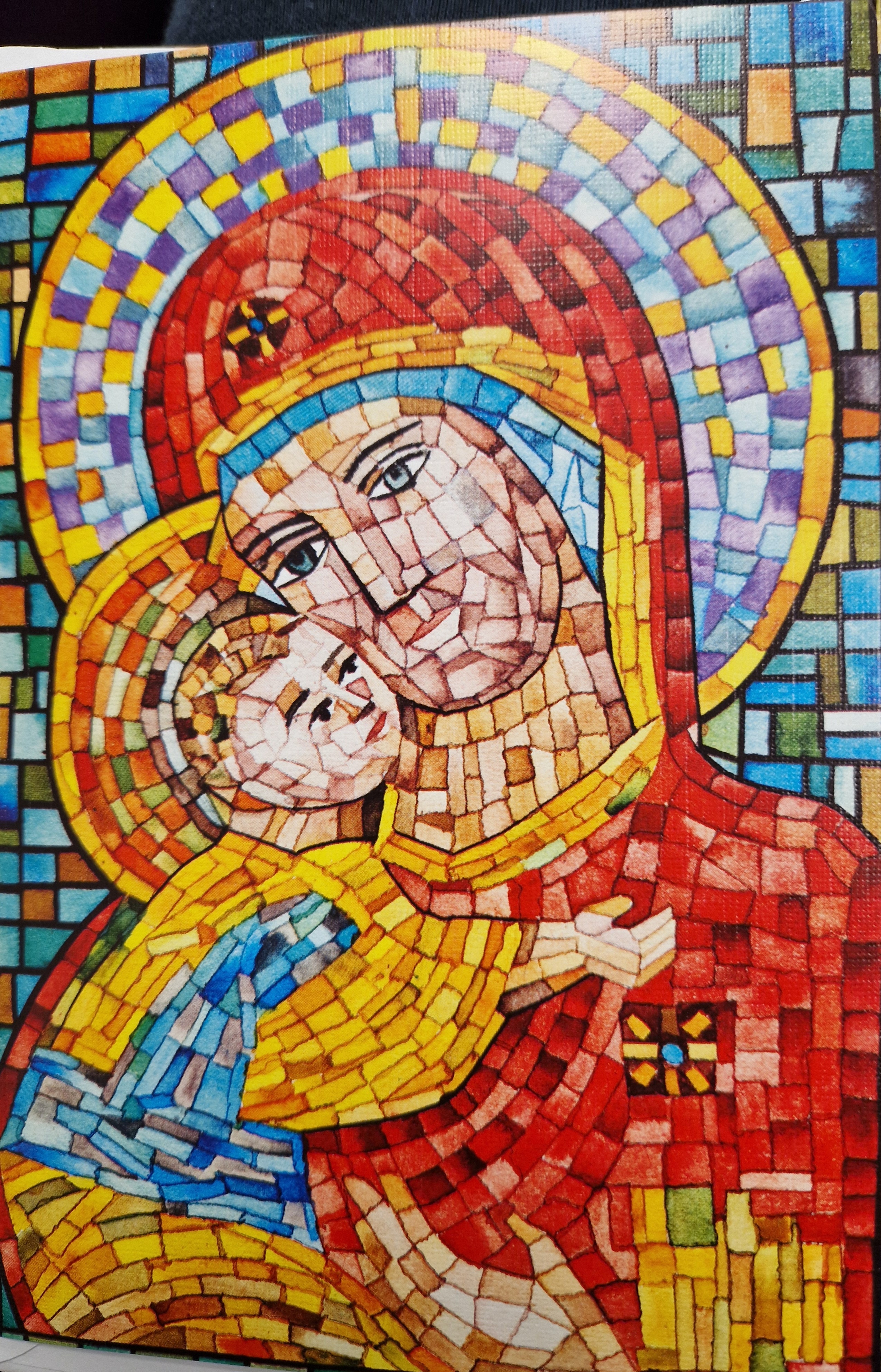
Did the Prophet Muhammad protect an icon of Mary and Jesus inside the Ka’bah at Mecca?

December 25, 2025

Bismillah. This alleged incident, at the time of the Conquest of Mecca when the Ka’bah was purified of the 360+ idols around it and inside it, was famously mentioned by Martin Lings (Abu Bakr Siraj al-Din), may God have mercy upon him, in his book, Muhammad: His Life Based on the Earliest Sources.

In 1990, JIMAS (UK) published a then-recent exchange of letters in the Saudi Gazette between Abu Bilal Mustafa al-Kanadi [The Canadian], may God have mercy upon him, and Martin Lings, in which Kanadi was very critical of Lings: one of his criticism was Lings’ inclusion of this story in his Sirah (Biography of the Prophet), based on its mention by al-Waqidi in Kitab al-Maghazi (The Book of Military Expeditions) and al-Azraqi (d. 250 H) in Akhbar Makkah (History of Mecca). That exchange is reproduced at the bottom of this post, for reference. Neither correspondent referred to the Hadith expert Imam Dhahabi’s discussion and comment on this report.

Imam Dhahabi’s discussion and comment on this report

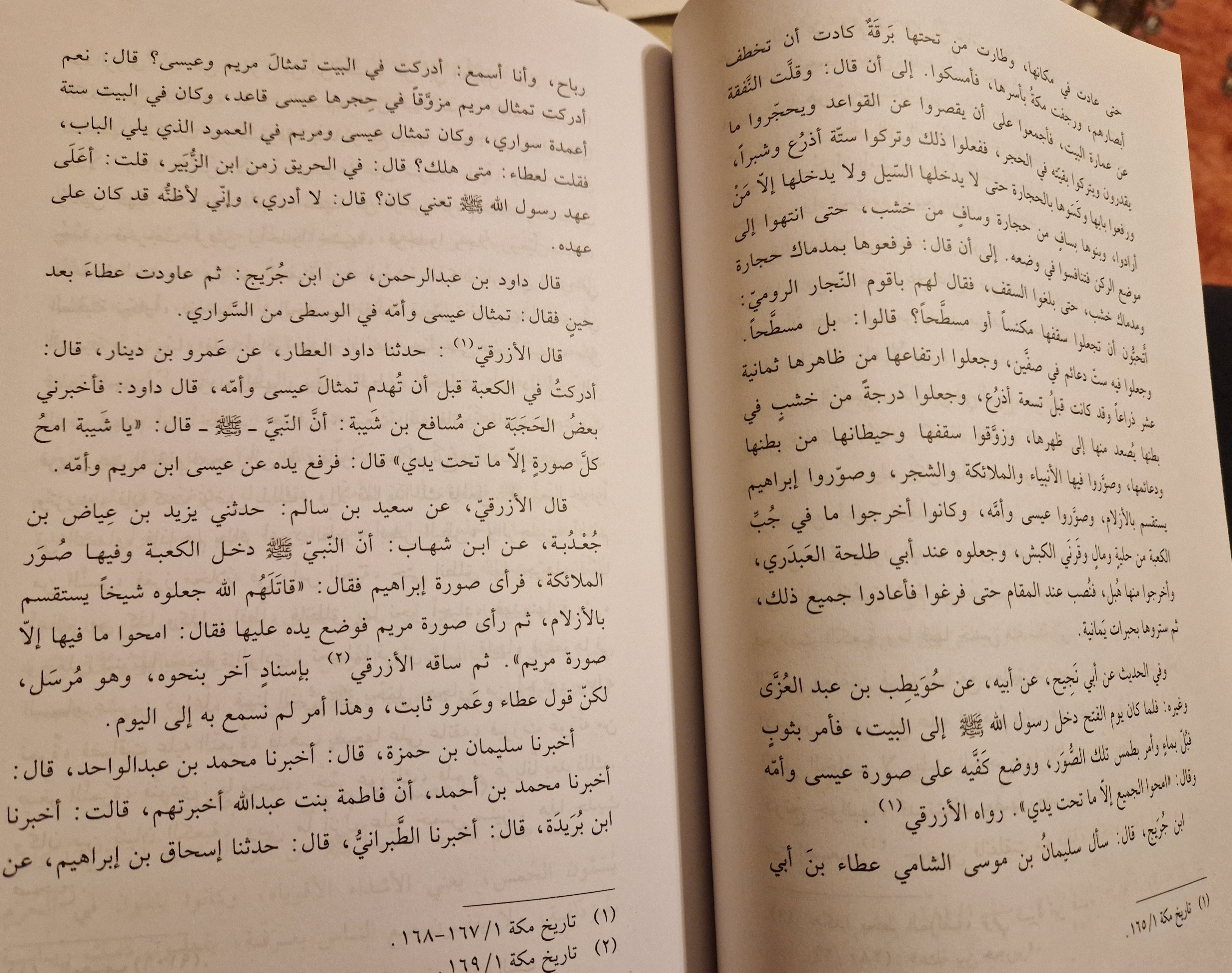
Muslim [bin Khalid] al-Zanji [The Negro], on the authority of Ibn Abi Najih, on the authority of his father [Abu Najih], who said: Men of the Quraysh sat and reminisced about the building of the Ka’bah … [The builders] depicted prophets, angels and trees inside it. They depicted Ibrahim [Abraham] divining with arrows. They depicted Jesus and his mother …

And in the hadith on the authority of Ibn Abi Najih, on the authority of his father [Abu Najih], on the authority of Huwaytib bin ‘Abdul ‘Uzza and others: On the day of the Conquest [of Mecca], the Messenger of God, may God bless him and grant him peace, entered the House [of God]. He ordered for a cloth to be moistened and commanded that those pictures be effaced. He placed his palms upon the picture of Jesus and his mother and said, “Erase them all, except what is beneath my hand.” Al-Azraqi transmitted it.[1]

Ibn Jurayj said: Sulayman bin Musa al-Shami [The Syrian] asked ‘Ata’ bin Abi Rabah [The Mufti of Mecca] whilst I was listening, “Did you come across the statue[2] of Mary and Jesus in the House [of God]?” He replied, “Yes, I came across the embellished[3] statue of Mary with Jesus standing in her lap. There used to be six support pillars inside the House: the statue of Jesus and Mary was in the pillar nearest the door.” So I [Ibn Jurayj] asked ‘Ata’, “When was it destroyed?” He replied, “In the fire during the rule of Ibn al-Zubayr.” I asked, “Do you mean that it was there during the time of the Messenger of God, may God bless him and grant him peace?” He replied, “I do not know, but I think it was there during his time.”

Dawud bin ‘Abdul Rahman said, on the authority of Ibn Jurayj: I then repeated the question to ‘Ata’ after a while. He said, “The statue of Jesus and his mother was in the middle pillar.”

Al-Azraqi said: [4] Dawud al-‘Attar [The Perfumier] narrated to us, on the authority of ‘Amr bin Dinar, who said, “I came across the statue of Jesus and his mother in the Ka’bah before it was demolished.”[5] Dawud said: One of the gatekeepers informed me on the authority of Musafi’ bin Shaybah that The Prophet, may God bless him and grant him peace, said: “O Shaybah! Erase all the pictures except what is beneath my hand.” When he lifted his hand, there was Jesus, son of Mary, and his mother.

Al-Azraqi said, on the authority of Sa’id bin Salim: Yazid bin ‘Iyad bin Ju’dubah narrated to me, on the authority of Ibn Shihab [al-Zuhri] that The Prophet, may God bless him and grant him peace, entered the Ka’bah containing pictures of angels. He saw the picture of Ibrahim [Abraham] and said, “May God fight them! They made him an old man divining with arrows.” He then saw the picture of Mary and placed his hand upon it, saying, “Erase all [the pictures] in it, except the picture of Mary.”

Al-Azraqi then quoted similarly with another chain of transmission. It is mursal [“hanging loose”; discontinuous].[6] But the statements of ‘Ata’ and ‘Amr are established (thabit): this is a matter that we had never heard of until today. [emphasis added]

Source:

al-Imam Shams al-Din Muhammad bin Ahmad bin ‘Uthman al-Dhahabi (d. 748 H / 1347 CE),
Siyar A’lam al-Nubala’ (Biographies of Notable Nobles),
ed. Dr Bashshar ‘Awwad Ma’ruf,
Mu’assasat al-Risalah, Beirut, 1422 H / 2001 CE, vol. 26, pp. 67-69


[1] The editor of the Siyar adds the reference: Akhbar Makkah,1/165

[2] Timthal: icon, picture or statue

[3] Muzawwaq: embellished, especially with quicksilver (mercury) or an amalgam of quicksilver and gold.

[4] The editor of the Siyar adds the reference: Akhbar Makkah,1/167-8

[5] The Ka’bah has been destroyed and rebuilt several times in its history due to floods, fires, earthquakes, etc.

[6] Mursal especially refers to a Follower (Tabi’i) quoting the Prophet directly without naming the Companion (Sahabi) from whom he must have heard the narration. In this case, Ibn Shihab [al-Zuhri] is a Follower and quotes The Prophet directly without naming the intervening Companion(s), so the narration is mursal. There is much difference of opinion amongst Hadith scholars about the authenticity of the mursal hadith. See the section on this topic in Suhaib Hasan, An Introduction to the Science of Hadith, Al-Qur’an Society, London, 1994, pp. 24-29.

ANALYSIS & BIOGRAPHICAL NOTES from Imam Dhahabi’s Tadhkirat al-Huffaz (Memoire of the Preservers of Hadith)

A. IBN SHIHAB AL-ZUHRI (50-124 H): The most knowledgeable of the Preservers of Hadith (Huffaz)

Abu Bakr Muhammad bin Muslim bin ‘Ubaydillah bin ‘Abdillah bin Shihab bin ‘Abdillah bin Zuhrah bin Kulab, The Qurayshi, The Zuhri, The Madinan, The Imam. He narrated Hadith from Ibn ‘Umar, Sahl bin Sa’d, Anas bin Malik, Mahmud bin al-Rabi’, Sa’id bin al-Musayyib, Abu Umamah bin Sahl and their generation of minor Companions (Sahabah) and major Followers (Tabi’in). The following narrated Hadith from him: Ma’mar bin Rashid, Awza’i, Layth, Malik, Sufyan bin ‘Uyaynah and multitudes besides them.

Layth said, “I never saw a person of knowledge at all more comprehensive than Zuhri. He would narrate about encouragement of worship: you would say that he only specialised in that. If he narrated about the (history of) the Arabs and genealogies, you would say that he only specialised in those. If he narrated about the Qur’an and the Sunnah, then similarly … He was amongst the most generous of people … He used to drink honey a lot, but not eat apples. He said: I never forgot any knowledge after my heart had deposited it … No-one has had patience upon knowledge like my patience; no-one has spread knowledge the way I have.”

Nafi’ checked his memorisation of the Qur’an with Zuhri. (Zuhri memorised the entire Qur’an in eighty nights.) ‘Umar bin ‘Abdul ‘Aziz said, “No one remains more knowledgeable about past traditions than Zuhri.” Malik said, “Ibn Shihab remained, but there was no-one similar to him in the world.” Ayyub al-Sikhtiani said, “I did not see anyone more knowledgeable than him.” ‘Amr bin Dinar said, “I did not see the dinar (gold coin) and the dirham (silver coin) less important to anyone than Zuhri: they were like dung to him.” Others said: Zuhri was an accomplished soldier. He used to dye his grey hair with henna.

[The Umayyad Caliph] Hisham bin ‘Abdul Malik asked Zuhri to dictate some knowledge to one of his sons, so he dictated four hundred hadiths to him. Zuhri then assembled People of Hadith and narrated those four hundred hadiths to them. He met Hisham again after a month or so: Hisham tested him by telling him that the book of dictated hadiths had been lost. Zuhri called a scribe and dictated the hadiths again: these were compared against the original book, and there was not a single difference, not even in a letter. Makhul was asked, “Who was the most knowledgeable person you ever met?” He replied, “Ibn Shihab.” He was asked, “Then who?” He replied, “Ibn Shihab.”

Some further statements of Ibn Shihab al-Zuhri:

“Al-Qasim bin Muhammad said to me: I see that you are eager for knowledge: Shall I not then point you to one of its great vessels? … ‘Amrah bint ‘Abdul Rahman, for she grew up in ‘Aisha’s lap. So I came to her and found her to be an ocean that could not be exhausted.”

“I never revised knowledge at all.”

“Whoever would like to memorise hadiths, should eat raisins.”

“A Preserver of Hadith is only born once in forty years.”

“God has not been worshipped via anything better than knowledge.”

B. ‘AMR BIN DINAR, THE PRESERVER OF HADITH, THE IMAM (c. 46-126 H)

The person of knowledge of the Sanctuary (Haram). Abu Muhammad of Jumayh (their freed-slave), The Meccan, al-Athram. He heard traditions from Ibn ‘Abbas, Ibn ‘Umar, Jabir bin ‘Abdillah, Bajalah bin ‘Abdah, Anas bin Malik, Abu l-Sha’tha’, Tawus and many others. Shu’bah, Ibn Jurayj, the two Hammads [Hammad bin Zayd & Hammad bin Salamah], the two Sufyans [Sufyan bin ‘Uyaynah & Sufyan al-Thawri], Warqa’ and many besides them, all narrated from him.

Shu’bah said, “I did not see anyone more established in Hadith than ‘Amr.” Ibn Mahdi said: Shu’bah said to me, “I did not see anyone like ‘Amr bin Dinar.” Yahya al-Qattan and Ahmad [bin Hanbal] said, “He was more established than Qatadah.” ‘Abdullah bin Abi Najih said, “I never saw anyone at all with more (juristic) understanding than ‘Amr, not even ‘Ata’, Mujahid or Tawus.”

Ibn ‘Uyaynah said, “He would not leave the mosque. He would ride a donkey. I only ever saw him sitting down. He was a person of understanding (jurist). He would narrate by meaning … Trustworthy, Trustworthy, Trustworthy … He divided the night into three: he would sleep for a third, teach his hadiths for a third and pray for a third … We did not have anyone with more understanding, knowledge or preservation than ‘Amr bin Dinar.”

The Hafiz Ibn al-Mufaddal established him as one of the four amongst the top generation (of hadith-narrators) after the year 40 H: Zuhri, ‘Amr bin Dinar, Qatadah & Abu Ishaq al-Sabi’i.

C. MUSLIM BIN KHALID AL-ZANJI (100-180 H): “the Imam, the Man of Understanding (Jurist) … Shaykh of the Sanctuary (Haram).”

Muslim bin Khalid al-Zanji [The Negro]. He narrated Hadith from the likes of Ibn Abi Mulaykah, Ibn Shihab al-Zuhri, ‘Amr bin Dinar, Zayd bin Aslam, Hisham bin ‘Urwah, ‘Abdul Malik Ibn Jurayj and their generation. He devoted himself to Ibn Jurayj for a while, gained juristic understanding and gave fatwas, concentrating on knowledge. He transmitted the (Qur’anic) letter variations (huruf) from ‘Abdullah bin Kathir, and gave Shafi’i permission to give fatwas. Shafi’i, Marwan al-Tatiri, Humaydi, Musaddad, Hakam bin Musa, the Hafiz Ibrahim bin Musa, Hisham bin ‘Ammar and others narrated Hadith from him.

Azraqi said, “He was a person of understanding and worship. He would fast all the time.”

Yahya Ibn Ma’in said, “There is no problem with him.”

Ibn ‘Adi said, “He is good in Hadith: I hope there is no problem with him.”

Abu Dawud said, “Weak in Hadith.”

Bukhari said, “Rejected in Hadith.”

Abu Hatim said, “He is not used as a proof.”

Ibrahim al-Harbi said, “He was the Jurist of Mecca.”

Suwayd said, “He was named ‘The Negro’ because of his black skin.” But Ibn Sa’d and others said that he was blonde: he was termed ‘The Negro’ via the irony of opposite meaning. Dhahabi: He died in 180 H, aged 80.

Professor Muhammad Hashim Kamali – two important articles on Sharia

December 2, 2025

Bismillah. I got hold of two valuable articles from 1998:

  1. Maqasid al-Sharia (The Higher Objectives of Islamic Ethics-Law)
  2. Qawa’id Fiqhiyyah (Juristic or Legal Maxims of the Sharia, Islamic Ethics-Law)

If interested, download them from here:

ISLAM & THE SEVEN STAGES OF GRIEF

November 29, 2025
3D Isometric Flat Vector Conceptual Illustration of Stages Of Grief, Denial, Anger, Bargaining, Depression, Acceptance

ISLAM & THE SEVEN STAGES OF GRIEF

Bismillah.

Previously, there were five stages of grief generally accepted amongst psychologists as:
1. SHOCK, 2. DENIAL, 3. ANGER, 4. BARGAINING, 5. ACCEPTANCE/HOPE.

Recently, some people have extended this to seven stages by adding GUILT & DEPRESSION after ANGER. But it varies from person to person: these are not necessarily linear stages: they may be cyclical or iterative.  Hence, the 7 stages of grief are:

1. SHOCK, 2. DENIAL, 3. ANGER, 4. GUILT, 5. DEPRESSION, 6. BARGAINING, 7. ACCEPTANCE/HOPE.

0. GRIEF

0.1 THE PROPHET MUHAMMAD’S YEAR OF GRIEF AND SORROW

The Prophet, peace be upon him, experienced his “year of grief or sorrow” (عام الحزن,  ‘Ām al Huzn) during his tenth year of prophethood, ie 3 years before the Hijra, when his only wife Khadija, his stalwart support for 25 years, died, followed closely by his uncle, Abu Talib, his tribal protector as chief of his clan, the Banu Hashim.

(I’m grateful to the Christian priest, whose name I’ve forgotten, who attended our Qur’an discussion circles c. 2013-14 and wished to co-write with me a Christian-Muslim guide to grief, since he had read about the Prophet’s “Year of Grief.” I didn’t have the time or capacity to work on it at the time, but he gave me an idea that has come to fruition today, God-willing.)

0.2 PROPHET YA’QUB BIN ISHAQ BIN IBRAHIM, aka ISRA’IL (JACOB BEN ISAAC BEN ABRAHAM, aka ISRAEL)

In the Surah named after his 11th son, Prophet Yusuf (Joseph), grief is prominent in the “best of stories.”

قال إني ليحزنني أن تذهبوا به وأخاف أن يأكله الذئب وأنتم عنه غافلون

(Yusuf, Joseph, 12:13)

When his elder 10 sons ask for his permission to take Joseph for a day out, Jacob combines grief (for the past) with fear (of the future):

“It grieves me that you take him away (from me), and I fear that the wolf will devour him whilst ye are heedless of him.”

When his sons lie to him, saying that the wolf had indeed eaten Joseph, Jacob sees through their lies and resigns himself to “beautiful patience” (صبر جميل).

Later, when his first 10 sons manage to come home without the 12th son Binyamin (Benjamin) as well, Jacob expresses extreme sorrow for Joseph, reiterates his commitment to “beautiful patience” and goes blind from grief:

وتولّى عنهم وقال ياأسفى على يوسف وابيضت عيناه من الحزن فهو كظيم 

(Yusuf, Joseph, 12:84)

Although Ibn Kathir quotes the commentator Dahhak as explaining kazeem here to mean ka’eeb: intense grief and broken in spirit, i.e. depressed, the vast majority of commentators agree that Prophet Jacob displayed beautiful patience and did not complain to anyone except God, restraining his sorrow and grief. Others amongst the Salaf said that he waited eighty years to see his beloved son Joseph, for whom his grief equalled that of seventy bereaved parents, but he “was never pessimistic about God.” (Tafsir Tabari)

1. SHOCK

1.1 UMAR BIN AL-KHATTAB: SHOCK, DENIAL, ANGER, ACCEPTANCE

Our Master Umar was in shock, denial and anger upon the news of the Prophet’s death, threatening to kill anyone who said that the Prophet was dead, until Our Master Abu Bakr said the famous words:

“Whoever worshiped Muhammad, he should know that Muhammad has died. Whoever worships God, he should know that God is The Ever-Living, Who Will Never Die.”

Abu Bakr also recited from Surah Āl Imran (The Family of Amram), the verses confirming that Muhammad was mortal and speaking of the possibility of his death, for every soul has a predestined moment of death, praising those who show gratitude. Umar commented: “It was as though I had never heard these verses before!” He rapidly reached the stage or station of Acceptance. 

وما محمد إلا رسول، قد خلت من قبله الرسل، أفائن مات أو قتل انقلبتم على أعقابكم، ومن ينقلب على عقبيه فلن يضرّ الله شيئا، وسيجزي الله الشاكرين

وما كان لنفس أن تموت إلا بإذن الله كتابا مؤجلا، ومن يرد ثواب الدنيا نؤته منها، ومن يرد ثواب الآخرة نؤته منها، وسنجزي الشاكرين

Āl Imran, The Family of Amram, 3:144-5)

3. ANGER

3.1 KHALID BIN WALEED 

Our Master Khalid bin Waleed, the Sword of God, was overcome by grief on his deathbed when he realised he wouldn’t be granted martyrdom on the battlefield (because no human’s sword could defeat the Sword of God). He was especially frustrated at knowing how many people are cowards. Khalid’s last words were:

“I have a wound on every inch of my body, but I’m dying like an aging camel. May the eyes of cowards never (find rest in) sleep!”

ASIDE:

Khalid bin Waleed’s extraordinary life and military genius and career deserve to be immortalised in an epic poem in English. I have written opening and closing stanzas for such a poem. I pray that I or someone else is able to complete it:

OPENING STANZA: THE TALE OF KHALID BIN WALEED 

If your eyes do weep and your heart does bleed

At the state of the Muslim nation, 

Then remember the tale of Khalid bin Waleed:

It is enough as inspiration. 

[…]

CLOSING STANZA: KHALID BIN WALEED’S LAST WORDS

“I’m dying like a camel

(Or like an aging sheep):

May the eyes of cowards 

Never rest in sleep!”

TRIVIUM: THE KHALID BIN WALEED PARK IN PESHAWAR, PAKISTAN

This park goes by its Urdu/Farsi name: Khalid bin Waleed Bagh. The locals are Pathan (Pashtun), and so pronounce it somewhat Farsi style, as follows, making the ‘a’ sound like ‘o’: Kholid bin Woleed Bagh. British Empire troops stationed in Peshawar heard it pronounced like this, switched the syllables around and nicknamed the park, the “Colly-Wolly Bean Bag.”

3.2 TRUE PATIENCE IS ONLY AT THE FIRST BLOW

Anas bin Malik narrated that the Prophet, may God bless him and grant him peace, passed by a woman who was weeping at a graveside, mourning a child she had lost. The Prophet said, “Fear God, and have patience.” She replied, not recognising him, “Get away from me, for you have not been afflicted by my affliction!” She was told that it was the Prophet who had spoken to her, so she came to his door and, finding no doorkeepers, said to him, “I did not recognise you.” He replied, “(True) Patience is only at the first blow.” (Bukhari & Muslim)

TRIVIUM: The Arabic for “blow” here is sadmah, root SDM. The name Saddam is derived from this as an intensive form, thus meaning, “One who delivers crushing blows.”

4. GUILT: JOSEPH’S BROTHERS

The 10 elder brothers of Prophet Yusuf (Joseph) had feelings of grief at the perceived favouritism of their father towards Yusuf. This manifested in Anger when some of them suggested killing him. Others felt guilty about this and suggested throwing him into a well, which is what they did. They must have had some feelings of guilt around this, and around lying to their father about Yusuf being eaten by a wolf. After many years, once they were reunited with Yusuf and his magnanimity, they went through the stages of Bargaining and Acceptance/Hope, admitting their mistakes to both Yusuf and their father Ya’qub. (Yusuf, Joseph, 12:91 & 12:97)

7. ACCEPTANCE/HOPE: NO FEAR, NO GRIEF

The Prophet, may God bless him and grant him peace, endured his Year of Grief with immense patience and acceptance. This is the way of “living in the moment” as “children of the moment in time” (abna’ al-waqt) without fear (of the future) or grief (for the past), the way of the “Friends of God” or saints. The phrase, “There will be no fear upon them, nor will they grieve,” occurs repeatedly in the Qur’an for the People of the Garden in the Hereafter. However, it applies to certain, select people in this world also:

أَلَآ إِنَّ أَوْلِيَآءَ ٱللَّهِ لَا خَوْفٌ عَلَيْهِمْ وَلَا هُمْ يَحْزَنُونَ
ٱلَّذِينَ ءَامَنُوا۟ وَكَانُوا۟ يَتَّقُونَ

Lo! Truly, the Friends of God:

There is no fear upon them, 

Nor do they grieve:

Those who have achieved faith (inner security)

And were always saving themselves (taqwa).

(Yunus, Jonah, 10:62-63)

In Imam al-Qushayri’s Treatise on Tasawwuf (Sufism), the first topic he discusses after brief biographies of early Sufis is that of Time (Waqt), where he says that “the Sufi is the son of his time,” i.e. that he lives in the moment. Shaykh Hamza Yusuf linked this to the above Qur’anic verse during a conversation in Abu Dhabi, 2022.

It is narrated from the Prophet, may God bless him and grant him peace, that this applies to people in this world “who did not fear when the people had fear, and did not grieve when people grieved.” They will be surrounded by Light in the Hereafter, and made to sit upon pulpits of Light: even the Prophets and the Martyr-Witnesses will be amazed by their station. (Tafsir Tabari, #17,730 & #17,731)

Usama Hasan

London, UK

8th Jumada al-Thani 1447

28th November 2025

On Following Madhhabs – Shaykh Muhammad al-Amin al-Shanqiti

September 16, 2023

CONTEMPLATING THE QUR’AN

FOLLOWING THE QUR’AN AND SUNNAH:
BENEFITING FROM THE MADHHABS HOLISTICALLY
AND NOT FOLLOWING ONE MADHHAB RIGIDLY

Shaykh Muhammad al-Amin al-Shanqiti

An abridged translation of the author’s tafsir of
an ayah of the Qur’an (Surah Muhammad, 47:24)
from his Adwa’ al-Bayan (Lights of Eloquence)

with an

INTRODUCTION

by

Shaykh Suhaib Hasan

1st Rabi’ al-Awwal 1445 H / 16th September 2023

© Al-Qur’an Society, 1445 H / 2023 CE – All rights reserved.

Contemplating the Qur’an is a treatise on following the Qur’an and the Sunnah, benefiting from the codified Madhhabs holistically whilst not following any one Madhhab rigidly or blindly, by Shaykh Muhammad al-Amin al-Shanqiti (1325-1393 H / 1907-1973 CE) of Mauritania and Saudi Arabia, one of the greatest authorities on the Qur’an of the 20th century CE and the 14th Islamic century. The treatise is an abridged translation of the author’s tafsir of an ayah of the Qur’an (Surah Muhammad, 47:24) from his monumental tafsir, Adwa’ al-Bayan (Lights of Eloquence).

In this treatise, the author covers the following topics:

  • Muslims must contemplate the Qur’an, learn it, understand it and act by it
  • There is no basis for those who say that the above is only for the mujtahids 
  • A muqallid is not an ‘alim: a follower of opinions does not have knowledge
  • Saying that we cannot follow the Qur’an and Sunnah but must follow the codified Madhhabs, is one of the greatest falsehoods
  • A critique of Sawi’s view that holding to the apparent meanings of the Book and the Sunnah is one of the principles of kufr (blasphemy)
  • On Ijtihad, Taqlid and Madhhab; permissible and impermissible taqlid

He concludes with eleven “Important Notes About This Issue,” including:

the Four Imams were united in forbidding their blind taqlid;

Haram/Halal cannot be stated on the basis of taqlid;

the difference between taqlid & ittiba’;

our stance towards the Imams;

every Imam has been criticized for going against the Sunnah in particular matters (with examples);

muqallids must distinguish between their Imam’s actual views and those added to his Madhhab after him;

it is impermissible for a Muslim to believe that the era of ijtihad is closed, and that only four Madhhabs must be followed;

turning away from the Qur’an and Sunnah in favour of the Four Madhhabs is one of the greatest problems that has beset Muslims over recent centuries.

We have added five important Appendices.

Firstly, an earlier, concise fatwa from the Shaykh about following Madhhabs, given in 1385 H (1964/5 CE). The Shaykh moved on from this fatwa somewhat, but we include it for the sake of integrity.

Secondly, we mention the Shaykh’s broadening out from his basis of the Maliki Madhhab after becoming exposed in Mecca and Medina to diverse views and schools from around the Muslim world.

Thirdly, we correct a contemporary misquote from Imam Ibn al-Qayyim, whom the Shaykh quotes extensively in his full discussion.

The misquote attempts to portray Ibn al-Qayyim as saying the opposite of his actual position, so we are happy to set the record straight.

Fourthly, we show how Imam Shatibi also presented a holistic approach to the Madhhabs.

Finally, we include Zamakhshari’s classic, educational and entertaining poem about Madhhabi sectarianism.

THE AGE OF AISHA AT MARRIAGE

September 26, 2021

With the Name of God, All-Merciful, Most Merciful

THE AGE OF AISHA AT MARRIAGE

Abridged translation from Islam Bahiri, Aisha’s marriage to the Prophet aged nine – a big mistake in the books of Hadith (in Arabic), Al-Yawm al-Sabi’, 15th July 2008. With additions from Salahi (2013).

Translation and editing by Usama Hasan

ABSTRACT

Aisha was about 18 years old when her marriage to the Prophet was consummated, and not nine.  The narrations of Bukhari and Muslim saying otherwise are dubious in their texts and chains of transmission.  They contradict the law (Sharia), the intellect, authentic hadiths, and the customs, habits and ethos of the age of Prophethood.  Furthermore, they are completely incongruous with the timeline of the Prophetic mission.

1   The hadith of Bukhari about the age of Aisha at marriage

Imam Bukhari included this hadith with five slightly-different chains of narration in his Sahih:

Aisha said: The Prophet, may God bless him and grant him peace, married me when I was six years old. We then came to Medina and I gave myself to him: I was nine years old then.

2         Timeline of the Prophetic Mission

The foundational sources of Islamic history and of the life of the Prophet overwhelmingly agree on the following timeline of the Prophetic mission:[1]

570-1 CE: Birth of the Prophet

610: Beginning of the Prophetic mission (aged 40)

623: Migration (Hijrah) to Medina, after 13 years of the mission in Mecca

632-3: Death of the Prophet in Medina, after 10 years of his mission there.

3         Historical critique of the narration of Bukhari

According to the narration of Bukhari, the Prophet married Aisha in 620 when she was six, and the marriage was consummated in 623 when she was nine. This would mean that she was born in 614, four years into the Prophet’s mission. This is a glaring error, as we shall now show.

3.1        Comparing Aisha’s age to that of her older sister Asma

The above historical sources are unanimous that Asma was 10 years older than Aisha, and that Asma was born 27 years before the Hijrah, i.e. in 596.

Thus:

Asma was born in 596: she was 14 when the Prophetic mission began and 27 at the time of the Hijrah.

Aisha was born in 606: she was 4 when the Prophetic mission began and 17 at the time of the Hijrah. She was married at 14; the marriage was consummated when she was 17, or 18 if we allow for a few months after the Hijrah.

The historical sources are unanimous that Asma died soon after a famous historical incident, the death of her son Abdullah bin Zubayr at the hands of Hajjaj bin Yusuf in 73 H, when she was aged 100.

Thus, she was born in 596 and died c. 693-696.[2]

3.2        Tabari: all of Abu Bakr’s children were born before the Prophetic mission

The previous point is in agreement with Tabari’s statement that all of Abu Bakr’s children, including Asma and Aisha, were born before the Prophetic mission.

When the Prophetic mission began, Asma was 14 and Aisha was 4. This further confirms the weakness of Bukhari’s narration.

3.3        Comparing Aisha’s age to that of Fatima, the Prophet’s daughter

Ibn Hajar, author of the premier commentary on Bukhari, mentions a narration in his Al-Isabah that Fatima was born in the year of the rebuilding of the Ka’bah, when the Prophet was 35 years old, and that she was 5 years older than Aisha.

According to this, Aisha would have been born around the time of the Prophetic mission. She would then have been 13 at the time of the Hijrah, and not 9 as the narration of Bukhari says.

This again illustrates that the narration of Bukhari is unreliable and suffers from what is known as idtirab (inconsistency) in Hadith terminology.

[NB: Ibn Hajar does not appear to have noticed this inconsistency, because in his same work Al-Isabah, he repeats that Aisha was born four years into the Prophet’s mission, even though other narrations, some of which he himself mentions, indicates that she was born several years before this. – U.H.]

3.4        Aisha’s age when she accepted Islam

Ibn Kathir mentions in Al-Bidayah wa l-Nihayah that “amongst the females who accepted Islam during the first three years of the Prophetic mission were Asma and Aisha. This was whilst the Prophet’s preaching was covert. Then, in the fourth year of his mission, God commanded him to announce his mission publicly.”

This again contradicts the original narration of Bukhari, since the latter implies that Aisha was born in the fourth year of the Prophetic mission.

However, according to the correct calculation, Aisha was born 4 years before the Prophetic mission began and so was 7 when she accepted Islam, being just about old enough to do so.

[Salahi (p. 204) further adds that Aisha is mentioned in Ibn Ishaq’s Sirah, the earliest book on the biography of the Prophet, amongst the first fifty people to accept Islam.  She is nineteenth on the list. There are no children on the list, although Ibn Ishaq mentions that she was young.  Salahi estimates that she must have been at least ten, making her 18 at the time of her marriage. – U.H.]

3.5        Aisha’s early memories of Islam

Imam Bukhari himself narrates in a chapter, “Abu Bakr’s neighbouring the Prophet” that Aisha said:

“My earliest memories are of my parents already practising Islam. The Prophet would visit us daily, morning and evening. When the Muslims were persecuted, Abu Bakr left, intending to migrate to Abyssinia.” [He was persuaded to return from the outskirts of Mecca. – U.H.]

The historical sources are unanimous that the first Muslim migration to Abyssinia was in Year 5 of the Prophetic mission. If Aisha was born in Year 4 of the Prophetic mission, there is no way she could have remembered her father heading towards Abyssinia. But the correct date for her birth is 4 years before the Prophetic mission: this is consistent with her remembering her father’s attempted journey, when she would have been around 9 years old.

3.6        The appropriate age of marriage

In his Musnad, section on Aisha, Imam Ahmad narrates that when the Prophet’s first wife Khadijah bint Khuwaylid died, Khawlah bint Hakeem, wife of Uthman bin Maz’oon, came to the Prophet and suggested that he should remarry. When the Prophet asked to whom, she said,

“A virgin or a matron, as you wish.”

The Prophet replied, “A virgin.”

Khawlah then recommended Aisha.

This establishes that Aisha was ready for marriage at this time, and that the Prophet did not need to wait for a few years.

The Qur’an (Women, 4:6) confirms that the minimum age of marriage is the same as that for financial responsibility.

Therefore, there is no way that Aisha could have been only 6 years old at this time.

3.7        Aisha’s previous engagement

In his Musnad, Imam Ahmad also narrates from Khawlah bint Hakeem that Abu Bakr had already agreed with Mut’im bin Adi that Aisha would marry the latter’s son, Jubayr bin Mut’im.  Abu Bakr then called off this engagement so that she could marry the Prophet.

Now, there is no way that Abu Bakr would have engaged her to Jubayr after the beginning of the Prophet’s mission, because Mut’im and his family were polytheists; Jubayr even fought against the Muslims at the Battles of Badr and Uhud.  Thus, this engagement must have been when Jubayr and Aisha were both children, before the Prophet’s mission began.  This again confirms that Aisha could not have been born four years into the Prophet’s mission; in fact, she was born four years before it began, as we have established above.

3.8        Aisha remembering the revelation of a Qur’anic verse as a child

Imam Bukhari narrates that Aisha said: “I was a little girl playing when this verse was revealed to Muhammad: Nay, the Hour is their appointed time; the Hour is more calamitous and more bitter.[3]

Now, it is established that Surat al-Qamar was revealed c. 614 CE, around four years into the Prophet’s mission.  This again is consistent with the correct view that Aisha would have been around 8 years old at this time: this fits with her saying, “I was a little girl playing then.”

3.9        A virgin must not be married without her permission

Imam Bukhari also narrates from the Prophet that he said, “A virgin must not be married without her permission.” 

It is impossible that the Prophet could say such a thing and do the opposite, for if the original hadith is to be believed, Aisha was six years old and playing with her friends and dolls when she got married – there is no mention of her permission being asked.  And even if it had been, it would have no Sharia acceptability, since it was before her age of responsibility, puberty and intellectual maturity.

3.10    Aisha nurses the wounded at the Battle of Uhud

[Salahi reminds us that Imam Bukhari also quotes that Aisha, along with Umm Salamah, nursed the Muslim soldiers at the Battle of Uhud, which took place 18 months after her marriage.[4]  Had she been nine upon marriage, she would have been only eleven at this time.  The Prophet did not allow anyone under 15 to join the army as a soldier – would he have allowed a girl of 11 to come along?  (Abdullah bin Umar turned 15 between the Battles of Badr and Uhud: he was not allowed to participate at Badr, but was allowed at Uhud.)]

4         Criticism of the chain of transmission

The original hadith has five routes of narration in Sahih Al-Bukhari.

4.1        The narrations in Bukhari are all suspect, because they are those of Hisham bin ‘Urwah to the people of Iraq

The five different chains of transmission (isnad) given by Imam Bukhari all have two narrators between him and Hisham bin ‘Urwah, who narrates from his father ‘Urwah from Aisha.  Thus, the hadith is singly-narrated by Hisham, Urwah and Aisha.  The two narrators between Bukhari and Hisham in each case are all people of Iraq:

  • Farwah bin Abi l-Mighra’ and Ali bin Mishar
  • ‘Ubayd bin Isma’il and Abu Usamah
  • Mu’alla bin Asad and Wuhayb
  • Muhammad bin Yusuf and Sufyan [bin ‘Uyaynah]
  • Qabisah bin ‘Uqbah and Sufyan [bin ‘Uyaynah]

Hisham appears to be the weak link in this chain.  Ibn Hajar narrates in his Hady al-Sari as well as in his Tahdhib that Imam Malik did not approve of Hisham’s narrations to the people of Iraq. Imam Malik said that Hisham went to Kufa in Iraq three times to narrate hadiths: the first time, he said: “My father narrated to me that he heard Aisha …” The second time, he said: “My father informed me on the authority of Aisha …”  The third time, he said: “My father, on the authority of Aisha …”

In other words, Imam Malik did not accept Hisham’s narrations in Iraq, since he went there to narrate in his old age when his memory had faltered somewhat, and he practised tadlis, i.e. obscuring or omitting the mode of transmission, making the narration suspect. 

4.2        Hisham never narrated these hadiths in Medina: the Muwatta omits them completely

Furthermore, Imam Malik learnt hadiths directly from Hisham in Medina for many years, but the age of Aisha at marriage is not mentioned in the Muwatta at all.  Thus, Hisham never mentioned this narration at all in Medina, but only in Iraq where his narrations are suspect anyway.  These considerations strengthen the earlier historical ones, confirming that the hadith about the age of Aisha is seriously flawed.

5         Conclusion

Islam Bahiri concludes:

Aisha was about 18 years old when her marriage to the Prophet was consummated, and not nine.  The narrations of Bukhari and Muslim saying otherwise are textually corrupt and dubious in their chains of transmission.  They contradict the law (Sharia), the intellect, authentic hadiths, and the customs, habits and ethos of the age of Prophethood.  Furthermore, they are completely incongruous with the timeline of the Prophetic mission.

Thus, we are not obliged to revere Bukhari and Muslim more than the Prophet, peace be upon him.  We have the right to reject what they accepted and accept what they rejected.  Islam is neither confined to the scholars of Hadith and Fiqh, nor to their time.  Thus, we are able to critique, correct and evaluate the books of Hadith, Fiqh, Sirah and Tafsir.  We are able to reject the numerous mistakes and fabrications found in them. In the end, these books are a purely human heritage: we are not obliged, and in fact it does not befit us, to imbue them with sacredness or divinity.  We are equal human beings to the people of our history.

6         References

  1. Islam Bahiri, Aisha’s marriage to the Prophet aged nine – a big mistake (or lie) in the books of Hadith (in Arabic), Al-Yawm al-Sabi’, 15th July 2008. Reproduced in Jamal al-Banna, Tajrid al-Bukhari wa Muslim min al-ahadith allati la tulzim [Expunging Bukhari and Muslim of non-binding hadiths], Da’wah al-Ihya’ al-Islamiyyah, Cairo, Dhu l-Qi’dah 1429 / November 2008.

  2. Adil Salahi, Muhammad – His Character and Conduct, Islamic Foundation, Markfield, 2013, pp. 203-5

[1] Al Kamil fi l-Tarikh by Ibn al-Athir; Tarikh Dimashq by Ibn ‘Asakir; Siyar A’lam al-Nubala’ by Dhahabi; Tarikh by Tabari; Al-Bidayah wa l-Nihayah by Ibn Kathir; Tarikh Baghdad by Khatib Baghdadi; Wafayat al-A’yan by Ibn Khillakan and many others.

[2] The three years’ uncertainty in her date of death is simply due to uncertainty between the pre-Islamic lunisolar Arabian calendar and the Islamic lunar calendar: over a century, the two differ by three years. – U.H.

[3] Qur’an, Surat al-Qamar, The Moon, 54:46

[4] Bukhari, Sahih, Kitab al-Jihad wa l-Siyar (Book of War and Military Expeditions), Dar al-Kutub al-‘Ilmiyyah, Beirut, 1423/2002, p. 530, no. 2880.

Jesuit Muslims

December 28, 2016

JESUIT MUSLIMS (OR MUSLIM JESUITS)

From Ibn ‘Arabi, al-Futuhat al-Makkiyyah [The Meccan Revelations], Dar Ihya’ al-Turath al-‘Arabi [House of Revival of Arab Heritage], Beirut, 1418/1997, vol. 1, pp. 286-291.

[NB: This is not about the Christian, Roman Catholic Order of Jesuits, but refers to Muslims who also follow Jesus in their practices and states.]

With the Name of God, All-Merciful, Most Merciful

Chapter 36: On the recognition of [Muslim] Jesuits …

Know, may God strengthen you, that the Way of Muhammad, may God bless him and grant him peace, includes all previous ways, and that the latter have no validity in this world save that of them that is endorsed by the Muhammadan Way, by the endorsement of which they remain valid. We exert ourselves in worship via these ways because Muhammad, may God bless him and grant him peace, endorsed them, not because the prophet specific to that way in his time endorsed it.

This is why the Messenger of God, peace be upon him, was given “Comprehensive Words” (jawami’ al-kalim). Thus, when a Muhammadan does a work, and the entire responsible universe today of human and jinn is Muhammadan, for there is no divine way in the universe today except for the Muhammadan Way, this worker from the [Muslim] nation may coincide in his work, with an opening in his heart and path, with a path of one of the previous prophets that it is included in this Way, which endorses it and the result of following it. Thus, such a person will be attributed to the founder of that way and called Jesuit (‘Isawi), Mosaic (Musawi) or Abrahamic (Ibrahimi) …

There is no prophethood with a way (shar’) after Muhammad, may God bless him and grant him peace … This is why it is mentioned in the report that “the people of knowledge are the inheritors of the prophets” …

The original Jesuits are the disciples and followers of Jesus … the second Jesuits are those who followed Jesus directly without a veil and then followed him via Muhammad, may God bless him and grant him peace, and there is an experiential difference between the two. This is why the Messenger of God, may God bless him and grant him peace, said about such a person, “Truly, he will be rewarded twice” [cf. Qur’an, The Story, 28:52-55], and similarly, such a person has two different sets of inheritances, openings and experiences, in each of which he is only attributed to the relevant prophet.

These are the second Jesuits. Their base of principles is to unify God, free of all likenesses. This is because the initiation into existence of Jesus, peace be upon him, was not by way of a human male, but by the manifestation (or likeness) of a spirit in the form of a human [Q. Mary 19:17]. This is why the doctrine of God manifested in a form dominated the nation of Jesus, son of Mary, over all other nations: they make forms, images and likenesses in their churches, and worship within themselves by focusing their attention on these. The origin of their prophet, peace be upon him, was by a likeness, so this reality has continued amongst his nation until now.

Then, when the Way of Muhammad, may God bless him and grant him peace, came and forbade likenesses (images), whilst he, peace be upon him, included the reality of Jesus, and his way in his, he laid the path for us, peace be upon him, “that we worship God as though we see Him,” in imagination, which is the meaning of making images. But he forbade us from this (making images) in the sensual/physical world, lest physical forms or images [of God] should appear in this nation.

Furthermore, this particular teaching, “Worship God as though you see Him,” was not stated to us by Muhammad, may God bless him and grant him peace, directly; rather, it was stated by Gabriel, peace be upon him, and it was he who appeared in the total likeness of a man to Mary at the conception of Jesus, peace be upon him … We were the ones addressed by that statement, which is why it occurs at the end of the tradition, “This was Gabriel: he wished for you to know, since you would not ask”; or in other narrations, “He came to teach the people their religion,” or “He came to you, to teach you your religion” …

Moreover, you should know that their [the Jesuits’] base of principles also includes the teaching that comes from ways other than that of Jesus, peace be upon him, “… but if you were not able to see Him, then truly, He sees you.”

Our shaykh, Abu l-‘Abbas al-‘Uraybi, may God have mercy upon him, was Jesuit at the end and extent of his path, which was the beginning of ours [i.e. the beginning of Ibn ‘Arabi’s path was Jesuit]; then we moved to a solar, Mosaic opening, then to Hud, peace be upon him, then to all the prophets, peace be upon them. After that, we moved to Muhammad, may God bless him and grant him peace. Thus was our matter in this path, may God establish us in it and not divert us from the straightness of the path …

Jesuits have extremely active aspiration, their prayers are answered and their speech is heard. One of the signs of the Jesuits, if you wish to recognise them, is that you will see each of them having mercy and compassion towards everyone, whoever they are, no matter what religion they follow. They entrust other people’s matters to God: when they address the servants of God, they do not utter anything that will constrain people’s hearts in respect of anyone at all.

Another of their signs is that they see the best in everything and only goodness flows from their tongues … e.g.

(1) What is narrated from Jesus, peace be upon him, that he saw a pig and said to it, “Go safely, in peace.” Upon being asked about this, he replied, “I train my tongue to speak goodness.”

(2) The Prophet, may God bless him and grant him peace, passed by a carcass and said, “How beautifully white are its teeth!” whereas those with him said, “How horrible is its stench!”

(3) The Prophet, may God bless him and grant him peace, commanded the killing of snakes in specific situations and informed us that God loves courage, even if only in killing snakes. However, despite this, when he was in the cave in Mina where Surah al-Mursalat [Qur’an Chapter: The Messengers, no. 77] descended upon him (it is known as the Cave of al-Mursalat until today – I have entered it, seeking blessings), a snake came out of its hole and the Companions rushed to kill it but it frustrated them, the Messenger of God, may God bless him and grant him peace, said, “Truly, God saved it from your evil just as He saved you from its evil.”

[3a] He thus named it (killing snakes) “evil”, even though it is a commanded matter, just like His saying, Most Exalted, regarding retribution, “The reward of a bad deed is a bad deed like it; [so whoever forgives and reforms, their reward is with God: truly, He does not love the oppressors” – Q. Consultation 42:40] – He named retribution a “bad deed” and encouraged forgiveness.

Thus, the Prophet’s eye, may God bless him and grant him peace, only fell upon the best aspect of the carcass. Similarly, the friends of God only see the best in everything they look at: they are blind to the faults of people, although not to faults in themselves, for they have been commanded to avoid these. Similarly, they are deaf against listening to obscenity and dumb against uttering bad words, even if this is allowed in some places.

This is how we have known them [the Jesuits], so Glory be to the One who purified them, chose them and guided them to the straight path. “They are the ones whom God has guided: by their guidance, follow!” [Q. Cattle 6:90]

This is the station of Jesus, peace be upon him, within Muhammad, may God bless him and grant him peace, for he preceded him in time and these states were transmitted from him by the latter. God said to His Prophet [Muhammad], may God bless him and grant him peace, after mentioning several prophets including Jesus, peace be upon them, “They are the ones whom God has guided: by their guidance, follow!” [Q. Cattle 6:90].

However, the station of Messenger determines that the beautiful must be explained and distinguished from the ugly in order to be known, as the Exalted said, “… that you may explain to the people what has been revealed to them” [Q. The Honey-Bee 16:44]. Thus, when he explained the bad side of a person, it was by inspiration from God, such as his saying about someone, “What a bad son of his tribe!” Similarly, Khidr killed a lad and said about him, “His nature had been stamped as an ingrate unbeliever (kafir)” and reported that if he had left him alive, he would have behaved badly towards his parents. He also said, “I did not do that of my own accord.” [i.e. it was by God’s command; Q. The Cave 18:74, 80-82]

Thus, the essences of such people, whether prophets or saints, are characterised by kind speech, seeing the best in everything and listening attentively only to goodness. However, if there is the occasional exception to this, it is by divine command, not from their own tongue.

This is what we have mentioned of the states of the Jesuits, as facilitated by God upon my tongue, “and God speaks the Truth and He guides to the Way.” [Q. The Confederates 33:4]


Abridgment and Translation: Usama Hasan

London, 28th December 2016 / 29th Rabi’ al-Awwal 1438


FREEDOM – Islamic reflections on Liberty

December 25, 2016

With the Name of God, All-Merciful, Most Merciful

FREEDOM

Reflections by Imam Usama Hasan, Head of Islamic Studies at Quilliam Foundation, in preparation for the Inspire Dialogue Foundation conference in Cambridge, Saturday 17th September 2016, hosted by Lord Rowan Williams, Emeritus Archbishop of Canterbury

There are many universal human rights: arguably, freedom is one of the basic ones, intertwined with life itself. As Tipu Sultan, the famous Indian resistance leader against the British, exclaimed: “better to live one day, free as a lion, than to live as a slave for a thousand years.” Caliph Omar once berated one of his commanders, who had followed the common pre-Islamic medieval wartime practice of enslaving the women and children of a defeated army, asking: “how could you enslave people whom God had created free?!” echoing Moses’ defiant response to Pharaoh in the Qur’an (26:22), which asks: “is this the favour, of which you are reminding me, that you have enslaved the Children of Israel?”

Theologically, true faith is based on free will and free choice: any practice that is not free, including faith and religious observance, cannot be genuine. Hence the famous Qur’anic declaration (2:256), “There is no compulsion in religion!”

The centrality of freedom to faith raises important issues: drugs, alcohol, mental illness, carnal lusts and social pressures all mean that our choices and decisions in life are not totally free. How, then, are these actions judged by fellow humans and by God? In particular, one of the goals of religious practice has always been to remove internal shackles that inhibit our expression of humanity, enabling greater self-awareness and realisation of our potential. Thus, a tradition of the Prophet Muhammad says that “the world is a prison for the believer,” i.e. the moral person, and great sages survived imprisonment because they were, internally, free spirits. Ideas of freedom and liberty have, of course, strongly shaped the modern world since the 18th century with the abolition of slavery, French and American republican ideals and anti-colonial independence movements.

It is my firm belief that the great philosophers, sages and prophets: Moses, Mary, Christ and Muhammad, Buddha and Confucius, and men and women of God through the ages, supported the liberation of men and women of all colours, races and religions, children and slaves, individuals and populations, from the yokes of tyranny and oppression. Our modern heroes in this regard range from Wilberforce to Jefferson to Gandhi, Jinnah, Martin Luther King and Mandela.

But today, we still have our modern forms of slavery: bonded and child labour; entire multiple-generation families working in sweatshop factories; highly-organised international rings dealing in human trafficking, including that of children, for financial and sexual exploitation. Therefore, we need to address the above problems by rekindling the same spirit that historically liberated children from labour into education, slaves from enslavement into liberty, peoples from colonisation into independence, and people of colour from segregation and apartheid into civic equality.

Tony Blair, whilst UK Prime Minister, once said in an historic speech on Capitol Hill that “to be American is to be free.” In reality, as spiritual-animal beings made in the image of the Divine, to be human is to be free. Now, let’s continue with working towards inner and outer freedom, and sharing it with our fellow travellers, with the goal of reaching our full and common humanity.

INNER AND OUTER ASPECTS OF ISLAMIC RITUAL PRAYER (SALAT)

June 26, 2015

Bismillah. This is about some of the beautiful symbolism and meaning behind the salat or ritual prayer, one of the five pillars of Islam and to be performed at least five times a day.  When the salat is reduced to pure ritual without any understanding of the Arabic words or of the symbolism of the actions, many inward and outward problems arise, God forbid!  But the salat is the believer’s daily ascension (mi’raj) and communion with God: it is up to us to deepen this daily experience of ours. It is the Muslim’s daily practice of mindfulness, meditation and remembrance, to develop a deep wellspring of love, faith and humility to equip us for life’s individual, social and political challenges. May God continue to bless our journeys!

All italicised phrases are from the Qur’an and Sunna; references are omitted for ease of reading and clarity: this is not an academic article, but an attempt to elucidate certain indications and symbols, with the hope of helping people on their own journeys.

With the Name of God, All-Merciful, Most Merciful

INNER AND OUTER ASPECTS OF ISLAMIC RITUAL PRAYER (SALAT)

  1. Prayer times: Time is sacred (God says, I am Time); we offer each prayer within its time in order to share in the sacredness of every part of the day and night, and to give thanks for that portion of sacred time.
  2. Washing (ablutions) before prayer: we cleanse our limbs and hearts of wrongdoing.
  3. Ablutions are nullified by toilet or sexual acts: these represent our basic animal natures, so we wash again to symbolise recovering our angelic natures in order to stand before God.
  4. Facing Mecca: The Ka’bah, as the House of God, symbolises the heart, which is also the House of God. Whilst facing Mecca outwardly, we turn inwardly to face the home of God at the centre and core of our being. So turn your face towards the Sacred Mosque!
  5. Standing in straight rows: we are in fellowship, equal before God, and imitating the ranks of the angels. The hearts of the people of Paradise beat as one … By Those Who Stand in Ranks!
  6. Raising the hands at the beginning of the prayer: symbolises the “lifting of the veil” between us and God. In prayer, we are talking directly to our Lord.
  7. Standing before God in prayer: facing up to life as a journey to God; a foretaste and preparation for standing before God on Judgment Day.
  8. Keeping the eyes open, rather than closed, in prayer: do not be veiled by multiplicity from Unity, nor by Unity from multiplicity.
  9. Lowering the head and looking at the ground (if practised): humility before God.
  10. Keeping the chin up and looking straight ahead towards Mecca (if practised): facing life, and one’s inward reality, directly.
  11. Folding the arms across the body (if practised): the servant’s pose before the Master.
  12. Reciting the Opening Chapter of the Qur’an (Surat al-Fatiha): we are sharing in a communion with God. God says, I have divided the prayer between Me and My servant …
  13. Praise be to God, Lord of the Worlds; All-Merciful, Most Merciful; Master and King of the Day of Judgment: God says, These belong to Me, as our glorification is of God.
  14. You alone we worship; You alone we ask for help: God says, This is (shared) between Me and My servant; the God-human relationship.
  15. Guide us to the Straight Path; the path of those whom You have favoured, who neither receive (Your) anger nor stray: God says, These belong to My servant, and My servant shall have whatever he or she requests.
  16. Reciting further from the Qur’an: the remembrance of God continues; God and the angels bear witness to it. Truly, the recitation at dawn was witnessed.
  17. Bowing: humility before God; bearing life’s hardships, followed by standing tall again.
  18. Prostration, with forehead, nose, hands, knees and feet pressed to the ground: ultimate humility before God; one is closest to God in this posture, which is outwardly humiliation, inwardly elevation; our hearts are higher than our brains, whilst the rest of the time, our brains are higher than our hearts; Pray hard, for your prayers are most likely to be accepted in this position; death.
  19. The second prostration, after a brief sitting: the second death, at the blowing of the Horn. Our Lord! You caused us to die twice, and to live twice …
  20. In prayer, do not sit like a dog, peck like a cockerel or squat like a monkey: throughout prayer, we must rise above our animal natures and try to inhabit our angelic natures.
  21. Standing, bowing, prostration: the body forms the Arabic letters Alif (A), Dal (D) and Mim (M) respectively, hence spelling Adam during the prayer; we are seeking our original Paradisal, primordial humanity before the Fall through our communion with God.

    [In Hebrew and Arabic, the Aleph/Alif (A) also signifies the number 1, so “Adam” is identical to “1 dam” meaning “one blood”: humanity is united; we have different skin colours, but we bleed the same colour. Red blood cells have no DNA (although white ones do), so in a sense blood represents our common humanity – much of it does not have our unique, genetic fingerprints that are found in every other of the trillions of cells of our body.]

  22. Standing, bowing, prostration: the body forms a straight line, right angle and (semi-)circle respectively, the bases of all geometry and form; we are signifying that we are at one with Nature and its beautiful forms. God is Beautiful, and loves Beauty.
  23. Sitting in remembrance of God at the end of the prayer: a foretaste of the eternal rest in Paradise.
  24. The prayer ends with the greeting of peace (salam): Their greeting on the Day they meet Him is Peace; Their greeting there (in the Garden) is Peace; they hear no vain or sinful talk, only the words, Peace, Peace!

Usama Hasan

London, Ramadan 1436 / June 2015

Abortion – Rulings in Islamic Jurisprudence and Muslim-majority countries

October 23, 2014

Bismillah.  Here is a translation I put together for my presentation at the International Summer School on Science and Religion, Paris, August 2014.

The discussion is interesting because these Sharia scholars refer to the modern science of embryology in their discussion, although there are one or two minor errors in the scientific references.  The traditional juristic positions are based on Qur’an/Hadith, so abortion is prohibited after 0, 40 or 120 days, with some exceptions.  Thus the hadiths are not conclusive.  But the science is not conclusive either as to “beginning of life”: people make a case for 0 days (conception), 40 days (foetal brain activity) or 120 days (development of major organs).  Note that the latter two views are relevant to “end of life” discussions also, i.e. brain-death vs. organ-death.  In the end, this is a complex ethical problem with medical and religious input: the material provided below is intended to educate, clarify and provoke thought and debate around this difficult topic.

Rulings on Abortion – Islamic Jurisprudence (PDF)

Abortion laws in OIC countries – summary (PDF with UK, US & France for comparison; the 7 most common justifications for abortion in legal systems around the world are interesting, according to the UN; research by Sofia Patel)

[Update 26/10/2014:]

Here are some suggested study/discussion questions:

1. What does Islamic tradition say about the beginning of life? (0 days = conception; 40-49 days = 6-7 weeks; 120 days = 4 months = 17 weeks 1 day)

2. Are the hadiths about ensoulment after 40 or 120 days related to Aristotle’s view (40 days for boys; 80 days for girls) ?  Do these have a common origin (e.g. divine revelation), or did Greek ideas influence the transmission of some hadiths?

3. Is Ibn al-Qayyim’s comparison of pre-ensoulment foetal life to plant life valid? Is this related to the Ikhwan al-Safa’s theory about mineral/plant/animal/human soul, all derived from the Cosmic Spirit?

4. Is abortion ever justifiable in Islam?  If so, under what conditions?

5. How far are the 7 international legal justifications for abortion, listed by the UN, compatible with the holistic, universal objectives of Islamic law (maqasid al-sharia) ?

6. Islamic jurists often speak about the danger to a mother’s life or health in discussions about abortion.  Are considerations of a mother’s mental health also relevant or included in such discussions?

7. Are there are any other considerations regarding the welfare (maslaha) of mother and foetus/child, consistent with the letter and spirit of Islamic law, that should be taken into account in such discussions?

With the Name of God, All-Merciful, Most Merciful


ABORTION, STAGES OF THE EMBRYO AND THE BEGINNING OF LIFE


Summarised from: Dr. Ali Muhyi l-Din al-Qarahdaghi & Dr. Ali Yusuf al-Muhammadi, Fiqh al-Qadaya al-Tibbiyyah al-Mu’asirah (Jurisprudence of Contemporary Medical Issues), Dar al-Basha’ir al-Islamiyyah, Beirut, 1426/2005, pp. 428-451


Summary and translation by Dr. Usama Hasan

August 2014


Contents


1        A General Ruling on Abortion. 2


2        Specific Rulings on Abortion, related to the Stages of the Embryo. 2


2.1        The “mixed fluid” stage (al-nutfah al-amshaj): days 0-8. 3

2.2        The “clinging” stage (al-‘alaqah): days 9-22/23. 3

2.3        The “chewed lump” stage (al-mudghah): days 23/24-42, i.e. up to 6 weeks. 3

2.4        The stage of the creation of bones, and the clothing of them with flesh. 4

2.5        When is the spirit breathed in? [ensoulment] 4

2.6        [The view of modern science] 5

2.7        Our view.. 5


3        Rulings on Abortion. 7


3.1        [Fatwa of the Islamic Fiqh Academy] 8

3.2        [Resolution of the Islamic Organisation for Medical Sciences] 8

3.3        Views of past jurists about abortion. 8

3.4        [Discussion] 9

3.4.1        [Abortion is prohibited in general, as per Ghazzali’s view] 9

3.4.2        [Ibn Taymiyyah’s view] 10

3.5        Summarised Juristic Rulings Related to Foetuses. 10

3.6        The Ruling on Abortion due to Deformities. 11


1. A General Ruling on Abortion

Abortion is, in general, haram (morally and legally prohibited and sinful) unless out of necessity due to the mother’s life: abortion is allowed if the mother’s life is in danger, or if she is in danger of great and severe harm.


This is indicated by all the Qur’anic verses that prohibit transgression on any person’s life in any stage of life, e.g. Whoever kills one person … it is as though he has killed all people;[1] Do not kill your children due to poverty: we sustain you and them;[2] Do not kill your children due to fear of poverty: we sustain them and you.[3]


As for abortion being allowed to save the mother’s life, this is from the evidence indicating that the foetus owes its existence to the mother so it cannot cause her death; also, her life is real and stable, and is therefore preferred over the foetus’ life that is not certain. This falls under repelling a greater harm by tolerating a lesser harm.[4]


2. Specific Rulings on Abortion, related to the Stages of the Embryo 

The specific ruling on abortion is connected to the stages of the embryo, from the fertilisation of ovum by sperm to the breathing of the spirit into it and the completion of these stages.


The Qur’an mentions that the human was created from dust that turned to dry clay. Clay includes various minerals such as iron, phosphorus, calcium, copper, etc. It also has subtle plant-like and animal-like structures. God created Adam from this clay, and from Adam He created Eve. Then natural reproduction continued with the mixing of the man’s semen and the woman’s ovum, each one of them contributing 23 chromosomes to the genetic code. God calls this the “mixed fluid.”[5] This is the basis of the creation of humans, except for the miraculous creation of Jesus, peace be upon him.[6]


The stages of the embryo, [that give rise to] the ruling on abortion at each stage, are as follows:


2.1    The “mixed fluid” stage (al-nutfah al-amshaj)[7]: days 0-8


This is the fertilisation of the ovum by sperm, and may be done artificially outside the womb. The fertilised cell divides, becoming 16 cells after about 4 days. These settle in what the Qur’an calls a “safe place,” i.e. the womb: Then We made him a drop of fluid in a safe place.[8]


2.2    The “clinging” stage (al-‘alaqah): days 9-22/23


God described this stage with “creation”[9] whereas the previous stage was described as “making,” indicating that this stage has characteristics and changes that make it deserving of such a label.[10]


The ‘alaqah linguistically relates to “clinging,” i.e. to the womb wall. The group of cells that developed by division from a single one are composed essentially of a nucleus and cytoplasm, having no limbs or other distinguishing structures of a human body, but they suck their necessary sustenance and oxygen inside the womb from the structures and fluids around them.[11] This stage lasts 2 weeks.


2.3    The “chewed lump” stage (al-mudghah): days 23/24-42, i.e. up to 6 weeks


This stage is so named[12] because the embryo looks like it has been chewed by a human mouth. During this stage, the heart cavity forms, as do the reproductive organs. The small umbilical cord, which grows as the foetus develops, transports the necessary sustenance and oxygen to the foetus from the mother and its waste products in the other direction.


All the stages, up to and including this one, end around 40-42 days, as stated by specialist doctors and embryologists. Around 42 days, a new stage of development begins, when the embryo begins to take the form of a human being with all its apparatus, following which the stage of a new creation beings after the breathing of the spirit: We clothed the bones with flesh, then We began a new creation – so Blessed is God, the Best of Creators![13]


Scientific instruments and investigation, as well as imaging of the foetus inside the womb, have all shown us that the foetus takes the form of a human after the sixth week, i.e. after about 42 days of pregnancy,[14] and this is also indicated by the hadith of Sahih Muslim (see below).


2.4    The stage of the creation of bones, and the clothing of them with flesh


The skeleton begins to become apparent after 40 days. Its initial centres of development are the jaw and collar-bone, followed by the thigh and shin.


2.5    When is the spirit breathed in? [ensoulment]


[Canonical hadiths speak of three stages of creation of the foetus, each lasting 40 days, after which there is ensoulment. However, the hadiths are slightly ambiguous as to whether these three stages are consecutive or parallel. Respectively, these two interpretational possibilities imply ensoulment after 120 days or 40 days, and traditional authorities are indeed divided into two camps about this. Interestingly, Aristotle taught that ensoulment for boys and girls occurred after 40 days and 80 days, respectively. – Translator’s note]


All the stages, up to and including this one, end around 40-42 days, as stated by specialist doctors and embryologists. Around 40-42 days, a new stage of development begins, when the embryo begins to take the form of a human being with all its apparatus, following which the stage of a new creation beings after the breathing of the spirit. The foetus takes the form of a tiny human after the sixth week, i.e. after about 42 days of pregnancy. This is also indicated by the various narrations of Sahih Muslim that mention the basic creation of a person in their mother’s womb taking 40, 42 or 45 days and nights. One narration mentions “40 plus a few nights.”[15]


Hafiz Ibn Hajar says, “Once the fluid remains in the womb for 40 days or nights, God gives permission for its [full] creation … this is when the angel descends upon it … The narrations of the hadith of Ibn Mas’ud agree on 40 days; the hadith of Anas does not mention any timing; the narrations of Hudhayfah’s hadith differ: some of them mention 40, others 42, 43, 45 or ‘40 plus a few’.”[16]


The scholars reconcile these narrations by saying that they may differ according to individual embryos; according to Qadi ‘Iyad, the narrations mean that the following stages occur at the beginning of the second period of 40 days, i.e. days 41-80.[17]


2.6    [The view of modern science]


In modern embryology, this period of days 40-49 is when the embryo becomes a foetus, and when ultrasound is able to detect the beating heart. The bone skeleton also begins to appear.[18] Hence, these narrations do not contradict.


Modern science also indicates that the initial creation (Stages 1-3) is completed in the first 40-odd days. However, one hadith in Bukhari and Muslim appears that to say that each of Stages 1-3 takes 40 days, after which the spirit is breathed in, i.e. after four months or 120 days.[19]


However, if we analyse this hadith carefully, we find it does not unequivocally indicate the meaning that the previous people of knowledge understood. In fact, its beginning agrees with the others hadiths of Sahih Muslim which say that all three stages are completed within the first 40-odd days. The word thumma can mean “then” for consecutive stages or “moreover” for simultaneous stages. “With such interpretations,” says the leading authority Dr. Muhammad Salam Madhkur, “the hadith agrees with modern medicine.”[20]


2.7    Our view


There are three major stages, based on our understanding of the hadith of Ibn Mas’ud in Bukhari:


  1. From the fertilised egg to the beginning of the small human form (0-40 days, roughly)
  2. Formation of a small human (40-120 days, roughly)
  3. Breathing of the spirit (ensoulment), i.e. 120 days onwards


Any intentional harm to the embryo is haram (prohibited) after 40 days.


In terms of life:


  1. 0-40 days – there is the lowest level of life, beginning with the developing cell life. Cell division leads to similar living cells that form a structure, but this does not reach the level of human life.
  2. Week 6: the foetus begins to take the form of a small human. Ultrasound detects its heart beating. Blood circulation begins to work. Major skeletal nodes appear.
  3. Week 7: Thigh and shin bones appear.
  4. Week 8: Upper and lower arm bones appear, as do weak, stretching movements.       However, this does not represent complex human life.
  5. End of Week 11- Week 12: the foetus enters a new, distinctive stage. Its brain is developed, its functions start: the beginning of a human entity emerges clearly, as follows. Movements develop from reflex reactions to complex, compound actions such as bending the back, raising the head, kicking the feet and moving the mouth and lips. Brain stem activity begins, sending electrical signals to the heart.       Periods of rest and stillness follow activity and movement: sleep and waking, sensation and shock, jump and play. Electrical signals appear that can be recorded and traced to the foetal brain, indicating surface brain activity.


However, the doctors say that the brain is not fully-formed in terms of its basic structure until the 4-month mark. Dr. Muhammad Ali Albar says, “At the end of the fourth month, the foetus can hear and make movements by its own will. Individual, personalised facial features appear. Do not all these indicate the breathing of the spirit?”


All this is the medical aspect of the issue, revealed by modern medicine and rare, modern instruments that monitor the development and movements of the embryo and foetus; none of these means were available in the past. If we analyse this modern knowledge and the hadiths on the subject, we find that there is no contradiction. In particular, only one hadith seems to mention three periods of 40 days; most of the narrations mention a total of 40, 42, 45 or 40-odd days.


Modern medicine does not speak about the spirit, which is mentioned in the hadith. Only God knows the nature and reality of this spirit.[21] The Messenger of God, peace be upon him, informed us that this spirit is breathed in after 120 days, so this must be affirmed.


Although bear in mind that only one narrator from Ibn Mas’ud, Zayd b. Wahb, mentioned the breathing of the spirit after 120 days; the rest of the narrators mentioned the writing of sustenance, lifetime and eventual misery or happiness, but did not mention the breathing of the spirit; neither did the other Companions who narrated the hadith: Ibn ‘Abbas mentioned it, but did not attribute it to the Prophet, peace be upon him.[22] It is possible to reconcile these two hadiths: the angel visits twice – once after 40 days to arrange the formation of the foetus and again after 120 days to breathe the spirit.[23] God knows best.


According to the doctors, life begins with a single cell but gradually develops into a full human life. The jurists draw the line (for full human life) at 120 days, which is when the spirit is breathed in. Similarly, all plants and animals enjoy life but do not benefit from the spirit of God that is breathed into humans, and on the basis of which the angels were commanded to prostrate to the human.[24]


The moment of breathing the spirit at 120 days is a matter of the unseen – humans and our medicine cannot know it, so we must accept it without interpretation or explanation, especially since it does not contradict modern science. After 120 days, the foetus is a complete human, deserving all that a human being enjoys after birth: respect, rights and the prohibition of harm against it.


Plant life has less power than animal life, which has less than human life. Animals may have more or less chromosomes: apes have more than other animals, whilst humans have the most at 46 chromosomes.[25]


Imam Ibn al-Qayyim mentions two types of embryonic life:


  • plant-like life before ensoulment, and
  • complete, human life after ensoulment.[26]


Foetal life after 40 days is complete in a material sense, just like complete animal life but more respected than the latter since it is in the fundamental human form. However, it lacks the divine breathing that bestows, and God knows best, the special human attributes such as knowledge, logical thinking, deduction and analysis as explained in the verses about the creation of Adam. God created Adam to settle in the world and civilise it and to be its steward, so He breathed His Spirit into him, taught him the Names. He gave him, along with knowledge and logical deduction, the capability to act. Along with intellect, He gave him choice and will. These higher attributes do not appear in the early stages of the foetus, but only after 120 days, e.g. voluntary movement etc.


3. Rulings on Abortion

It is undoubtedly haram (prohibited) to harm the embryo that is younger than 40 days. The prohibition becomes more severe after 40 days. The greatest prohibition occurs after 120 days, in which case killing the foetus would be like murdering an independent human being. These levels of prohibition are appropriate in Islam to describe the size of the crime and its effects.


3.1    [Fatwa of the Islamic Fiqh Academy]


The Islamic Fiqh Academy issued a ruling (no. 56-6/7) prohibiting abortion absolutely, and mandating medical techniques to save and protect the lives of embryos and foetuses. Furthermore, Ruling No. 113 (12/7) says in Clause 2 that, “The embryo has a right to life as soon as it is formed. It must not be harmed by abortion, or by any type of damage …”


3.2    [Resolution of the Islamic Organisation for Medical Sciences]

The Council on Conception, part of the Islamic Organisation for Medical Sciences, issued the following resolution: “The Council has considered contemporary medical, scientific realities explained by modern research and medical technology. It concluded that:


  • the foetus is alive from the beginning of pregnancy
  • its life is to be respected during all stages, and especially after ensoulment
  • transgression against the foetus by abortion is not permissible, except for an extreme medical necessity
  • some members disagreed, allowing abortion before 40 days, especially in case of a valid reason”[27]


3.3    Views of past jurists about abortion


  • The schools of jurisprudence in the past agreed that abortion was haram (prohibited) after 120 days.[28] Some of them even said that this was so when the mother’s life was in danger, e.g. Ibn ‘Abidin said, “If the foetus is alive, abortion is prohibited, since the mother’s death is hypothetical and it is not permissible to kill a human being on the basis of a whimsical matter.”[29] But if her death is certain or very likely, not simply hypothetical, then her life is to be given precedence over the foetus’, which may be aborted.
  • As for before ensoulment, most jurists regard abortion as prohibited (haram) also, unless it is to safeguard the mother. This is the view of the Malikis and Ibadis, the dominant view of the Hanafis and Shafi’is, one view of the Hanbalis and the apparent view of the Zahiris.[30] Some of the Hanafis, Shafi’is, Malikis and Hanbalis allowed abortion before ensoulment[31], as did the Zaydis on condition that both parents agreed. Some jurists, including Lakhmi (Maliki) and Abu Ishaq Marwazi (Shafi’i) allowed abortion before 40 days, but prohibited it thereafter.[32] Some Hanafis allowed abortion before ensoulment for a valid reason, even if it did not reach the level of necessity, whilst others specified the condition of necessity.[33] Some Shafi’is allowed abortion before ensoulment if the conception was via illegal extra-marital sex (zina: fornication or adultery).[34]

3.4    [Discussion]


The majority of jurists held that abortion was prohibited at any stage based on:


  • the verses prohibiting the taking of life, e.g. 6:151 and 17:33. A foetus is a life without doubt.
  • God forbade pilgrims from hunting (5:95), and the Prophet forbade the destruction of ostrich eggs by pilgrims, stipulating their value in compensation in cases of violation.[35] Malik said, “I have always heard that the compensation due upon a pilgrim for killing an ostrich is a camel. In case of an ostrich egg, my view is that the amount is a tenth of a camel’s value, just as the compensation for the foetus of a freewoman is to free a slave, male or female; these are worth 50 dinars, which is a tenth of his mother’s blood-money.”[36] Ibn al-Qasim said, “Malik compared the egg to a foetus,” i.e. in essence, like a foetus that is prohibited to harm.


3.4.1   [Abortion is prohibited in general, as per Ghazzali’s view]


Thus, the stronger view is that of the majority, i.e. that harming embryos is prohibited, even before ensoulment. One researcher who emphatically supported this position was Imam Ghazzali. In explaining the difference between coitus interruptus and abortion before ensoulment, he said: “The child is formed when the sperm enters the womb … Coitus interruptus is not like abortion or burying the infant alive because the latter two are crimes against an existing thing that is of different stages. The first stage is that the sperm enters the womb, mixes with the woman’s water and prepares to accept life: spoiling this would be a crime. Once it becomes a chewed lump and a suspended lump, the crime becomes more obscene, and even more so once ensoulment has taken place and the process of creation has levelled out. The extremity of such obscenity is once the foetus has become an independent life [i.e. been born as a baby].” He then mentioned that the beginning of the embryo’s existence is from the entry of semen into the womb.[37]


3.4.2   [Ibn Taymiyyah’s view]


Shaykh-ul-Islam Ibn Taymiyyah was asked about a man who said to his wife, “Abort your foetus: the sin is upon me.” If she does this, what expiation is due upon them both?


He answered: “They must free a believing slave: if they are unable to, they must both fast two months consecutively. In addition, they must give compensation to the heirs of the foetus who did not kill it: not to the father, for he ordered its killing, and so deserves nothing.” In answer to another question, he said, “Abortion is prohibited by the consensus of the Muslims: it is like burying children alive or killing them, which God has forbidden (81:8-9 & 17:31).”


He also said about a woman who aborted her foetus by striking her belly or by drinking medicine, “She must give compensation to the heirs of the foetus, other than the mother, by the Sunnah of the Messenger of God and the agreement of the Imams.”[38]


3.5    Summarised Juristic Rulings Related to Foetuses


  1. Blood-money and expiation if prohibited abortion is carried out: the perpetrator, whether father, mother or someone else, must pay the blood-money, which is a tenth of that of the mother according to the Malikis and Shafi’is; others distinguish between a male and female foetus.[39] According to the Shafi’is and Hanbalis, expiation is also due, being the freeing of a slave if possible, otherwise fasting for two consecutive months.[40]
  2. The waiting-period (‘iddah) of a widow or divorced woman ends by [termination of the pregnancy:] delivery of the child or abortion of the foetus.
  3. The father of the child must pay maintenance for the pregnant mother in case of divorce.[41]
  4. A pregnant woman may break her fast during Ramadan if she fears harm.[42]
  5. Delay of the punishment for extra-marital sex [i.e. flogging and/or stoning to death] whilst the woman is pregnant. [43]
  6. The foetus has incomplete personhood, so it has rights of inheritance etc.[44]


3.6    The Ruling on Abortion due to Deformities


The following declaration was issued by the Islamic Fiqh Academy of the Muslim World League:


The Academy analysed this matter during its twelfth meeting held in Mecca 15-22 Rajab 1410 H / 10-17 February 1990 CE. The council of religious scholars, after consultation with specialist medical experts who attended for this purpose, declares the following:


  • Once pregnancy reaches 120 days, abortion is not permissible, even if medical analysis shows that the foetus is deformed. The only exception is if it is established, by a medical panel consisting of reliable, specialist experts, that the continuation of pregnancy comprises a confirmed danger to the life of the mother, in which case abortion is allowed, whether or not the foetus is deformed, in order to repel the greater of two evils.
  • Before 120 days of pregnancy, if it is established and confirmed, by a medical panel consisting of reliable, specialist experts, using instrument-based monitoring, that the foetus is dangerously and incurably deformed, and that if it remains and is born to term, it will have a bad life, with both it and its family suffering much pain, then in that case: abortion is permissible if the parents request it. The academy, whilst making this declaration, advises the doctors and parents in such cases to save themselves from God, and to take every caution in this matter.


[1] Q. 5:32

[2] Q. 6:151

[3] Q. 17:31

[4] Ibn ‘Abidin 5/377, al-Sharh al-Kabir with commentary by Disuqi 4/268, Sharh al-Kharshi 5/274, al-Iqna’ 4/129, Kuwaiti Encyclopaedia of Jurisprudence 2/59.

[5] Q. 76:1

[6] Q. 3:59

[7] al-nutfah: the ejaculated fluid of the man or woman; amshaj: a mixture of the essential parts of a thing. See the lexicons al-Misbah al-Munir, Lisan al-‘Arab and al-Qamus al-Muhit.

[8] Q. 23:13

[9] Q. 23:14

[10] Muhammad Salam Madhkur, al-Jinin [Foetuses], 1389, p. 56

[11] Dr. Mukhtar al-Mahdi, The Beginning of Human Life, Book 2 of the Islamic Organisation for Medical Sciences, Kuwait, pp. 65 onwards.

[12] Q. 23:14 & 22:5

[13] Q. 23:14

[14] Papers by Dr. Hassan Hathout, Dr. Mukhtar al-Mahdi, Dr. Ahmad Shawqi, Dr. Muhammad Na’im Yasin & Dr. Abdullah Salamah.

[15] The Arabic for “a few” here is bid’, which refers to a single-digit number, i.e. 1-9 maximum. (Translator’s note)

[16] Fath al-Bari 11/480-1

[17] Fath al-Bari 11/481

[18] Dr. Mukhtar al-Mahdi’s paper, p. 65

[19] Fath al-Bari 11/481

[20] Al-Jinin (Foetuses), p. 54

[21] Q. 17:85

[22] Fath al-Bari 11/468

[23] Ibn al-Qayyim, Kitab al-Ruh [The Spirit], p. 205

[24] Q. 38:71-72

[25] This is not true: some apes have 48 chromosomes, with a very clear and close relationship to the 46 human chromosomes. (Translator’s note)

[26] Kitab al-Ruh, p. 38 & Shifa’ al-‘Alil, pp. 38-41

[27] Book 1, Islamic Organisation for Medical Sciences, p. 351

[28] Fath al-Qadir 2/495 [Hanafi], Hashiyah al-Disuqi 2/267 [Maliki], Nihayat al-Muhtaj 8/416, Al-Majmu’ 5/301 [Shafi’i], Al-Mughni 7/815 [Hanbali], Al-Muhalla 11/29-31 [Zahiri].

[29] Ibn ‘Abidin, Hashiyah, 1/602

[30] See sources previously cited.

[31] See sources previously cited; also al-Furu’ 6/191, al-Insaf 1/386

[32] See sources previously cited; also Rahuni’s commentary on Zurqani 3/264; Sharawani 6/248; Nihayat al-Muhtaj 8/416

[33] Ibn ‘Abidin 2/380

[34] Nihayat al-Muhtaj 8/416

[35] Ibn Majah, Sunan – Manasik 3077; Ahmad 744-5

[36] Al-Mudawwanah 2/437

[37] Ghazzali, Ihya’ ‘Ulum al-Din [Revival of the Religious Sciences], 2/53

[38] Ibn Taymiyyah, Majmu’ Fatawa [Collected Fatwas], 34/159-161

[39] Meaning that the blood-money for a male is double that of a female. (Translator’s note)

[40] See sources previously cited; also Bidayat al-Mujtahid 2/656

[41] This implies that this payment comes to an end upon abortion. (Translator’s note)

[42] This implies that this concession comes to an end upon abortion. (Translator’s note)

[43] This implies that this punishment is due upon abortion.  The authors are referring to ancient/mediaeval punishments, although the Ottomans abolished these in the mid-19th century, since they were no longer suitable for the age. (Translator’s note)

[44] See the brilliant book by our teacher, Muhammad Salam Madhkur: Al-Jinin [Foetuses], where he has explained this in detail.