Posts Tagged ‘Ka’bah’

INNER MEANINGS OF HAJJ & ‘UMRAH – IMAM SHIBLI

August 2, 2026

Bismillah al-Rahman al-Rahim

With the Name of God, All-Merciful, Most Merciful

INNER MEANINGS OF HAJJ & ‘UMRAH – IMAM SHIBLI

The Companion of Shibli:

[1] Shibli asked me, “Did you make a firm intention (‘aqd – contract) for The Hajj?”

I replied, “Yes.”

Shibli: By your contract, did you nullify every contract opposing that contract [of Hajj for God] that you had concluded ever since you were created?

“No.”

Shibli: Then you did not make a firm contract.

[2] Shibli: Did you remove your clothes [before donning the dress of sacredness – ihram] ?

“Yes.”

Shibli: Did you strip yourself of everything [i.e. all attachments] ?

“No.”

Shibli: Then you did not remove your clothes.

[3] Shibli: Did you purify (wash) yourself [before donning the dress of sacredness – ihram] ?

“Yes.”

Shibli: Did all your faults leave you when you purified yourself?

“No.”

Shibli: Then you did not purify yourself.

[4] Shibli: Did you answer God’s call with talbiyah [after donning the dress of sacredness – ihram] ?

[The traditional words of this prayer, in answer to God’s call to people to make Pilgrimage to His House, are: Labbayk Allahumma Labbayk. Labbayka La Shareeka laka Labbayk. Inn-al-Hamda wan-Ni’mata laka wal-Mulk. La Shareeka lak. (I am here, Dear God, I am here. I am here: You have no partner; I am here. Truly, all Praise and Favour belong to You, and all Kingdom: You have no partner.)]

“Yes.”

Shibli: Did you find a similar talbiyah in answer to your own call of talbiyah ?

“No.”

Shibli: Then you did not answer God’s call.

[5] Shibli: Did you enter the Sanctuary (Haram) [of Mecca] ?

“Yes.”

Shibli: When you entered the Sanctuary (Haram), did you resolve to leave every prohibited (haraam) matter?

“No.”

Shibli: Then you did not enter the Sanctuary (Haram).

[6] Shibli: Did you overlook Mecca [from the top of a surrounding mountain] ?

“Yes.”

Shibli: Did a spiritual state from Truth-Reality (al-Haqq) overlook you because of your overlooking Mecca?

“No.”

Shibli: Then you did not overlook Mecca.

[7] Shibli: Did you enter the [Sacred] Mosque ?

“Yes.”

Shibli: Did you know (feel) that you had entered His Proximity?

“No.”

Shibli: Then you did not enter the [Sacred] Mosque.

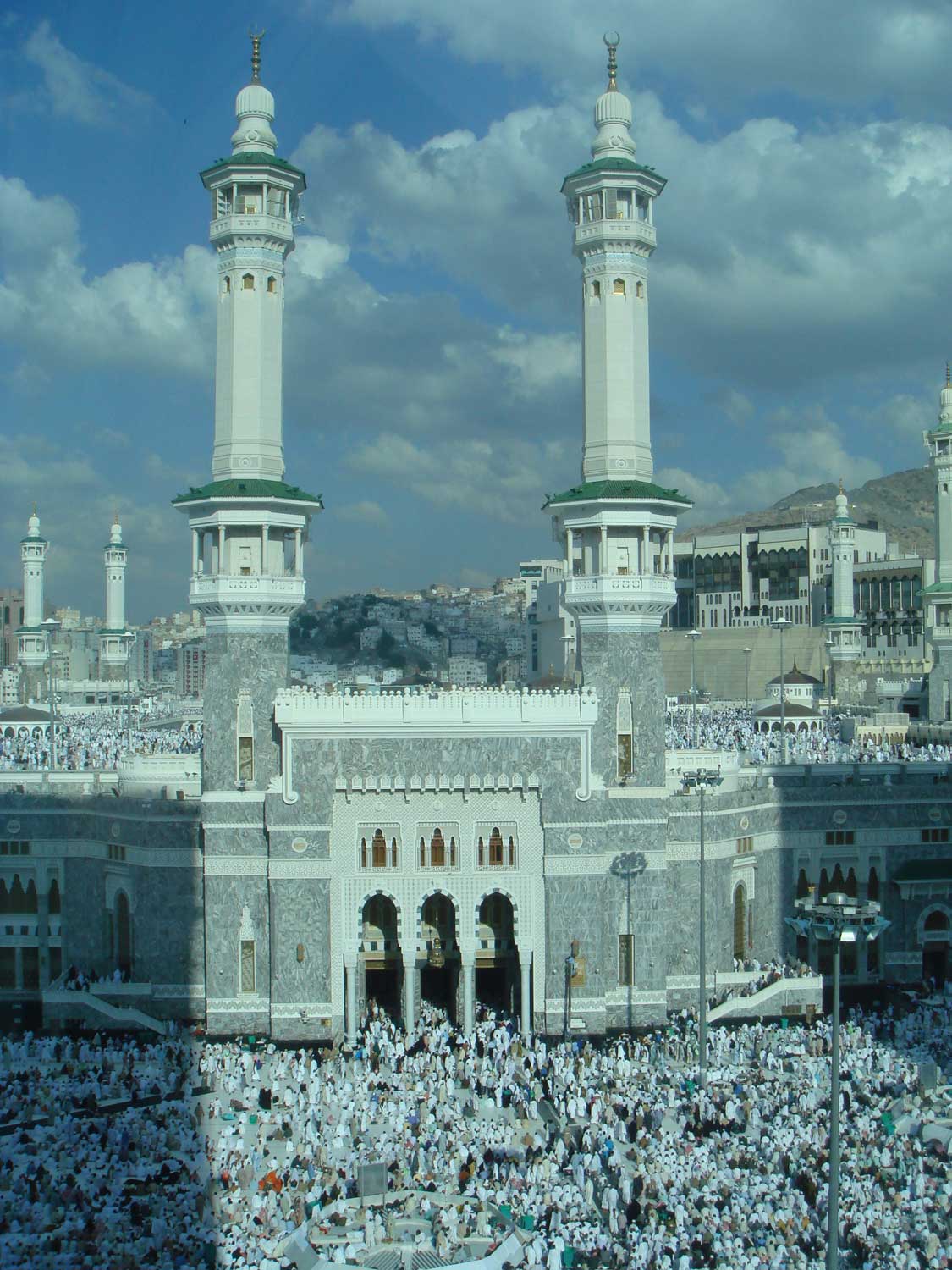
[8] Shibli: Did you see the Ka’bah ?

“Yes.”

Shibli: Did you see the actual goal for which you travelled to it?

“No.”

Shibli: Then you did not see the Ka’bah.

[9] Shibli: Did you run three circuits and walk four [in the total of seven circumambulations around the Ka’bah] ?

“Yes.”

Shibli: Did you run from the world (in the first three circuits) such that you knew that you had distanced yourself from it and disconnected from it? Did you find from the four circuits you walked, safety from that which you were running from, such that you increased in gratitude to God for it?

“No.”

Shibli: Then you did not run [and walk].

[10] Shibli: Did you touch the Black Stone and kiss it?

“Yes.”

Shibli cried out, saying: Woe to you! It is said that whoever touches the Black Stone has shaken hands with [God] The Truth-Reality (al-Haqq), Glorified and Exalted [because of the hadith: “The Black Stone is God’s Right Hand on Earth”]. Whoever shakes hands with [God] The Truth-Reality (al-Haqq), Glorified and Exalted, is in a state of safety. Did the effect of safety become manifest upon you?

“No.”

Shibli: Then you did not touch the Black Stone.

[11] Shibli: Did you stand for a moment in front of God, behind the Station [of Abraham], and did you offer two cycles of prayer?

“Yes.”

Shibli: Did you stand according to your station with your Lord, such that you were shown your purpose?

“No.”

Shibli: Then you did not pray.

[12] Shibli: Did you exit to Mount Safa [“purity”] and stand there?

“Yes.”

Shibli: What did you do there?

“I said takbir [Allahu akbar – “God is Greatest”], seven times. I mentioned the Hajj and asked God for it to be accepted.”

Shibli: Did you say the takbir of (and with) the angels, finding the reality of your takbir in that place?

“No.”

Shibli: Then you did not say takbir.

[13] Shibli: Did you descend from Mount Safa (“purity”) ?

“Yes.”

Shibli: Did all your faults leave you, such that you had attained purity?

“No.”

Shibli: Then you neither ascended, nor descended from, Mount Safa [“purity”].

[14] Shibli: Did you sprint [in the bottom of the valley between Safa and Marwah] ?

“Yes.”

Shibli: Did you flee to Him, disavow yourself of your fleeing, and arrive at your existence/being?

“No.”

Shibli: Then you did not sprint.

[15] Shibli: Did you arrive at Mount Marwah (“thirst quenched with water”) ?

“Yes.”

Shibli: Did you see Tranquillity at Marwah, such that you took it, or did it descend upon you?

“No.”

Shibli: Then you did not arrive at Mount Marwah.

[16] Shibli: Did you go out to Mina (“desires”) ?

“Yes.”

Shibli: Did you place your desires in God, in a different state from that in which you had disobeyed Him?

“No.”

Shibli: Then you did not go out to Mina.

[17] Shibli: Did you enter the Mosque of Khayf (“fear / awe”) ?

“Yes.”

Shibli: Did you fear God whilst entering and exiting? Did you find fear unparalleled elsewhere ?

“No.”

Shibli: Then you did not enter the Mosque of Khayf.

[18] Shibli: Did you proceed to ‘Arafat (“recognitions”) and stand there ?

“Yes.”

Shibli: Did you recognise the state for which you were created, the state that you intend and the state which you are becoming? Did you recognise the One Who Teaches you to recognise these states? Did you see the place to which there are the indications, for it is He Who enables the breaths of the souls in every state ?

“No.”

Shibli: Then you did not stand at ‘Arafat.

[19] Shibli: Did you then leave for Muzdalifah (“the one nearing”) and see the Sacred Place [the area around Muzdalifah] ?

[NB God commands in the Qur’an, “Remember God at the Sacred Place.” (al-Baqarah, The Heifer, 2:198)]

“Yes.”

Shibli: Did you remember God with a remembrance that made you forget whatever is other-than-Him, such that you were occupied with Him only?

“No.”

Shibli: Then you did not stay at Muzdalifah.

[20] Shibli: Did you return to Mina and slaughter [the sacrificial animal] ?

“Yes.”

Shibli: [The sacrificial animal being] your self and ego?

“No.”

Shibli: Then you did not slaughter [the sacrificial animal].

[21] Shibli: Did you cast stones [at the devil] ?

“Yes.”

Shibli: Did you cast your ignorance aside from yourself by an increase in knowledge that manifested upon you ?

“No.”

Shibli: Then you did not cast stones.

[22] Shibli: Did you shave your head ?

“Yes.”

Shibli: Did your (false) hopes decrease ?

“No.”

Shibli: Then you did not shave your head.

[23] Shibli: Did you visit the Ka’bah ?

[During the Hajj, there are three compulsory trips to the Ka’bah: Arrival (Qudoom), Visit (Ziyarah/Ifadah) and Farewell (Wida’).]

“Yes.”

Shibli: Were any realities unveiled to you, or did you see any increase in divine generosity and honour upon you because of this visit, for the Prophet, may God bless him and grant him peace, said, “The Hajj and ‘Umrah pilgrims are the Visitors of God. It is a duty upon the one being visited to honour his visitors.

“No.”

Shibli: Then you did not visit the Ka’bah.

[24] Shibli: Did you exit the state of ihram (sacredness and prohibition) into that of matters being halal (permissible) ?

“Yes.”

Shibli: Did you resolve to eat only what is halal ?

“No.”

Shibli: Then you did not enter the state of being halal.

[25] Shibli: Did you perform the Farewell Visit to the Ka’bah ?

“Yes.”

Shibli: Did you bid farewell to your soul and spirit entirely?

“No.”

Shibli: Then you did not perform farewell (wad’), and you must return (‘awd). See how you perform the Hajj after this, for I have instructed you. When you perform the Hajj, strive that it may be as I have described to you.

[Ibn ‘Arabi:] So know, may God strengthen you, that I have only quoted this story for notification, reminder and for it to be known that the Way of the People of Allah upon this has continued with their spiritual states in it. This was Shibli’s understanding during his Hajj, for he only asked based on his own taste and experience: did others experience the same, or not? Another person might experience the same, or something higher or lower, for “all of them have a known station.” [A reference to the angels: “All of us have a known station.” (al-Saffat, Those Ranked In Rows, 37:164)]

I have not invented a path in the considerations (inner meanings) of these acts of worship different to what has preceded me, except that people’s tastes and experiences are of different levels according to God’s care of each servant in such matters.

Source: Ibn ‘Arabi, al-Futuhat al-Makkiyyah [The Meccan Openings], Kitab Asrar al-Hajj [Book of the Secrets of the Pilgrimage], Dar al-Kutub al-‘Ilmiyyah, Beirut, 3rd ed., 2011, vol. 2, pp. 437-8

Translation, with added notes and numbering of paragraphs:

Usama Hasan

London

17th Safar 1448 ~ 1st August 2026
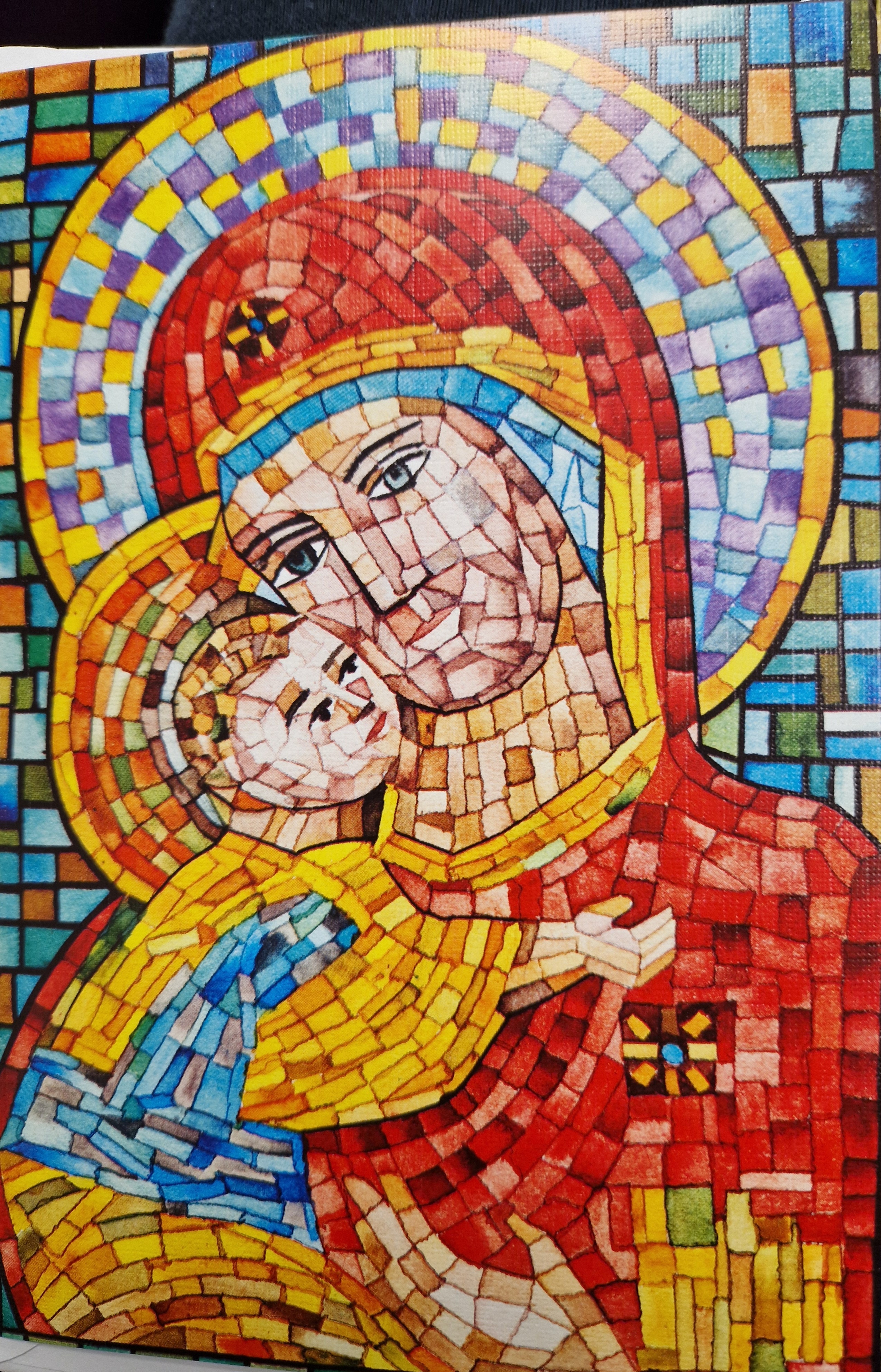
Did the Prophet Muhammad protect an icon of Mary and Jesus inside the Ka’bah at Mecca?

December 25, 2025

Bismillah. This alleged incident, at the time of the Conquest of Mecca when the Ka’bah was purified of the 360+ idols around it and inside it, was famously mentioned by Martin Lings (Abu Bakr Siraj al-Din), may God have mercy upon him, in his book, Muhammad: His Life Based on the Earliest Sources.

In 1990, JIMAS (UK) published a then-recent exchange of letters in the Saudi Gazette between Abu Bilal Mustafa al-Kanadi [The Canadian], may God have mercy upon him, and Martin Lings, in which Kanadi was very critical of Lings: one of his criticism was Lings’ inclusion of this story in his Sirah (Biography of the Prophet), based on its mention by al-Waqidi in Kitab al-Maghazi (The Book of Military Expeditions) and al-Azraqi (d. 250 H) in Akhbar Makkah (History of Mecca). That exchange is reproduced at the bottom of this post, for reference. Neither correspondent referred to the Hadith expert Imam Dhahabi’s discussion and comment on this report.

Imam Dhahabi’s discussion and comment on this report

Muslim [bin Khalid] al-Zanji [The Negro], on the authority of Ibn Abi Najih, on the authority of his father [Abu Najih], who said: Men of the Quraysh sat and reminisced about the building of the Ka’bah … [The builders] depicted prophets, angels and trees inside it. They depicted Ibrahim [Abraham] divining with arrows. They depicted Jesus and his mother …

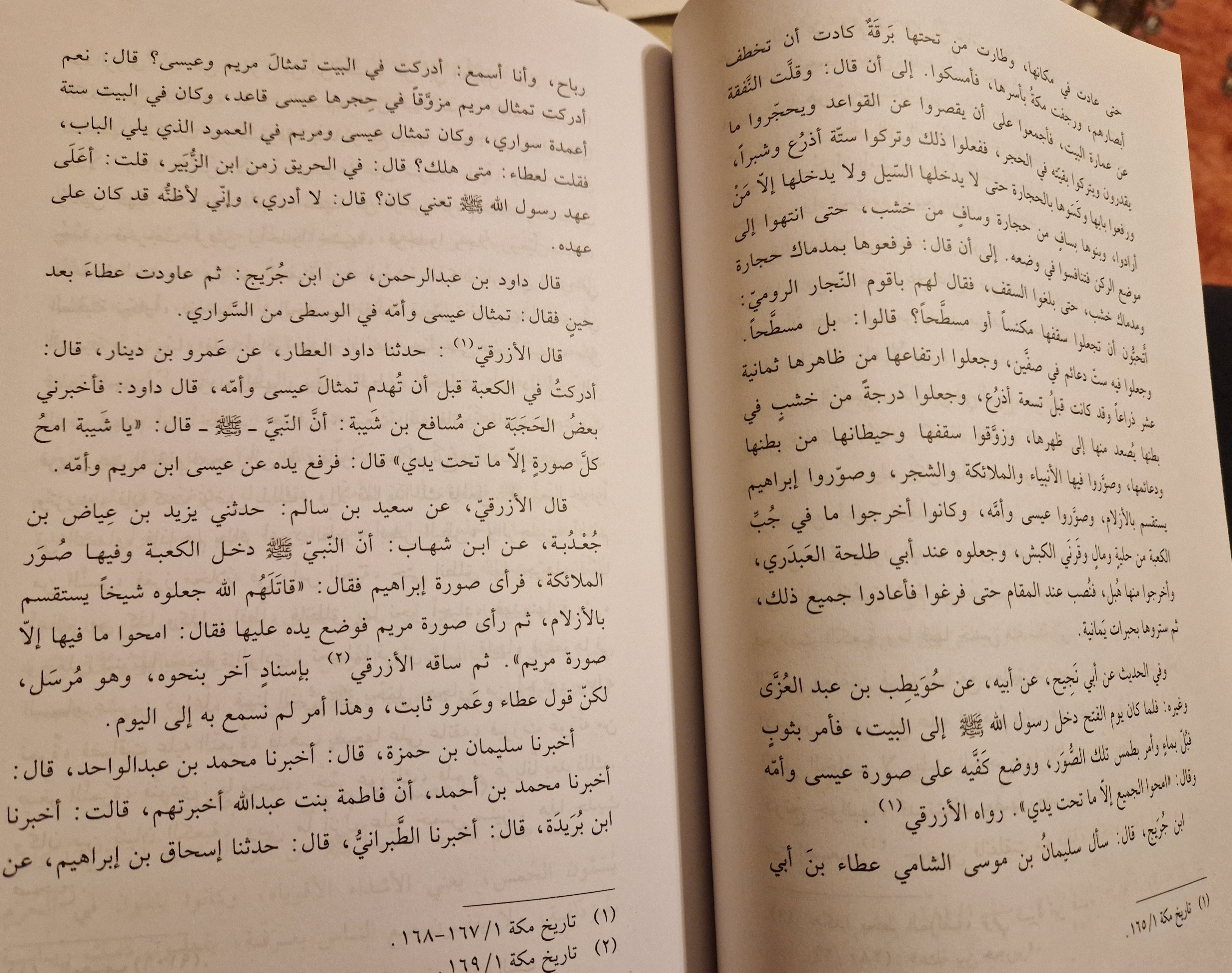
And in the hadith on the authority of Ibn Abi Najih, on the authority of his father [Abu Najih], on the authority of Huwaytib bin ‘Abdul ‘Uzza and others: On the day of the Conquest [of Mecca], the Messenger of God, may God bless him and grant him peace, entered the House [of God]. He ordered for a cloth to be moistened and commanded that those pictures be effaced. He placed his palms upon the picture of Jesus and his mother and said, “Erase them all, except what is beneath my hand.” Al-Azraqi transmitted it.[1]

Ibn Jurayj said: Sulayman bin Musa al-Shami [The Syrian] asked ‘Ata’ bin Abi Rabah [The Mufti of Mecca] whilst I was listening, “Did you come across the statue[2] of Mary and Jesus in the House [of God]?” He replied, “Yes, I came across the embellished[3] statue of Mary with Jesus standing in her lap. There used to be six support pillars inside the House: the statue of Jesus and Mary was in the pillar nearest the door.” So I [Ibn Jurayj] asked ‘Ata’, “When was it destroyed?” He replied, “In the fire during the rule of Ibn al-Zubayr.” I asked, “Do you mean that it was there during the time of the Messenger of God, may God bless him and grant him peace?” He replied, “I do not know, but I think it was there during his time.”

Dawud bin ‘Abdul Rahman said, on the authority of Ibn Jurayj: I then repeated the question to ‘Ata’ after a while. He said, “The statue of Jesus and his mother was in the middle pillar.”

Al-Azraqi said: [4] Dawud al-‘Attar [The Perfumier] narrated to us, on the authority of ‘Amr bin Dinar, who said, “I came across the statue of Jesus and his mother in the Ka’bah before it was demolished.”[5] Dawud said: One of the gatekeepers informed me on the authority of Musafi’ bin Shaybah that The Prophet, may God bless him and grant him peace, said: “O Shaybah! Erase all the pictures except what is beneath my hand.” When he lifted his hand, there was Jesus, son of Mary, and his mother.

Al-Azraqi said, on the authority of Sa’id bin Salim: Yazid bin ‘Iyad bin Ju’dubah narrated to me, on the authority of Ibn Shihab [al-Zuhri] that The Prophet, may God bless him and grant him peace, entered the Ka’bah containing pictures of angels. He saw the picture of Ibrahim [Abraham] and said, “May God fight them! They made him an old man divining with arrows.” He then saw the picture of Mary and placed his hand upon it, saying, “Erase all [the pictures] in it, except the picture of Mary.”

Al-Azraqi then quoted similarly with another chain of transmission. It is mursal [“hanging loose”; discontinuous].[6] But the statements of ‘Ata’ and ‘Amr are established (thabit): this is a matter that we had never heard of until today. [emphasis added]

Source:

al-Imam Shams al-Din Muhammad bin Ahmad bin ‘Uthman al-Dhahabi (d. 748 H / 1347 CE),
Siyar A’lam al-Nubala’ (Biographies of Notable Nobles),
ed. Dr Bashshar ‘Awwad Ma’ruf,
Mu’assasat al-Risalah, Beirut, 1422 H / 2001 CE, vol. 26, pp. 67-69


[1] The editor of the Siyar adds the reference: Akhbar Makkah,1/165

[2] Timthal: icon, picture or statue

[3] Muzawwaq: embellished, especially with quicksilver (mercury) or an amalgam of quicksilver and gold.

[4] The editor of the Siyar adds the reference: Akhbar Makkah,1/167-8

[5] The Ka’bah has been destroyed and rebuilt several times in its history due to floods, fires, earthquakes, etc.

[6] Mursal especially refers to a Follower (Tabi’i) quoting the Prophet directly without naming the Companion (Sahabi) from whom he must have heard the narration. In this case, Ibn Shihab [al-Zuhri] is a Follower and quotes The Prophet directly without naming the intervening Companion(s), so the narration is mursal. There is much difference of opinion amongst Hadith scholars about the authenticity of the mursal hadith. See the section on this topic in Suhaib Hasan, An Introduction to the Science of Hadith, Al-Qur’an Society, London, 1994, pp. 24-29.

ANALYSIS & BIOGRAPHICAL NOTES from Imam Dhahabi’s Tadhkirat al-Huffaz (Memoire of the Preservers of Hadith)

A. IBN SHIHAB AL-ZUHRI (50-124 H): The most knowledgeable of the Preservers of Hadith (Huffaz)

Abu Bakr Muhammad bin Muslim bin ‘Ubaydillah bin ‘Abdillah bin Shihab bin ‘Abdillah bin Zuhrah bin Kulab, The Qurayshi, The Zuhri, The Madinan, The Imam. He narrated Hadith from Ibn ‘Umar, Sahl bin Sa’d, Anas bin Malik, Mahmud bin al-Rabi’, Sa’id bin al-Musayyib, Abu Umamah bin Sahl and their generation of minor Companions (Sahabah) and major Followers (Tabi’in). The following narrated Hadith from him: Ma’mar bin Rashid, Awza’i, Layth, Malik, Sufyan bin ‘Uyaynah and multitudes besides them.

Layth said, “I never saw a person of knowledge at all more comprehensive than Zuhri. He would narrate about encouragement of worship: you would say that he only specialised in that. If he narrated about the (history of) the Arabs and genealogies, you would say that he only specialised in those. If he narrated about the Qur’an and the Sunnah, then similarly … He was amongst the most generous of people … He used to drink honey a lot, but not eat apples. He said: I never forgot any knowledge after my heart had deposited it … No-one has had patience upon knowledge like my patience; no-one has spread knowledge the way I have.”

Nafi’ checked his memorisation of the Qur’an with Zuhri. (Zuhri memorised the entire Qur’an in eighty nights.) ‘Umar bin ‘Abdul ‘Aziz said, “No one remains more knowledgeable about past traditions than Zuhri.” Malik said, “Ibn Shihab remained, but there was no-one similar to him in the world.” Ayyub al-Sikhtiani said, “I did not see anyone more knowledgeable than him.” ‘Amr bin Dinar said, “I did not see the dinar (gold coin) and the dirham (silver coin) less important to anyone than Zuhri: they were like dung to him.” Others said: Zuhri was an accomplished soldier. He used to dye his grey hair with henna.

[The Umayyad Caliph] Hisham bin ‘Abdul Malik asked Zuhri to dictate some knowledge to one of his sons, so he dictated four hundred hadiths to him. Zuhri then assembled People of Hadith and narrated those four hundred hadiths to them. He met Hisham again after a month or so: Hisham tested him by telling him that the book of dictated hadiths had been lost. Zuhri called a scribe and dictated the hadiths again: these were compared against the original book, and there was not a single difference, not even in a letter. Makhul was asked, “Who was the most knowledgeable person you ever met?” He replied, “Ibn Shihab.” He was asked, “Then who?” He replied, “Ibn Shihab.”

Some further statements of Ibn Shihab al-Zuhri:

“Al-Qasim bin Muhammad said to me: I see that you are eager for knowledge: Shall I not then point you to one of its great vessels? … ‘Amrah bint ‘Abdul Rahman, for she grew up in ‘Aisha’s lap. So I came to her and found her to be an ocean that could not be exhausted.”

“I never revised knowledge at all.”

“Whoever would like to memorise hadiths, should eat raisins.”

“A Preserver of Hadith is only born once in forty years.”

“God has not been worshipped via anything better than knowledge.”

B. ‘AMR BIN DINAR, THE PRESERVER OF HADITH, THE IMAM (c. 46-126 H)

The person of knowledge of the Sanctuary (Haram). Abu Muhammad of Jumayh (their freed-slave), The Meccan, al-Athram. He heard traditions from Ibn ‘Abbas, Ibn ‘Umar, Jabir bin ‘Abdillah, Bajalah bin ‘Abdah, Anas bin Malik, Abu l-Sha’tha’, Tawus and many others. Shu’bah, Ibn Jurayj, the two Hammads [Hammad bin Zayd & Hammad bin Salamah], the two Sufyans [Sufyan bin ‘Uyaynah & Sufyan al-Thawri], Warqa’ and many besides them, all narrated from him.

Shu’bah said, “I did not see anyone more established in Hadith than ‘Amr.” Ibn Mahdi said: Shu’bah said to me, “I did not see anyone like ‘Amr bin Dinar.” Yahya al-Qattan and Ahmad [bin Hanbal] said, “He was more established than Qatadah.” ‘Abdullah bin Abi Najih said, “I never saw anyone at all with more (juristic) understanding than ‘Amr, not even ‘Ata’, Mujahid or Tawus.”

Ibn ‘Uyaynah said, “He would not leave the mosque. He would ride a donkey. I only ever saw him sitting down. He was a person of understanding (jurist). He would narrate by meaning … Trustworthy, Trustworthy, Trustworthy … He divided the night into three: he would sleep for a third, teach his hadiths for a third and pray for a third … We did not have anyone with more understanding, knowledge or preservation than ‘Amr bin Dinar.”

The Hafiz Ibn al-Mufaddal established him as one of the four amongst the top generation (of hadith-narrators) after the year 40 H: Zuhri, ‘Amr bin Dinar, Qatadah & Abu Ishaq al-Sabi’i.

C. MUSLIM BIN KHALID AL-ZANJI (100-180 H): “the Imam, the Man of Understanding (Jurist) … Shaykh of the Sanctuary (Haram).”

Muslim bin Khalid al-Zanji [The Negro]. He narrated Hadith from the likes of Ibn Abi Mulaykah, Ibn Shihab al-Zuhri, ‘Amr bin Dinar, Zayd bin Aslam, Hisham bin ‘Urwah, ‘Abdul Malik Ibn Jurayj and their generation. He devoted himself to Ibn Jurayj for a while, gained juristic understanding and gave fatwas, concentrating on knowledge. He transmitted the (Qur’anic) letter variations (huruf) from ‘Abdullah bin Kathir, and gave Shafi’i permission to give fatwas. Shafi’i, Marwan al-Tatiri, Humaydi, Musaddad, Hakam bin Musa, the Hafiz Ibrahim bin Musa, Hisham bin ‘Ammar and others narrated Hadith from him.

Azraqi said, “He was a person of understanding and worship. He would fast all the time.”

Yahya Ibn Ma’in said, “There is no problem with him.”

Ibn ‘Adi said, “He is good in Hadith: I hope there is no problem with him.”

Abu Dawud said, “Weak in Hadith.”

Bukhari said, “Rejected in Hadith.”

Abu Hatim said, “He is not used as a proof.”

Ibrahim al-Harbi said, “He was the Jurist of Mecca.”

Suwayd said, “He was named ‘The Negro’ because of his black skin.” But Ibn Sa’d and others said that he was blonde: he was termed ‘The Negro’ via the irony of opposite meaning. Dhahabi: He died in 180 H, aged 80.

INNER AND OUTER ASPECTS OF ISLAMIC RITUAL PRAYER (SALAT)

June 26, 2015

Bismillah. This is about some of the beautiful symbolism and meaning behind the salat or ritual prayer, one of the five pillars of Islam and to be performed at least five times a day.  When the salat is reduced to pure ritual without any understanding of the Arabic words or of the symbolism of the actions, many inward and outward problems arise, God forbid!  But the salat is the believer’s daily ascension (mi’raj) and communion with God: it is up to us to deepen this daily experience of ours. It is the Muslim’s daily practice of mindfulness, meditation and remembrance, to develop a deep wellspring of love, faith and humility to equip us for life’s individual, social and political challenges. May God continue to bless our journeys!

All italicised phrases are from the Qur’an and Sunna; references are omitted for ease of reading and clarity: this is not an academic article, but an attempt to elucidate certain indications and symbols, with the hope of helping people on their own journeys.

With the Name of God, All-Merciful, Most Merciful

INNER AND OUTER ASPECTS OF ISLAMIC RITUAL PRAYER (SALAT)

  1. Prayer times: Time is sacred (God says, I am Time); we offer each prayer within its time in order to share in the sacredness of every part of the day and night, and to give thanks for that portion of sacred time.
  2. Washing (ablutions) before prayer: we cleanse our limbs and hearts of wrongdoing.
  3. Ablutions are nullified by toilet or sexual acts: these represent our basic animal natures, so we wash again to symbolise recovering our angelic natures in order to stand before God.
  4. Facing Mecca: The Ka’bah, as the House of God, symbolises the heart, which is also the House of God. Whilst facing Mecca outwardly, we turn inwardly to face the home of God at the centre and core of our being. So turn your face towards the Sacred Mosque!
  5. Standing in straight rows: we are in fellowship, equal before God, and imitating the ranks of the angels. The hearts of the people of Paradise beat as one … By Those Who Stand in Ranks!
  6. Raising the hands at the beginning of the prayer: symbolises the “lifting of the veil” between us and God. In prayer, we are talking directly to our Lord.
  7. Standing before God in prayer: facing up to life as a journey to God; a foretaste and preparation for standing before God on Judgment Day.
  8. Keeping the eyes open, rather than closed, in prayer: do not be veiled by multiplicity from Unity, nor by Unity from multiplicity.
  9. Lowering the head and looking at the ground (if practised): humility before God.
  10. Keeping the chin up and looking straight ahead towards Mecca (if practised): facing life, and one’s inward reality, directly.
  11. Folding the arms across the body (if practised): the servant’s pose before the Master.
  12. Reciting the Opening Chapter of the Qur’an (Surat al-Fatiha): we are sharing in a communion with God. God says, I have divided the prayer between Me and My servant …
  13. Praise be to God, Lord of the Worlds; All-Merciful, Most Merciful; Master and King of the Day of Judgment: God says, These belong to Me, as our glorification is of God.
  14. You alone we worship; You alone we ask for help: God says, This is (shared) between Me and My servant; the God-human relationship.
  15. Guide us to the Straight Path; the path of those whom You have favoured, who neither receive (Your) anger nor stray: God says, These belong to My servant, and My servant shall have whatever he or she requests.
  16. Reciting further from the Qur’an: the remembrance of God continues; God and the angels bear witness to it. Truly, the recitation at dawn was witnessed.
  17. Bowing: humility before God; bearing life’s hardships, followed by standing tall again.
  18. Prostration, with forehead, nose, hands, knees and feet pressed to the ground: ultimate humility before God; one is closest to God in this posture, which is outwardly humiliation, inwardly elevation; our hearts are higher than our brains, whilst the rest of the time, our brains are higher than our hearts; Pray hard, for your prayers are most likely to be accepted in this position; death.
  19. The second prostration, after a brief sitting: the second death, at the blowing of the Horn. Our Lord! You caused us to die twice, and to live twice …
  20. In prayer, do not sit like a dog, peck like a cockerel or squat like a monkey: throughout prayer, we must rise above our animal natures and try to inhabit our angelic natures.
  21. Standing, bowing, prostration: the body forms the Arabic letters Alif (A), Dal (D) and Mim (M) respectively, hence spelling Adam during the prayer; we are seeking our original Paradisal, primordial humanity before the Fall through our communion with God.

    [In Hebrew and Arabic, the Aleph/Alif (A) also signifies the number 1, so “Adam” is identical to “1 dam” meaning “one blood”: humanity is united; we have different skin colours, but we bleed the same colour. Red blood cells have no DNA (although white ones do), so in a sense blood represents our common humanity – much of it does not have our unique, genetic fingerprints that are found in every other of the trillions of cells of our body.]

  22. Standing, bowing, prostration: the body forms a straight line, right angle and (semi-)circle respectively, the bases of all geometry and form; we are signifying that we are at one with Nature and its beautiful forms. God is Beautiful, and loves Beauty.
  23. Sitting in remembrance of God at the end of the prayer: a foretaste of the eternal rest in Paradise.
  24. The prayer ends with the greeting of peace (salam): Their greeting on the Day they meet Him is Peace; Their greeting there (in the Garden) is Peace; they hear no vain or sinful talk, only the words, Peace, Peace!

Usama Hasan

London, Ramadan 1436 / June 2015