Posts Tagged ‘Faith’

ISLAM & THE SEVEN STAGES OF GRIEF

November 29, 2025
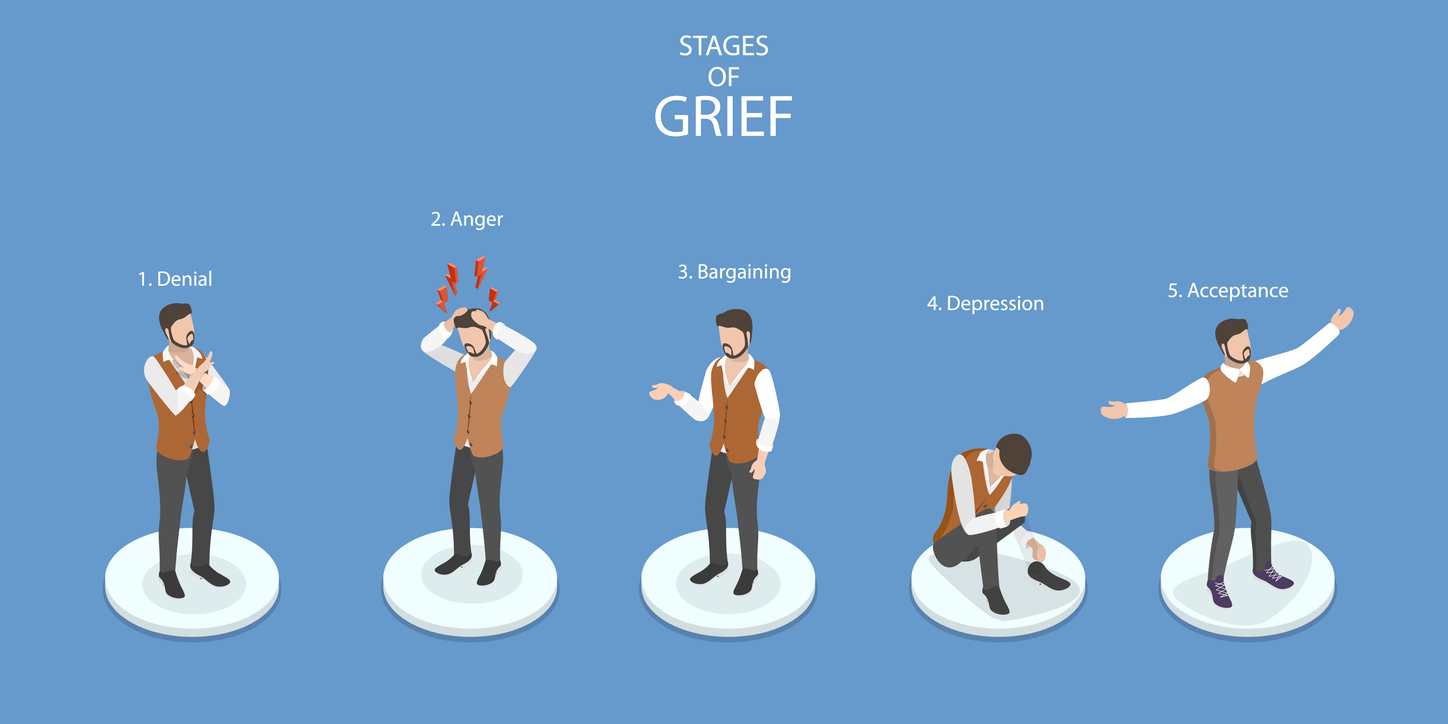
3D Isometric Flat Vector Conceptual Illustration of Stages Of Grief, Denial, Anger, Bargaining, Depression, Acceptance

ISLAM & THE SEVEN STAGES OF GRIEF

Bismillah.

Previously, there were five stages of grief generally accepted amongst psychologists as:
1. SHOCK, 2. DENIAL, 3. ANGER, 4. BARGAINING, 5. ACCEPTANCE/HOPE.

Recently, some people have extended this to seven stages by adding GUILT & DEPRESSION after ANGER. But it varies from person to person: these are not necessarily linear stages: they may be cyclical or iterative.  Hence, the 7 stages of grief are:

1. SHOCK, 2. DENIAL, 3. ANGER, 4. GUILT, 5. DEPRESSION, 6. BARGAINING, 7. ACCEPTANCE/HOPE.

0. GRIEF

0.1 THE PROPHET MUHAMMAD’S YEAR OF GRIEF AND SORROW

The Prophet, peace be upon him, experienced his “year of grief or sorrow” (عام الحزن,  ‘Ām al Huzn) during his tenth year of prophethood, ie 3 years before the Hijra, when his only wife Khadija, his stalwart support for 25 years, died, followed closely by his uncle, Abu Talib, his tribal protector as chief of his clan, the Banu Hashim.

(I’m grateful to the Christian priest, whose name I’ve forgotten, who attended our Qur’an discussion circles c. 2013-14 and wished to co-write with me a Christian-Muslim guide to grief, since he had read about the Prophet’s “Year of Grief.” I didn’t have the time or capacity to work on it at the time, but he gave me an idea that has come to fruition today, God-willing.)

0.2 PROPHET YA’QUB BIN ISHAQ BIN IBRAHIM, aka ISRA’IL (JACOB BEN ISAAC BEN ABRAHAM, aka ISRAEL)

In the Surah named after his 11th son, Prophet Yusuf (Joseph), grief is prominent in the “best of stories.”

قال إني ليحزنني أن تذهبوا به وأخاف أن يأكله الذئب وأنتم عنه غافلون

(Yusuf, Joseph, 12:13)

When his elder 10 sons ask for his permission to take Joseph for a day out, Jacob combines grief (for the past) with fear (of the future):

“It grieves me that you take him away (from me), and I fear that the wolf will devour him whilst ye are heedless of him.”

When his sons lie to him, saying that the wolf had indeed eaten Joseph, Jacob sees through their lies and resigns himself to “beautiful patience” (صبر جميل).

Later, when his first 10 sons manage to come home without the 12th son Binyamin (Benjamin) as well, Jacob expresses extreme sorrow for Joseph, reiterates his commitment to “beautiful patience” and goes blind from grief:

وتولّى عنهم وقال ياأسفى على يوسف وابيضت عيناه من الحزن فهو كظيم 

(Yusuf, Joseph, 12:84)

Although Ibn Kathir quotes the commentator Dahhak as explaining kazeem here to mean ka’eeb: intense grief and broken in spirit, i.e. depressed, the vast majority of commentators agree that Prophet Jacob displayed beautiful patience and did not complain to anyone except God, restraining his sorrow and grief. Others amongst the Salaf said that he waited eighty years to see his beloved son Joseph, for whom his grief equalled that of seventy bereaved parents, but he “was never pessimistic about God.” (Tafsir Tabari)

1. SHOCK

1.1 UMAR BIN AL-KHATTAB: SHOCK, DENIAL, ANGER, ACCEPTANCE

Our Master Umar was in shock, denial and anger upon the news of the Prophet’s death, threatening to kill anyone who said that the Prophet was dead, until Our Master Abu Bakr said the famous words:

“Whoever worshiped Muhammad, he should know that Muhammad has died. Whoever worships God, he should know that God is The Ever-Living, Who Will Never Die.”

Abu Bakr also recited from Surah Āl Imran (The Family of Amram), the verses confirming that Muhammad was mortal and speaking of the possibility of his death, for every soul has a predestined moment of death, praising those who show gratitude. Umar commented: “It was as though I had never heard these verses before!” He rapidly reached the stage or station of Acceptance. 

وما محمد إلا رسول، قد خلت من قبله الرسل، أفائن مات أو قتل انقلبتم على أعقابكم، ومن ينقلب على عقبيه فلن يضرّ الله شيئا، وسيجزي الله الشاكرين

وما كان لنفس أن تموت إلا بإذن الله كتابا مؤجلا، ومن يرد ثواب الدنيا نؤته منها، ومن يرد ثواب الآخرة نؤته منها، وسنجزي الشاكرين

Āl Imran, The Family of Amram, 3:144-5)

3. ANGER

3.1 KHALID BIN WALEED 

Our Master Khalid bin Waleed, the Sword of God, was overcome by grief on his deathbed when he realised he wouldn’t be granted martyrdom on the battlefield (because no human’s sword could defeat the Sword of God). He was especially frustrated at knowing how many people are cowards. Khalid’s last words were:

“I have a wound on every inch of my body, but I’m dying like an aging camel. May the eyes of cowards never (find rest in) sleep!”

ASIDE:

Khalid bin Waleed’s extraordinary life and military genius and career deserve to be immortalised in an epic poem in English. I have written opening and closing stanzas for such a poem. I pray that I or someone else is able to complete it:

OPENING STANZA: THE TALE OF KHALID BIN WALEED 

If your eyes do weep and your heart does bleed

At the state of the Muslim nation, 

Then remember the tale of Khalid bin Waleed:

It is enough as inspiration. 

[…]

CLOSING STANZA: KHALID BIN WALEED’S LAST WORDS

“I’m dying like a camel

(Or like an aging sheep):

May the eyes of cowards 

Never rest in sleep!”

TRIVIUM: THE KHALID BIN WALEED PARK IN PESHAWAR, PAKISTAN

This park goes by its Urdu/Farsi name: Khalid bin Waleed Bagh. The locals are Pathan (Pashtun), and so pronounce it somewhat Farsi style, as follows, making the ‘a’ sound like ‘o’: Kholid bin Woleed Bagh. British Empire troops stationed in Peshawar heard it pronounced like this, switched the syllables around and nicknamed the park, the “Colly-Wolly Bean Bag.”

3.2 TRUE PATIENCE IS ONLY AT THE FIRST BLOW

Anas bin Malik narrated that the Prophet, may God bless him and grant him peace, passed by a woman who was weeping at a graveside, mourning a child she had lost. The Prophet said, “Fear God, and have patience.” She replied, not recognising him, “Get away from me, for you have not been afflicted by my affliction!” She was told that it was the Prophet who had spoken to her, so she came to his door and, finding no doorkeepers, said to him, “I did not recognise you.” He replied, “(True) Patience is only at the first blow.” (Bukhari & Muslim)

TRIVIUM: The Arabic for “blow” here is sadmah, root SDM. The name Saddam is derived from this as an intensive form, thus meaning, “One who delivers crushing blows.”

4. GUILT: JOSEPH’S BROTHERS

The 10 elder brothers of Prophet Yusuf (Joseph) had feelings of grief at the perceived favouritism of their father towards Yusuf. This manifested in Anger when some of them suggested killing him. Others felt guilty about this and suggested throwing him into a well, which is what they did. They must have had some feelings of guilt around this, and around lying to their father about Yusuf being eaten by a wolf. After many years, once they were reunited with Yusuf and his magnanimity, they went through the stages of Bargaining and Acceptance/Hope, admitting their mistakes to both Yusuf and their father Ya’qub. (Yusuf, Joseph, 12:91 & 12:97)

7. ACCEPTANCE/HOPE: NO FEAR, NO GRIEF

The Prophet, may God bless him and grant him peace, endured his Year of Grief with immense patience and acceptance. This is the way of “living in the moment” as “children of the moment in time” (abna’ al-waqt) without fear (of the future) or grief (for the past), the way of the “Friends of God” or saints. The phrase, “There will be no fear upon them, nor will they grieve,” occurs repeatedly in the Qur’an for the People of the Garden in the Hereafter. However, it applies to certain, select people in this world also:

أَلَآ إِنَّ أَوْلِيَآءَ ٱللَّهِ لَا خَوْفٌ عَلَيْهِمْ وَلَا هُمْ يَحْزَنُونَ
ٱلَّذِينَ ءَامَنُوا۟ وَكَانُوا۟ يَتَّقُونَ

Lo! Truly, the Friends of God:

There is no fear upon them, 

Nor do they grieve:

Those who have achieved faith (inner security)

And were always saving themselves (taqwa).

(Yunus, Jonah, 10:62-63)

In Imam al-Qushayri’s Treatise on Tasawwuf (Sufism), the first topic he discusses after brief biographies of early Sufis is that of Time (Waqt), where he says that “the Sufi is the son of his time,” i.e. that he lives in the moment. Shaykh Hamza Yusuf linked this to the above Qur’anic verse during a conversation in Abu Dhabi, 2022.

It is narrated from the Prophet, may God bless him and grant him peace, that this applies to people in this world “who did not fear when the people had fear, and did not grieve when people grieved.” They will be surrounded by Light in the Hereafter, and made to sit upon pulpits of Light: even the Prophets and the Martyr-Witnesses will be amazed by their station. (Tafsir Tabari, #17,730 & #17,731)

Usama Hasan

London, UK

8th Jumada al-Thani 1447

28th November 2025

Is Faith A Good Anti-Depressant? Thought For The Day, BBC Radio 4, Today Programme, Friday 23/02/2018

February 24, 2018

Is Faith a Good Anti-Depressant?

[FINAL TEXT AS DELIVERED]

Thought For The Day, BBC Radio 4, broadcast Friday 23 February 2018, 0748-0751

Imam Dr Usama Hasan

[Listen to the 3-minute audio clip here]

Good morning, and good news! Anti-depressants do work: that’s the emphatic conclusion of a major medical study published in The Lancet two days ago. But is faith a good anti-depressant?

Mental health is like physical health, in that it may be good or bad, or fluctuate over time, taking turns for better or worse. And just as we take drugs for physiological ailments, we know enough about brain function to be able to prescribe targeted medicines for mental health problems. It is pleasing that there is now a greater awareness and acceptance of the nature of mental health problems and treatments.

But medication is neither the first resort, nor the only method, in treating depression. Indeed, one of the main authors of the scientific study confirmed that other treatments, including psychological therapies, should always be considered alongside drugs. But psychology and psychotherapy, literally meaning ‘the study and treatment of the soul or self’ respectively, are rooted in faith for many people in cultures around the world.

Religious practice, individually as well as communally, was always supposed to develop spirituality, or the improvement and growth of one’s self. A key passage of the Qur’an speaks of the human soul: to purify and develop the soul is success, but to bury the soul with heavy and harmful burdens is perdition.

Many of us will know people, perhaps including ourselves, who were cured of depression once root causes, such as the effects of trauma or other negative experiences, were neutralised appropriately, perhaps with medication. But often, people living through depression do not know what the root causes are, and why exactly they feel the way they do. For some, replacing negative thoughts and attitudes with positive ones, and taking part in social activities, can be extremely helpful, often with the help of a support network of family and friends.

Yesterday’s news coverage included the fascinating experiences of two people who’d had to cope with long-term depression.  One discovered a hidden talent when he started doodling, and the appreciative response he got for his artwork gave him unprecedented confidence and self-belief.  Another, a comedian, spoke of being able to share his experience with audiences after deep therapy.  He went on to say how lovely it would be if, once people knew his situation, they could offer to help. It was crucial for both of them to be open and expressive about their issues.

The Prophet of Islam taught that we should always “speak goodness only.” Mystics from all religions encourage always seeing the good in situations and in other people.  So, we all have a part to play in supporting each other with positive encouragement, kind words and optimistic attitudes.  For many, this will complement medical interventions, and such supportive relationships can be fundamental for good mental health and wellbeing.

Mirrors

August 1, 2013

Bismillah. The Prophet, peace be upon him, taught: al-mu’min mir’at al-mu’min – “the believer is the mirror of the believer.”

This morning, I read a mind-boggling commentary on this teaching from Ibn ‘Arabi, of which more later.

But first, here is a traditional explanation of the hadith, adapted slightly from Sheikh Abdul Ghaffar Hasan in his Way of the Prophet:

In this Hadith, a believer has been declared to be the mirror of another believer. This is a profoundly meaningful comparison. Keeping this comparison in mind, the following aspects of a believer’s relationship with another believer become apparent:

 (1) A mirror reflects only those spots and stains that actually exist. It neither reduces nor enlarges them.

(2) The mirror only reveals spots and stains when the face is present. If the person goes away, the tongue of the mirror is silenced.

(3) We have never heard of anyone becoming annoyed or angry at seeing their spots and stains in the mirror. On the contrary, we see that people gratefully keep the mirror in a safe place so that it may used when needed later.

(4) The mirror only reveals the spots and stains when it is level with the person’s face. If the mirror is above or below the face, it does not serve its essential purpose.

Instead of simile and metaphor, it can be stated in plain words that through the comparison with the mirror, the Messenger of Allah (may God bless him and grant him peace) has given us four pieces of guidance:

(1) If there is a need to mention a person’s defect, it should only be described as far as it exists.

(2) The defect should be mentioned in the person’s presence, not behind their back.

(3) If someone informs us of a defect or criticises us, we should be grateful to them instead of being annoyed with them.

(4) When a sincere adviser or critic criticises, he should neither show himself as greater and higher, nor use flattery and sycophancy [to be lower].

Now onto Ibn ‘Arabi: al-Mu’min (the Source or Guardian of Faith) is also a Name of God [Qur’an 59:23]. Hence, the hadith also means:

a) “The believer is the mirror of God” and

b) “God is the mirror of the believer.”

Explanations:

a) A person of pure faith has annihilated the ego and inculcated godly or saintly qualities such that the person’s heart and being is filled with (faith in) God, so God and other people only see a reflection of God in the person.

b) Since the World (the Universe or Nature) is also a locus or place of the reflection of God’s Names, and the human is a microcosm of the universe (the macrocosm), the believer learns about himself/herself through experiencing life, looking at the world and God’s action in it.  This teaching is related to the one that “a believer sees by the light of God”: s/he also sees by the multiple, renewed reflections of God’s light.


Islam and Science Workshop 2013

November 27, 2012
Bismillah.  This is a cross-post from http://www.quilliamfoundation.org/events/islam-science-workshop-2013/

Islam & Science Workshop 2013

FINAL CALL: Deadline extended to 9am on Monday 14th January 2013

Quilliam, in association with the American University of Sharjah, Université Interdisciplinaire de Paris and Muslim-Science.com, are pleased to announce a workshop entitled, “Islam and Science: A Reasoned Approach” for students and young researchers to be held on 18th-20th January 2013 at a prestigious location in Central London, UK.

This event will be the latest in a series of educational workshops that have previously been held in Algiers, Paris and other locations. A “reasoned approach” will be taken to Islam and Science: one that is well informed, balanced and constructive. The workshop will represent a unique opportunity for Muslim students and young researchers to discover the contemporary field of ‘science and religion’ through lectures by, and in-depth discussions with, internationally-recognised thinkers and experts in this field, including Prof. Nidhal Guessoum, Prof. Jean Staune, Prof. Bruno Guiderdoni, Ehsan Masood, Dr. Athar Osama and Dr. Usama Hasan.

Participants can attend the workshop by invitation only. There will be 20 invitations and in order to be selected, potential participants must complete and submit this application form (also below) and an accompanying essay on a subject that directly relates to the general theme of the workshop and to the topic of ‘Islam and Science.’

The eligibility criteria to apply for an invitation to the workshop are as follows:

• Participants must be either senior undergraduate students, graduate students, or young researchers (post-doctoral fellows or equivalent).
• The essays submitted by potential participants must be 1000-2000 words in English with an abstract of roughly 150 words.
• The essays must present an argument representative of the author’s opinion. They must be written in an academic style and include bibliographic references for every citation or factual statement, while avoiding being a summary or compilation of ideas expressed by other people.
• Potential participants should try to be consistent with the “reasoned approach” of this workshop and project on the theme of “Islam and Science.” In their essays, potential participants must avoid excessively focusing on “separationist” approaches which relegate religion to people’s private lives and science to the material world, or “concordist” approaches which “find” specific science in the scriptures and end up merely trivialising Islamic culture and its relationship to science.
• All essays must be submitted by email to workshop@QuilliamFoundation.org by 9am on Monday 14th January 2013. Essays received after this time will not be considered.

• Telephone interviews may be conducted to complete the selection process and to verify participants’ interest in, and familiarity with, the subject.
• The best essays may either be presented verbally by their authors during the workshop or published on the project website.The 20 participants who demonstrate their aptitude to fully benefit from the workshop will have all of their expenses paid (including transport, hotel accommodation and catering) and receive valuable educational material (books, articles, DVD, etc.).

Application Form
Islam & Science Workshop in London
18-20 January, 2013

Full name: ………………………………………………………………………..
Date of Birth: …………………………………………………………………………………..
Postal Address: …………………………………………………………………………………………………………… …………………………………………………………………………………………………………………………………. …………………………………………………………………………………………………………………………………………………………………………………………………………………………………………………………..
Telephone Number:…………………………………………………………………………………………………
Current educational / employment status:……………………………………………………………………… ……………………………………………………………………………………………………………………………………………………………………………………………………………………………………………………………………..
Academic Qualifications (include college and university attended): …………………………………………………………………………………………………………………………………. …………………………………………………………………………………………………………………………………. ………………………………………………………………………………………………………………………………….
Email Address: …………………………………………………………………………………………………………….
Website (if applicable): ………………………………………………………………………………………………..

Important: Please attach this form to a short essay of between one thousand and two thousand words, include an abstract of roughly one hundred and fifty words, and send to the following email address: Workshop@QuilliamFoundation.org by 9am on Monday 14th January 2013.

LECTURERS:

Nidhal Guessoum: Professor of Physics and Astronomy and Associate Dean at the American University of Sharjah in the United Arab Emirates; he has published several books on science with direct or indirect relevance to Islam, as well as dozens of scholarly papers in astrophysics and numerous articles on science, education, and culture. He has also organized two conferences (and co-edited the proceedings) on the application of Astronomy to Islamic problems.

Bruno Abdelhaq Guiderdoni: Director of the Observatory of Lyon (France), his main research being in galaxy formation and evolution, with over 100 papers published in the field. He is also a prominent Muslim figure in France; from 1993 to 1999 he was in charge of a French public television program ‘Knowing Islam’; he is a member of the Board of Advisors of the John Templeton Foundation.

Ehsan Masood: Science policy expert, writer, teacher, journalist, and broadcaster. He is the editor of Research Fortnight and Research Europe and teaches at Imperial College London. Masood’s latest book is Science and Islam: A History, in which he tells the story of how science developed during Islam’s imperial period, from 800 to 1500; the book was the official tie-in to a three-part documentary series on BBC Television presented by the award-winning Jim Al-Khalili, Professor of Physics at the University of Surrey.

Jean Staune: with degrees in Philosophy of Science, Mathematics, Paleontology, Political Science, Computer Science, and Management, he has taught at two Pontifical universities, in China at Shandong University, and is currently an adjunct professor at the Ecole Polytechnique Federale de Lausanne; he is also the founder and General Secretary of the Interdisciplinary University of Paris, and has published several best-selling books on science, philosophy and religion in France.

Usama Hasan: Senior Researcher in Islamic Studies at Quilliam, he has a PhD, MA & MSc from the Universities of Cambridge and London in Theoretical Physics and Artificial Intelligence, and is a Fellow of the Royal Astronomical Society. Also a traditionally-trained Imam with certification in Qur’an and Hadith, he is the author of a number of translations and academic papers in the fields of Qur’an, Hadith, Islamic law and ethics. He is a regular contributor to mainstream, international media.

Athar Osama: Science and innovation policy consultant and advisor. He is the founder of Muslim-Science.com and the Pakistan Innovation Foundation.

Others TBC