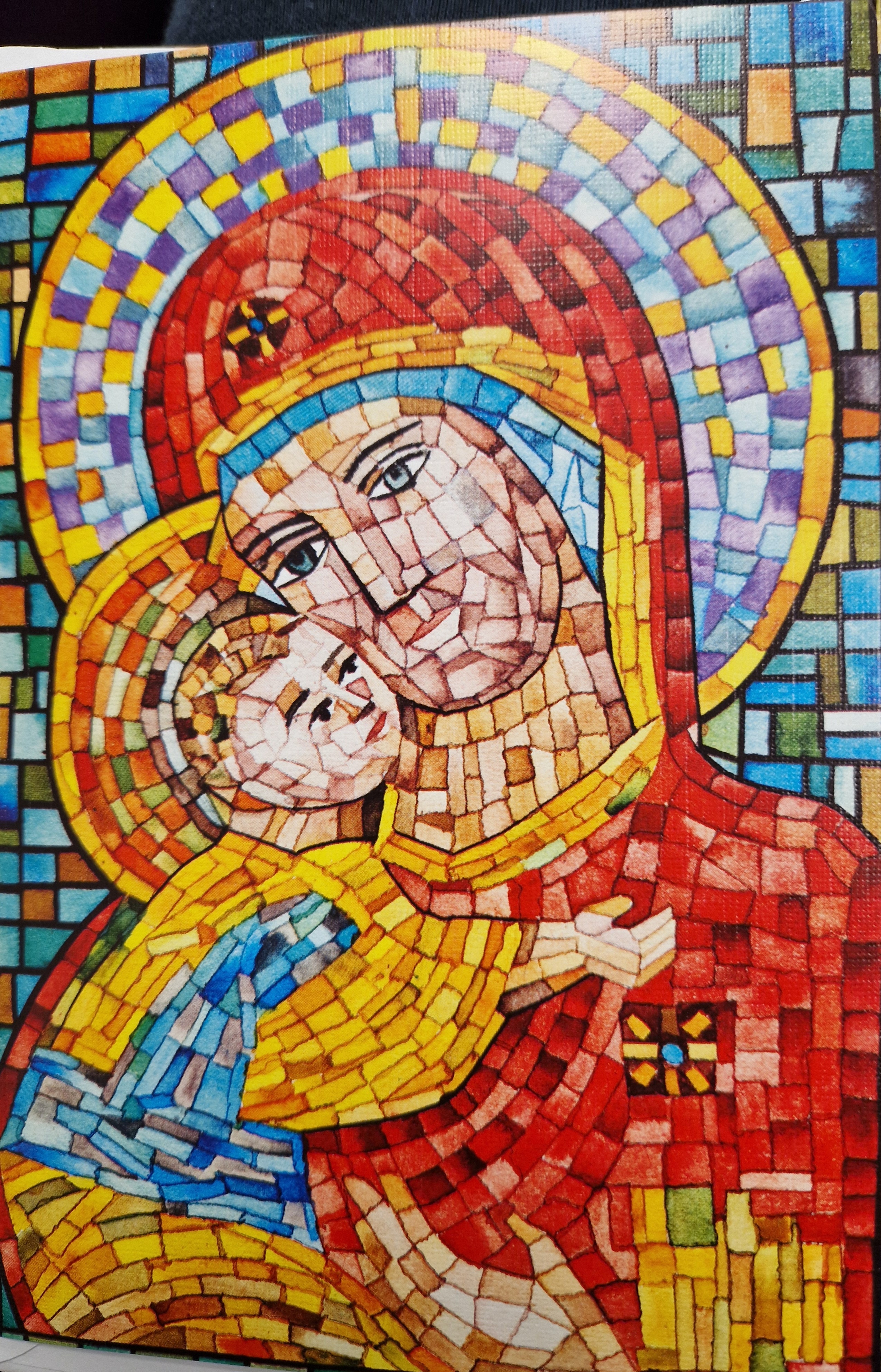
Bismillah. This alleged incident, at the time of the Conquest of Mecca when the Ka’bah was purified of the 360+ idols around it and inside it, was famously mentioned by Martin Lings (Abu Bakr Siraj al-Din), may God have mercy upon him, in his book, Muhammad: His Life Based on the Earliest Sources.
In 1990, JIMAS (UK) published a then-recent exchange of letters in the Saudi Gazette between Abu Bilal Mustafa al-Kanadi [The Canadian], may God have mercy upon him, and Martin Lings, in which Kanadi was very critical of Lings: one of his criticism was Lings’ inclusion of this story in his Sirah (Biography of the Prophet), based on its mention by al-Waqidi in Kitab al-Maghazi (The Book of Military Expeditions) and al-Azraqi (d. 250 H) in Akhbar Makkah (History of Mecca). That exchange is reproduced at the bottom of this post, for reference. Neither correspondent referred to the Hadith expert Imam Dhahabi’s discussion and comment on this report.
Imam Dhahabi’s discussion and comment on this report
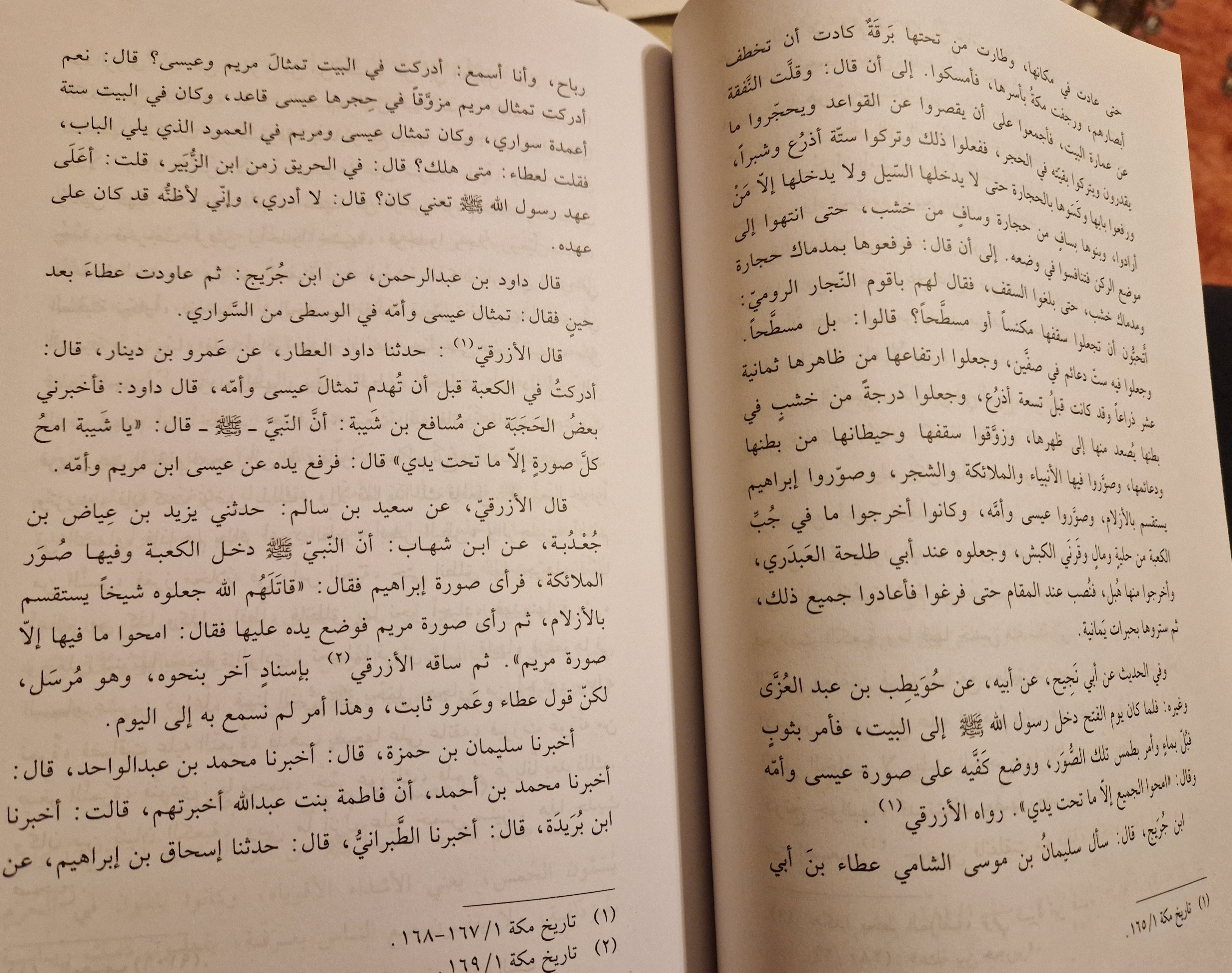
Muslim [bin Khalid] al-Zanji [The Negro], on the authority of Ibn Abi Najih, on the authority of his father [Abu Najih], who said: Men of the Quraysh sat and reminisced about the building of the Ka’bah … [The builders] depicted prophets, angels and trees inside it. They depicted Ibrahim [Abraham] divining with arrows. They depicted Jesus and his mother …
And in the hadith on the authority of Ibn Abi Najih, on the authority of his father [Abu Najih], on the authority of Huwaytib bin ‘Abdul ‘Uzza and others: On the day of the Conquest [of Mecca], the Messenger of God, may God bless him and grant him peace, entered the House [of God]. He ordered for a cloth to be moistened and commanded that those pictures be effaced. He placed his palms upon the picture of Jesus and his mother and said, “Erase them all, except what is beneath my hand.” Al-Azraqi transmitted it.[1]
Ibn Jurayj said: Sulayman bin Musa al-Shami [The Syrian] asked ‘Ata’ bin Abi Rabah [The Mufti of Mecca] whilst I was listening, “Did you come across the statue[2] of Mary and Jesus in the House [of God]?” He replied, “Yes, I came across the embellished[3] statue of Mary with Jesus standing in her lap. There used to be six support pillars inside the House: the statue of Jesus and Mary was in the pillar nearest the door.” So I [Ibn Jurayj] asked ‘Ata’, “When was it destroyed?” He replied, “In the fire during the rule of Ibn al-Zubayr.” I asked, “Do you mean that it was there during the time of the Messenger of God, may God bless him and grant him peace?” He replied, “I do not know, but I think it was there during his time.”
Dawud bin ‘Abdul Rahman said, on the authority of Ibn Jurayj: I then repeated the question to ‘Ata’ after a while. He said, “The statue of Jesus and his mother was in the middle pillar.”
Al-Azraqi said: [4] Dawud al-‘Attar [The Perfumier] narrated to us, on the authority of ‘Amr bin Dinar, who said, “I came across the statue of Jesus and his mother in the Ka’bah before it was demolished.”[5] Dawud said: One of the gatekeepers informed me on the authority of Musafi’ bin Shaybah that The Prophet, may God bless him and grant him peace, said: “O Shaybah! Erase all the pictures except what is beneath my hand.” When he lifted his hand, there was Jesus, son of Mary, and his mother.
Al-Azraqi said, on the authority of Sa’id bin Salim: Yazid bin ‘Iyad bin Ju’dubah narrated to me, on the authority of Ibn Shihab [al-Zuhri] that The Prophet, may God bless him and grant him peace, entered the Ka’bah containing pictures of angels. He saw the picture of Ibrahim [Abraham] and said, “May God fight them! They made him an old man divining with arrows.” He then saw the picture of Mary and placed his hand upon it, saying, “Erase all [the pictures] in it, except the picture of Mary.”
Al-Azraqi then quoted similarly with another chain of transmission. It is mursal [“hanging loose”; discontinuous].[6] But the statements of ‘Ata’ and ‘Amr are established (thabit): this is a matter that we had never heard of until today. [emphasis added]
Source:
al-Imam Shams al-Din Muhammad bin Ahmad bin ‘Uthman al-Dhahabi (d. 748 H / 1347 CE),
Siyar A’lam al-Nubala’ (Biographies of Notable Nobles),
ed. Dr Bashshar ‘Awwad Ma’ruf,
Mu’assasat al-Risalah, Beirut, 1422 H / 2001 CE, vol. 26, pp. 67-69
[1] The editor of the Siyar adds the reference: Akhbar Makkah,1/165
[2] Timthal: icon, picture or statue
[3] Muzawwaq: embellished, especially with quicksilver (mercury) or an amalgam of quicksilver and gold.
[4] The editor of the Siyar adds the reference: Akhbar Makkah,1/167-8
[5] The Ka’bah has been destroyed and rebuilt several times in its history due to floods, fires, earthquakes, etc.
[6] Mursal especially refers to a Follower (Tabi’i) quoting the Prophet directly without naming the Companion (Sahabi) from whom he must have heard the narration. In this case, Ibn Shihab [al-Zuhri] is a Follower and quotes The Prophet directly without naming the intervening Companion(s), so the narration is mursal. There is much difference of opinion amongst Hadith scholars about the authenticity of the mursal hadith. See the section on this topic in Suhaib Hasan, An Introduction to the Science of Hadith, Al-Qur’an Society, London, 1994, pp. 24-29.
ANALYSIS & BIOGRAPHICAL NOTES from Imam Dhahabi’s Tadhkirat al-Huffaz (Memoire of the Preservers of Hadith)
A. IBN SHIHAB AL-ZUHRI (50-124 H): The most knowledgeable of the Preservers of Hadith (Huffaz)
Abu Bakr Muhammad bin Muslim bin ‘Ubaydillah bin ‘Abdillah bin Shihab bin ‘Abdillah bin Zuhrah bin Kulab, The Qurayshi, The Zuhri, The Madinan, The Imam. He narrated Hadith from Ibn ‘Umar, Sahl bin Sa’d, Anas bin Malik, Mahmud bin al-Rabi’, Sa’id bin al-Musayyib, Abu Umamah bin Sahl and their generation of minor Companions (Sahabah) and major Followers (Tabi’in). The following narrated Hadith from him: Ma’mar bin Rashid, Awza’i, Layth, Malik, Sufyan bin ‘Uyaynah and multitudes besides them.
Layth said, “I never saw a person of knowledge at all more comprehensive than Zuhri. He would narrate about encouragement of worship: you would say that he only specialised in that. If he narrated about the (history of) the Arabs and genealogies, you would say that he only specialised in those. If he narrated about the Qur’an and the Sunnah, then similarly … He was amongst the most generous of people … He used to drink honey a lot, but not eat apples. He said: I never forgot any knowledge after my heart had deposited it … No-one has had patience upon knowledge like my patience; no-one has spread knowledge the way I have.”
Nafi’ checked his memorisation of the Qur’an with Zuhri. (Zuhri memorised the entire Qur’an in eighty nights.) ‘Umar bin ‘Abdul ‘Aziz said, “No one remains more knowledgeable about past traditions than Zuhri.” Malik said, “Ibn Shihab remained, but there was no-one similar to him in the world.” Ayyub al-Sikhtiani said, “I did not see anyone more knowledgeable than him.” ‘Amr bin Dinar said, “I did not see the dinar (gold coin) and the dirham (silver coin) less important to anyone than Zuhri: they were like dung to him.” Others said: Zuhri was an accomplished soldier. He used to dye his grey hair with henna.
[The Umayyad Caliph] Hisham bin ‘Abdul Malik asked Zuhri to dictate some knowledge to one of his sons, so he dictated four hundred hadiths to him. Zuhri then assembled People of Hadith and narrated those four hundred hadiths to them. He met Hisham again after a month or so: Hisham tested him by telling him that the book of dictated hadiths had been lost. Zuhri called a scribe and dictated the hadiths again: these were compared against the original book, and there was not a single difference, not even in a letter. Makhul was asked, “Who was the most knowledgeable person you ever met?” He replied, “Ibn Shihab.” He was asked, “Then who?” He replied, “Ibn Shihab.”
Some further statements of Ibn Shihab al-Zuhri:
“Al-Qasim bin Muhammad said to me: I see that you are eager for knowledge: Shall I not then point you to one of its great vessels? … ‘Amrah bint ‘Abdul Rahman, for she grew up in ‘Aisha’s lap. So I came to her and found her to be an ocean that could not be exhausted.”
“I never revised knowledge at all.”
“Whoever would like to memorise hadiths, should eat raisins.”
“A Preserver of Hadith is only born once in forty years.”
“God has not been worshipped via anything better than knowledge.”
B. ‘AMR BIN DINAR, THE PRESERVER OF HADITH, THE IMAM (c. 46-126 H)
The person of knowledge of the Sanctuary (Haram). Abu Muhammad of Jumayh (their freed-slave), The Meccan, al-Athram. He heard traditions from Ibn ‘Abbas, Ibn ‘Umar, Jabir bin ‘Abdillah, Bajalah bin ‘Abdah, Anas bin Malik, Abu l-Sha’tha’, Tawus and many others. Shu’bah, Ibn Jurayj, the two Hammads [Hammad bin Zayd & Hammad bin Salamah], the two Sufyans [Sufyan bin ‘Uyaynah & Sufyan al-Thawri], Warqa’ and many besides them, all narrated from him.
Shu’bah said, “I did not see anyone more established in Hadith than ‘Amr.” Ibn Mahdi said: Shu’bah said to me, “I did not see anyone like ‘Amr bin Dinar.” Yahya al-Qattan and Ahmad [bin Hanbal] said, “He was more established than Qatadah.” ‘Abdullah bin Abi Najih said, “I never saw anyone at all with more (juristic) understanding than ‘Amr, not even ‘Ata’, Mujahid or Tawus.”
Ibn ‘Uyaynah said, “He would not leave the mosque. He would ride a donkey. I only ever saw him sitting down. He was a person of understanding (jurist). He would narrate by meaning … Trustworthy, Trustworthy, Trustworthy … He divided the night into three: he would sleep for a third, teach his hadiths for a third and pray for a third … We did not have anyone with more understanding, knowledge or preservation than ‘Amr bin Dinar.”
The Hafiz Ibn al-Mufaddal established him as one of the four amongst the top generation (of hadith-narrators) after the year 40 H: Zuhri, ‘Amr bin Dinar, Qatadah & Abu Ishaq al-Sabi’i.
C. MUSLIM BIN KHALID AL-ZANJI (100-180 H): “the Imam, the Man of Understanding (Jurist) … Shaykh of the Sanctuary (Haram).”
Muslim bin Khalid al-Zanji [The Negro]. He narrated Hadith from the likes of Ibn Abi Mulaykah, Ibn Shihab al-Zuhri, ‘Amr bin Dinar, Zayd bin Aslam, Hisham bin ‘Urwah, ‘Abdul Malik Ibn Jurayj and their generation. He devoted himself to Ibn Jurayj for a while, gained juristic understanding and gave fatwas, concentrating on knowledge. He transmitted the (Qur’anic) letter variations (huruf) from ‘Abdullah bin Kathir, and gave Shafi’i permission to give fatwas. Shafi’i, Marwan al-Tatiri, Humaydi, Musaddad, Hakam bin Musa, the Hafiz Ibrahim bin Musa, Hisham bin ‘Ammar and others narrated Hadith from him.
Azraqi said, “He was a person of understanding and worship. He would fast all the time.”
Yahya Ibn Ma’in said, “There is no problem with him.”
Ibn ‘Adi said, “He is good in Hadith: I hope there is no problem with him.”
Abu Dawud said, “Weak in Hadith.”
Bukhari said, “Rejected in Hadith.”
Abu Hatim said, “He is not used as a proof.”
Ibrahim al-Harbi said, “He was the Jurist of Mecca.”
Suwayd said, “He was named ‘The Negro’ because of his black skin.” But Ibn Sa’d and others said that he was blonde: he was termed ‘The Negro’ via the irony of opposite meaning. Dhahabi: He died in 180 H, aged 80.


 UNITY
UNITY 