Archive for the ‘Hadith’ Category

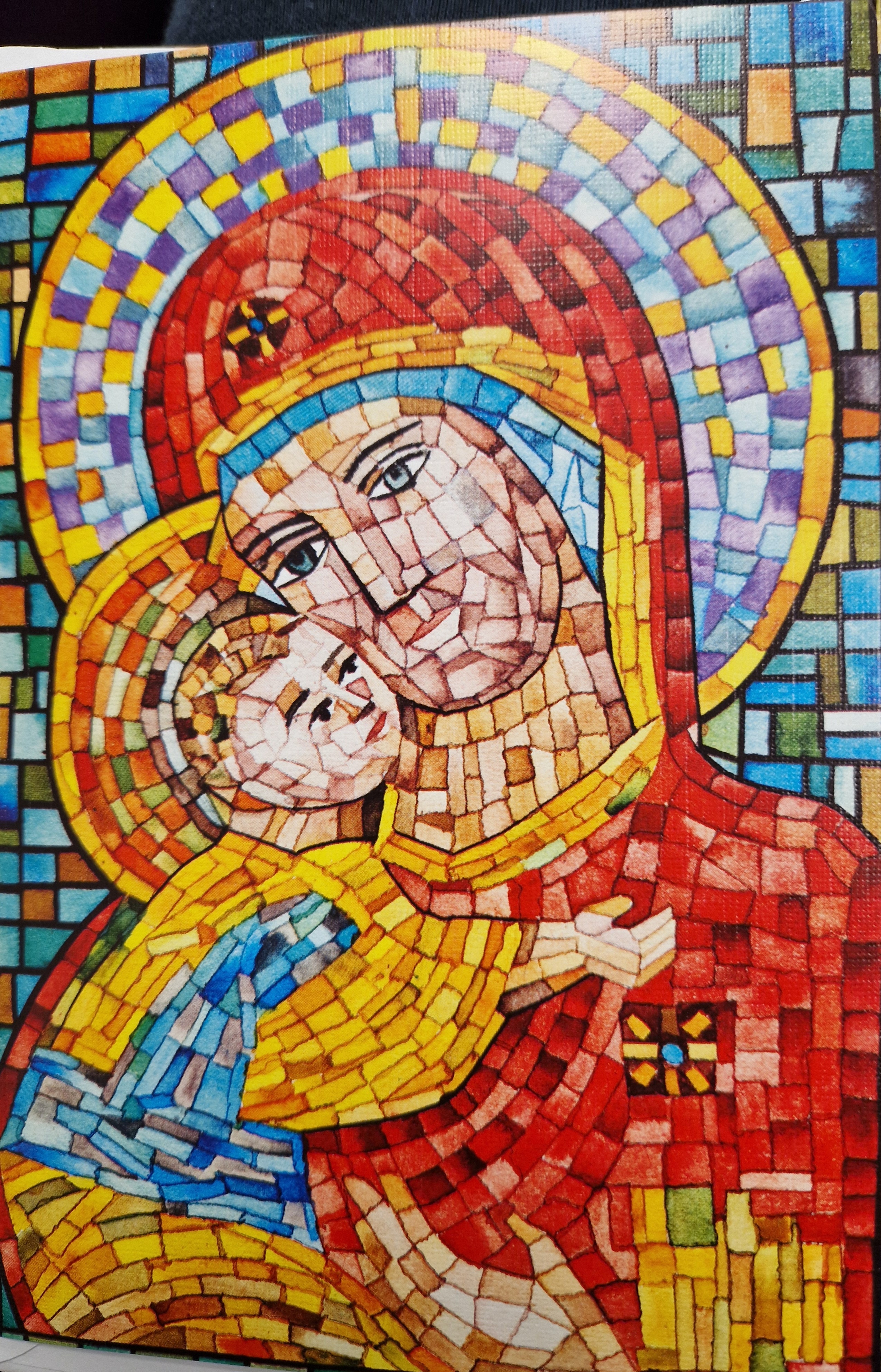
Did the Prophet Muhammad protect an icon of Mary and Jesus inside the Ka’bah at Mecca?

December 25, 2025

Bismillah. This alleged incident, at the time of the Conquest of Mecca when the Ka’bah was purified of the 360+ idols around it and inside it, was famously mentioned by Martin Lings (Abu Bakr Siraj al-Din), may God have mercy upon him, in his book, Muhammad: His Life Based on the Earliest Sources.

In 1990, JIMAS (UK) published a then-recent exchange of letters in the Saudi Gazette between Abu Bilal Mustafa al-Kanadi [The Canadian], may God have mercy upon him, and Martin Lings, in which Kanadi was very critical of Lings: one of his criticism was Lings’ inclusion of this story in his Sirah (Biography of the Prophet), based on its mention by al-Waqidi in Kitab al-Maghazi (The Book of Military Expeditions) and al-Azraqi (d. 250 H) in Akhbar Makkah (History of Mecca). That exchange is reproduced at the bottom of this post, for reference. Neither correspondent referred to the Hadith expert Imam Dhahabi’s discussion and comment on this report.

Imam Dhahabi’s discussion and comment on this report

Muslim [bin Khalid] al-Zanji [The Negro], on the authority of Ibn Abi Najih, on the authority of his father [Abu Najih], who said: Men of the Quraysh sat and reminisced about the building of the Ka’bah … [The builders] depicted prophets, angels and trees inside it. They depicted Ibrahim [Abraham] divining with arrows. They depicted Jesus and his mother …

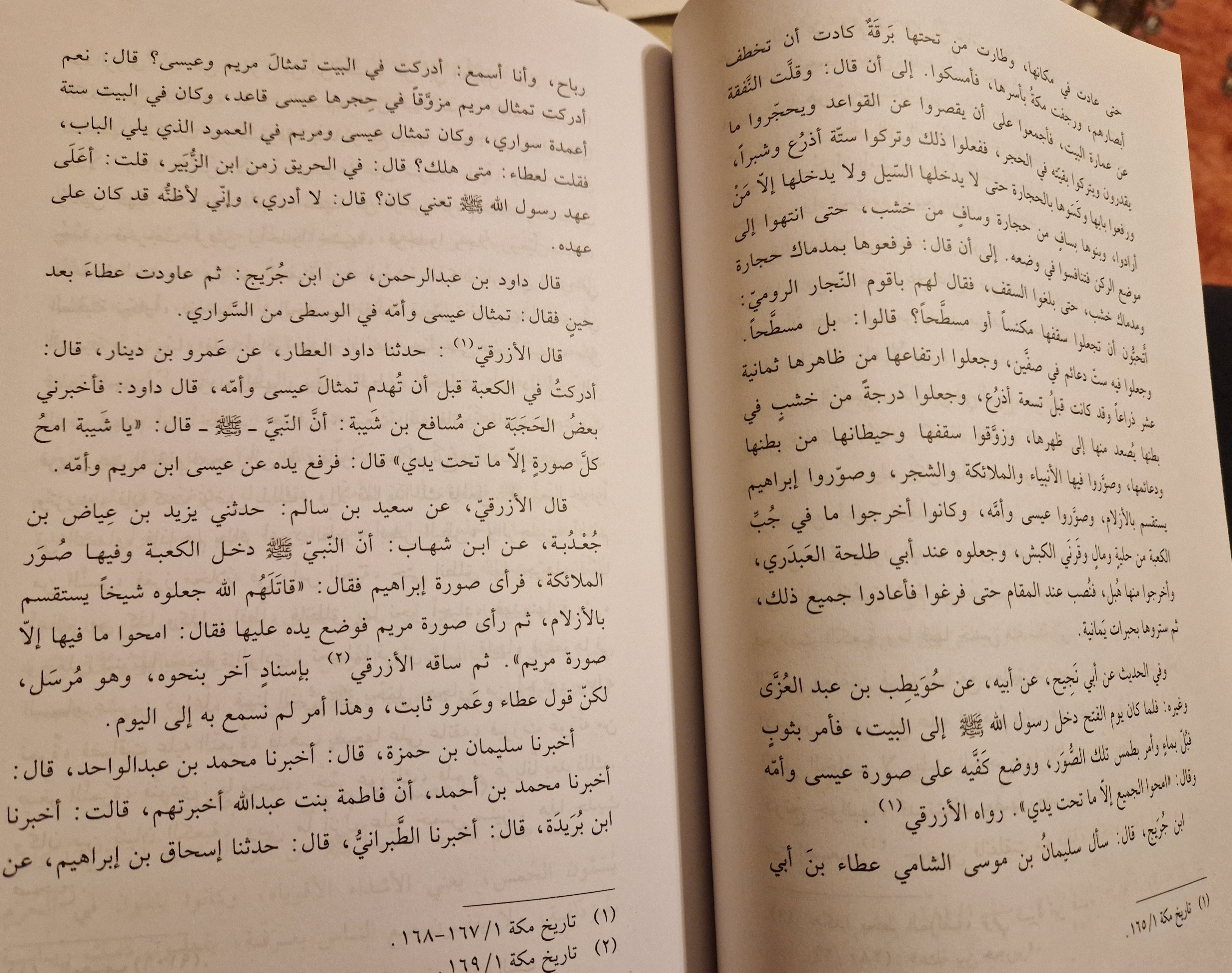
And in the hadith on the authority of Ibn Abi Najih, on the authority of his father [Abu Najih], on the authority of Huwaytib bin ‘Abdul ‘Uzza and others: On the day of the Conquest [of Mecca], the Messenger of God, may God bless him and grant him peace, entered the House [of God]. He ordered for a cloth to be moistened and commanded that those pictures be effaced. He placed his palms upon the picture of Jesus and his mother and said, “Erase them all, except what is beneath my hand.” Al-Azraqi transmitted it.[1]

Ibn Jurayj said: Sulayman bin Musa al-Shami [The Syrian] asked ‘Ata’ bin Abi Rabah [The Mufti of Mecca] whilst I was listening, “Did you come across the statue[2] of Mary and Jesus in the House [of God]?” He replied, “Yes, I came across the embellished[3] statue of Mary with Jesus standing in her lap. There used to be six support pillars inside the House: the statue of Jesus and Mary was in the pillar nearest the door.” So I [Ibn Jurayj] asked ‘Ata’, “When was it destroyed?” He replied, “In the fire during the rule of Ibn al-Zubayr.” I asked, “Do you mean that it was there during the time of the Messenger of God, may God bless him and grant him peace?” He replied, “I do not know, but I think it was there during his time.”

Dawud bin ‘Abdul Rahman said, on the authority of Ibn Jurayj: I then repeated the question to ‘Ata’ after a while. He said, “The statue of Jesus and his mother was in the middle pillar.”

Al-Azraqi said: [4] Dawud al-‘Attar [The Perfumier] narrated to us, on the authority of ‘Amr bin Dinar, who said, “I came across the statue of Jesus and his mother in the Ka’bah before it was demolished.”[5] Dawud said: One of the gatekeepers informed me on the authority of Musafi’ bin Shaybah that The Prophet, may God bless him and grant him peace, said: “O Shaybah! Erase all the pictures except what is beneath my hand.” When he lifted his hand, there was Jesus, son of Mary, and his mother.

Al-Azraqi said, on the authority of Sa’id bin Salim: Yazid bin ‘Iyad bin Ju’dubah narrated to me, on the authority of Ibn Shihab [al-Zuhri] that The Prophet, may God bless him and grant him peace, entered the Ka’bah containing pictures of angels. He saw the picture of Ibrahim [Abraham] and said, “May God fight them! They made him an old man divining with arrows.” He then saw the picture of Mary and placed his hand upon it, saying, “Erase all [the pictures] in it, except the picture of Mary.”

Al-Azraqi then quoted similarly with another chain of transmission. It is mursal [“hanging loose”; discontinuous].[6] But the statements of ‘Ata’ and ‘Amr are established (thabit): this is a matter that we had never heard of until today. [emphasis added]

Source:

al-Imam Shams al-Din Muhammad bin Ahmad bin ‘Uthman al-Dhahabi (d. 748 H / 1347 CE),
Siyar A’lam al-Nubala’ (Biographies of Notable Nobles),
ed. Dr Bashshar ‘Awwad Ma’ruf,
Mu’assasat al-Risalah, Beirut, 1422 H / 2001 CE, vol. 26, pp. 67-69


[1] The editor of the Siyar adds the reference: Akhbar Makkah,1/165

[2] Timthal: icon, picture or statue

[3] Muzawwaq: embellished, especially with quicksilver (mercury) or an amalgam of quicksilver and gold.

[4] The editor of the Siyar adds the reference: Akhbar Makkah,1/167-8

[5] The Ka’bah has been destroyed and rebuilt several times in its history due to floods, fires, earthquakes, etc.

[6] Mursal especially refers to a Follower (Tabi’i) quoting the Prophet directly without naming the Companion (Sahabi) from whom he must have heard the narration. In this case, Ibn Shihab [al-Zuhri] is a Follower and quotes The Prophet directly without naming the intervening Companion(s), so the narration is mursal. There is much difference of opinion amongst Hadith scholars about the authenticity of the mursal hadith. See the section on this topic in Suhaib Hasan, An Introduction to the Science of Hadith, Al-Qur’an Society, London, 1994, pp. 24-29.

ANALYSIS & BIOGRAPHICAL NOTES from Imam Dhahabi’s Tadhkirat al-Huffaz (Memoire of the Preservers of Hadith)

A. IBN SHIHAB AL-ZUHRI (50-124 H): The most knowledgeable of the Preservers of Hadith (Huffaz)

Abu Bakr Muhammad bin Muslim bin ‘Ubaydillah bin ‘Abdillah bin Shihab bin ‘Abdillah bin Zuhrah bin Kulab, The Qurayshi, The Zuhri, The Madinan, The Imam. He narrated Hadith from Ibn ‘Umar, Sahl bin Sa’d, Anas bin Malik, Mahmud bin al-Rabi’, Sa’id bin al-Musayyib, Abu Umamah bin Sahl and their generation of minor Companions (Sahabah) and major Followers (Tabi’in). The following narrated Hadith from him: Ma’mar bin Rashid, Awza’i, Layth, Malik, Sufyan bin ‘Uyaynah and multitudes besides them.

Layth said, “I never saw a person of knowledge at all more comprehensive than Zuhri. He would narrate about encouragement of worship: you would say that he only specialised in that. If he narrated about the (history of) the Arabs and genealogies, you would say that he only specialised in those. If he narrated about the Qur’an and the Sunnah, then similarly … He was amongst the most generous of people … He used to drink honey a lot, but not eat apples. He said: I never forgot any knowledge after my heart had deposited it … No-one has had patience upon knowledge like my patience; no-one has spread knowledge the way I have.”

Nafi’ checked his memorisation of the Qur’an with Zuhri. (Zuhri memorised the entire Qur’an in eighty nights.) ‘Umar bin ‘Abdul ‘Aziz said, “No one remains more knowledgeable about past traditions than Zuhri.” Malik said, “Ibn Shihab remained, but there was no-one similar to him in the world.” Ayyub al-Sikhtiani said, “I did not see anyone more knowledgeable than him.” ‘Amr bin Dinar said, “I did not see the dinar (gold coin) and the dirham (silver coin) less important to anyone than Zuhri: they were like dung to him.” Others said: Zuhri was an accomplished soldier. He used to dye his grey hair with henna.

[The Umayyad Caliph] Hisham bin ‘Abdul Malik asked Zuhri to dictate some knowledge to one of his sons, so he dictated four hundred hadiths to him. Zuhri then assembled People of Hadith and narrated those four hundred hadiths to them. He met Hisham again after a month or so: Hisham tested him by telling him that the book of dictated hadiths had been lost. Zuhri called a scribe and dictated the hadiths again: these were compared against the original book, and there was not a single difference, not even in a letter. Makhul was asked, “Who was the most knowledgeable person you ever met?” He replied, “Ibn Shihab.” He was asked, “Then who?” He replied, “Ibn Shihab.”

Some further statements of Ibn Shihab al-Zuhri:

“Al-Qasim bin Muhammad said to me: I see that you are eager for knowledge: Shall I not then point you to one of its great vessels? … ‘Amrah bint ‘Abdul Rahman, for she grew up in ‘Aisha’s lap. So I came to her and found her to be an ocean that could not be exhausted.”

“I never revised knowledge at all.”

“Whoever would like to memorise hadiths, should eat raisins.”

“A Preserver of Hadith is only born once in forty years.”

“God has not been worshipped via anything better than knowledge.”

B. ‘AMR BIN DINAR, THE PRESERVER OF HADITH, THE IMAM (c. 46-126 H)

The person of knowledge of the Sanctuary (Haram). Abu Muhammad of Jumayh (their freed-slave), The Meccan, al-Athram. He heard traditions from Ibn ‘Abbas, Ibn ‘Umar, Jabir bin ‘Abdillah, Bajalah bin ‘Abdah, Anas bin Malik, Abu l-Sha’tha’, Tawus and many others. Shu’bah, Ibn Jurayj, the two Hammads [Hammad bin Zayd & Hammad bin Salamah], the two Sufyans [Sufyan bin ‘Uyaynah & Sufyan al-Thawri], Warqa’ and many besides them, all narrated from him.

Shu’bah said, “I did not see anyone more established in Hadith than ‘Amr.” Ibn Mahdi said: Shu’bah said to me, “I did not see anyone like ‘Amr bin Dinar.” Yahya al-Qattan and Ahmad [bin Hanbal] said, “He was more established than Qatadah.” ‘Abdullah bin Abi Najih said, “I never saw anyone at all with more (juristic) understanding than ‘Amr, not even ‘Ata’, Mujahid or Tawus.”

Ibn ‘Uyaynah said, “He would not leave the mosque. He would ride a donkey. I only ever saw him sitting down. He was a person of understanding (jurist). He would narrate by meaning … Trustworthy, Trustworthy, Trustworthy … He divided the night into three: he would sleep for a third, teach his hadiths for a third and pray for a third … We did not have anyone with more understanding, knowledge or preservation than ‘Amr bin Dinar.”

The Hafiz Ibn al-Mufaddal established him as one of the four amongst the top generation (of hadith-narrators) after the year 40 H: Zuhri, ‘Amr bin Dinar, Qatadah & Abu Ishaq al-Sabi’i.

C. MUSLIM BIN KHALID AL-ZANJI (100-180 H): “the Imam, the Man of Understanding (Jurist) … Shaykh of the Sanctuary (Haram).”

Muslim bin Khalid al-Zanji [The Negro]. He narrated Hadith from the likes of Ibn Abi Mulaykah, Ibn Shihab al-Zuhri, ‘Amr bin Dinar, Zayd bin Aslam, Hisham bin ‘Urwah, ‘Abdul Malik Ibn Jurayj and their generation. He devoted himself to Ibn Jurayj for a while, gained juristic understanding and gave fatwas, concentrating on knowledge. He transmitted the (Qur’anic) letter variations (huruf) from ‘Abdullah bin Kathir, and gave Shafi’i permission to give fatwas. Shafi’i, Marwan al-Tatiri, Humaydi, Musaddad, Hakam bin Musa, the Hafiz Ibrahim bin Musa, Hisham bin ‘Ammar and others narrated Hadith from him.

Azraqi said, “He was a person of understanding and worship. He would fast all the time.”

Yahya Ibn Ma’in said, “There is no problem with him.”

Ibn ‘Adi said, “He is good in Hadith: I hope there is no problem with him.”

Abu Dawud said, “Weak in Hadith.”

Bukhari said, “Rejected in Hadith.”

Abu Hatim said, “He is not used as a proof.”

Ibrahim al-Harbi said, “He was the Jurist of Mecca.”

Suwayd said, “He was named ‘The Negro’ because of his black skin.” But Ibn Sa’d and others said that he was blonde: he was termed ‘The Negro’ via the irony of opposite meaning. Dhahabi: He died in 180 H, aged 80.

ISLAM & THE SEVEN STAGES OF GRIEF

November 29, 2025
3D Isometric Flat Vector Conceptual Illustration of Stages Of Grief, Denial, Anger, Bargaining, Depression, Acceptance

ISLAM & THE SEVEN STAGES OF GRIEF

Bismillah.

Previously, there were five stages of grief generally accepted amongst psychologists as:
1. SHOCK, 2. DENIAL, 3. ANGER, 4. BARGAINING, 5. ACCEPTANCE/HOPE.

Recently, some people have extended this to seven stages by adding GUILT & DEPRESSION after ANGER. But it varies from person to person: these are not necessarily linear stages: they may be cyclical or iterative.  Hence, the 7 stages of grief are:

1. SHOCK, 2. DENIAL, 3. ANGER, 4. GUILT, 5. DEPRESSION, 6. BARGAINING, 7. ACCEPTANCE/HOPE.

0. GRIEF

0.1 THE PROPHET MUHAMMAD’S YEAR OF GRIEF AND SORROW

The Prophet, peace be upon him, experienced his “year of grief or sorrow” (عام الحزن,  ‘Ām al Huzn) during his tenth year of prophethood, ie 3 years before the Hijra, when his only wife Khadija, his stalwart support for 25 years, died, followed closely by his uncle, Abu Talib, his tribal protector as chief of his clan, the Banu Hashim.

(I’m grateful to the Christian priest, whose name I’ve forgotten, who attended our Qur’an discussion circles c. 2013-14 and wished to co-write with me a Christian-Muslim guide to grief, since he had read about the Prophet’s “Year of Grief.” I didn’t have the time or capacity to work on it at the time, but he gave me an idea that has come to fruition today, God-willing.)

0.2 PROPHET YA’QUB BIN ISHAQ BIN IBRAHIM, aka ISRA’IL (JACOB BEN ISAAC BEN ABRAHAM, aka ISRAEL)

In the Surah named after his 11th son, Prophet Yusuf (Joseph), grief is prominent in the “best of stories.”

قال إني ليحزنني أن تذهبوا به وأخاف أن يأكله الذئب وأنتم عنه غافلون

(Yusuf, Joseph, 12:13)

When his elder 10 sons ask for his permission to take Joseph for a day out, Jacob combines grief (for the past) with fear (of the future):

“It grieves me that you take him away (from me), and I fear that the wolf will devour him whilst ye are heedless of him.”

When his sons lie to him, saying that the wolf had indeed eaten Joseph, Jacob sees through their lies and resigns himself to “beautiful patience” (صبر جميل).

Later, when his first 10 sons manage to come home without the 12th son Binyamin (Benjamin) as well, Jacob expresses extreme sorrow for Joseph, reiterates his commitment to “beautiful patience” and goes blind from grief:

وتولّى عنهم وقال ياأسفى على يوسف وابيضت عيناه من الحزن فهو كظيم 

(Yusuf, Joseph, 12:84)

Although Ibn Kathir quotes the commentator Dahhak as explaining kazeem here to mean ka’eeb: intense grief and broken in spirit, i.e. depressed, the vast majority of commentators agree that Prophet Jacob displayed beautiful patience and did not complain to anyone except God, restraining his sorrow and grief. Others amongst the Salaf said that he waited eighty years to see his beloved son Joseph, for whom his grief equalled that of seventy bereaved parents, but he “was never pessimistic about God.” (Tafsir Tabari)

1. SHOCK

1.1 UMAR BIN AL-KHATTAB: SHOCK, DENIAL, ANGER, ACCEPTANCE

Our Master Umar was in shock, denial and anger upon the news of the Prophet’s death, threatening to kill anyone who said that the Prophet was dead, until Our Master Abu Bakr said the famous words:

“Whoever worshiped Muhammad, he should know that Muhammad has died. Whoever worships God, he should know that God is The Ever-Living, Who Will Never Die.”

Abu Bakr also recited from Surah Āl Imran (The Family of Amram), the verses confirming that Muhammad was mortal and speaking of the possibility of his death, for every soul has a predestined moment of death, praising those who show gratitude. Umar commented: “It was as though I had never heard these verses before!” He rapidly reached the stage or station of Acceptance. 

وما محمد إلا رسول، قد خلت من قبله الرسل، أفائن مات أو قتل انقلبتم على أعقابكم، ومن ينقلب على عقبيه فلن يضرّ الله شيئا، وسيجزي الله الشاكرين

وما كان لنفس أن تموت إلا بإذن الله كتابا مؤجلا، ومن يرد ثواب الدنيا نؤته منها، ومن يرد ثواب الآخرة نؤته منها، وسنجزي الشاكرين

Āl Imran, The Family of Amram, 3:144-5)

3. ANGER

3.1 KHALID BIN WALEED 

Our Master Khalid bin Waleed, the Sword of God, was overcome by grief on his deathbed when he realised he wouldn’t be granted martyrdom on the battlefield (because no human’s sword could defeat the Sword of God). He was especially frustrated at knowing how many people are cowards. Khalid’s last words were:

“I have a wound on every inch of my body, but I’m dying like an aging camel. May the eyes of cowards never (find rest in) sleep!”

ASIDE:

Khalid bin Waleed’s extraordinary life and military genius and career deserve to be immortalised in an epic poem in English. I have written opening and closing stanzas for such a poem. I pray that I or someone else is able to complete it:

OPENING STANZA: THE TALE OF KHALID BIN WALEED 

If your eyes do weep and your heart does bleed

At the state of the Muslim nation, 

Then remember the tale of Khalid bin Waleed:

It is enough as inspiration. 

[…]

CLOSING STANZA: KHALID BIN WALEED’S LAST WORDS

“I’m dying like a camel

(Or like an aging sheep):

May the eyes of cowards 

Never rest in sleep!”

TRIVIUM: THE KHALID BIN WALEED PARK IN PESHAWAR, PAKISTAN

This park goes by its Urdu/Farsi name: Khalid bin Waleed Bagh. The locals are Pathan (Pashtun), and so pronounce it somewhat Farsi style, as follows, making the ‘a’ sound like ‘o’: Kholid bin Woleed Bagh. British Empire troops stationed in Peshawar heard it pronounced like this, switched the syllables around and nicknamed the park, the “Colly-Wolly Bean Bag.”

3.2 TRUE PATIENCE IS ONLY AT THE FIRST BLOW

Anas bin Malik narrated that the Prophet, may God bless him and grant him peace, passed by a woman who was weeping at a graveside, mourning a child she had lost. The Prophet said, “Fear God, and have patience.” She replied, not recognising him, “Get away from me, for you have not been afflicted by my affliction!” She was told that it was the Prophet who had spoken to her, so she came to his door and, finding no doorkeepers, said to him, “I did not recognise you.” He replied, “(True) Patience is only at the first blow.” (Bukhari & Muslim)

TRIVIUM: The Arabic for “blow” here is sadmah, root SDM. The name Saddam is derived from this as an intensive form, thus meaning, “One who delivers crushing blows.”

4. GUILT: JOSEPH’S BROTHERS

The 10 elder brothers of Prophet Yusuf (Joseph) had feelings of grief at the perceived favouritism of their father towards Yusuf. This manifested in Anger when some of them suggested killing him. Others felt guilty about this and suggested throwing him into a well, which is what they did. They must have had some feelings of guilt around this, and around lying to their father about Yusuf being eaten by a wolf. After many years, once they were reunited with Yusuf and his magnanimity, they went through the stages of Bargaining and Acceptance/Hope, admitting their mistakes to both Yusuf and their father Ya’qub. (Yusuf, Joseph, 12:91 & 12:97)

7. ACCEPTANCE/HOPE: NO FEAR, NO GRIEF

The Prophet, may God bless him and grant him peace, endured his Year of Grief with immense patience and acceptance. This is the way of “living in the moment” as “children of the moment in time” (abna’ al-waqt) without fear (of the future) or grief (for the past), the way of the “Friends of God” or saints. The phrase, “There will be no fear upon them, nor will they grieve,” occurs repeatedly in the Qur’an for the People of the Garden in the Hereafter. However, it applies to certain, select people in this world also:

أَلَآ إِنَّ أَوْلِيَآءَ ٱللَّهِ لَا خَوْفٌ عَلَيْهِمْ وَلَا هُمْ يَحْزَنُونَ
ٱلَّذِينَ ءَامَنُوا۟ وَكَانُوا۟ يَتَّقُونَ

Lo! Truly, the Friends of God:

There is no fear upon them, 

Nor do they grieve:

Those who have achieved faith (inner security)

And were always saving themselves (taqwa).

(Yunus, Jonah, 10:62-63)

In Imam al-Qushayri’s Treatise on Tasawwuf (Sufism), the first topic he discusses after brief biographies of early Sufis is that of Time (Waqt), where he says that “the Sufi is the son of his time,” i.e. that he lives in the moment. Shaykh Hamza Yusuf linked this to the above Qur’anic verse during a conversation in Abu Dhabi, 2022.

It is narrated from the Prophet, may God bless him and grant him peace, that this applies to people in this world “who did not fear when the people had fear, and did not grieve when people grieved.” They will be surrounded by Light in the Hereafter, and made to sit upon pulpits of Light: even the Prophets and the Martyr-Witnesses will be amazed by their station. (Tafsir Tabari, #17,730 & #17,731)

Usama Hasan

London, UK

8th Jumada al-Thani 1447

28th November 2025

WHO ARE THE MU’ALLAFATU QULUBUHUM (THOSE WHO ARE GIVEN ZAKAT TO BRING THEIR HEARTS NEAR) ?

April 22, 2024

WITH THE NAME OF GOD, ALL-MERCIFUL, MOST MERCIFUL

WHO ARE THE MU’ALLAFATU QULUBUHUM
(THOSE WHO ARE GIVEN ZAKAT/ALMS TO BRING THEIR HEARTS NEAR) ?

Allah (God) says in the Qur’an:

إِنَّمَا الصَّدَقـٰتُ لِلفُقَراءِ وَالمَسـٰكينِ وَالعـٰمِلينَ عَلَيها وَالمُؤَلَّفَةِ قُلوبُهُم وَفِى الرِّقابِ وَالغـٰرِمينَ وَفى سَبيلِ اللَّهِ وَابنِ السَّبيلِ ۖ فَريضَةً مِنَ اللَّهِ ۗ وَاللَّهُ عَليمٌ حَكيمٌ

Truly, the [compulsory] alms are only for: the poor; the needy;
those who work upon them (in alms-collection);
those whose hearts are brought near;
those whose necks are under the yoke;
those who have taken on a major debt;
in the path of God; and the child of the path [i.e. the traveller]:
an obligation from God: for God is Knowing, Wise.

(Surah al-Tawbah, Repentance, 9:60 Hafs)

TAFSIR TABARI ON THIS VERSE (SUMMARISED)

Imam Tabari (224-310 H / 839-923 CE) said:

As for “those whose hearts are brought near”: they were a group of people who were brought closer to Islam (through the incentive of being given wealth), who could not be (openly) supported. The alms benefited themselves and their close families. Such people were: Abu Sufyan bin Harb, ‘Uyaynah bin Badr, Aqra’ bin Habis and similar heads of tribes.

Similar to what we have said, has been said by the People of Interpretation.

Mention of those who said that: Ibn ‘Abbas, Yahya bin Abi Kathir, Zuhri, Mujahid, Hasan [Basri] and Qatadah. Yahya bin Abi Kathir said that such heads of tribes were given a hundred she-camels[1] each by the Prophet, may God bless him and grant him peace; a few others were given fifty each. Zuhri added that this phrase includes Jews and Christians who submit to God (via Islam), even if they are rich.

The people of knowledge differed about whether or not this category exists today, and whether anyone today may be given charity to bring them closer to Islam?

Some of them said: The category of “those whose hearts are brought together” is invalid today: there is no share in the compulsory alms except for those in need, those in the path of God and those who work upon them (in alms-collection).

Mention of those who said that: Hasan [Basri], ‘Amir [bin Sharahil al-Sha’bi] and ‘Umar bin al-Khattab.

When ‘Uyaynah bin Hisn came to [Caliph] ‘Umar bin al-Khattab [seeking to be given alms], ‘Umar said, “The Truth (has come) from your Lord: so whoever wishes to, may have faith; and whoever wishes to, may deny!” [Surah al-Kahf, The Cave, 18:29 Hafs] That is, there is no bringing near today.

‘Amir [bin Sharahil al-Sha’bi] said: Those whose hearts were brought near, were only during the time of the Prophet, may God bless him and grant him peace: when Abu Bakr, may God Exalted’s Mercy be upon him, came to power, incentives stopped.

Others said: “Those whose hearts are brought near” exist in every age, and they have a right to some alms.

Mention of those who said that: Abu Ja’far [i.e. Imam Muhammad bin ‘Ali al-Baqir].

Abu Ja’far [i.e. Imam Tabari, who had his own, independent Madhhab] said:

The correct saying from amongst those, in my view, is that God has made alms to serve two purposes. One of them is to fill any gaps (of need) amongst the Muslims. The other is to aid and strengthen Islam. Whatever charity is to aid Islam and strengthen its means, this is given to both rich and poor. This is because it is not given to a person due to his need for it, but is given to him in order to aid the religion. This is just like what is given to a person for the sake of sacred war (Jihad) in the way of God, for that is given to him whether he is rich or poor, and not to fill his gap (of need). Similar are those whose hearts are brought near: they are given that charity even if they are rich: such giving to them seeks to benefit the matter of Islam and seeks to strengthen and fortify it.

The Prophet, may God bless him and grant him peace, gave to whomever amongst those whose hearts were to be brought near, after God opened the victories for him: Islam spread and its people increased in honour. Thus, there is no proof in the argument of the one who says that “Today, no-one is to be brought near to Islam (via alms), because the people of Islam, by their great number, are prevented from being reached by anyone who wishes to give them alms.” The Prophet, may God bless him and grant him peace, gave to those whom he gave whilst they were in the condition that has been described.

TAFSIR IBN KATHIR ON THIS VERSE (SUMMARISED)

Imam Ibn Kathir (700-774 H / 1300-1373 CE) said:

As for “those whose hearts are brought near”:

[1] Some were those who were given (alms) that they may submit (in Islam).

An example is that the Prophet, may God bless him and grant him peace, gave to Safwan bin Umayyah out of the spoils (of war) at Hunayn, a battle that the latter had witnessed as a polytheist. Imam Ahmad, Muslim and Tirmidhi narrated that Safwan bin Umayyah said, “The Messenger of God, may God bless him and grant him peace, gave me (wealth) on the Day of Hunayn whilst he was the most hated of people to me, but he continued giving me (wealth) until he became the most beloved of people to me.”

[2] Some were given (alms) in order that they improve their Islam (having already submitted) and for their hearts to become firm.

An example is that he distributed (wealth), on the Day of Hunayn, to a group of tribal chiefs and nobles amongst the released captives: a hundred camels each. He said, “Truly, I give to a man whilst another is more beloved to me, fearing that God will upend him (the former) on his face in the Fire of Jahannam.”

In the two Sahihs (of Bukhari and Muslim), there is on the authority of Abu Sa’id that ‘Ali sent a small nugget of gold, (encased) in its rock, to the Prophet, may God bless him and grant him peace, from Yemen: he divided it amongst four people: Aqra’ bin Habis, ‘Uyaynah bin Badr, ‘Alqamah bin ‘Ulathah and Zayd al-Khayr, and said, “I bring them near.”

[3] Some were given (wealth) because of the hope that their peers would submit (in Islam).

[4] Some were given (wealth) in order to elicit alms from those around them, or

[5] To ward off harm from the border lands around the territory of the Muslims.

The place for detailed explanation of this is the books of jurisprudential rulings (furu’).

And God knows best.

Can alms be given to those being brought closer to Islam, after the (time of) the Prophet, may God bless him and grant him peace ?

There is difference of opinion in this matter.

It is narrated from ‘Umar, ‘Amir al-Sha’bi and a group (of authorities) that they are not to be given (alms) after his time, because God has honoured Islam and its people, established them firmly in the land and made the necks of others subservient to them.

Others said: Rather, they are to be given (alms) because he, Blessings and Peace be upon him, gave to such people after the Opening of Mecca [i.e. when Islam had already become established] and the Breaking of (the Tribe of) Hawazin [at Hunayn]: this was a situation where alms might be needed, so these could be diverted to them.

IMAM ABU BAKR AL-JASSAS (HANAFI) & QADI ABU BAKR IBN AL-‘ARABI (MALIKI)[2]

Imam Abu Bakr al-Jassas (305-370 H / 917-981 CE) said in his Ahkam al-Qur’an (Rulings of the Qur’an), whilst discussing the premise that alms are essentially for the poor:

If it is said that “those whose hearts were brought near” would receive alms without being poor, it would be said in reply: they would not receive it as alms; rather, alms would be collected for the poor, but some of it would be given to those whose hearts are brought near, in order to repel their harm against the poor amongst the Muslims, and that the former might submit in Islam, thus strengthening the poor amongst the Muslims. Thus, they would not receive it as alms; rather, alms were collected and used for the benefit (masalih) of the Muslims. This is because wealth given for the poor may be diverted for their benefit (masalih) if the Imam [i.e. the Caliph] rules over them and decides about matters beneficial to them (masalih).

[Summarised] Qadi Abu Bakr ibn al-‘Arabi (468-543 H / 1076-1148 CE) said in his Ahkam al-Qur’an (Rulings of the Qur’an):

THE NINTH ISSUE [regarding this verse of the Qur’an]

About “those whose hearts are brought near,” there are four views:

  1. They were given alms because of the weakness of their certainty, until this became strong. Those who said that they were Muslims, cited the examples of Abu Sufyan bin Harb, Aqra’ bin Habis and ‘Abbas bin Mirdas. Those who said that they were non-Muslims, cited the example of ‘Amir bin Tufail. Those who said that they were polytheists with an inclination towards Islam, cited the example of Safwan bin Umayyah.

  2. Yahya bin Abi Kathir named them as leaders of the following [ten] tribes or clans: Banu Umayyah, Banu Jumah, Banu ‘Amir, Banu Asad, Banu Hashim, Banu Fazarah, Banu Tamim, Banu Nasr, Banu Sulaym and Thaqif.

  3. Ibn Wahb narrated from Malik that he said: Safwan bin Umayyah, Hakim bin Hizam, Aqra’ bin Habis, ‘Uyaynah bin Badr, Suhayl bin ‘Amr and Abu Sufyan were amongst “those whose hearts were brought near,” and that on the day [of Hunayn] when Safwan was given alms, he was a polytheist.

    Asbagh said, on the authority of Ibn al-Qasim: “Those whose hearts were brought near” were Safwan bin Umayyah and certain men of Quraysh.

  4. The Shaykh Abu Ishaq named them to be forty men of the Quraysh and other tribes, including leaders and others.

THE TENTH ISSUE

There has been a difference of opinion as to whether [the category of] “those whose hearts are brought near” persisted.

Some of them said: They [i.e. this category of people] disappeared. This view was expressed by a group (of authorities), and was held by Malik.

Some said: They remain, because the Imam [i.e. the Caliph] may need to bring people near to Islam. [Caliph] ‘Umar discontinued them [i.e. this category of people] because of what he saw of the might of the religion.

My view is that if Islam is strong, this category disappears; but if such people are needed, they are given their share, just as the Messenger of God, may God bless him and grant him peace, used to give the share. For it is narrated in the Sahih (authentic hadiths): “Islam began as a stranger, and will return as a stranger, as it began.” [Sahih Muslim]

THE ELEVENTH ISSUE

If we say that this category of people has disappeared, then their share returns to all the (other) categories, or to whichever (category or categories) the Imam decides, according to the previous explanation regarding the root of the disagreement.

Zuhri said: Half of their share is to be given to those who frequent the mosques. There is no evidence for this view. The first view (mentioned above) is more correct.


[1] A hundred camels represents a lot of wealth: it is the same as the diyah (blood-money) for murder. In today’s financial terms, it would approximate up to a hundred thousand US dollars or UK pounds, or even more. (AQS)

[2] The Hanafi and Maliki schools are complementary, in the sense that they represent the schools of Reason (Ahl al-Ra’y) and Tradition (Ahl al-Hadith) respectively. A holistic approach to the Sunnah combines these complementary approaches, as per Imam Shatibi (cf. Al-Shanqiti, On Madhhabs & Taqlid, AQS, 1445/2023)

DO WE FOLLOW THE AUTHENTIC HADITH, OR THE CONTRARY VIEWS OF IMAM, ABOUT FASTING SIX DAYS OF SHAWWAL, THE MONTH THAT FOLLOWS RAMADAN ?

April 11, 2024

Imam Nawawi said in his Commentary upon the hadith of Sahih Muslim about fasting the six days of Shawwal:

“In it is a clear indication to support the position of Shafi’i, Ahmad, Dawud and those who agreed with them in recommending the fasting of these six days. Malik and Abu Hanifah said that it is disliked. Malik said in al-Muwatta’ , ‘I never saw any of the people of knowledge fasting these days … They said: It is disliked, in case people think it is obligatory.’ The evidence of Shafi’i and those who agree with him is this clear, authentic hadith: if the Sunnah is established, it is not to be abandoned because some people abandon it, and not even if most or all of them abandon it. Their saying, ‘in case people think it is obligatory’ is disproven by the fast of ‘Arafah, ‘Ashura and other recommended fasts.”

Shaykh Muhammad al-Amin al-Shanqiti said:

There is no doubt that in the compiled Madhhab of Imam Malik, there are derived rulings (furu’) that oppose some texts of the revelation. It is apparent that some of these texts did not reach him, may Allah have mercy upon him: had they reached him, he would have acted upon them. Other texts did reach him, but he chose not to act upon them due to another indication that he believed was stronger evidence.

An example of a text not reaching him is the hadith about fasting six days of Shawwal, after the fast of Ramadan. He, may Allah have mercy upon him, said in his Muwatta’ (The Well-Trodden Path),

“Truly, I never saw any of the people of knowledge and understanding fasting these days, and nothing has reached me regarding this on the authority of the predecessors (Salaf). The people of knowledge dislike this practice and fear that it is an innovation, and that ignorant and coarse people will add to Ramadan what is not part of it if they see the people of knowledge allowing it and practising it.”

Here, Malik says explicitly that fasting six days of Shawwal reached him neither on the authority of the Prophet, nor on that of any of the Salaf. There is no doubt that had encouragement from the Prophet, may Allah bless him and grant him peace, to fast these days reached him, he would have fasted them and recommended others to fast them – it goes without saying that he would not have disliked the practice. This is because Malik would not have doubted that the Prophet, may Allah bless him and grant him peace, was more kind and merciful towards the community than he was, for Allah has described the Prophet in the Qur’an as being kind and merciful.

If fasting those six days necessitated the problem because of which Malik disliked the practice, the Prophet would not have encouraged it and he would have considered the problem that Malik identified. But the Prophet, may Allah bless him and grant him peace, avoided and dismissed the problem because he knew that the month of Ramadan is too well-known to be confused with any of Shawwal. This is similar to the recommended prayers before and after the obligatory prayers: none of the people of knowledge ever disliked them for fear that the ignorant would add to the obligatory prayers. This is due to the five compulsory prayers being well-known and not confused with others.

Anyhow, it is not for any Imam to say that a matter that has been approved by the Prophet, may Allah bless him and grant him peace, is disliked for fear of the ignorant thinking that it is obligatory. Fasting of the aforementioned six days, and the Prophet’s encouragement of this, is established authentically from him. The hadith was transmitted by Ahmad, Muslim, Abu Dawud, Tirmidhi and Ibn Majah via several Companions, including Thawban, Jabir, Ibn ‘Abbas, Abu Hurayrah and Bara’ bin ‘Azib, as explained by [Imam Shawkani,] the author of Nayl al-Awtar.

(Shaykh Muhammad al-Amin al-Shanqiti, Lights of Eloquence: Commentary on Qur’an, Surah Muhammad, 47:24)

NB: Both the Hafiz Ibn ‘Abdul Barr and Imam Nawawi, leading Hadith scholars from the Maliki and Shafi’i schools of jurisprudence respectively, approved fasting six days of Shawwal due to the authentic hadith, and preferred this over the view of Imam Malik.

On Following Madhhabs – Shaykh Muhammad al-Amin al-Shanqiti

September 16, 2023

CONTEMPLATING THE QUR’AN

FOLLOWING THE QUR’AN AND SUNNAH:
BENEFITING FROM THE MADHHABS HOLISTICALLY
AND NOT FOLLOWING ONE MADHHAB RIGIDLY

Shaykh Muhammad al-Amin al-Shanqiti

An abridged translation of the author’s tafsir of
an ayah of the Qur’an (Surah Muhammad, 47:24)
from his Adwa’ al-Bayan (Lights of Eloquence)

with an

INTRODUCTION

by

Shaykh Suhaib Hasan

1st Rabi’ al-Awwal 1445 H / 16th September 2023

© Al-Qur’an Society, 1445 H / 2023 CE – All rights reserved.

Contemplating the Qur’an is a treatise on following the Qur’an and the Sunnah, benefiting from the codified Madhhabs holistically whilst not following any one Madhhab rigidly or blindly, by Shaykh Muhammad al-Amin al-Shanqiti (1325-1393 H / 1907-1973 CE) of Mauritania and Saudi Arabia, one of the greatest authorities on the Qur’an of the 20th century CE and the 14th Islamic century. The treatise is an abridged translation of the author’s tafsir of an ayah of the Qur’an (Surah Muhammad, 47:24) from his monumental tafsir, Adwa’ al-Bayan (Lights of Eloquence).

In this treatise, the author covers the following topics:

  • Muslims must contemplate the Qur’an, learn it, understand it and act by it
  • There is no basis for those who say that the above is only for the mujtahids 
  • A muqallid is not an ‘alim: a follower of opinions does not have knowledge
  • Saying that we cannot follow the Qur’an and Sunnah but must follow the codified Madhhabs, is one of the greatest falsehoods
  • A critique of Sawi’s view that holding to the apparent meanings of the Book and the Sunnah is one of the principles of kufr (blasphemy)
  • On Ijtihad, Taqlid and Madhhab; permissible and impermissible taqlid

He concludes with eleven “Important Notes About This Issue,” including:

the Four Imams were united in forbidding their blind taqlid;

Haram/Halal cannot be stated on the basis of taqlid;

the difference between taqlid & ittiba’;

our stance towards the Imams;

every Imam has been criticized for going against the Sunnah in particular matters (with examples);

muqallids must distinguish between their Imam’s actual views and those added to his Madhhab after him;

it is impermissible for a Muslim to believe that the era of ijtihad is closed, and that only four Madhhabs must be followed;

turning away from the Qur’an and Sunnah in favour of the Four Madhhabs is one of the greatest problems that has beset Muslims over recent centuries.

We have added five important Appendices.

Firstly, an earlier, concise fatwa from the Shaykh about following Madhhabs, given in 1385 H (1964/5 CE). The Shaykh moved on from this fatwa somewhat, but we include it for the sake of integrity.

Secondly, we mention the Shaykh’s broadening out from his basis of the Maliki Madhhab after becoming exposed in Mecca and Medina to diverse views and schools from around the Muslim world.

Thirdly, we correct a contemporary misquote from Imam Ibn al-Qayyim, whom the Shaykh quotes extensively in his full discussion.

The misquote attempts to portray Ibn al-Qayyim as saying the opposite of his actual position, so we are happy to set the record straight.

Fourthly, we show how Imam Shatibi also presented a holistic approach to the Madhhabs.

Finally, we include Zamakhshari’s classic, educational and entertaining poem about Madhhabi sectarianism.

THE AGE OF AISHA AT MARRIAGE

September 26, 2021

With the Name of God, All-Merciful, Most Merciful

THE AGE OF AISHA AT MARRIAGE

Abridged translation from Islam Bahiri, Aisha’s marriage to the Prophet aged nine – a big mistake in the books of Hadith (in Arabic), Al-Yawm al-Sabi’, 15th July 2008. With additions from Salahi (2013).

Translation and editing by Usama Hasan

ABSTRACT

Aisha was about 18 years old when her marriage to the Prophet was consummated, and not nine.  The narrations of Bukhari and Muslim saying otherwise are dubious in their texts and chains of transmission.  They contradict the law (Sharia), the intellect, authentic hadiths, and the customs, habits and ethos of the age of Prophethood.  Furthermore, they are completely incongruous with the timeline of the Prophetic mission.

1   The hadith of Bukhari about the age of Aisha at marriage

Imam Bukhari included this hadith with five slightly-different chains of narration in his Sahih:

Aisha said: The Prophet, may God bless him and grant him peace, married me when I was six years old. We then came to Medina and I gave myself to him: I was nine years old then.

2         Timeline of the Prophetic Mission

The foundational sources of Islamic history and of the life of the Prophet overwhelmingly agree on the following timeline of the Prophetic mission:[1]

570-1 CE: Birth of the Prophet

610: Beginning of the Prophetic mission (aged 40)

623: Migration (Hijrah) to Medina, after 13 years of the mission in Mecca

632-3: Death of the Prophet in Medina, after 10 years of his mission there.

3         Historical critique of the narration of Bukhari

According to the narration of Bukhari, the Prophet married Aisha in 620 when she was six, and the marriage was consummated in 623 when she was nine. This would mean that she was born in 614, four years into the Prophet’s mission. This is a glaring error, as we shall now show.

3.1        Comparing Aisha’s age to that of her older sister Asma

The above historical sources are unanimous that Asma was 10 years older than Aisha, and that Asma was born 27 years before the Hijrah, i.e. in 596.

Thus:

Asma was born in 596: she was 14 when the Prophetic mission began and 27 at the time of the Hijrah.

Aisha was born in 606: she was 4 when the Prophetic mission began and 17 at the time of the Hijrah. She was married at 14; the marriage was consummated when she was 17, or 18 if we allow for a few months after the Hijrah.

The historical sources are unanimous that Asma died soon after a famous historical incident, the death of her son Abdullah bin Zubayr at the hands of Hajjaj bin Yusuf in 73 H, when she was aged 100.

Thus, she was born in 596 and died c. 693-696.[2]

3.2        Tabari: all of Abu Bakr’s children were born before the Prophetic mission

The previous point is in agreement with Tabari’s statement that all of Abu Bakr’s children, including Asma and Aisha, were born before the Prophetic mission.

When the Prophetic mission began, Asma was 14 and Aisha was 4. This further confirms the weakness of Bukhari’s narration.

3.3        Comparing Aisha’s age to that of Fatima, the Prophet’s daughter

Ibn Hajar, author of the premier commentary on Bukhari, mentions a narration in his Al-Isabah that Fatima was born in the year of the rebuilding of the Ka’bah, when the Prophet was 35 years old, and that she was 5 years older than Aisha.

According to this, Aisha would have been born around the time of the Prophetic mission. She would then have been 13 at the time of the Hijrah, and not 9 as the narration of Bukhari says.

This again illustrates that the narration of Bukhari is unreliable and suffers from what is known as idtirab (inconsistency) in Hadith terminology.

[NB: Ibn Hajar does not appear to have noticed this inconsistency, because in his same work Al-Isabah, he repeats that Aisha was born four years into the Prophet’s mission, even though other narrations, some of which he himself mentions, indicates that she was born several years before this. – U.H.]

3.4        Aisha’s age when she accepted Islam

Ibn Kathir mentions in Al-Bidayah wa l-Nihayah that “amongst the females who accepted Islam during the first three years of the Prophetic mission were Asma and Aisha. This was whilst the Prophet’s preaching was covert. Then, in the fourth year of his mission, God commanded him to announce his mission publicly.”

This again contradicts the original narration of Bukhari, since the latter implies that Aisha was born in the fourth year of the Prophetic mission.

However, according to the correct calculation, Aisha was born 4 years before the Prophetic mission began and so was 7 when she accepted Islam, being just about old enough to do so.

[Salahi (p. 204) further adds that Aisha is mentioned in Ibn Ishaq’s Sirah, the earliest book on the biography of the Prophet, amongst the first fifty people to accept Islam.  She is nineteenth on the list. There are no children on the list, although Ibn Ishaq mentions that she was young.  Salahi estimates that she must have been at least ten, making her 18 at the time of her marriage. – U.H.]

3.5        Aisha’s early memories of Islam

Imam Bukhari himself narrates in a chapter, “Abu Bakr’s neighbouring the Prophet” that Aisha said:

“My earliest memories are of my parents already practising Islam. The Prophet would visit us daily, morning and evening. When the Muslims were persecuted, Abu Bakr left, intending to migrate to Abyssinia.” [He was persuaded to return from the outskirts of Mecca. – U.H.]

The historical sources are unanimous that the first Muslim migration to Abyssinia was in Year 5 of the Prophetic mission. If Aisha was born in Year 4 of the Prophetic mission, there is no way she could have remembered her father heading towards Abyssinia. But the correct date for her birth is 4 years before the Prophetic mission: this is consistent with her remembering her father’s attempted journey, when she would have been around 9 years old.

3.6        The appropriate age of marriage

In his Musnad, section on Aisha, Imam Ahmad narrates that when the Prophet’s first wife Khadijah bint Khuwaylid died, Khawlah bint Hakeem, wife of Uthman bin Maz’oon, came to the Prophet and suggested that he should remarry. When the Prophet asked to whom, she said,

“A virgin or a matron, as you wish.”

The Prophet replied, “A virgin.”

Khawlah then recommended Aisha.

This establishes that Aisha was ready for marriage at this time, and that the Prophet did not need to wait for a few years.

The Qur’an (Women, 4:6) confirms that the minimum age of marriage is the same as that for financial responsibility.

Therefore, there is no way that Aisha could have been only 6 years old at this time.

3.7        Aisha’s previous engagement

In his Musnad, Imam Ahmad also narrates from Khawlah bint Hakeem that Abu Bakr had already agreed with Mut’im bin Adi that Aisha would marry the latter’s son, Jubayr bin Mut’im.  Abu Bakr then called off this engagement so that she could marry the Prophet.

Now, there is no way that Abu Bakr would have engaged her to Jubayr after the beginning of the Prophet’s mission, because Mut’im and his family were polytheists; Jubayr even fought against the Muslims at the Battles of Badr and Uhud.  Thus, this engagement must have been when Jubayr and Aisha were both children, before the Prophet’s mission began.  This again confirms that Aisha could not have been born four years into the Prophet’s mission; in fact, she was born four years before it began, as we have established above.

3.8        Aisha remembering the revelation of a Qur’anic verse as a child

Imam Bukhari narrates that Aisha said: “I was a little girl playing when this verse was revealed to Muhammad: Nay, the Hour is their appointed time; the Hour is more calamitous and more bitter.[3]

Now, it is established that Surat al-Qamar was revealed c. 614 CE, around four years into the Prophet’s mission.  This again is consistent with the correct view that Aisha would have been around 8 years old at this time: this fits with her saying, “I was a little girl playing then.”

3.9        A virgin must not be married without her permission

Imam Bukhari also narrates from the Prophet that he said, “A virgin must not be married without her permission.” 

It is impossible that the Prophet could say such a thing and do the opposite, for if the original hadith is to be believed, Aisha was six years old and playing with her friends and dolls when she got married – there is no mention of her permission being asked.  And even if it had been, it would have no Sharia acceptability, since it was before her age of responsibility, puberty and intellectual maturity.

3.10    Aisha nurses the wounded at the Battle of Uhud

[Salahi reminds us that Imam Bukhari also quotes that Aisha, along with Umm Salamah, nursed the Muslim soldiers at the Battle of Uhud, which took place 18 months after her marriage.[4]  Had she been nine upon marriage, she would have been only eleven at this time.  The Prophet did not allow anyone under 15 to join the army as a soldier – would he have allowed a girl of 11 to come along?  (Abdullah bin Umar turned 15 between the Battles of Badr and Uhud: he was not allowed to participate at Badr, but was allowed at Uhud.)]

4         Criticism of the chain of transmission

The original hadith has five routes of narration in Sahih Al-Bukhari.

4.1        The narrations in Bukhari are all suspect, because they are those of Hisham bin ‘Urwah to the people of Iraq

The five different chains of transmission (isnad) given by Imam Bukhari all have two narrators between him and Hisham bin ‘Urwah, who narrates from his father ‘Urwah from Aisha.  Thus, the hadith is singly-narrated by Hisham, Urwah and Aisha.  The two narrators between Bukhari and Hisham in each case are all people of Iraq:

  • Farwah bin Abi l-Mighra’ and Ali bin Mishar
  • ‘Ubayd bin Isma’il and Abu Usamah
  • Mu’alla bin Asad and Wuhayb
  • Muhammad bin Yusuf and Sufyan [bin ‘Uyaynah]
  • Qabisah bin ‘Uqbah and Sufyan [bin ‘Uyaynah]

Hisham appears to be the weak link in this chain.  Ibn Hajar narrates in his Hady al-Sari as well as in his Tahdhib that Imam Malik did not approve of Hisham’s narrations to the people of Iraq. Imam Malik said that Hisham went to Kufa in Iraq three times to narrate hadiths: the first time, he said: “My father narrated to me that he heard Aisha …” The second time, he said: “My father informed me on the authority of Aisha …”  The third time, he said: “My father, on the authority of Aisha …”

In other words, Imam Malik did not accept Hisham’s narrations in Iraq, since he went there to narrate in his old age when his memory had faltered somewhat, and he practised tadlis, i.e. obscuring or omitting the mode of transmission, making the narration suspect. 

4.2        Hisham never narrated these hadiths in Medina: the Muwatta omits them completely

Furthermore, Imam Malik learnt hadiths directly from Hisham in Medina for many years, but the age of Aisha at marriage is not mentioned in the Muwatta at all.  Thus, Hisham never mentioned this narration at all in Medina, but only in Iraq where his narrations are suspect anyway.  These considerations strengthen the earlier historical ones, confirming that the hadith about the age of Aisha is seriously flawed.

5         Conclusion

Islam Bahiri concludes:

Aisha was about 18 years old when her marriage to the Prophet was consummated, and not nine.  The narrations of Bukhari and Muslim saying otherwise are textually corrupt and dubious in their chains of transmission.  They contradict the law (Sharia), the intellect, authentic hadiths, and the customs, habits and ethos of the age of Prophethood.  Furthermore, they are completely incongruous with the timeline of the Prophetic mission.

Thus, we are not obliged to revere Bukhari and Muslim more than the Prophet, peace be upon him.  We have the right to reject what they accepted and accept what they rejected.  Islam is neither confined to the scholars of Hadith and Fiqh, nor to their time.  Thus, we are able to critique, correct and evaluate the books of Hadith, Fiqh, Sirah and Tafsir.  We are able to reject the numerous mistakes and fabrications found in them. In the end, these books are a purely human heritage: we are not obliged, and in fact it does not befit us, to imbue them with sacredness or divinity.  We are equal human beings to the people of our history.

6         References

  1. Islam Bahiri, Aisha’s marriage to the Prophet aged nine – a big mistake (or lie) in the books of Hadith (in Arabic), Al-Yawm al-Sabi’, 15th July 2008. Reproduced in Jamal al-Banna, Tajrid al-Bukhari wa Muslim min al-ahadith allati la tulzim [Expunging Bukhari and Muslim of non-binding hadiths], Da’wah al-Ihya’ al-Islamiyyah, Cairo, Dhu l-Qi’dah 1429 / November 2008.

  2. Adil Salahi, Muhammad – His Character and Conduct, Islamic Foundation, Markfield, 2013, pp. 203-5

[1] Al Kamil fi l-Tarikh by Ibn al-Athir; Tarikh Dimashq by Ibn ‘Asakir; Siyar A’lam al-Nubala’ by Dhahabi; Tarikh by Tabari; Al-Bidayah wa l-Nihayah by Ibn Kathir; Tarikh Baghdad by Khatib Baghdadi; Wafayat al-A’yan by Ibn Khillakan and many others.

[2] The three years’ uncertainty in her date of death is simply due to uncertainty between the pre-Islamic lunisolar Arabian calendar and the Islamic lunar calendar: over a century, the two differ by three years. – U.H.

[3] Qur’an, Surat al-Qamar, The Moon, 54:46

[4] Bukhari, Sahih, Kitab al-Jihad wa l-Siyar (Book of War and Military Expeditions), Dar al-Kutub al-‘Ilmiyyah, Beirut, 1423/2002, p. 530, no. 2880.

TEN TRUTHS ABOUT JIHAD

November 10, 2019

With the Name of God, All-Merciful, Most Merciful


TEN TRUTHS ABOUT JIHAD


Bismillah. During the Islamic lunar month of Rabi’ al-Awwal [originally, the “first month of spring”], when the Prophet Muhammad, peace be upon him, was born and died, thus fulfilling an ancient Jewish or Israelite prophecy about the Prophets being born and dying on the same date, thus completing a cosmic cycle, I am moved to republish this article that I wrote in 2017, since the Prophet and his name continues to be praised and vilified around the world.  I suggest that it may be useful as a basis for Friday sermons (Jumu’ah / Jumma khutbahs) about Jihad, for those who agree with this content.

Within those last two years, some more things have happened:

(1) I was reminded that there are narrations in the Sirah tradition saying that the Prophet’s birth name was not Muhammad, but Qutham, and that Muhammad (“The Oft-Praised One”) was a title given to him later.  If these are true, then “Muhammad” would be much like “Christ” or “Buddha,” i.e. a title originally, not a name, although of course many titles become names later, and vice-versa, as with Caesar.

(2) Sheikh Hamza Yusuf Hanson recommended to me the book by Juan Cole, Muhammad: Prophet of Peace Amid the Clash of Empires (Hachette USA, 2018).  I’ve read a few chapters, and it is a very interesting read.  And it tends to confirm my own conclusions that I wrote on 1st August 2017 for the Muslim Reform Movement, and that are republished here as: Ten Truths About Jihad.  In particular, see the quote from Ibn Sa’d via Ibn al-Qayyim on the context of Qur’an, Repentance, 9:29, that appears to be the most militant verse in the Qur’an, but the context again suggests a meaning of self-defence!

(3) A modified version of this article was included by me and my friend, Sheikh Dr Salah al-Ansari al-Azhari in our Tackling Terror (Quilliam, 2018), a rebuttal of ISIS’ Fiqh al-Dima’ or Jurisprudence of Blood.

(4) I also discussed some of this with Prof. Rabbi Dan Cohn-Sherbok and Dr. George Chryssides in our chapter on “War and Peace” in our People of the Book – How Jews, Christians and Muslims Understand Their Sacred Scriptures (Jessica Kingsley Publishers, 2018)

But here we are, back to my original article [with a few additions in square brackets]:


TEN TRUTHS ABOUT JIHAD

With the Name of God, All-Merciful, Most Merciful

[Note: the Meccan period of the Prophet’s mission represented peaceful preaching under persecution; the Medinan period represented city-state-power and included war. Hence the reference to Meccan & Medinan verses, to understand context.]


  1. THE ESSENTIAL QUR’ANIC TEACHING ABOUT JIHAD IS THAT IT IS A LIFELONG, NONVIOLENT STRUGGLE FOR GOODNESS, JUSTICE AND TRUTH AGAINST EVIL, INJUSTICE AND FALSEHOOD

The essential Qur’anic teaching about Jihad is that it is a non-violent struggle for goodness of all kinds, and against evil of all types.  This is clear from the following Meccan verses of the Qur’an:

“Struggle in God, as the struggle (jihad) deserves …” (Pilgrimage 22:78); and

“Obey not the concealers (of truth), and struggle against them with it (the Qur’an): a great struggle (jihad).” (The Criterion 25:52)


  1. DURING HIS 13 YEARS’ MISSION IN MECCA, THE PROPHET AND HIS FOLLOWERS WERE SUBJECTED TO PERSECUTION, BUT WERE ORDERED TO REMAIN PATIENT & NONVIOLENT

This is clear from verses such as the following:

“Withhold your hands (from violence in self-defence): establish prayer and give in charity” (Women 4:77)

Note that during this time, the Prophet’s followers were persecuted, tortured and killed. He himself was the subject of assassination attempts and plots (Spoils of War 8:30), but the Muslim response remained peaceful and nonviolent.


  1. DURING THE PROPHET’S 10-YEAR MISSION IN MEDINA, MILITARY JIHAD IN SELF-DEFENCE WAS EVENTUALLY PERMITTED

This is clear from Medinan verses such as the following:

“Permission has been given to those who were fought (to fight back), because they have been oppressed … those who were unjustly expelled from their homes, only for saying: ‘Our Lord is God’.” (Pilgrimage 22:39-40)

“Fight, in the way of God, those who fight you, and transgress not: truly, God does not love transgressors.” (The Heifer 2:190)


  1. MILITARY JIHAD MAY ONLY BE DECLARED BY A LEGITIMATE AUTHORITY

An example of such an authority was the Prophet Muhammad, undisputed leader of the city-state of Medina – see the Medina Charter, an agreement between the Prophet and the non-Muslim, largely Jewish, tribes of Medina, for clauses relating to mutual defence of Medina against external aggression.

Several Qur’anic verses that speak of fighting and concluding peace are addressed in the singular to the Prophet, e.g. Women 4:84 and Spoils of War 8:61. This is because only he, as the legitimate ruler of the city-state of Medina, had the authority to declare a state of war or peace.

Throughout the centuries of Islamic jurisprudence on warfare ethics, the jurists have agreed that only a legitimate authority can declare a state of war or military jihad. In modern times, this means that only legitimate states have the authority to declare a state of war or military jihad: vigilante or non-state actors such as terrorist groups have no Islamic authority whatsoever to issue a call to arms in the name of jihad. This is why we stated in the Muslim Reform Movement Declaration that “we reject violent jihad.” [i.e. by non-state actors]


  1. EVEN THE MOST APPARENTLY-BELLIGERENT VERSES ABOUT JIHAD ARE IN SELF-DEFENCE

For example, the eighth and ninth surahs or chapters of the Qur’an, al-Anfal (Spoils of War) and al-Tawbah (Repentance):

In Surah al-Anfal, the command to “Prepare against them your strength to the utmost …” is followed by the exhortation to accept overtures of peace from the enemy: “If they incline towards peace, then also incline towards it, and trust in God.” (Spoils of War 8:60-61)

Thus, the preparation of utmost strength is largely a deterrent, to encourage any enemies to sue for peace.

In Surah al-Tawbah, the command to “Fight them: God will punish them at your hands …” was preceded by the cause: “They violated their oaths and … attacked you first.” (Repentance, 9:12-15)

Thus, as in The Heifer 2:190 and Pilgrimage 22:39, fighting was ordered in self-defence. Note that in the Medinan era, the pagan, polytheistic Meccan armies attacked the Muslims in Medina several times, aiming to wipe the latter out, e.g. at the Battles of Uhud and the Trench. Thus, the Prophet and the Muslims in Medina were utterly justified in waging military jihad to protect themselves. The numerous Qur’anic verses dealing with military jihad against the Meccan polytheists must be understood in this context.

Finally, the verse of jizya (Repentance 9:29) was revealed when the Byzantines and their allies under Emperor Heraclius threatened the northern regions of Islamic Arabia from Syria, resulting in the Tabuk expedition that ended without any fighting.[1]

The jizya protection- and poll-tax, the name itself deriving from Persian [according to a narration by Imam al-Qurtubi under 9:29], was always a political tax, not religious. This is evident in the fact that some Islamic jurists later advised Muslims under the Reconquista in Andalusia to pay jizya to their Christian conquerors. Furthermore, the Ottoman Caliph abolished the jizya and the associated category of dhimma in the mid-19th century CE, with the agreement of his most senior Islamic scholars, recognising that it was no longer relevant to the modern world of the time.[2]

Thus, although early Muslim armies did take part in expansionist campaigns, at least partly motivated by the war strategem that ‘Offence is the best form of defence’, Muslim authorities, both political and religious, have recognised for at least two centuries that this kind of military jihad has no place in the modern world that is governed by treaties, peace agreements and international collaboration.


  1. MILITARY JIHAD WAS ALSO LEGISLATED TO PROTECT & PROMOTE RELIGIOUS FREEDOM

This is clear from the following Qur’anic verse:

“Permission has been given to those who were fought (to fight back), because they have been oppressed … those who were unjustly expelled from their homes, only for saying: ‘Our Lord is God’.

And were God not to check some people by means of others, then monasteries, churches, synagogues and mosques, where God’s name is mentioned often, would surely be demolished.” (Pilgrimage 22:39-40)

Thus, military Jihad was also legislated to protect the religious freedom of Muslims, Jews and Christians, according to the explicit text of the Qur’an. Muhammad bin Qasim, the 8th-century CE Muslim commander who first brought Islam to India, extended this religious protection to Zoroastrian and Hindu temples.[3]

Note that this religious protection also originally extended to the idolatrous polytheists of Mecca and Medina – the latter were included in the Medina Charter, and both were covered by the Qur’anic dictum, “To you, your religion: to me, my religion.” (The Concealers of Truth, 109:6) It was only when the Meccan polytheists refused to be peaceful and violently persecuted the Muslims, attempting genocide, that they were fought. Even then, the Hudaybiya peace treaty was concluded with them later.


  1. MILITARY JIHAD WAS ALWAYS CONDITIONED BY STRONG ETHICAL RESTRICTIONS

Numerous hadiths speak of the obligation of avoiding the killing of women, children, old people, peasants, monks and others in war – in the 7th-century CE, these were advanced, civilised teachings. Further hadiths forbid the chopping down of trees, burning of orchards or poisoning wells or other water supplies as part of war tactics. These teachings may be seen as Islamic forerunners of modern warfare ethics, such as the Geneva Conventions, that are also Islamic in spirit and must be seen as binding upon Muslims worldwide.

The 12th-13th century CE Andalusian philosopher and jurist, Ibn Rushd (Averroes), in his short ‘Book of Jihad’, part of his Bidayat al-Mujtahid (available in English as ‘The Distinguished Jurist’s Primer‘), discusses ten issues related to the philosophy and ethics of war or military jihad. Thus, Islam has a long tradition of warfare ethics.


  1. TO REITERATE, JIHAD IS A STRUGGLE FOR GOOD AGAINST EVIL

This may take many forms: jihad bil-mal is charitable spending; jihad bil-lisan is speaking truth or goodness against evil and injustice. Thus, all forms of social, intellectual and political struggle with noble aims are a type of jihad, in traditional Islamic terminology.  An example of this is the hadith or Prophet’s teaching, “The best jihad is to speak a word of truth before a tyrant ruler.”

However, this teaching does not privilege so-called ‘Islamic political parties’ or islamist groups that wrongly claim to monopolise interpretations of Islam in the social and political realms.

Jihad is a universal struggle for good against evil. The verse, “Struggle in God, as the struggle (jihad) deserves …” (Pilgrimage 22:78) also includes the teachings, “… This is the path of your father Abraham … Establish prayer, give charity and hold to God: He is your Protector  …”


  1. THE OUTER JIHAD IS ALWAYS UNDERPINNED BY INNER JIHAD

Inner jihad or jihad al-nafs (struggle against the self’s base desires) has always been understood as a prerequisite for taking part in the outer jihad, or struggle for goodness and truth in the world.

This is reflected in the Qur’anic promise of heaven to whoever fears standing before God and “forbids their self from base desires” (The Snatchers 79:40-41). Furthermore, a hadith states, “The true mujahid (holy warrior) is the one who struggles against their own self for the sake of God.”

Ibrahim bin Abi Ablah, an early ascetic of Islam, once remarked after a military expedition, “We have returned from the lesser jihad to the greater jihad,” i.e. from the lesser, military jihad to the greater jihad of lifelong struggle against evil. This teaching was also attributed to the Prophet himself and widely favoured by the Sufis, who were keen to preserve the spiritual dimensions of Islam during the early centuries of astonishing Islamic military conquests and worldly success. [Although many Hadith scholars did not accept this as a saying of the Prophet, they accepted its meaning, since it came from someone regarded as a holy main or saint (wali). Such scholars include Ibn Hajar al-‘Asqalani.]


  1. JIHAD TODAY

As shown above, Islamic teachings about jihad are essentially spiritual and non-violent. All charitable efforts or struggles by Muslims today for goodness, truth and justice against evil and injustice may be termed jihad. For example, the Prophet termed “struggling to help widows and orphans” and “struggling to serve elderly parents” as types of jihad. [Sound hadiths of Bukhari & Muslim, etc.]

Armed or military jihad is the strict preserve of legitimate authority such as modern nation-states engaging in ethical warfare: this is why the Muslim Reform Movement firmly rejects ‘violent jihad’ carried out by non-state actors or vigilante groups such as terrorist organisations.

What we really need is a jihad for universal human rights, dignity, equality, peace and justice, tempered by the mercy and compassion that are the essential spirit of Islam and the Qur’an.


Imam Dr Usama Hasan (briefly an armed mujahid alongside the anti-communist mujahideen in Afghanistan, 1990-1)

London, UK, 1st August 2017

Modified & republished: 10th November 2019 / 12th Rabi’ al-Awwal 1441


NOTES:


[1] Ibn Sa’d said, “It reached the Messenger of God, may God bless him and grant him peace, that the Romans [Byzantines] had gathered large multitudes in Syria, and that Heraclius had prepared provision for his men for a year. He had brought with him the tribes of Lakhm, Judham, ‘Amilah and Ghassan. They had sent an advance party to al-Balqa’.” – cf. Ibn al-Qayyim, Zad al-Ma’ad, Al-Matba’ah al-Misriyyah wa Maktabatuha, n.d., vol. 3, p. 2

[2] cf. Usama Hasan, From Dhimmitude to Democracy, Quilliam, 2015

[3] Al-Baladhuri, as quoted by Ihsanoglu. cf. Usama Hasan, From Dhimmitude to Democracy, Quilliam, 2015, p. 26


RIP Stephen Hawking (1942-2018) – In Memoriam

March 15, 2018

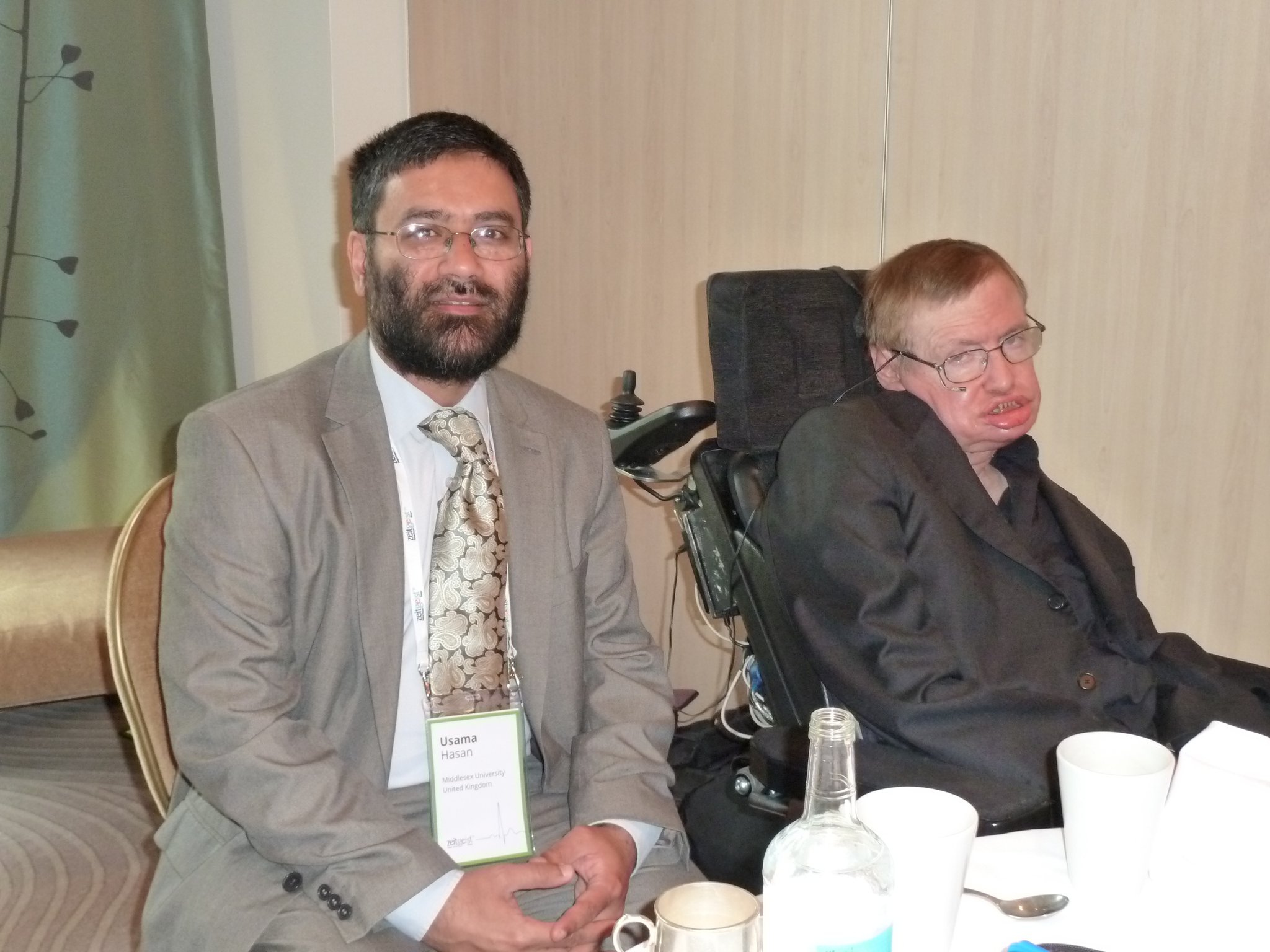
Usama Hasan with Prof Stephen Hawking, Google Zeitgeist Europe Conference, London, 2011

[Download a PDF of this article here (9 pages)]:

Stephen Hawking – In Memoriam by Usama Hasan

Bismillah. So, RIP Prof. Stephen Hawking, often called “the greatest physicist since Einstein,” who returned to his source yesterday.

Here is a brief history, in time, of my encounters with him, intellectually & physically:


  1. An early copy of A Brief History of Time, 1988

Hawking’s famous bestseller was originally published by Bantam Press in 1988. That same year, by the grace of God, I achieved a silver medal in the British Physics Olympiad after being entered into it by my school, the City of London School for Boys (CLSB), aged around 17. (Dozens of students from around the country each won gold, silver or bronze medals, and the very best would be selected to represent Britain at the International Physics Olympiad.) My prize was a hardback copy of A Brief History of Time, and it is still a prized possession.

For some reason, they wrote my name in the presentation sticker as “V. Hasan” – perhaps they thought I was an Ancient Roman or something. A classmate, Keith Eyeions, won a gold medal – his prize was a large sum of cash, book tokens or possibly a microcomputer, but in hindsight, my prize was possibly more valuable. Keith also read Natural Sciences at Cambridge and took the History & Philosophy of Science course in the second year – he encouraged me to study it also; I was unable to, but at least he had introduced me to the subject, of which I had never heard before.

I started the book several times, but like the vast majority of people, couldn’t get very far with it.  It would be several years before I was able to understand the book entirely, obviously whilst or after completing a physics degree.

Whilst at school, I did manage to read the excellent In Search of Schrodinger’s Cat by John Gribbin and God & The New Physics by Paul Davies.


2. A Christian Union lecture critiquing Hawking at Cambridge University, 1990

During my second year at Cambridge, I attended, along with a fellow Islamic Society committee member, an eye-catching Christian Union lecture on religion and physics. The CU were largely evangelical, literalist, fundamentalist Christians, and quite a few academics had similar beliefs to them. The lecturer, whose name I don’t recall but was probably a colleague of David Wilkinson and a pupil of John Polkinghorne, gave a good, entertaining talk about the new physics, quoting the famous lines, “Whoever is not shocked by quantum theory, has not understood it!” (Niels Bohr) and, “God does not play dice with the universe!” (Albert Einstein). He ended by critiquing Hawking, whose ABHT was already a bestseller and many religious people were engaging with it. He quoted from Hawking’s penultimate paragraph, that seems to incline towards theism amidst a largely agnostic discussion, and concluded,

“Stephen Hawking holds the Lucasian Chair in Mathematics at Cambridge, a post once held by Isaac Newton. Hawking may not share Newton’s faith, but he points us in the same direction.”

This was to have a profound influence on me, and my argument in a 2010 article elsewhere on this blog, A Muslim Response to Stephen Hawking, is partly based on that 1990 lecture.


3. Hawking’s lecture on “Imaginary Time”, c. 1990/1

The Cambridge University Physics Society organised this, at a science lecture theatre that accommodated a few hundred people: Hawking rarely lectured publicly, so it was packed, although very few of us had any idea what the title meant.  I arrived quite early, to guarantee a spot. An orthodox Jewish chap called Mark Israel had arrived before me, and was intensely reading what looked like a pocket Torah. As a fellow Abrahamic monotheist, he seemed to be preparing himself to take on someone who was becoming a star for atheist scientists. (Mark had been a year above me at CLSB, but we were now in the same year at university, since he had taken a gap year in Israel, working on a kibbutz or studying at a yeshiva or something. We barely knew each other.)

Hawking’s pre-loaded lecture, delivered via his computer and voice-synthesiser, began by explaining the difference between real and imaginary numbers: basic, A-level mathematics. He then accelerated up several gears and lost the vast majority of us in his details, talking about solving Einstein’s equations for General Relativity in imaginary or complex (real+imaginary) time, avoiding infinities and renormalisations, promoting his no-boundary proposal and his positivist philosophical position. Although he lost me and others in the details, I think I got the gist of his lecture, as above. His link between the mathematical physics and his philosophical position was interesting: he argued that we could not know to begin with (a priori) whether time was best represented by real, imaginary or complex numbers, if at all. But given that we could not solve the GR equations in real time, but could do so in imaginary/complex time, this was evidence or proof that imaginary time existed. (To my mind, time clearly has a real dimension as well, but no-one used the term, “complex time,” i.e. real+imaginary time, at the time!)

When the lecture ended, there was stunned silence: most of us were still trying to process the whirlwind of mathematics & physics ideas to which we had just been exposed. There were only one or two questions, and I think Mark Israel bravely asked the first question: an undergraduate natural scientist and devout Abrahamic monotheist trying to take on one of the world’s greatest scientists who was also agnostic/atheist. Mark asked (in paraphrase), beginning with a typically-British understatement,

“This is all very complicated. But this positivism of yours – isn’t it a cop-out from accepting the reality that we all experience?”

We waited with bated breath for many minutes for Hawking’s pithy answer: because he had to compose his answer, character by character, using only one finger to operate his computer, even a one-sentence answer could take quite a while to produce. But Hawking eventually answered (in paraphrase),

“Give me an experimental test for any ‘reality’ and I will accept its existence if it is empirically (experimentally) proved.”

I’ve remembered the entire exchange, but it was many years before I understood Hawking’s answer, and what on earth he was talking about.

These were of course some of the intensely salafi years: when I told JIMAS colleagues about attending Hawking’s lectures, Abu Muntasir remarked, “the Sheikh Albani of physics!”


4. Hawking’s lecture on “Predestination”, c. 1991/2

This was organised by the university’s Philosophical Society at, if I remember correctly, the Lady Margaret Hall on the Sidgwick Site. [Lady Margaret, whose name adorns several Cambridge roads and buildings, was the wife of Henry VI, mother of Henry VII and hence grandmother of Henry VIII, again if I remember correctly.]

This was a large hall, and again, it was standing-room only: I estimated that about 2,000 people attended.

The question being addressed in the lecture was,

“Is Everything Predestined?”

Hawking’s answer was one of pure determinism: he argued that the laws of physics determined absolutely everything, including our brain configurations and neuronal firing patterns. As a fellow-student once put it,

“If the laws of physics determine exactly how an object falls, why shouldn’t they determine exactly how our brain neurons fire?”

Those who knew Hawking well, often comment that he had an irresistible sense of humour. This was on display at this lecture when, to illustrate how the laws of physics have determined, according to his view, everything from the Big Bang to the most trivial details of human behaviour, Hawking mischievously put up a copy of a Page 3 of The Sun, featuring a famous female, topless model, declaring,

“The laws of physics even determine that Samantha Fox appears nude on Page 3!”

The audience roared with laughter – my, such goings-on at one of the world’s most prestigious learned societies and universities!

Hawking’s conclusion was very interesting:

“Is Everything Predestined? Yes, everything is predestined, but it might as well not be, since we can never know!”

His reasoning for this conclusion was that although the laws of physics did determine everything, we could not possibly predict the future since, to do so, we would need to solve zillions of non-linear equations simultaneously, and this is simply impossible.

Obviously, predestination is a major topic in Islam, and I grappled with Hawking’s conclusion for a long time.  Many years later, I read in the famous book by Ali al-Hujwiri (Data Ganj Bakhsh, 1009-1077 CE, buried in Lahore), Kashf al-Mahjub [Unveiling of the Veiled, trans. Reynold A. Nicholson] that he had taught,

“Believe that everything is predestined, but act as though nothing is.”

In other Islamic texts, this is stated as follows:

“Believe like a jabari [determinist], but behave like a qadari [free-willer].”

It is also alluded to in the later Ash’ari text, Hashiyat al-Disuqi ‘ala Umm al-Barahin, when the commentator claims that,

“The People of the Sunna [Ahl al-Sunna, according to the Ash’ari school] are rationally determinist (jabariyya ‘aqlan).”

The dispute between the determinists [jabariyya] and absolute free-willers [qadariyya] dates back to the Sahaba (Companions of the Prophet, may God bless him and grant him peace, and be pleased with them) and will continue until the Day of Judgment, with a whole spectrum of views within Islam, amongst the Sunni, Shia, Mu’tazili, Ash’ari, Maturidi, Hanbali/Athari/Salafi, etc. As Imam ‘Ali said, and was echoed by Imam Tahawi in his Creed [‘Aqida],

“Predestination [qadar] is a secret/mystery (sirr) of God in His Creation.”

But here we have a leading Muslim Sufi saint, whose tomb is visited by lakhs of people every year, taking a compromise position between belief and action, between jabar and qadar, over nine centuries before a great mathematician and physicist who essentially comes to the same conclusion. From Hujwiri to Hawking – Glory be to God!


5. Hawking on Grange Rd, c. 1991/2

I was cycling along Grange Road, Cambridge, dressed in my usual dress at the time of a flowing Arab robe and turban, when I passed Hawking coming the other way in his motorised wheelchair. It was a powerful moment for me, and remains etched in my memory: this great scientist, silently and serenely passing by, with only the quiet hum of his wheelchair, like the force of nature (God’s creation) that he was. I wonder if he remembered a cyclist in Arab dress?

Relatedly, I read in the newspapers later that year, after leaving Cambridge, that Hawking had had another encounter with a Muslim using Grange Rd: a Pakistani taxi-driver (who else?) had crashed into Hawking, destroying his wheelchair although Hawking escaped unhurt. Thank God he was relatively unharmed – had he been seriously injured or killed, it might have been the biggest Pakistani influence on theoretical physics and cosmology since Prof Abdus-Salam’s Nobel Prize. [I am of Pakistani origin, so I’m allowed to poke fun at my own countrymen.]


6. Quoting Hawking in MSc exam, 1993

For my MSc in Information Processing & Neural Networks at King’s College London, one of our modules was Advanced Neural Networks, taught by Prof. John Taylor, who had a previous career as a TV actor before returning to science. Taylor was an excellent lecturer. His exam paper included a question about whether our artificial (computerised) neural networks could ever emulate the human brain. In my answer, I argued that this might be possible in principle, but we were astronomically far away from achieving it in practice. As an analogy, I quoted Hawking’s famous passage in ABHT where he argued that, in principle, we could build a particle accelerator of enough size and energy to recreate the high energy of the early universe, but it was very unlikely that we would achieve this in practice. With more of his wry humour, he had written something like,

“Such an accelerator would need to be roughly the size of the solar system, and is unlikely to be funded in the current economic climate.” (Stephen Hawking, A Brief History of Time)

In the post-exam discussion with fellow students, I told a colleague that I had quoted Hawking. His reply was,

“Oops! Don’t you remember what Hawking wrote about Prof. John Taylor?”

I had no recollection of this, but he told me and I went home and was horrified to verify it via my copy of ABHT. The story may be summarised as follows:

Hawking gave his seminal lecture at a physics conference where he first announced his theory that “black holes ain’t so black”, i.e. the decay of black holes via Hawking radiation, a quantum effect. Hawking described one of the reactions as follows: “One man, John Taylor of King’s College London, stood up and said that this was all rubbish … [But my theory was later proved right, and he was proved wrong]” (summarised from Stephen Hawking, A Brief History of Time)

This was not Taylor’s finest hour, but nor was it Hawking’s, when he wrote about it: academics, like sports players or generals, should be gracious in victory and defeat. But both of them taught me mathematics, physics & AI – we all know how awkward it is when your parents or teachers quarrel.

I hope Prof Taylor wasn’t offended by my quoting Hawking in the exam, a scientist who was arguably even more famous than Taylor, from a book in which Hawking had publicly avenged an academic insult from one or two decades earlier. I don’t think Taylor was offended, at least not too much, because he gave me an ‘A’ grade in the exam.


7. The Universe in A Nutshell

Towards the end of the 2000s, two decades after publishing ABHT, Hawking wrote another excellent book, The Universe in A Nutshell. He proposed his version of M-theory, a generalised string theory, that involved high-dimensional spaces called ‘branes.’ These are like 2- or 3-dimensional membranes, but in higher dimensions. But which letter should mathematicians use to denote the number of dimensions: x, n or d, etc.? With characteristic humour, Hawking decided to use p, hence cutting edge theoretical physics and cosmology now involved p-branes, a pun on “pea-brains.”

The title of this book derived from the fact that Hawking argued that our universe was enclosed by high-dimensional spaces (p-branes) that were shaped like a peanut shell.

Arguably, Hawking had taken an agnostic position regarding God in his ABHT. But based on his TUIAN, he now publicly announced an atheist position. I wrote my Muslim Response … to him in 2010, available elsewhere on this blog.


8. Meeting Hawking at Google Zeitgeist Europe, 2011

In 2011, by the grace of God, I got to finally meet Hawking after his lecture at Google’s Zeitgeist Europe conference near Watford in Greater London, attended by hundreds of people. It was a bi-annual conference at the time, with the alternate year having a Zeitgeist USA conference, I think. I was invited to this conference as part of Quilliam’s work with Google and YouTube, specifically with regard to the later, international Summit Against Violent Extremism in Dublin, June 2011.

Hawking lectured on M-theory, based on his TUIAN, and also attacked religion but especially philosophy: he argued that modern philosophy had lost all touch with (scientific) reality, and that philosophers were often speculating theoretically based on outdated, ancient philosophical ideas about the mind, life, etc. He argued that they were not taking into account modern knowledge about the workings of the brain, the laws of physics, the life sciences etc.

I got to meet Hawking as a fellow-speaker at the conference, and because of my physics background. Because of his limited communication technology, most people were simply taking a photo with him. I was advised that I needed to ask his permission to do this first, though: we were able to ask him brief questions, and he would respond with one twitch of his cheek muscle for yes, and two for no (or vice-versa, I don’t recall precisely – it had been 20 years since I had seen him in person, and he had lost the movement of the only working finger, and was restricted to one muscle with which to communicate).

This is roughly what I said to him:

“Professor Hawking, it is an honour to finally meet you.  I attended two of your lectures whilst a Cambridge undergraduate about 20 years ago: one on ‘Imaginary Time’ and one on ‘Predestination’ at the Lady Margaret Hall. Do you remember those lectures? And may I have a photo with you?”

I remember thinking that my first question was very daft: I was asking a genius, scientist and professor with a very precise mind, whether he remembered two of his major public lectures at his beloved university, about his beloved subjects. Of course he remembered them! He replied in the affirmative to both my questions, hence the photo reproduced above.


9. Islamic reflections about Hawking

Hawking was a bit of a dilemma for theists, but his brilliance and humour endeared him to most. One of his students was Prof Brian Carr, later of QMUL, who is a devout Christian as well as a brilliant physicist.  I’ve met him twice via the Scientific & Medical Network, and had brief discussions on religion and science. He loved his teacher, despite the difference in religious beliefs.

When I posted briefly on Facebook in 2011 about meeting Hawking, a young islamist woman kept posting nasty, rude comments about him, condemning him for his atheism. I deleted her comments, but when she continued, I blocked her. He was probably 2-3 times her age, and had inspired millions to love knowledge and God’s creation, even if he himself didn’t believe, yet she, with good intentions to defend theism, was despicably rude about someone with a crippling illness, and whom she had clearly never met. May Allah forgive me and her. On the other hand, a young, devout Muslim physicist friend praised Hawking in glowing terms when some were criticising him on our Islamic Astronomy yahoogroup that ran for many years in the 2000’s.

Thinking of theist/atheist scientist friends, I am reminded of Newton’s friendship with Hooke or Boyle, at least for a while. Whenever his atheist friend would try to preach atheism to him, Newton, a Unitarian Christian who wrote treatises refuting the Trinity, replied,

“Don’t go there. I have studied theology, whereas you haven’t.” (paraphrase)

Perhaps if Hawking had a friend who was a greater scientist than him and also a theist like Newton, he may have believed. But it is all God’s will.

Pope John Paul II told Hawking upon their meeting, not to investigate the first three minutes or first six seconds after the Big Bang, because these were “the moment of God’s creation.” Hawking was utterly put off religion by this, as he described in ABHT. Perhaps if, instead of this advice, Hawking had met a Muslim rationalist leader cut from the cloth of the Abbasid Caliph Al-Ma’mun who might have wholeheartedly encouraged Hawking to pursue such research, he may not have turned against religion. But it is all God’s will.

So, Hawking did not believe in God for most of his life. But in the Islamic tradition: God is Truth. God is Beauty. God is Time (al-dahr, in a famous hadith qudsi – since the commentators explain al-dahr as “extended time,” some contemporary sheikhs have suggested that this means: God is Spacetime). God is Infinitely Wise and Forbearing.

Hawking certainly believed in Truth and the search for Truth. He certainly believed in Beauty, especially the beauty of nature and of its laws of mathematics, physics, chemistry and biology. He helped and inspired millions of people all around the world to study these subjects [I was excited to see an Arabic copy of ABHT on sale in Amman in 2017, & today’s media coverage shows crowds of Israelis and Arabs flocking to see him – he especially encouraged Palestinians to study physics]. He inspired us to probe into the mysteries of space and time, that are sacred because of the above hadith qudsi and because of God’s taking an oath, swearing by the sacred token of Time, as in Surah al-‘Asr, one of two Qur’anic Chapters entitled: Time, referring to long-term and short-term respectively.

Living patiently with a crippling illness for over half a century: not just living, but working, leading the world in his subjects and inspiring generations with his intelligence, humanity and humour – he knew Forbearance, again a quality of the Divine.

So farewell, Professor Stephen Hawking: may you rest in God’s Peace (al-Salam): you understood more than most the mysteries of the infinite: may you be admitted into God’s Infinite Mercy. Amen.

Imam Dr Usama Hasan

Cardiff, UK.

Thursday 15th March 2018, approximately 24 hours after the fateful death.

Islam and China

December 13, 2017

Niu Jie Mosque – Beijing. The mosque was established in 996 CE, so it is over 1,000 years old, in its successive manifestations. The mosque front faces due west, which is used as the approximate qibla. The man in the foreground is a Chinese Muslim trader from Xinjiang province, fluent in Arabic.

Bismillah. I visited the sacred land of China (Beijing) for the first time last week, by the grace of God. The sacredness and spirituality of the land and its people was palpable. Here are some reflections from my reading and experiences:


1. The alleged hadith, “Seek knowledge, even unto China,” is a traditional Islamic saying, but unlikely to be from the Prophet, peace be upon him.

As I wrote in the Introduction and Appendix to my father Sheikh Suhaib Hasan’s Introduction to the Science of Hadith, “This additional statement is found in a few of the (weak) narrations of the previous hadith [‘Seeking knowledge is a duty upon every Muslim’], and is declared as mawdu’ [fabricated] by Ibn Hibban, Ibn al- Jawzi, al-Sakhawi and al-Albani.” The views of these hadith scholars may be found in the following works by Albani: Silsilat al-Ahadith al-Da’ifah, no. 416; Da’if al-Jami’ al- Saghir, nos. 1005-6.

Furthermore, the text of this alleged hadith “otherises” China, whereas the Prophet was a mercy to the worlds (Qur’an, The Prophets, 21:107) and all languages in their diversity, including the Chinese languages, are amongst the Signs of God (ayatullah – Qur’an, The Romans or Byzantines, 30:22). At the most, “even unto China” is an Arab-centric phrase in this context, and does not fit with the universality of the Qur’anic and Prophetic message.

2. There are legends about the Prophet’s Companions visiting China, and even of up to four of them being buried there.

They include Sa’d bin Abi Waqqas. Since he conquered Persia, it is highly plausible that he could have ventured further east to India and China. If he was buried in China, this would be more widely known to the scholars of Hadith and Rijal, who compiled detailed biographies of the Companions. I would be grateful for learned contributions to this question.

The following is from Wikipedia (not the most reliable source I know, but this is a blog, not an academic paper), under Emperor Tang Gaozong (649-683):

Known by Islamic sources as Yung Wei, which was in fact the name of the first era in his reign (Yonghui era from February 650 to February 656; see era name), Islamic sources credit him with building the first mosque, a mosque that still stands in Guangzhou. According to those records, Islam was introduced to China and Emperor Gaozong by the visit of Sa`d ibn Abi Waqqas, a companion of the Prophet Muhammad, in the year 650. According to these sources, Emperor Gaozong is said to have respected the teachings of Islam greatly, feeling the teachings were compatible with Confucianism, and offered the building of the mosque as a sign of admiration. The emperor himself did not convert as he felt Islam was too restrictive for his own preferences, but according to those sources, did not stop him from allowing Sa`d and his company to spread the teachings throughout the region. These sources, however, were not corroborated by Chinese records.

[1]  Lan Xu, Tianfang zheng xue (The true learning of Arabia), Beijing: Niujie Mosque, 1925 edition (first edition 1852), juan 7; quoted in Zhang Xinglang, p. 744.


3. An anecdote from al-Mas’udi’s Meadows of Gold (Muruj al-Dhahab) about a Sino-Arab encounter

Reproduced from elsewhere on this blog: al-Masu’di of Baghdad (c. 276-344 H / 890-956 CE) wrote,

The story of Habbar bin al-Aswad, an Arab notable of Basra who left during the Zanj [negro slaves’] rebellion there, is entertaining. He went to China via India. A Chinese king showed his Arab visitor portraits of prophets including Noah, Moses, Jesus and Muhammad. The king stated that Noah’s flood didn’t reach India or China.

He further showed him portraits of Indian and Chinese prophets’ portraits, depicting them as pointing the index finger to the heavens, warning of the power of God, or making a circle with the thumb and index finger, to indicate that creation is a circle.

[Muslims daily indicate the unity of God with the right index finger (cf. Michaelangelo’s famous painting depicting God and Adam). During prayer, they also sometimes make a circle with the thumb and middle finger, following the Prophet Muhammad, peace be upon him.

Furthermore, according to a sound hadith: Umm Salama emigrated to Abyssinia with her first husband Abu Salama as part of the early sacred migration (hijra). In the churches there, she saw images of prophets with index fingers raised (cf. Michaelangelo again), a feature of daily Islamic prayers. See Albani, Sifah Salah al-Nabi or The Prophet’s Prayer Described, for these hadiths. – U.H.]

Al-Mas’udi continued:

The people of China are the most skilful in painting and arts. No other nation can compare with them in any craft whatsoever.

China was prosperous due to its justice until the Huang Chao rebellion of 878. He attacked Khanfu, massacring 200,000 Muslims, Christians, Jews and fire-worshippers [Zoroastrians/Parsees].


4. Admiral Zheng He (Cheng Ho) was one of the great figures of Chinese history, and was Muslim.

As a child, I read a kids’ book about Admiral Cheng-Ho and his voyages, part of a series about “Heroes of Islam.” I remember nothing from the stories, except the striking name. I always thought that he was highlighted in this series simply because he was Muslim, and was amazed to discover later that he was the greatest Chinese admiral in history. (By the way, admiral is an English word derived from the Arabic, amir al-bahr: ‘commander of the sea.’)

Yuval Noah Harari’s Homo Sapiens: A Brief History of Humankind (Vintage, 2011) is described by its publisher as a ‘Number One Bestseller.’ In it, the author writes these glowing lines about Zheng He (Cheng-Ho), but unfortunately does not mention that he was an integrated Chinese Muslim who assumed a major leadership position, like millions of his fellow Chinese Muslims. Harari wrote:

Many scholars argue that the voyages of Admiral Zheng He of the Chinese Ming dynasty heralded and eclipsed the European voyages of discovery. Between 1405 and 1433, Zheng led seven huge armadas from China to the far reaches of the Indian Ocean. The largest of these comprised almost 300 ships and carried close to 300,000 people. They visited Indonesia, Sri Lanka, India, the Persian Gulf, the Red Sea and East Africa. Chinese ships anchored in Jedda, the main harbour of the Hejaz, and in Malindi, on the Kenyan coast. Columbus’ fleet of 1492 – which consisted of three small ships manned by 120 sailors – was like a trio of mosquitoes compared to Zheng He’s drove of dragons.

Yet there was a crucial difference. Zheng He explored the oceans, and assisted pro-Chinese rulers, but he did not try to conquer or colonise the countries he visited. Moreover, the expeditions of Zheng He were not deeply rooted in Chinese politics and culture. When the ruling faction in Beijing changed during the 1430s, the new overlords abruptly terminated the operation. The great fleet was dismantled, crucial technical and geographical knowledge was lost, and no explorer of such stature and means ever set out again from a Chinese port. Chinese rulers in the coming centuries, like most Chinese rulers in previous centuries, restricted their interests and ambitions to the Middle Kingdom’s immediate environs.

(Harari, p. 324)

Harari (p. 325) then provides a striking, visual illustration of his comparison between the fleets of Zheng He and Christopher Columbus:

from Yuval Noah Harari, Homo Sapiens: A Brief History of Humankind, Vintage Books, 2011, p. 325

5. The Niu Jie Mosque in Beijing has been a place of Islamic worship for over a thousand years, and is well worth a visit, including to non-Muslim visitors.

The mosque is easily reachable by subway to Guang’AnMennei: take the SE exit, turn left, heading due west and take the second major right onto Niu Jie Street. The mosque is clearly visible on the left, a couple of blocks down.

The mosque embodies “Islam with Chinese characteristics”: the pagoda- or Chinese palace-style is obvious. Many of inscriptions on the rock steles and in the ante-hall to the main worship hall are in Chinese. (Inside the main worship hall, all the calligraphy is in Arabic, in a distinctive font known as Sini [Chinese], influenced by Chinese calligraphy.) Look carefully, as in the photo of the mosque, and you will see small carved dragons on top of the mosque buildings, presumably to drive away evil spirits. This of course violates the traditional Judeo-Islamic prohibition on graven images, but illustrates the integration of Chinese Muslims: they seem to have tolerated small dragons, that certainly do not dominate the mosque buildings, most of which uphold the ban on graven images.

The mosque consists of several buildings: the main (men’s) worship hall with an ante-hall, a minaret and two pavilions, all pagoda-style. The main worship hall holds about 500 men, according to my estimate. There were some women attending prayers too, so presumably there must be a women’s prayer hall. There is an old sundial that can be used to tell the time generally, and specifically zawal (noon), and hence zuhr or afternoon prayer time. The sundial looks very similar to the one I saw in the Forbidden City, to the side of Tian’Anmen Square.

The qibla direction of the mosque appears to be due west, which is reasonable for China, although I would like to check this more precisely.

The main prayer hall effectively has three open and interconnected mini-courtyards within it, due to an array of pillars and arches. The outer sides of the pillars and arches are plain, but the inner sides are beautifully decorated with floral motifs and Islamic calligraphy. As you enter the mosque, the courtyard sizes are small, large and medium, in that order.

As one enters the main hall, the first archway has three Qur’anic verse inscribed in a series of six circular designs. I was unable to work out the first verse, reading from right to left. The middle verse is “Truly, God has bought from the believers their selves and their possessions, in exchange for their owning the Garden.” (Qur’an, Repentance, 9:111). The verse on the left is “Whoever brings goodness will receive ten times like it; whoever brings evil, will only be recompensed in like measure” (Qur’an, Cattle, 6:160).

The entire texts of the following surahs are written in gorgeous calligraphy on the remaining arches: al-Fath (Victory, 48), al-Rahman (Most Merciful, 55), al-Mulk (Kingdom, 67), al-Naba’ (News, 78) and al-Nazi’at (Tearers, 79). There is precise attention to detail, e.g. the small circle above the word s(ui)’at in 67:27 indicating that the first vowel is to be read initially as a damma (u), followed by a long kasra (i), in a one-third:two-thirds ratio, as is well-known in the science of Qur’an-recitation or tajwid. However, seven verses appear to be missing from al-Naba’, nos. 21-27, except that the last two letters of 78:27 are present, the long ba. This is something I’ve occasionally seen in Qur’anic calligraphy in old mosques, since it’s not easy to fit passages precisely onto buildings, especially when your canvas is a curved arch.

In addition, three of the arches are inscribed with a collection of about 45 salawat or blessings upon the Prophet. They follow an identical pattern: each is comprised of the formula, Allahumma salli ‘ala Muhammad sayyid … (Dear God, Bless Muhammad, Master of …). Each blessing is then completed with a plural noun: the first is al-mursalin (the Messengers); others are al-muttaqin (the Pious)al-tawwabin (the Oft-Repenting), etc.


6. The Sinofication of Chinese Muslim surnames from Arabic.

Some years ago, a Chinese imam called Sheikh Ibrahim Ma visited London and spoke at a number of locations, including Masjid al-Tawhid. This Wikipedia entry under “Islam during the Ming dynasty”, if correct, gives the origin of Chinese Muslim surnames such as Ma:

Foreign origin Muslims adopted the Chinese character which sounded the most phonetically similar to the beginning syllables of their Muslim names – Ha for Hasan, Hu for Hussain and Sa’I for Said and so on. Han who converted to Islam kept their own surnames like Kong, Zhang. Chinese surnames that are very common among Muslim families are Mo, Mai, and Mu – names adopted by the Muslims who had the surnames Muhammad, Mustafa and Masoud.


7. Are Allama Iqbal’s famous lines of poetry beginning with “Cheen (China)” imperialist or universalist?

Iqbal wrote these famous lines, known as Tarana-e-Milli or “Anthem of the Muslim Nation”, that begins:

Cheen-o-Arab hamara, Hindustan hamara
Muslim hain hum, watan hai sara jahan hamara

China and Arabia are ours; India is ours.
We are Muslims, the whole world is ours.

Touheed ki Amanat seenon mein hai hamare
Asan nahin nitana naam-o-nishan hamara

God’s unity is held in trust in our hearts.
It is not easy to erase our name and sign …

I first learnt this as a child in its Arabic translation, such was Iqbal’s influence:

al-sinu lana wa l-hindu lana

wa l-‘arbu lana wa l-kullu lana

adha l-islamu lana dinan

wa jami’u l-kawni lana watana

tawhidullahi lana nurun …

Since Iqbal was a poet, he may have meant all of this metaphorically and universally, in the sense that the earth belongs to God and therefore to the true people of God. But many people read these verses literally, and imagine that they have the right to conquer and dominate other people. The age of military conquests is largely over, and any non-Chinese person who visits China and sees a fraction of its billion-and-a-half population, should know immediately that it is ridiculous to pretend or dream that China belongs to anyone but the Chinese. And the same goes for India, Arabia, Africa, Europe, the Americas, Oceania etc.

But such delusions do persist: in Pakistan in 2003, I met a LeT supporter who had helped to establish a mosque in Islamabad and told me that the “mujahideen” during the Kargil incident had come close to “liberating Kashmir” and that they would have gone on to “liberate India” !! We Muslims need to have honest conversations about such matters. The divisions and conflicts are such a shame, especially when it is obvious that Indians, Pakistanis and Chinese etc. have so much in common, not least their eastern-ness.

Which reminds me: there is a famous saying, “East is East, and West is West, and never the twain shall meet.”

But the reality is: “East is East, and West is West, and the twain have met many times in all kinds of ways, and continue to do so.”

8. Ibn Arabi’s curious visionary prediction that the the last human ever to be born will be a boy, immediately preceded by his twin sister, in China. This boy will also grow up to be the last saint or holy person of humanity.

This is in his Fusus al-Hikam (Bezels of Wisdom) under the bezel of Seth (Shith):

It will be in the line of Seth that the last true Man will be born, bearing his mysteries [of divine Wisdom], nor will such be born after him. He will be the Seal of Offspring. There will be born with him a [twin] sister who will be born before him, so that his head will be at her feet. He will be born in the land of China and will speak the language of that land. Sterility will then overcome the men and women of this land and, although there will be much consorting, there will be no bringing forth of children [as true men (?)]. He will call them to God without success and when God has taken him and those of his time who believed, the others will remain living like beasts with no sense of right and wrong, giver over to the law of the [lower] nature, devoid of intellect and Sacred Law [and Ethics]. The Last Hour will overtake them.

The above is in Austin’s translation, p. 70, with slight modifications by me. Austin summarises this prediction as follows (pp. 61-2):

Ibn al-‘Arabi concludes this chapter with a curious prediction concerning the fate of man as defined in his teachings. He says that the last true human, in the line of Seth, will be born in China and that he will have an elder sister. He goes on to prophesy that thereafter men will become as beasts, bereft of spirit and law, until the coming of the Hour. Thus, he indicates that that particular human synthesis of spirit and nature, of which we are all a part, will come to an end and the link be broken.


Usama Hasan (Ha)

London, UK

13/12/2017

REFLECTIONS FROM KUNAR 1990 AND HELMAND 2010 – THE TRAGEDY OF AFGHANISTAN’S WARS

November 10, 2017

With the Name of God, All-Merciful, Most Merciful

REFLECTIONS FROM KUNAR 1990 & HELMAND 2010

– THE TRAGEDY OF AFGHANISTAN’S WARS

Introduction

I am publishing this partly because I am tired of telling the same story about Kunar to dozens of journalists and academic researchers, partly because I am fed up of questions about my one-minute video message in support of British troops (2010), and partly because I hope that people may benefit and learn from the story.

I began writing this on the last day of Ramadan 1433/2012, and completed the bulk of it shortly after Eid.  The recent death of two British soldiers in Nad Ali in Helmand (Matthew Smith http://www.bbc.co.uk/news/uk-19228325 and Robert Chesterman http://www.bbc.co.uk/news/uk-19227317 ) brought back vivid memories of our FCO-sponsored four-man delegation’s “Projecting British Muslims” trip to Helmand during Ramadan in August 2010, a visit that included ISAF’s Forward Operating Base at Nad Ali.  As I finalise it, I’m reading about the 2,000th US soldier to die in Afghanistan since 2001.

*Update: I am finalising and publishing this on 10th November 2017 – it has been sitting in my draft folder for five years.*


Memories from the Jihad in Kunar, 1990-1

This was my second 10-day visit to Afghanistan: the first had been in December-January 1990-1991, during my second-year Cambridge University holidays, as part of a three-man fact-finding mission of senior JIMAS (www.jimas.org ) figures to Kunar.  The other two people were up to a decade older than me: Abu Muntasir and Abu Aaliyah.  I was fortunate to have the strongest Arabic at the time, and served as interpreter for much of the trip, although of course other mujahideen helped also.

We drove to Afghanistan from Islamabad via Peshawar and Bajaur, and spent a week at a training camp near Asadabad, Kunar, for Arab fighters run by Jama’ah al-Da’wah ila l-Qur’an wa l-Sunnah (JDSQ, “Group of Calling to the Qur’an and Sunnah”), the major Salafi organisation that controlled large parts of Kunar province as well as of neighbouring Nuristan.  There were separate training camps for Arab, Afghan and Pakistani fighters – we chose the Arab one, for access to more Arabic-speaking scholars.  The camp rules stated that disagreements would be solved in a last resort by referring to the fatwas of Sheikhs Ibn Baz and Albani. On our introduction to the camp, I introduced myself with my first name, upon which I was immediately corrected by a Kuwaiti mujahid: “In Jihad, we only use aliases.” Specifically, he meant aliases of the kunya type that take the form of “Abu X” meaning “Father of X.”  My colleagues were fathers and already had kunyas, so I used, for the first time, my middle name that my grandfather had given me when he named me upon birth: Abu Dharr, after an austere, ascetic Companion of the Prophet.  The emir of the training camp was a tall, well-built, muscular, fair-skinned, charismatic and learned Palestinian fighter called Abu Asim.  In appearance and character, he reminded me of Abdur-Raheem Green, then also a senior JIMAS figure.  I shed many tears upon hearing about Abu Asim’s reported death in a training accident some years later, when a weapon exploded accidentally.

Upon joining the training camp, we had to fill in a registration form, giving personal details and skills that might be useful for the jihad. The three of us all put down our computer/IT skills, and I also mentioned my mathematics and physics knowledge. A quarter of a century later, ISIS, who had turned defensive, liberating jihad into bloodthirsty terrorism, had similar registration forms, with one striking addition: asking registrants whether they wanted to be regular fighters, suicide-bombers or suicidal attackers (inghimasi).

This was Abu Muntasir’s second trip to the same region: he had trained and fought at the front line in 1989 or early 1990 also, with a close companion known as Brother Mushtaq.  JIMAS’ contacts with the Afghan mujahideen had come about via salafi scholars in Holland and meetings in London that had involved Dawood Burbank (d. during Hajj 2011, may Allah have mercy on his soul) and Brother Mushtaq.  Abu Muntasir later fought in Kashmir and even in Burma with Rohingya militia in the early 1990s.

Note that JIMAS (Jamiat Ihyaa’ Minhaaj al-Sunnah: The Society for the Revival of the Way of the Messenger) had earlier been called HISAM (Harakatu Islahish Shabab al-Muslim: The Movement to Reform the Muslim Youth) but had recently had a name-change after an offshoot insisted on retaining the name HISAM.  During this episode, one of the suggestions for the name of JIMAS was in fact JDQS – this was directly copied from the Afghan group.  The current Pakistani salafi/Ahl-e-Hadith jihadi group Jama’at-ud-Da’wah, linked to Lashkar-e-Taiba, may also have based its name on the Afghan one.

We also met and interviewed Sheikh Jameel-ur-Rahman, an Afghan salafi/Ahle-e-Hadith muhaddith-mujahid (scholar of Hadith and warrior), founder and emir of JDQS.  Sheikh Jameel was an elderly, learned man with a long beard, dyed with henna.  He was accompanied by elders who constituted his shura and by a group of younger, heavily-armed men who served as his bodyguards.  Abu Muntasir conducted the interview in English: Sheikh Jameel replied in Arabic.  One of the questions was whether or not the Jihad in Afghanistan was fard ‘ayn or fard kifaya, i.e. an individual or collective obligation: his reply was the former.  The interview was recorded and it was many months before Dawood Burbank translated it into English for the benefit of other JIMAS members.  Abu Muntasir may still have this material in his possession.

The Arab mujahidin credit Sheikh Jameel with having begun the “Jihad against the communists” in 1973, way before the Soviet invasion.  Sheikh Jameel gave a talk after dawn prayers on one occasion whilst we were at the training camp, during which the camp generator failed, leaving the prayer tent in darkness.  At the end of that talk, he took questions.  One of the questions was about whether or not there was any dhikr to be recited during the prostration of gratitude (sajdah al-shukr) – this was related to the story of The Prophet’s disciples Ka’b bin Malik, Murara bin Rabi’ah and Hilal bin Umayyah and their missing a military expedition followed by their subsequent ostracism and eventual repentance recounted in the long hadith of Bukhari and Muslim in reference to Qur’an 9:118 (Surah al-Tawbah or Chapter: Repentance).  In this heart-rending story that had been recounted by one of the younger scholar-warriors at the camp after dawn prayers the day before, Ka’b performs such a prostration of gratitude.  Sheikh Jameel replied that no specific dhikr had been narrated about this prostration, and therefore any dhikr would suffice, but a young Saudi mujahid argued vehemently with him that there was no dhikr in this prostration for the same reason.  Salafism in a nutshell!

Sheikh Jameel had announced an “Islamic emirate” (imarat-e-Islami) in Kunar. One day at the training camp, one of the commanders gave us the “good news” of the full establishment of Sharia in the emirate: predictably, this involved the hudud, with which islamists are obsessed: a thief’s hand had been amputated as corporal punishment for his crime.

We were holy warriors: ascetic monks and soldiers, simultaneously. With regular congregational prayer, scriptural study, physical exercise and weapons training. Being halfway up a valley, there wasn’t much food: on one day, the camp had run out of food and all we had for 24 hours was a glass of milk and an orange. Soldiers know all about the rationing of supplies. At the firing range, Abu Muntasir embarrassed our instructor by being the only one to hit the target during a sniping contest. (This reminds me of a story about Caliph Omar: he came across some people practising archery and found that they weren’t very good at hitting their target. When he enquired as to why this was the case, they replied in ungrammatical Arabic that they were learners. “Your Arabic is even worse than your archery,” the Caliph quipped!)

Around 1993/94 we heard the awful news that Sheikh Jameel had been assassinated by an Arab fighter – many salafis blamed this on forces loyal to Gulbuddin Hekmatyar (Hizb-e-Islami), who was backed by the Jamat-e-Islami of Pakistan and the Arab Muslim Brotherhood.  Hekmatyar denied these accusations, but the incident was one of the many causes of tension between salafis and the Brotherhood, a tension that continues all over the world until today.  A few years later at Imperial College London, I asked the Riyadh-based Syrian salafi Sheikh Adnan Arour, who had taken part in Saudi-sponsored mediation amongst the warring mujahidin groups after the fall of Kabul in 1992, about Hekmatyar’s denial of being behind Sheikh Jameel’s assassination.  He replied, “Who killed him then, Ibn Baz and Albani??!”

With hindsight, it was probably for the best that the Kunar emirate had fizzled out with the death of Sheikh Jameel, otherwise the obsession with hudud might have led to a situation similar to ISIS.

Around 2004, I briefly met one of Sheikh Jameel’s sons who was studying at the Islamic University of Madinah during my only visit there, facilitated by Yasir Qadhi.

Back to Kunar: we spent a day and night at the front line, taking part in the Jihad against forces loyal to President Najibullah.  The Soviets had of course withdrawn in early 1990, but most mujahideen groups fought on, firstly against Najib’s communists, and then against each other during the vicious civil war of 1992-6.  The latter war helped me realise the emptiness of the Islamist dream that the mujahideen were going to establish the ideal “Islamic state” after taking Kabul in 1992.

The Saudis subsidised half the cost of mujahidin’s flights to Pakistan, but kept a record of all names. There was, of course, close co-operation amongst the US, Saudis and Pakistanis during the anti-USSR Jihad.  We met a couple of Libyans at the front line who had burnt their passports, since returning mujahideen were not too welcome in Gaddafi’s police-state.

The training camp’s courtyard had a disused Soviet tank in the centre and was covered in snow: many of the Arabs, religious scholars and committed warriors, had never seen snow before and thoroughly enjoyed their first snowball fights whilst we, the British trio, looked on bemused.  The Arabs were from various countries, including Saudi Arabia, Kuwait, Libya, Egypt and Palestine.  There was also a trio of Indonesian or Filipino fighters who kept to themselves since they didn’t know Arabic.  At the camp, we received basic weapons training: Kalashnikov/M16 and also studied scripture after regular, congregational prayers.  In between the prayer rows would be lines of AK-47s belonging to the warrior-worshippers. At the front line, we exchanged artillery fire with invisible communist forces, as several mountain ridges separated us.  Our guns were 76mm cannon.  One enemy shell, fired from several miles away, landed a hundred feet from us but we were quite safe: this taught me about the fragility of life, but not to be afraid of the ever-present danger of death.  A disturbing scene throughout Kunar was the sight of large cemeteries in place of villages.

At the front line, I had hoped to use my expert Further Mathematics A-level knowledge of precise mathematical calculations of projectile motion to help with the accuracy of our shelling. (18 months earlier, I had been the only one to score 100% in our Lower Sixth Form mathematics examination at the City of London School for Boys, where I held the John Carpenter Scholarship, 1987-9, and been awarded the Mathematics Prize in the Upper Sixth Form, although a couple of Jewish friends were better mathematicians than me.) But we were only there for a day, and there were no PCs or calculators. The mujahideen’s method to ensure shelling accuracy was simple: it was piety – we were encouraged to mention and remember God in dhikr every time we fired a shell!

There were many funny incidents during our stay: a sense of humour helps in tough situations.  The Kuwaiti who stopped the jeep to pick up snow for the first time: “This is not like the snow in our freezer!” (Snow and ice are synonyms in Arabic: thalj.)  The young Saudi who had studied English “whilst he wasn’t religious” in Cambridge some years ago and knew the Pakistani-run Nasreen Dar store there, famous amongst Fitzwilliam and Churchill College students for selling cheap, out-of-date biscuits.  This was a surreal moment for me: I had travelled thousands of miles from Cambridge to meet an Arab mujahid in the mountains of Afghanistan and talk about a shop back home.  (Partly due to our salafist influence in Cambridge, Nasreen Dar eventually stopped selling alcohol. And it finally closed recently.)  Abu Muntasir nicknaming the Indonesian or Filipino mujahid, “Brother One-Bullet” since he could only afford one bullet for his M16 gun (these bullets were much more scarce and therefore expensive, compared to AK-47 bullets). Abu Muntasir saying to Abul Qa’qa’ (named after a Companion of the Prophet), “They’re calling you,” when a flock of crows crowed loudly: caw! caw! The 007-style “pen gun,” disguised as a heavy ink pen that housed a bullet instead of an ink cartridge, with the pen clip as the trigger, and used for close-range assassinations.  The Arabs called it the “ben gun” since there is no “p” in Arabic, and this made me think of my primary-school days spent reading Treasure Island.  At the front line, I described the “man in the moon” that I could see in the full moon through binoculars.  Our Arab guide there, unfamiliar with the nuances of the English language, rebuked me gently although unfairly with the teaching of the Prophet (pbuh), “Tell the truth, even if you are joking.”

My parents, siblings and extended family, plus the JIMAS group in the UK, were very supportive of our jihad trip and very proud of us. My grandfather, Sheikh Abdul Ghaffar Hasan, a very senior salafi scholar of India, Pakistan and Saudi Arabia, quoted to me the hadith of the Prophet, peace be upon him, upon my return, “There are two eyes that will not be touched by the Fire: an eye that watches guard at night in the path of God [esp. holy war], and an eye that weeps from the awe of God.” My grandfather added, “I hope that you will qualify on both counts.” It was a quarter of a century later, prompted by a journalist’s question, that I asked my dear mother how she felt whilst I was away for a fortnight – I had remembered her tears upon both my departure and return. She told me that there were some days when she couldn’t eat, out of worry. The FATE video showing a family of a jihadi fighter at a dinner table gives some idea of how she must have felt.

JIMAS and other UK groups later sent dozens of fighters to Afghanistan and hundreds to Bosnia (1992-5).  One young man from Southall spent months in Afghanistan and described fishing in the river by use of hand-grenades: the explosion would blast the fish onto the banks.  One Londoner I know, currently a primary schoolteacher, spent a year or so in Afghanistan in the mid-90s, having gone there with the intention of a “sacred migration to the Islamic state” (hijrah), but became disillusioned when he heard talk of plans to attack western countries: some of the mujahideen were of course building Al-Qaeda.

So, fast-forward 20 years to 2010, almost a decade after 9/11 and the whole idea of Jihad had become utterly confused, including in the UK after the 7/7 attacks.  British involvement in the war in Afghanistan was deeply unpopular amongst UK Muslims, so when the FCO offered me a trip to the country to project British Muslims, I jumped at the chance, deciding that I would also treat it as a fact-finding mission again as to what was going on there.


Ex-Taliban Mullahs at the UK Embassy in Kabul, August 2010

We flew from London to Kabul via Dubai, after having undergone two days of “Hostile Environment Training” in Shropshire provided by ex-army people.  The training included practice in wearing the body armour (with ceramic plates) and helmet that we would need everywhere in Afghanistan, a simulated roadside bomb attack on the armoured jeeps in which we would travel and advice on what to do if we got kidnapped (co-operate with your kidnappers, don’t try anything silly, and hope to get rescued).  Whenever I wore the body armour, I thought of the Qur’anic story of Prophet Sulayman, or King Solomon, manufacturing iron armour under divine inspiration for protection in war: modern body armour, with its light but strong material that is ever-improving due to science and technology, is the latest manifestation of the Solomonic Sunnah.

At the heavily-fortified UK embassy in Kabul, we had iftar with a couple of ex-Taliban, including Mullah Ishaq Nizami, who had once served as a junior communications minister for Mullah Omar.  Nizami spoke of the need for human rights and corruption-free institution-building in Muslim-majority countries, something much stronger in western ones. He was also working with other, higher-profile ex-Taliban, including Mullah Mutawakkil and Mullah Zaeef (author of My Life With The Taliban, http://www.hurstpublishers.com/book/my-life-with-the-taliban/), in negotiations between Karzai’s government and Taliban leaders.  The iftar was hosted by Ambassador Sir William Patey and his staff.


Lashkar Gah ISAF Base, Helmand

The next day we flew to Lashkar Gah (“Lash”) via the formidable Kandahar Air Base.  At Lash we met the Commander of Task Force Helmand, Brigadier Felton.  (He had the England v Pakistan cricket test match from Lord’s on TV in the background via satellite: Sky Sports, but switched it off when we entered. This was the test match when Mohammed Amir bowled “those no-balls.”) I led the delegation in that meeting and my first question to him was about civilian casualties: his reply was that the Taliban were now killing more civilians than ISAF were, and that the new strategy under US General Petraeus was to minimise civilian casualties.

The head of the civilian mission here was Arthur Snell, formerly head of UK Prevent and now (2012) our High Commissioner in Barbados.  At the Lash command centre, one poster showed a big gun with the caption: “One size fits all: Taliban, Al-Qaeda, Haqqanis and HIGs” – the latter referring to Hezb-e-Islami Gulbuddin, i.e. the fighters still loyal to our old friend-or-foe Hekmatyar.  (Hekmatyar finally laid down his arms in 2017, after almost 40 years of fighting.) Another striking recruitment poster read, “Who is fighting in place of your son?”

One striking feature at Lash was the presence of a handful of young, female soldiers. I saw a couple of male soldiers pumping iron whilst staring lustfully at a young female who was jogging in her shorts, and looking quite scared. I felt an air of fear and tension, as these young, British men and women had been transplanted into the midst of a war against a ferocious enemy: they were thousands of miles from home, and millions of miles away from any understanding of the surrounding Afghan Muslim culture. I asked the base chaplain about sexual ethics in the camp. His reply was that the soldiers were advised “not to have sex” but that if a female soldier became pregnant, she could return home immediately.

We also met the local mullahs at Lash’s rebuilt Central Mosque, including the Chief Mullah. A few years ago, a suicide-bomber had destroyed the mosque and killed the previous Chief Mullah: his shrine was next door.  There was a long queue of local men waiting to apply for the Hajj programme.  All of the mullahs were anti-Taliban; most were vehemently anti-Pakistan also, blaming the country for supporting insurgents.  The day before we eventually left Helmand, the Chief Mullah was arrested on charges of corruption relating to the embezzlement of Hajj application fees.


Nad Ali and the death of a young, British soldier

We also spent a few days in Nad Ali, where facilities were much more primitive compared to the relative luxuries of Lash (nicknamed “Lash Vegas” by soldiers).  We flew there and back by helicopter (RAF Merlin and Chinook, respectively): my first rides in a chopper.

We again met local mullahs in the main Nad Ali mosque.  There was almost a riot outside because two ISAF soldiers, both Muslim (one British male, one American female), had entered the mosque: a mob became very angry at the fact that foreign soldiers and a woman had “desecrated” their place of worship: they found it very difficult to comprehend that NATO soldiers could be Muslim.  Some of the mullahs accompanied us back to the base to show the public that NATO were not anti-Islam.

A Scottish army major here told me that many of the young Taliban recruits were clearly very devoted and brave fighters who believed in their Jihad, attacking NATO posts in their flip-flops, armed only with AK-47s: they stood no earthly chance against NATO’s superior firepower.

During our stay in Nad Ali, Lance Corporal Jordan Bancroft (http://www.bbc.co.uk/news/uk-england-11068103 ) was killed.  All private communications by troops were disabled whilst the MoD officially informed the family, rather than them receiving the news via friends.  Back at Lash, almost everyone turned out for a moving memorial service.  Bancroft’s commanding officer read a tribute to him and the chaplain read from Psalm 23 and the Lord’s Prayer.  The service happened to occur at the time of the late afternoon Muslim prayer, so throughout the ceremony, the Islamic call to prayer rang out from the speakers of local mosques.  The total effect was something like:

The Lord is my shepherd

God is Greatest! God is Greatest!

I shall not be in want

He makes me lie down in green pastures

I bear witness that there is no god but God

He leads me beside quiet waters

He restores my soul.

I bear witness that Muhammad is the Messenger of God

He guides me in paths of righteousness for his name’s sake.

Come to life-giving prayer!

Even though I walk through the valley of the shadow of death, I will fear no evil

Come to life-giving success!

For you are with me; your rod and staff they comfort me.

God is Greatest! God is Greatest!

There is no god but God.

God is Greatest! God is Greatest!

Our Father, who art in heaven

Hallowed be thy name

I bear witness that there is no god but God

Thy kingdom come, thy will be done

On earth as it is in heaven

I bear witness that Muhammad is the Messenger of God

Give us this day our daily bread

And forgive us our trespasses

Come to life-giving prayer!

As we forgive those who trespass against us

And lead us not into temptation

Come to life-giving success!

But deliver us from evil

God is Greatest! God is Greatest!

For thine is the kingdom, the power and the glory

For ever and ever, amen!

There is no god but God!


A friend commented that many of Bancroft’s comrades would have been offended by the Islamic prayers, that they associated with the Taliban, throughout his memorial service, but this was a poignant moment for me: here we had thousands of western soldiers and Jihadist insurgents fighting each other, with no understanding at all of their shared, Abrahamic, religious heritage that is utterly devoted to the Glory of God.  As a Muslim believer in the divine origin of the Torah, Psalms, Gospel and Qur’an, the futility of the war was summed up for me in this scriptural and liturgical encounter: when will the Children of Abraham ever stop killing each other, I wondered?


Visit to a British-run training camp for Afghan police recruits

 We visited a British-run camp training Afghan police to take over security roles.  Helmand has a very high illiteracy rate, and the literacy levels of these police officers after training was that of 5-year-old children.  As may be expected, “unlettered” nations like this rely heavily on oral tradition and word-of-mouth means of communication and education.


Visit to the British-built Lashkar Gah Prison, and the would-be suicide-bomber aged 16

We also visited a relatively state-of-the-art British-built prison, where a significant minority of the inmates were Taliban or Pakistani and there was a separate wing for women, who were probably in the safest place for them.  Here we met 18-year-old Umar, a madrasa graduate from Pakistan who had served two years of his sentence ever since being intercepted before he could carry out a suicide-bombing attack.  “I came for Jihad,” he told me, “… The people who sent me are not good.  I won’t return to them when I’m released.”  I also asked him whether or not he got to exchange letters with his parents in Pakistan.  (Twenty years earlier, I had met a Pakistani fighter at the front line of the Jihad whose family home happened to be near my parents’ one in Karachi.  He had given me a letter and message to convey to his family, since he hadn’t seen them for years: my mother had accompanied me when I did so, feeling the pain of another woman whose son was at war in a far-off land.)  But Umar’s reply was a sign of the times: “I speak to them via mobile phone, two or three times a week.”

Another tragic story at the prison was that of the child imprisoned, mainly for his own safety, after he shot dead his own father in a fit of rage after the latter had shot dead the family’s pet goat in a fit of anger.  The authorities said that there was no drug problem in the prison, but we noticed a discarded hypodermic needle lying in the yard.  They also told us that they had procured TVs for the prisoners, and that all of the Taliban had gratefully accepted these, despite Mullah Omar’s fatwa banning television.


Other visits in Lashkar Gah

We met officials dealing with the problem of poppy-farming and opium-production: most of the world’s heroin supply originates in Helmand.  We were shown official UN figures to this effect, which also recorded the remarkable anomaly of near-zero poppy production in summer 2001 after Mullah Omar’s decree prohibiting it: 9/11 followed soon afterwards and narcotics production resumed.  Instability and war are clearly in the interests of the drug-traffickers, and the drugs trade is of course a massive source of income for warlords and insurgents.

We met a senior local judge whose work was supported by British officials: a traditional version of Hanafi Sharia law was applied, but the penal code consisted of fines, imprisonment or the death penalty by hanging: there were no floggings, amputations or stonings to death.  The judge maintained that Sharia embodied justice in all matters.

We had iftar at the official residence of the Governor of Helmand, a humble and educated man who served us personally.  Governor Mangal has come to the UK several times on FCO-sponsored trips.  He was himself not from Helmand but from one of the other 33 provinces: bringing outsiders to govern provinces is a common practice in Afghanistan due to the tribal rivalries everywhere.  I discussed with him the importance of education for the future of Afghanistan, having noticed the fledgling Helmand University in Lash, occupying two floors of a multi-storey building and reminding me of universities similarly-housed in simple surroundings in Pakistan.

We also had suhur (the pre-dawn meal in preparation for fasting) with the local head of the Afghan National Army, after which I remember seeing the familiar and reassuring sight of the Pleiades, Taurus, Orion and Sirius rising in the eastern sky.  In the middle of war-torn Helmand, it was nice to be reminded that we were actually still on the same planet as our comfortable homes in the UK.

Our scheduled 3-day stay in Helmand was extended to a week due to a large sandstorm that grounded all flights – a common occurrence, during which insurgent attacks are more dangerous since air cover is not available.  Back in the UK, families and civil servants were desperately worried about an official delegation being stranded in a war-zone, but we took the opportunity to benefit as much as possible from the experience.  I even did a half-hour interview by phone for Edinburgh’s Radio Ramadan, discussing lunar visibility, Islamic dates and prayer-times etc.


Reflection: three decades of brutal war in Afghanistan

During this trip, talking to many experienced people helped me build up a picture of the tragic story of Afghanistan over the past century, a story of which I had been entirely oblivious when joining the Jihad as a well-intentioned but naïve undergraduate in 1990. Here is a rough timeline:

1919-1973: A monarchy rules Afghanistan.  (In the mid-90s, I saw the copy of the Qur’an used in the early 20th-century initiation ceremony of the King of Afghanistan into Freemasonry on public display at the United Grand Lodge near Holborn – and no, I am not a freemason!)  By the end of this phase of history, the royals are living in obscene luxury whilst most of the people are in abject poverty.  Hence, it is no surprise when …

1973: A coup overthrows King Zahir Shah.  Many of the various political factions and warlords are in touch with the neighbouring Communist superpower USSR, vying for influence and funding.

1979: The USSR invades to support the Marxist-Communist coup of 1978.  Warlords and tribal leaders announce a Jihad against the “atheist, communist enemy.”  The Jihad is backed heavily by the Pakistani, Saudi and US governments.  Thousands of Jihad fighters (mujahideen) flock to Afghanistan from all over the Muslim-majority world.  The Soviets commit many massacres: between 600,000 and 2 million Afghans, mainly civilians, die in the war.

1989: The Soviets withdraw, defeated by a combination of mujahideen operations and US-supplied Stinger anti-aircraft missiles that erase Soviet mastery of Afghan airspace; the Jihad continues against Afghan communist forces.

1992: Kabul falls to the mujahideen.

1992-6: A vicious civil war ensues, as the various Afghan mujahideen warlords fight for power: Hekmatyar (backed by Pakistan’s Jamat-e-Islami), Massoud, Mujaddedi, Rabbani, Sayyaf, Dostum, etc.  The Saudis attempt to broker peace, with limited success.  The warlords commit many massacres, notably including the regular, heavy shelling of Kabul by Hekmatyar’s forces, said to be far worse than any Soviet bombardment.

1996-2001: The Taliban emerge and rapidly take over most of the country, disarming the warlords.  Civil war continues as the Northern Alliance fights the Taliban.  Both sides commit atrocities.  Massacres of Afghan Shias almost lead to war between the Taliban and Iran. (Religious sectarianism is a serious problem in Afghanistan, as in many countries: in the Lash prayer-room, I found a polemical Shia text deeply offensive to Sunnis; no doubt, reverse cases are in abundance too.)

2001-12: The US-led invasion force removes the Taliban from power after 9/11 and  continues fighting Al-Qaeda.  NATO and the Taliban (the latter allied with Al-Qaeda, the Haqqani Network and remnants of Hekmatyar’s fighters) commit many atrocities in over a decade of fighting.


Conclusion: hope from Helmand?

Back in the UK, I was asked by a video-wall company to record a short message of support for British troops in Afghanistan who were obviously missing their families back home.  I obliged, wording it carefully with the hope that we could help end the war, leave the Afghans with the peace and freedom to rebuild their devastated country, and bring our troops home as soon as possible.  With UK combat troops set to withdraw by 2014, that hope is closer to fruition.  And with it being an open secret that NATO is negotiating with the Taliban and GIROA (Government of the Islamic Republic of Afghanistan), the talks being hosted in Qatar, the seeds of peace and mediation efforts that we saw in 2010 seem to have also borne some fruit.

But what next for the Afghans?  I had asked many people this question whilst in the country, and of course everyone was very uncertain.  One thing they generally agreed upon was that the country was caught between brutal, religious extremists and corrupt, secular politicians, with most people simply wishing to get on with their lives in peace: sadly, a familiar story in Muslim-majority nations.

Wherever we had driven in Helmand, children had mostly waved at our prominent, armoured jeeps but a few boys would always hurl pebbles at the convoys.  During one of our excursions in Lash, I had watched a very old woman slowly cross a busy road. (She reminded me of my Indian-Pakistani grandmothers and great-grandmothers).  It struck me that this woman had probably been in Helmand all her life, and would have lived through most of the history described above, including three decades of near-constant war.  What’s more, there were probably millions of men and women like her in Afghanistan: all touched by war and death, yet determined to achieve the best for themselves and their families.  The old woman’s enduring, wrinkled face was a tribute to humanity’s courage, faith and perseverance in the midst of constant tragedy: a message of hope from Helmand.

© Usama Hasan

London, UK

30th September 2012 (minor edits & publication: 10th November 2017)