Archive for the ‘Spirituality’ Category

FREEDOM – Islamic reflections on Liberty

December 25, 2016

With the Name of God, All-Merciful, Most Merciful

FREEDOM

Reflections by Imam Usama Hasan, Head of Islamic Studies at Quilliam Foundation, in preparation for the Inspire Dialogue Foundation conference in Cambridge, Saturday 17th September 2016, hosted by Lord Rowan Williams, Emeritus Archbishop of Canterbury

There are many universal human rights: arguably, freedom is one of the basic ones, intertwined with life itself. As Tipu Sultan, the famous Indian resistance leader against the British, exclaimed: “better to live one day, free as a lion, than to live as a slave for a thousand years.” Caliph Omar once berated one of his commanders, who had followed the common pre-Islamic medieval wartime practice of enslaving the women and children of a defeated army, asking: “how could you enslave people whom God had created free?!” echoing Moses’ defiant response to Pharaoh in the Qur’an (26:22), which asks: “is this the favour, of which you are reminding me, that you have enslaved the Children of Israel?”

Theologically, true faith is based on free will and free choice: any practice that is not free, including faith and religious observance, cannot be genuine. Hence the famous Qur’anic declaration (2:256), “There is no compulsion in religion!”

The centrality of freedom to faith raises important issues: drugs, alcohol, mental illness, carnal lusts and social pressures all mean that our choices and decisions in life are not totally free. How, then, are these actions judged by fellow humans and by God? In particular, one of the goals of religious practice has always been to remove internal shackles that inhibit our expression of humanity, enabling greater self-awareness and realisation of our potential. Thus, a tradition of the Prophet Muhammad says that “the world is a prison for the believer,” i.e. the moral person, and great sages survived imprisonment because they were, internally, free spirits. Ideas of freedom and liberty have, of course, strongly shaped the modern world since the 18th century with the abolition of slavery, French and American republican ideals and anti-colonial independence movements.

It is my firm belief that the great philosophers, sages and prophets: Moses, Mary, Christ and Muhammad, Buddha and Confucius, and men and women of God through the ages, supported the liberation of men and women of all colours, races and religions, children and slaves, individuals and populations, from the yokes of tyranny and oppression. Our modern heroes in this regard range from Wilberforce to Jefferson to Gandhi, Jinnah, Martin Luther King and Mandela.

But today, we still have our modern forms of slavery: bonded and child labour; entire multiple-generation families working in sweatshop factories; highly-organised international rings dealing in human trafficking, including that of children, for financial and sexual exploitation. Therefore, we need to address the above problems by rekindling the same spirit that historically liberated children from labour into education, slaves from enslavement into liberty, peoples from colonisation into independence, and people of colour from segregation and apartheid into civic equality.

Tony Blair, whilst UK Prime Minister, once said in an historic speech on Capitol Hill that “to be American is to be free.” In reality, as spiritual-animal beings made in the image of the Divine, to be human is to be free. Now, let’s continue with working towards inner and outer freedom, and sharing it with our fellow travellers, with the goal of reaching our full and common humanity.

A FATWA ON ZAKAT AL-FITR AND FOOD BANKS IN THE UK

July 16, 2015

WITH THE NAME OF GOD, MOST GRACIOUS, MOST MERCIFUL

A FATWA ON ZAKAT AL-FITR (“FAST-BREAKING ALMS-GIVING” AT THE END OF RAMADAN) & FOOD BANKS IN THE UK

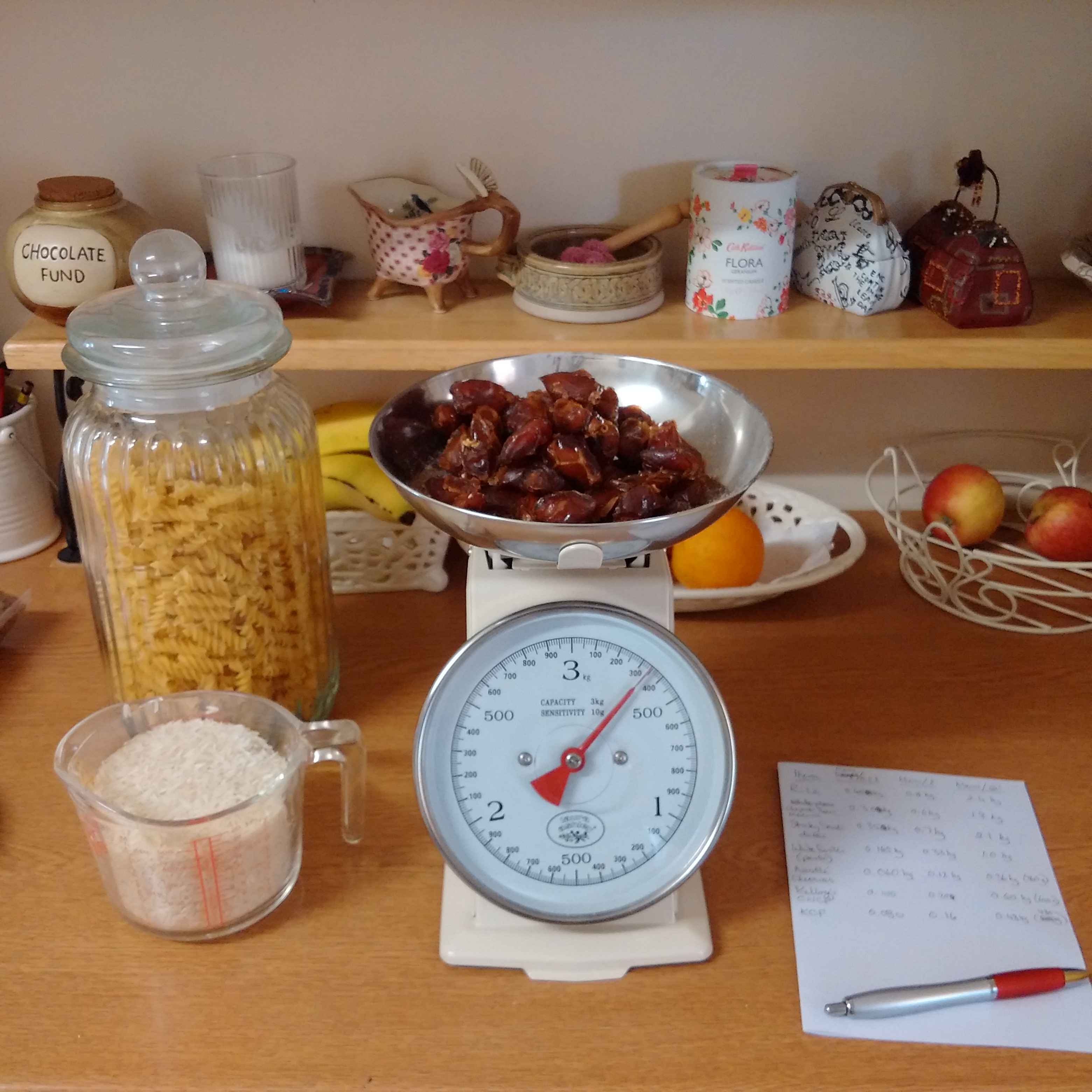
Measuring foodstuffs for zakat al-fitr

(Please click here for a PDF of this fatwa: Zakat al-Fitr and food banks)

All Praise be to God, Lord of the Worlds.  Peace and Blessings of God be upon His Noble Messengers.

  1. The “fast-breaking alms-giving” (zakat al-fitr or sadaqat al-fitr) is a confirmed Islamic tradition at the end of Ramadan, of donating food (in the form of staple foodstuffs) to poor people before Eid prayer in the morning of the day of Eid. The majority of jurists hold that zakat al-fitr is compulsory (fard), whilst a minority hold that it is a highly-recommended tradition (sunna); a small minority even argued that it was abrogated by the full obligation of zakat.
  2. Any charitable donation may be sent abroad. However, it is a basic Islamic principle, in common with other religions, that “Charity begins at home,” or as the Prophet Muhammad, peace be upon him, expressed it repeatedly, “Begin with your dependants.” (ibda’ bi man ta’ul, a sound hadith with several narrations)  Thus, it is recommended for Muslims in Britain to distribute their zakat al-fitr offerings locally.  Furthermore, God and His Prophets repeatedly recommend the rights of neighbours: regarding food, the Prophet Muhammad, peace be upon him, emphatically taught, “By God, they are not trustworthy believers: those who spend the night with stomachs full whilst their neighbours go hungry!”
  3. Zakat al-fitr is usually given as food items; the Hanafi jurists allowed the giving of cash, but this was with the intention that the poor recipients may use the cash to buy food or other essential items. Therefore, it remains an option to donate zakat al-fitr as either food items or cash.
  4. The amount of zakat al-fitr payable is, per wealthy Muslim head (adult or child), traditionally equal to one saa’ (approximately 3 litres in volume[1]) of the staple food item, or possibly half of one saa’ (approximately 1.5 litres) for more expensive foodstuffs.[2] One saa’ equates to the following approximate weight of common UK staple foods: rice 2.5kg, flour 2kg, pasta 1kg, porridge (porage) oats 1kg; by comparison, one saa’ of dates (not a UK staple food) weighs approximately 2kg.[3]
  5. The retail prices of the above items imply that UK zakat al-fitr is approximately £3-£5 per person. Some jurists recommend, to be safe, giving 3kg of staple food, which would be more than one saa’ in the vast majority of cases of staple food.
  6. Alternatively, the zakat al-fitr amount was traditionally understood to be the equivalent of food for one or two meals, each meal consisting of one or two mudds (one saa’ = four mudds). Since an average, filling meal costs roughly £2.50-5.00 in the UK currently, this approach gives us a similar answer, i.e. zakat al-fitr at £2.50-5.00 or £5-10.
  7. Traditionally, zakat al-fitr was mostly given to poor Muslims: most jurists held that poor people who were not Muslim were not eligible to receive zakat al-fitr, since both poverty and Islam were conditions for recipients. But Imam Abu Hanifa and others held that poor dhimmis (non-Muslim People of Scripture, protected by Muslim authorities) were eligible to receive it, since poverty was the only condition for recipients.
  8. Since the category of dhimmis was abolished by the Ottoman caliph in 1856 in favour of equal citizenship (muwatana) irrespective of faith or religion, and since Muslims comprise only 4-5% of the population of Britain where all citizens are equal, zakat al-fitr in the UK may simply go to poor people, irrespective of their religion, faith or belief (or lack thereof).
  9. With up to a million annual estimated uses of food banks by people in the UK to complement their situation of poverty, an obvious way for Muslims to distribute their zakat al-fitr locally is via their local food banks. Since the recipients do not have to be Muslim, based on the view of Imam Abu Hanifa, this should pose no problem religiously.  Food banks based in areas of the UK with Muslim-majority populations, or those run by mosques, are likely to have recipients who are mainly Muslim.
  10. Suggestions for the staple foodstuffs of people in the UK include, but are not limited to: bread, potatoes, rice, pasta, cereals, flour, couscous, etc. (Traditionally, zakat al-fitr has been given in solid staple foodstuffs, whereas for fidya and kaffara, bread was prominently given, accompanied by oil, fat, vinegar, meat, etc. – cf. Tafsir Ibn Kathir on Qur’an 5:89 & 5:95. Long-life milk and juice is in demand at UK foodbanks, and it is arguable that these liquids are also UK staple foods.)
  11. It is thus recommended for wealthy Muslims in the UK who wish to distribute their zakat al-fitr to do so either directly to needy families, else via their local food bank, else via cash to a local, national or international charity.
  12. May God accept and bless our worship during Ramadan, Eid and all year round, and guide us towards helping to eliminate poverty and unnecessary hunger.

(Sheikh Dr) Usama Hasan: London (UK), 29th Ramadan 1436 / 16th July 2015

APPENDIX: SOME BACKGROUND RESEARCH


  1. EXTRACTS FROM THE BOOK OF ZAKAT AL-FITR (“FAST-BREAKING ALMSGIVING”) by IBN RUSHD / AVERROES[4]

Its ruling: The majority of jurists hold that zakat al-fitr is compulsory (fard).

The ‘Iraqi jurists and some of the later Maliki ones hold that it is a recommended tradition (sunna).

Some said that it was abrogated by the obligation of zakat, based on the hadith of Qays bin Sa’d bin ‘Ubadah, who said, “The Messenger of God, may God bless him and grant him peace, used to order us to give it [zakat al-fitr] before the obligation of zakat was revealed.  When the verse of zakat was revealed, we were neither commanded to, nor forbidden from, giving it [zakat al-fitr], but we continue doing so.”[5]


When does zakat al-fitr become obligatory?

Abu Hanifa and Malik via Ibn al-Qasim: At dawn on the day of Eid al-Fitr.

Shafi’i and Malik via Ashhab: At sunset on the last day of Ramadan.

Thus, for a newborn baby between these two times, there is disagreement as to whether or not zakat al-fitr is due on his/her behalf.


Recipients

Poor Muslims may receive it, by consensus (ijma’).

As for poor dhimmis [protected non-Muslims], most of the jurists say that they may not receive it. Imam Abu Hanifa said that they may receive it. Some said that only monks amongst dhimmis may receive it.


  1. EXTRACT FROM FATH AL-BARI, IBN HAJAR AL-‘ASQALANI’S COMMENTARY ON SAHIH AL-BUKHARI, CHAPTERS ON SADAQAH AL-FITR, HADITHS NOS. 1503-1512 (translations of these hadiths widely available)

http://hadith.al-islam.com/Page.aspx?pageid=192&TOCID=965&BookID=33&PID=2783

Ja’far al-Firyabi narrated in his Kitab Sadaqat al-Fitr (Book of Fast-Breaking Almsgiving) that when Ibn ‘Abbas was the governor of Basra, he ordered the giving of zakat al-fitr: a saa’ of dates etc. or half a saa’ of wheat. When ‘Ali came and saw the cheap prices, he commanded that a saa’ measure be used for all foodstuffs, indicating that he considered the value of the food, whilst Abu Sa’id considered the volume of the food.

ويدل على أنهم لحظوا ذلك ما روى جعفر الفريابي في ” كتاب صدقة الفطر ” أنابن عباس لما كان أمير البصرة أمرهم بإخراج زكاة الفطر وبين لهم أنها صاع من تمر ، إلى أن قال : أو نصف صاع من بر . قال : فلما جاء علي ورأى رخص أسعارهم قال : اجعلوها صاعا من كل ، فدل على أنه كان ينظر إلى القيمة في ذلك ، ونظرأبو سعيد إلى الكيل كما سيأتي .


  1. ABOUT UK FOOD BANKS

In the UK, the Trussell Trust (http://www.trusselltrust.org/) runs a network of foodbanks, although there are many other independent foodbanks and collection points run by churches, mosques, synagogues, temples, community centres, etc.  Trussell can help community and faith organisations to begin a foodbank, and also have a partnership with Tesco, such that every Tesco store is potentially a foodbank collection point.  Many foodbanks distribute food parcels to the needy on one day each week.

Trussell’s recommended items for foodbanks, based on http://www.trusselltrust.org/resources/documents/foodbank/website-shopping-list.pdf and variations in printed leaflets from Trussell:

  • Milk (long-life/UHT or powdered)
  • Sugar
  • Fruit Juice (long-life or carton)
  • Soup / Hot Chocolate
  • Pasta Sauces
  • Sponge Pudding (tinned)
  • Cereals
  • Rice pudding / Custard
  • Tea Bags / Instant Coffee
  • Instant Mashed Potato
  • Rice / Pasta
  • Tinned Meat / Fish
  • Tinned Fruit, incl. tomatoes
  • Jam
  • Biscuits or Snack Bars
  1. APPROXIMATE WEIGHT (MASS) OF ONE SAA’ (THREE LITRES) OF VARIOUS FOODSTUFFS, THE RECOMMENDED AMOUNT OF ZAKAT AL-FITR TO BE GIVEN PER PERSON

This is based on simple measuring out and weighing using a measuring container and scales found in an average kitchen, by the author on the date of the fatwa. (This is a fun, instructive and educational activity for adults and children towards a religious, humanitarian objective.)

  • Rice 2.4kg
  • Flour (medium chapatti) 1.8kg
  • Dates (sticky Saudi ones) 2.1kg
  • Pasta (white fusilli) 1.0kg
  • Porridge / porage oats (Scott’s) 1.1kg
  • Corn Flakes (Kellogg’s) 480g
  • Crunchy Nut Corn Flakes (Kellogg’s) 600g
  • Cheerios (Nestle) 360g


  1. EXAMPLE OF DIY ZAKAT AL-FITR IN ACTION IN THE UK

On this date, the author and his wife are blessed with four children, so the following foodstuffs, all in 500g packets, were bought from a local supermarket and delivered to a local foodbank collection point, by the grace of God:

Rice 5kg

Pasta 3kg

Porridge oats 2.5kg

Total cost: £20, working out at just under £3.50 per head for a family of six

May Allah (God) accept and bless our Ramadan and Eid!

FOOTNOTES / REFERENCES

[1] Cf. http://www.bakkah.net/en/zakat-fitr-measurements-saa-three-litres-mudd.htm

[2] Cf. Sahih al-Bukhari, Book of Zakat, Chapters on Sadaqat al-Fitr, Hadiths nos. 1503-1512

[3] Note that 3 litres of water weigh exactly 3kg, so this implies that all these foods are less dense (“lighter”) than water. In fact, they are denser than water but the air trapped between the food particles means that 3 litres of food generally weighs less than 3 litres of water (3kg).

[4] Extracted from: Ibn Rushd al-Qurtubi al-Andalusi [Averroes], Bidayat al-Mujtahid [The Distinguished Jurist’s Primer], Dar al-Kutub al-‘Ilmiyyah, Beirut, 1418/1997, vol. 1, pp. 413-420; a full English translation of this work is available, by Prof. Imran Ahsan Khan Nyazee

[5] Nasa’i, Ibn Majah, Hakim & Bayhaqi

INNER AND OUTER ASPECTS OF ISLAMIC RITUAL PRAYER (SALAT)

June 26, 2015

Bismillah. This is about some of the beautiful symbolism and meaning behind the salat or ritual prayer, one of the five pillars of Islam and to be performed at least five times a day.  When the salat is reduced to pure ritual without any understanding of the Arabic words or of the symbolism of the actions, many inward and outward problems arise, God forbid!  But the salat is the believer’s daily ascension (mi’raj) and communion with God: it is up to us to deepen this daily experience of ours. It is the Muslim’s daily practice of mindfulness, meditation and remembrance, to develop a deep wellspring of love, faith and humility to equip us for life’s individual, social and political challenges. May God continue to bless our journeys!

All italicised phrases are from the Qur’an and Sunna; references are omitted for ease of reading and clarity: this is not an academic article, but an attempt to elucidate certain indications and symbols, with the hope of helping people on their own journeys.

With the Name of God, All-Merciful, Most Merciful

INNER AND OUTER ASPECTS OF ISLAMIC RITUAL PRAYER (SALAT)

  1. Prayer times: Time is sacred (God says, I am Time); we offer each prayer within its time in order to share in the sacredness of every part of the day and night, and to give thanks for that portion of sacred time.
  2. Washing (ablutions) before prayer: we cleanse our limbs and hearts of wrongdoing.
  3. Ablutions are nullified by toilet or sexual acts: these represent our basic animal natures, so we wash again to symbolise recovering our angelic natures in order to stand before God.
  4. Facing Mecca: The Ka’bah, as the House of God, symbolises the heart, which is also the House of God. Whilst facing Mecca outwardly, we turn inwardly to face the home of God at the centre and core of our being. So turn your face towards the Sacred Mosque!
  5. Standing in straight rows: we are in fellowship, equal before God, and imitating the ranks of the angels. The hearts of the people of Paradise beat as one … By Those Who Stand in Ranks!
  6. Raising the hands at the beginning of the prayer: symbolises the “lifting of the veil” between us and God. In prayer, we are talking directly to our Lord.
  7. Standing before God in prayer: facing up to life as a journey to God; a foretaste and preparation for standing before God on Judgment Day.
  8. Keeping the eyes open, rather than closed, in prayer: do not be veiled by multiplicity from Unity, nor by Unity from multiplicity.
  9. Lowering the head and looking at the ground (if practised): humility before God.
  10. Keeping the chin up and looking straight ahead towards Mecca (if practised): facing life, and one’s inward reality, directly.
  11. Folding the arms across the body (if practised): the servant’s pose before the Master.
  12. Reciting the Opening Chapter of the Qur’an (Surat al-Fatiha): we are sharing in a communion with God. God says, I have divided the prayer between Me and My servant …
  13. Praise be to God, Lord of the Worlds; All-Merciful, Most Merciful; Master and King of the Day of Judgment: God says, These belong to Me, as our glorification is of God.
  14. You alone we worship; You alone we ask for help: God says, This is (shared) between Me and My servant; the God-human relationship.
  15. Guide us to the Straight Path; the path of those whom You have favoured, who neither receive (Your) anger nor stray: God says, These belong to My servant, and My servant shall have whatever he or she requests.
  16. Reciting further from the Qur’an: the remembrance of God continues; God and the angels bear witness to it. Truly, the recitation at dawn was witnessed.
  17. Bowing: humility before God; bearing life’s hardships, followed by standing tall again.
  18. Prostration, with forehead, nose, hands, knees and feet pressed to the ground: ultimate humility before God; one is closest to God in this posture, which is outwardly humiliation, inwardly elevation; our hearts are higher than our brains, whilst the rest of the time, our brains are higher than our hearts; Pray hard, for your prayers are most likely to be accepted in this position; death.
  19. The second prostration, after a brief sitting: the second death, at the blowing of the Horn. Our Lord! You caused us to die twice, and to live twice …
  20. In prayer, do not sit like a dog, peck like a cockerel or squat like a monkey: throughout prayer, we must rise above our animal natures and try to inhabit our angelic natures.
  21. Standing, bowing, prostration: the body forms the Arabic letters Alif (A), Dal (D) and Mim (M) respectively, hence spelling Adam during the prayer; we are seeking our original Paradisal, primordial humanity before the Fall through our communion with God.

    [In Hebrew and Arabic, the Aleph/Alif (A) also signifies the number 1, so “Adam” is identical to “1 dam” meaning “one blood”: humanity is united; we have different skin colours, but we bleed the same colour. Red blood cells have no DNA (although white ones do), so in a sense blood represents our common humanity – much of it does not have our unique, genetic fingerprints that are found in every other of the trillions of cells of our body.]

  22. Standing, bowing, prostration: the body forms a straight line, right angle and (semi-)circle respectively, the bases of all geometry and form; we are signifying that we are at one with Nature and its beautiful forms. God is Beautiful, and loves Beauty.
  23. Sitting in remembrance of God at the end of the prayer: a foretaste of the eternal rest in Paradise.
  24. The prayer ends with the greeting of peace (salam): Their greeting on the Day they meet Him is Peace; Their greeting there (in the Garden) is Peace; they hear no vain or sinful talk, only the words, Peace, Peace!

Usama Hasan

London, Ramadan 1436 / June 2015

SACRED TIME – THE NIGHT OF MAJESTY – LAYLAT AL-QADR

July 31, 2013

Bismillah

SACRED TIME – THE NIGHT OF MAJESTY

Laylat al-Qadr is a special night mentioned in the Qur’an, with a whole chapter devoted to it. The name means, “The Night of: Power, Destiny, Decree, Predestination, Fate, Majesty, Honour, Glory, Value.” It is the greatest night of the Islamic year.  The short Qur’anic chapter (no. 97) reads as follows:

Truly, We have sent it down in the Night of Majesty. 

And what will tell you what is the Night of Majesty? 

The Night of Majesty is better than a thousand months! 

The angels and the Spirit descend in it, by the permission of their Lord, along with every command. 

Peace! … It is, until the rise of Dawn.

The Night of Majesty is thus a night of intense spirituality and peace: The Prophet Muhammad, peace be upon him, taught, “Whoever stands in prayer during The Night of Majesty, motivated by faith and seeking reward from God, their past and future sins will be forgiven.” [Bukhari & Muslim have “past sins”; other authentic hadiths add “and future sins”]

“It” in the first verse is masculine, and refers to the Qur’an but generates a sense of awe for it by not naming it.  The previous surah is precisely “Recite!” (Iqra’, no. 96), so the openings of these two surahs correspond.  “It” in the last verse is feminine, and refers to the night.

The Prophet, peace be upon him, once spent the entire month of Ramadan in I’tikaf (retreat or seclusion in the mosque) in order to find this night.  Traditionally, this night is said to fall on one of the odd nights during the last ten of Ramadan, i.e. the 21st, 23rd, 25th, 27th or 29th nights.  Ibn Hazm argued that the last 10 ten nights depend on whether Ramadan has 29 or 30 days, something not usually known in advance: if Ramadan has 29 days, then the odd nights of the last 10 are the 20th, 22nd, 24th, 26th and 28th, so one should seek for it throughout the last ten nights, not just the odd ones. The commentators further disagree as to whether this special night is on a fixed date every year, or whether it changes from year to year.  The most popular traditional date for the night is the 27th – it is said that the Qur’an indicates this because the 27th word in the above surah is hiya (“It”), referring to the night itself.  Other views are that it occurs on the first or last night of Ramadan, or the 17th or 19th.  Some authorities (eg Ibn Mas’ud) insisted that it may fall on any night of the year. [cf. Tafsir Ibn Kathir for all these views]

But what does it mean to say that it is “better than a thousand months!”?  Traditional commentators often point that, taken literally, this equates to 83 years 4 months, a longer-than-average human lifetime.  Thus, this night’s worship is better than a lifetime of devotion. 

Other commentators, say that the phrase “a thousand months” is metaphorical; it is a bit like saying in English, “It is better than a million years!”  Eg Imam Qurtubi says that it means “better than all of time” (khayrun min al-dahri kullihi).  In other words, it is “better than forever” or “better than eternity” – the Night of Majesty is a search for eternity, for timelessness, for the connection with God that transcends all space and time.  No wonder, then, that this precious night is associated with the angels, with the Cosmic Spirit that permeates all of creation and with the outer and inner peace that we all crave and seek.


A Prayer

Ayesha, the Prophet’s honoured wife, asked him what prayer to say on this night.  He taught her the following words, that have been repeated billions of times by Muslims since, all of whom who learnt it via the Prophet’s wife from him:

Allahumma innaka ‘afuwwun tuhibbu l-‘afwa fa’fu ‘anni

“Dear God, truly: You are Forgiving; You love Forgiveness: so please Forgive me!”


Poetry – William Blake, Auguries of Innocence

To see a world in a grain of sand

And a heaven in a wild flower.

Hold Infinity in the palm of your hand

And Eternity in an hour.


Poetry – Auguries of Innocence Ramadanified

To break your fast with a wholesome date

And recite noble verses of Light.

Seek Infinity in your unfolding Fate

And Eternity in one Night!

Usama Hasan, with apologies to William Blake

A 13th-century Moroccan Sufi on the Hadith of the 73 Sects

February 24, 2013

Bismillah.  An important explanation of what is meant by “What I and my Companions are upon” in the hadith of the 73 sects, a phrase often abused nowadays by un-Islamic, sectarian mindsets.  With thanks to Arnold Yasin Mol for digging this out.

In the tafsir by the 12-13th century Moroccan Sufi, Abu al-’Abbas al-Subti, he makes a very interesting exegesis on Qur’an verse 16:90 and the famous 72-sects Hadith. Through Asbab al-Nuzul he sees that 16:90 was revealed about the brotherhood pact between the first Muslims from Mecca (Muhajirun) and the helping community in Medina (Ansar) through which they obliged each other to share everything equally. The word ‘adl (عدل) in 16:90 means ‘equal value/weight/justice’, and so al-Subti understands that true justice means sharing everything equally among everybody. Later he sees that the famous 72-sects Hadith (72 Muslim sects go to Hell, 1 sect is saved) which is abused by many groups and sects to declare themselves the ‘saved sect’ and all others as condemned, was said the day after the ‘equal sharing pact’ was made, and thus equal sharing is what the Prophet and the first Muslims followed. The Hadith isn’t about following detailed sectarian rules concerning creed and ritual; to be saved is to share equally among mankind.

“I found a verse in the Book of God that had a great effect on both my heart and my tongue. It was, ‘Verily, God commands justice and the doing of good.’ I pondered this and said [to myself], ‘Perhaps [finding] this is no coincidence and I am the one who is meant by this verse.’ I continued to examine its meaning in the books of exegesis until I found Gharib at-Tafsir, which stated that [the verse] was revealed when the Prophet established brotherhood between the Emigrants (Muhajirun) and the Helpers (Ansar). They had asked the Prophet to establish a pact of brotherhood between them, so he commanded them to share among themselves. In this way, they learned that the justice commanded [by God] was through sharing. Then I looked into the saying of the Prophet: ‘My community will be divided into seventy-two sects, all of which will be in the Fire except the one followed by me and my companions,’ and found that he said this on the morning of the day that he had ordered the pact of brotherhood [to be established] between the Emigrants and the Helpers … So I understood that what he and his companions adhered to were the practices of equal sharing (mushatara) and favouring others (ithar). Then I swore to God Most High that when anything came to me I would share it with my believing brethren among the poor. I followed this practice for twenty years, and this rule affected my ideas to the point where nothing dominated my thoughts more than uncompromising honesty (sidq).”

[translation: Vincent J. Cornell, “Realm of the Saint: Power and Authority in Moroccan Sufism”]

Cornell also mentions that to Abu ‘l-‘Abbas, every act of human mercy (rahma) evoked a merciful response from the all-merciful God (ar-Rahim). He summed up his theory of reciprocity with the maxim: “[Divine] Being is actualised by generosity” (al-wujud yanfa’ilu bi ‘l-jud).

Three Upcoming Lectures in Cambridge, God-willing

January 31, 2012

Bismillah

1) Wednesday 1 February – The Libyan Revolution and its Future

Aref Ali Nayed in conversation with Edward Stourton

5.00 pm – 6:30 pm

Runcie Room, Faculty of Divinity, West Road, Cambridge CB3 9BS

Aref Ali Nayed is the Ambassador of Libya to the United Arab Emirates and was the Chief Operations Officer of the Libyan Stabilisation Team. In Cambridge as a Visiting Fellow with the Cambridge Inter-faith Programme, Dr Nayed is in conversation with the distinguished BBC print and broadcast journalist, Ed Stourton.

A reception, open to the audience, will follow the event.

This event is FREE but booking is essential: book now at libya.eventbrite.co.uk or call 01223 763 013.

In February 2011, Islamic scholar Aref Ali Nayed took part in demonstrations in Tripoli, where he was born. There, he witnessed first-hand the brutality of the Libyan regime against its own people. Together with other religious scholars, Nayed established the Network of Free Ulema. In their first press release, on 19th February, they wrote, “STOP THE MASS KILLINGS OF PEACEFUL DEMONSTRATORS IN LIBYA”. As the days progressed, their statements became more desperate, calling for international action, until on 2nd March, they called for the world to recognise Libya’s new Interim National Council and Government.

 Nayed was one of the first prominent Libyans to publically decry Gaddafi. He set up a Support Office for the Executive Team of the new National Transitional Council (NTC) in his Dubai premise, which worked around the clock towards the transition to NTC authority, working on matters which included humanitarian, financial, diplomatic, telecommunications and security issues.

In June, Nayed was appointed coordinator of the Tripoli Taskforce.  When Tripoli was liberated in late August 2011, the remit was broadened and he was made the lead coordinator of the Libya Stabilization Team.  Nayed’s team worked intensively and restored electricity, telecommunications, and water supply and fuel. In early August the NTC announced Nayed as the new Libyan Ambassador to the United Arab Emirates and he was given possession of the Libyan Consulate buildings in Dubai. He was the first ambassador to be officially appointed under the NTC.

Dr Aref Ali Nayed is a Libyan Islamic scholar, and Libyan Ambassador to the United Arab Emirates. He is also the founder and director of Kalam Research & Media, based in Tripoli, Libya and Dubai. Until the outbreak of the revolution in Libya he lectured on Islamic theology, logic, and spirituality at the restored Uthman Pasha Madrassa in Tripoli, and supervises graduate students at the Islamic Call College there.

Aref Nayed is also Senior Advisor to the Cambridge Inter-faith Programme, Fellow of the Royal Aal Al-Bayt Institute in Jordan, and was appointed to the Board of Advisers of the prestigious Templeton Foundation.


Cambridge Muslim College – Lecture Programme: Lent 2012                                                          

Cambridge Muslim College is pleased to announce its public lecture programme for the Lent Term 2012. The College welcomes distinguished speakers, each addressing a timely and scholarly topic.

Both lectures take place at the Runcie Room, Faculty of Divinity and will begin at 6.30 pm.

2) Wednesday 22nd February

The Islamic Garden: An Opportunity for ‘Bridge-Building’ Between Cultures

Emma Clark, Garden Designer and Senior Tutor, Prince’s School of Traditional Arts


3) Thursday 8th March

Images of People with (Mental) Disabilities in the Islamic Tradition

Mohammed Ghaly, Assistant Professor of Islamic Studies, Leiden University

Inner Aspects of Ramadan

August 23, 2011

With the Name of Allah, All-Merciful, Most Merciful

Inner Aspects of Ramadan

Three Levels of Fasting

Imam al-Ghazzali, in his Ihya’ ‘Ulum al-Din (Revival of the Sciences of Religion), describes the following three levels of fasting (cf. Inner Dimensions of Islamic Worship, publ. Islamic Foundation, which is a translation by the late Mukhtar Holland of an extract from the Ihya’):

  1. Fasting of the body: abstaining from food, drink and sex
  2. Fasting of the tongue: abstaining from backbiting, gossip, slander, idle talk, etc.
  3. Fasting of the heart and soul: abstaining from the remembrance of anything or anyone except God and engaging constantly in dhikr Allah, the mention or remembrance of God

Patience & Gratitude (Sabr & Shukr)

Allah says often in the Qur’an (e.g. 14:5, 34:19, 42:33), especially in regard to the ups and downs of life and history that constitute the Days of God (ayyam Allah), “… In this there are Signs for every extremely patient one, given to much gratitude.” (sabbar shakur, both intensive active participles derived from sabr and shukr, respectively)

The Prophet (peace be upon him) taught, “One who eats gratefully is like one who fasts patiently.” (al-ta’im al-shakir ka l-sa’im al-sabir, a sound hadith found in the Sunan collections)  Thus, eating wholesome food with thanks to God is spiritually equal to depriving oneself of food and drink for the sake of God.

Some of the early Muslim authorities (Salaf) said, especially in explaining the above Qur’anic ayah, “Faith has two halves: half of faith is patience; the other half is gratitude.” (al-iman nisfan: nisf sabr wa nisf shukr)

Thus, as Imam Ibn al-Qayyim explains, Patience and Gratitude are two sides of the same coin of faith: we are required to have patience in troubled times, and show gratitude to God in good times.  This is why these two qualities are mentioned in the Qur’an alongside lessons from time and history, or the Days of God.

Showing gratitude to God includes being grateful to people through whom we receive God’s favours. It also includes using our God-given talents, skills and faculties for good and noble purposes, rather than for disobeying God and engaging in mischief and evil: all good actions thus become part of the worship of God.

Imam Ibn al-Qayyim, further explains the importance of balancing these two qualities to achieve true faith and grow closer to God, with the following simile: “Patience and Gratitude are like the two wings of a believer in their flight to their Lord.”

Another beautiful teaching of the Prophet, peace be upon him, that reinforces these themes, is the following: “Wonderful is the situation of the believer! If he or she is afflicted by misfortune, he or she is patient, and this is good for him or her.  If he or she is touched by good fortune, he or she is grateful, and this is good for him or her.  This (grace) is not available to anyone except the believer!” (A sound hadith transmitted by Bukhari and Muslim)

(For further reading, refer to Patience and Gratitude by Ibn al-Qayyim, trans. Huda Khattab, publ. Dar al-Taqwa, London)

Life & Death

The Prophet (peace be upon him) famously taught that “The person fasting enjoys two moments of happiness: (1) happiness upon breaking the fast and (2) happiness upon meeting the Lord.”

Thus, the joy of iftar or Fitr (breaking the fast) is a foretaste of the joy of meeting God.

The daily cycle of fast and break-fast is a symbol of life and death: the daily fast symbolises the constraints, difficulties and tribulations of life; the daily break-fast symbolises the joy of death and meeting God, for the believer.

These inner meanings are wider: the entire month of fasting symbolises the tribulations of life, whilst ‘Id al-Fitr (the Festival of Breaking the Fast) symbolises the joy of meeting God.

The practice of I’tikaf (Seclusion in the Mosque) during the last ten days and nights of Ramadan, partly in order to seek the greatest night of the year, also contains reminders of these themes, amongst many other benefits.  Seclusion in the mosque entails devoting time to prayer, remembrance of God and other types of worship, avoiding worldly matters completely and minimising profane thought and talk.  Seclusion affords much time for silence and reflection.  The time of I’tikaf, i.e. the last third of Ramadan, is followed immediately by the ‘Id celebration.

I’tikaf may thus be seen and felt as a foretaste of our time in the grave, followed by ‘Id, which we hope is a foretaste of Paradise!

The authentic Sunnah (Way of the Prophet, peace be upon him) is that women may also stay in the mosque also for the spiritual seclusion of I’tikaf: many of the Prophet’s wives and female disciples engaged in this practice.  Mosques should thus be available to women for this uplifting bodily-and-spiritual practice.

Ramadan Cheer, Generosity and Spirit

As described by his Companions, Allah be pleased with them, the Prophet, peace be upon him, was the most generous of people and was especially generous during the month of Ramadan: even more generous than the winds that herald live-giving rains.  He, peace be upon him, himself explained why this was so: it was because the Archangel Jibril (Gabriel), the Ruh al-Qudus (Spirit of Holiness or Holy Spirit), would visit him daily to rehearse the Qur’an with him, consolidating during each Ramadan all that had been revealed of the Qur’an so far.  In the final Ramadan of the Prophet’s life, Jibril rehearsed the Qur’an with him twice, indicating that the revelation of the Qur’an was almost complete.  All the minor variations in the Qur’anic revelation were thus superseded by this “final rehearsal” (al-‘ard al-akhir), as it is known in Qur’anic studies.

Much may be learnt from this breathtaking meeting of Spirits (the Prophet Muhammad, the Noble Qur’an and the Archangel Gabriel) during Ramadan in Madinah during that Blessed Age:

  • The importance of visiting each other to strengthen spiritual contact.  The Prophet, peace be upon him, would sometimes complain to Gabriel outside Ramadan that the latter did not visit him enough, upon which the verse of the Qur’an was revealed, describing the movements of the angels, “We do not descend, except by the command of your Lord …” (19:64)
  • The blessed practice of rehearsing as much as one knows of the Qur’an during Ramadan, especially with someone who has preserved it equally or better (e.g. a teacher or colleague).  This should be done whether a person knows one verse or ten, one surah or ten, and in the case of preservers of the whole Qur’an (huffaz), one recitation (qira’ah) or ten.
  • The blessings of spirituality and generosity that arise from the above two matters: the Prophet’s generosity peaked during Ramadan due to these two factors.

Thus, Ramadan is the month of: fasting, recitation of the Qur’an, remembrance of God, generosity, mercy, charity and Jihad (struggling against all forms of evil).  And just as our Christian friends speak about “Christmas cheer,” Muslims should manifest the “Ramadan cheer, generosity and spirit.”

Tips for Getting the Most out of Ramadan

The following obvious tips may be derived from the Divine guidance to the Prophet, peace be upon him, “So when you have completed and become free (of worldly matters), stand (in worship).  And to your Lord, turn your desire!” (94:7-8)

  • Take time off work if possible
  • Get important worldly matters out of the way before Ramadan, e.g. house/car/furniture purchases and maintenance, bills, payments, etc.
  • Devote time to worship in all its forms, e.g. prayer, fasting, charity, reconciliation amongst people, serving people and the rest of God’s creation in general

May Allah shower upon us all the blessings of Ramadan, this year and every year.

© Usama Hasan
Know Thyself!

June 7, 2009

Socrates taught, “Know thyself!” and similar teachings are found in the Old and New Testaments, and undoubtedly in other faith traditions.  The Prophet Muhammad (may Allah bless him and grant him peace) is reported to have taught, “Whoever knows himself knows his Lord.”  The following analyses of this hadith by Imam Ibn Taymiyyah of Syria (d. 728 H) and Imam Suyuti of Egypt (d. 911 H) would suggest that although the hadith is questionable in its authenticity, its meaning is undoubtedly correct for it is implied in the Koran.  Furthermore, the early Salaf and Sufis were in no doubt that it is a central teaching of Islam.

Know Thyself

Were it not for you, O Muhammad, I would not have created the universe!

June 7, 2009

Interesting explanation of the idea of the “Muhammadan reality” (al-haqiqah al-Muhammadiyyah) from Imam Ibn Taymiyyah (661-728 H)!

In the mysticism of other faith traditions, the roles of Moses, Christ, Buddha, etc. correspond to the Muhammadan role here.

Muhammad as the reason for all of creation – Ibn Taymiyyah

Hajj – The Journey of Love

June 7, 2009

An incomplete draft translation of the wonderful Qasidah Mimiyyah by Imam Ibn Qayyim al-Jawziyyah, with explanatory notes.  The translation has reached 133 of the 229 lines (abyat) of the original Arabic text, so there’s still some more to do, God-willing. The English rendering is not great poetry, but I’m simply trying to convey some of the meaning in this great Qasidah.

Hajj – The Journey of Love

Hajj – The Journey of Love (Arabic text)