From Volcanic Ash to Volcanic Cash

April 20, 2010

From Volcanic Ash to Volcanic Cash

Bismillah. As-salamu ‘alaykum.

This is just a brief reminder that zakat money may be used to help stranded travellers, e.g. due to the recent closure of much airspace in Europe.

Stranded travellers comprise the last of the eight Qur’anic categories of valid zakat recipients (9:60).

(Zakat is an annual charity-tax that must be paid by wealthy Muslim individuals and businesses. It equates to 2.5% of annual surplus savings and profits. Zakat is one of the “five pillars” of Islam.)

Some speculations on the topological structure of elementary particles – by Sabbir Rahman

March 29, 2010

Bismillah.  This is from the remarkable Sabbir Rahman, may God increase his knowledge and intelligence even further.

27/3/10

I had something of an epiphany this morning, and wanted to share it with you.

In a recent paper, I explained how classical electrodynamics could perhaps be explained by the motion of a relativistic fluid in a double-sheeted spacetime, with time flowing in opposite directions on each sheet. The 4-dimensional spacetime in which we live is a superposition of these sheets. The fluid particles are identified with neutrinos and antineutrinos, which are rotating (Kerr) black holes formed by the gravitational collapse of gravitational waves. Furthermore, electrons are rotating (Kerr) black holes formed by the gravitational collapse of neutrinos. The motion of the neutrinos is what gives the electron its apparent negative charge (collapse of antineutrinos gives rise to positive charge, such as in the positron).

Now, Kerr black holes have a ring-like singularity which rotates at the speed of light (unlike the pointlike singularity which occurs at the centre of a Schwarzschild black hole – note that the Schwarzschild black hole can be considered as a particular limit of a Kerr black hole where the rotational anglar momentum is zero). In actual fact, the topology of the Kerr black hole is not that of a torus/doughnut, but rather that of a Klein bottle/double torus, which reconnects with itself only after two rotations around the ring. This is what gives the neutrinos and electrons their half-integral spin, and makes them fermions – i.e. they need to be rotated 720 degrees before they return to their original state/orientation in spacetime.

I was also able to explain in the paper how the interactions between electrons and positrons could be exchanged by the exchange of neutrinos. For example, a source electron will ’emit’ a neutrino, which will ‘strike’ the target electron, passing through its ring singularity and being sent backwards in time (i.e. it looks like an antineutrino going forwards in time) to the source electron, where it again passes through the ring singularity, emergin forwards in time to become the originally emitted neutrino!

Thus, the interaction between charged particles comes about through the exchange of a photon, which is nothing but a neutrino forming a closed timelike loop between the source and target charge. Furthermore, the neutrino travelling forwards in time will interact with itself travelling backwards in time, and this will in general result in an oscillatory or twisting motion, which gives rise to the frequency and polarisation of the photon. The existence of these closed timelike loops, i.e. the existence of time-reversing collisions within the context of classical mechanics can explain why the universe is actually quantum mechanical, because it means that at any given time, there are many possible futures which are consistent with the present (and the past), and which future actually occurs can only be determined probabilistically. As I have mentioned before, this can be identified precisely with the transactional interpretation of quantum mechanics. [Note that determinism and causality is therefore lost and a ‘choice’ has to be made at every point in time – which can lead on nicely to a discussion of predestination and free will, but I will not go into such matters now and stick to the underlying physics].

The above nicely can explain the structure of the electrons, neutrinos, photons, electromagnetic waves, etc, and even the foundations of quantum theory – all of which follow essentially from first principles from classical gravity (i.e. Einstein’s general theory of relativity).

This does however require that we keep the entire mathematical solutions of black holes and admit the existence of two spacetime sheets – usually one of these sheets is discarded as ‘unphysical’ as they seem to correspond to ‘white holes’ which are constantly spewing out particles which are not seen in reality. However, this overlooks the fact that the direction of time is reversed in these white hole solutions, so that they actually look like antiparticle black holes. So, whenever something falls into a black hole, it is actually accompanied by its own antiparticle, or looking at it differently, a particle that falls into a black hole is immediately re-emitted travelling backwards in time.

It also requires that we allow for the existence of ‘gravitational charges’. In particular, gravitational waves/antigravitons with negative mass. This however, must follow from the existence of the second (dual) spacetime sheet corresponding to the discarded half of the the black hole solutions. The change in time direction is also accompanied by a change in sign of mass. Thus, gravitational waves travelling forwards in time on the second sheet will have negative mass and collapse to form antineutrinos which spew out antigravitons into the first (base) sheet.

It seems then that we have a relatively complete description of classical (and quantum) electrodynamics, together with a description of neutrinos and photons, and together these pretty much cover the first family of leptonic particles in the standard model. But it is then natural to ask whether, and if so, how, the remaining elementary particles, namely the quarks and the hadrons (such as protons and neutrons and pions etc, which are composed of quarks) fit into this picture.

If the model cannot explain these as well, then, despite all of the successes so far, ultimately fails.

I believe insha’Allah that I now have a possible answer. It is beautiful, appears to be consistent, as one would ideally want from such a new theory, potentially makes a very interesting prediction which could explain the nature of the missing dark matter in the universe.

The clues to the answer are staring us in the face – the lowest mass quarks are the up and down quarks, and they are unusual in having fractional charges of +2/3 for the up quark and -1/3 for the down quark. It is also interesting that the down quark appears to have almost precisely twice the mass of the up quark. Both particles are also spin half fermions.

Now, we know from our model that charge is associated with particles which act as ‘sinks’ of neutrinos or antineutrinos. Also, mass is associated with spacetime curvature. Spin half is associated with the need for the particle to rotate 720 degrees before returning to its original orientation.

Those who have studied complex analysis, will realise that the structure of the electron looks very much like the structure of complex square root function, w=sqrt(z). The solution for w is a double-sheeted covering of the plane with a single branch cut – each complex number has two complex square roots, one on each sheet.

A good way to picture/model this is to take two circular pieces of paper placed on top of each other, and cut them both from the outside to the centre. Now, keeping them on top of each other, paste or tape them together so that a line drawn around the circle of the upper sheet which crosses the cut continues on to the lower circular sheet. The line then makes a rotation around the lower sheet, crosses the cut, and continues on the upper sheet (unfortunately it is impossible to tape the second cuts together, but hopefully you can imagine what this would look like.

There is a nice picture of the complex square root function on Wikipedia:

http://en.wikipedia .org/wiki/ Square_root# Square_roots_ of_negative_ and_complex_ numbers

The third picture, which shows the pasted sheets, is a pretty good representation of the structure of the electron.

The generalisation of this picture to complex cube roots (using three circular sheets of paper) is hopefully obvious, and is described in Wikipedia here:

http://en.wikipedia .org/wiki/ Cube_root

This is actually very similar to my proposed structure for the up and down quarks.

The problem however is that you would need to do three complete rotations (i.e. 1080 degrees) to come back to the starting points in this case, so this would actually decribe a particle of spin 1/3. As far as we know, no such elementary exists.

But there is a simple trick that solves the problem. Instead of starting with three circular sheets, we can cut out one-third of the circle from each sheet (i.e. leaving a 240 degree segment, each of which looks like a ‘Pacman’ shape), and then paste them together. The final picture remains much the same, however cutting out the 120 degree sliver from each circle results in a ‘pinched’ sheet for the particle’s ‘internal’ spacetime – we only have to go round 720 spatial degrees to travel round all three of the quark’s internal sheets. And this is precisely my proposed structure for the up quark. It is a triple-sheeted black hole solution with each sheet ‘pinched’ so that it has a missing or ‘defect’ angle of 120 degrees (technically such topological/ geometrical structures are called ‘quotient spaces’ or ‘orbifolds’) . See for example:

http://en.wikipedia .org/wiki/ Defect_(geometry)
http://en.wikipedia .org/wiki/ Orbifold).
http://en.wikipedia .org/wiki/ Quotient_ space

The ‘pinching’ of course produces curvature and hence mass, and it is necessary in order to be consistent with the double sheeted nature of spacetime – which also implies the spin-half of the quark. But it also explains in a very pleasing way why up quarks have a charge of +2/3 – the 120 degree defect angle means that only 2/3 of the (anti)neutrinos are falling into the singularity compared with the electron, which does not have a defect angle.

The down quark can be described in the same way as the up quark, but this time there is a defect angle of 240 degrees instead of 120 degrees for the up quark.

This means that the internal spacetime is pinched twice as much, which will require twice as much energy/mass/ curvature, and this is pleasingly confirmed by the fact that the mass of the down quark is approximately twice the mass of the up quark. The charge is negative because the down quark is formed from the gravitational collapse of neutrinos rather than antineutrinos.

The quarks can therefore be thought of as being intrinsically triple-sheeted objects which are being forced (by stretching out the angles) to live in a double-sheeted spacetime. This essentially explains why quarks are not found in their ‘naked’ state and are always constituents of composite particles such as nucleons (neutrons and protons) and mesons such as pions. In the standard model, the quarks are also assigned a ‘colour’ charge, of which there are three – namely ‘red’ ‘green’ and ‘blue’ – with their corresponding anti-colours for antiquarks. The observed particles are all colour ‘singlets’, i.e. they are either a combination of a quark and an antiquark of the same but opposite colour (e.g red + anti-red), or of three quarks, one of each colour, i.e. red + green + blue or anti-red + ant-green + anti-blue.

In the proposed model, the three quark colours can be associated with three sheets of which they are constituted. The requirement of observable particles being colour singlets is simply the requirement that the quark composites live naturally on the double-sheeted spacetime. (In actual fact, for mesons, which are made of a quark and an anti-quark, the specific colours assigned are probably irrelevant).

Consider the structure, then, of the lightest hadrons (mesons and baryons). The positively charged pion for example, is a composite of an up quark and an anti-down quark. We can now picture this as being very similar to a positron, but rather than there being a full 360 degree rotation on the two spacetime sheets around the Kerr singularity, there is a 240 degree rotation on the single (e.g. red) pinched internal sheet due to the up-quark, followed by a further 120 degree rotation on the doubly-pinched internal sheet (e.g. anti-red) due to the anti-down quark. There is a total internal rotation of 360 degrees, but an external rotation of 720 degrees, achieved by ‘stretching’ the internal angles as necessary. The same kind of picture can be drawn for the other mesons.

As for baryons such as the proton, which consists of two up quarks and one down quark for a net charge of +1, we have a similar situation, but this time all three ‘coloured sheets’ are used – e.g. 240 degrees of red, 240 degrees of green and 120 degrees of blue (note that the colours are really just labels for the sheets) which are stretched to fill out the complete 720 degree rotation in the double-sheeted spacetime.

We have seen that electrons and neutrinos have no defect angle, while up quarks have a defect angle of 120 degrees (i.e. 1/3 of a rotation) and down quarks have a defect angle of 240 degrees (i.e. 2/3 of a rotation remains). It is natural to ask whether there might also be particles [any name suggestions? – let’s just call it ‘S’ for now] with a defect angle of 180 degrees (1/2 of a rotation).

Such particles would be expected to have bare mass intermediate between that of an up quark and a down quark, i.e. around 3.6 MeV/c^2 (assuming 2.4MeV/c^2 for the up quark and 4.8 MeV/c^2 for the down quark), but there would only be one type with half-integral charge. It would therefore be paired with its own antiparticle in its lightest stable composite state (i.e. S + anti-S), which would therefore be electrically neutral (but could be significantly more massive than its consituents just as the pions are significantly more massive than their quark constituents, and of the order of 140 MeV/c^2). This would therefore be a massive neutral particle which does not interact the other standard model particles through either the elecroweak or strong forces, and could therefore be a potential candidate for the missing dark matter.

On the other hand, charged versions analogous to the proton (S + S and anti-S + anti-S composites of somewhat larger mass) would probably also be predicted. I don’t know if such things have been observed, or whether there is any other reason why they might not be allowed.

Defect angles of 90 degrees (i.e. 1/4 of a rotation) or higher fractions could potentially also exist, but there is presumably an energy/mass cost associated with squeezing in additional spacetime sheets, just as there is a large jump in mass from electron (0.511 MeV/c^2 to pion (140 MeV). There may be other reasons/selection rules which forbid their existence.

While I have discussed the structure a single family of elementary fermions above (electrons, neutrinos, up and down quarks), there are actually three fermion families which exist and need to be explained. They are very likely simply to be excited states of the first family (perhaps corresponding to black holes with more complex singularity structures than the Kerr black hole), and hopefully this will also explain why only three fermion families have been observed.

28/3/10

The most striking prediction of the model is that antimatter has negative gravitational mass (all matter has positive inertial mass), so antimatter should fall upwards in the gravitational field of ordinary matter. Even the Dirac equation predicts that positrons should have negative mass – though this fact tends to be conveniently overlooked by mainstream physicists for reasons not particularly well understood by me.

Despite the widespread belief that antimatter will also fall downwards like ordinary matter, it happens no-one has actually definitively tested whether which way antimatter falls. Fortunately the Aegis experiment (which was due to be carried out this year at CERN, though I do not know its current status), will for the first time insha’Allah be making measurements which will determine whether antimatter does indeed violate the equivalence principle. I have in the past contacted Michael Doser who is the spokesperson for the experiment, and he says that he is expecting either no violation or a very small violation, but will keep an open mind. Obviously, I am hoping for maximal violation! The AEGIS webpage is here,

http://aegis. web.cern. ch/aegis/ home.html

though it doesn’t seem to have changed much recently.

Another thought that came to mind after posting my earlier message, and which makes me feel rather silly now (with the benefit of hindsight of course) is that I speculated at the end about the possibility of an S + anti-S particle with zero charge, and also S + S and anti-S + anti-S particles with +1 and -1 charge respectively. Well, the only standard model particles which are missing from the first fermion family (I ignore the Higgs for now, which is still hypothetical) , are the Z0, W+ and W-, that is, the three weak interaction intermediate gauge vector bosons, which have charges 0, +1, and -1 respectively, with mases of 91 GeV/c^2 for the Z0 and 80 GeV/c^2 for the W’s. So the model could well be predicting the existence of these three particles – which would be something of a blessing.

The reason why I did not make the connection immediately is because I was expecting the SS particles to be fermions not bosons – but perhaps the 180 degree defect angle turns them into bosons in this context (needs further thought). Also, I was expecting the intermediate gauge vector bosons to be analogous to the photon in some way, which is associated with neutrino/antineutri no exchange. On the other hand, there is no need for photons to carry any kind of topological charge, whereas this is not the case for the weak vector bosons, and this may account for the major difference between the two types of vector boson in the model.

Husam Kaikati of Cambridge returns to Allah

March 25, 2010

29/3/10: Bismillah.  We buried Husam on Saturday, rahimahullah. Omar Mahroo, jazahullahu khayran, drove me and our elder boys up to Cambridge. At the funeral prayer and/or burial, amongst several hundred mourners, were: Sheikh Sejad, the young Bosnian imam (behind whom I used to say the Friday prayers at Hendon mosque) who led the Zuhr prayer; Abdul Jalil Mirza, who flew all the way from Saudi the day before, just for the funeral; Abdul Qayyum Arrain; Abdul Lateef Rajput; Aahmer, his dad and many of their clan; Dr. Abdul Ma’bud of the Islamic Academy in Cambridge and student of the late Prof. Syed Ali Ashraf rahimahullah; Ellis Karim; the sons of Abdul Shakoor Chilwan, who was abroad; Yusuf, teenage son of Sheikh Abdul Hakim Murad (also abroad).  Husam’s younger brother Yasir and three sons were there, of course: Muhammad, Abdullah & Umar.  They are all handsome young men now, masha’Allah, but are obviously devastated at the moment.  The last time I saw the elder two, they were toddlers running around their house, 18 years ago.  Their mum Julie and younger sister Safiyyah were presumably in the women’s section of the mosque; there were no women at the burial.

It was good to see several children, all boys aged 7-12 roughly, at the funeral and burial: children above an appropriate age are not traumatised or emotionally scarred by witnessing a funeral; rather, they are strengthened emotionally and begin to learn that most valuable of lessons: that death often punctuates life unexpectedly.  The more materialistic our lives and societies are, the more we become in a state of denial about death, and the harder it becomes for us to face up to the reality of the death of a loved one.  And, as far as I know, it is perfectly acceptable in Islamic tradition for women to attend burials if they so wish, and perhaps this should be encouraged, especially since it may help a grieving mother, wife, sister or daughter etc. come to terms with their loss.

There were many old friends there: a very emotional reunion in obviously sad circumstances.  Husam was buried next to Abdul Majid Arain, Abdul Qayyum’s father who died last year, rahimahullah.  Here are some tributes to Husam.

Yasir Kaikati: “My brother was an imam and khatib who wasn’t afraid to speak the truth based on what Allah and His Messenger said.  He visited prisoners to help them and also made many trips to talk to students at universities in London.  He would often be the first to literally jump into graves to help bury deceased people.  People would ask him to lead the funeral prayers for their relatives.  It’s almost unbelievable that it’s now his turn to be buried. Rahimahullah.”

Aahmer: “A great loss to Cambridge.”

Mujahid Khalid: “inna lillahi wa inna elaihi raajioon – I’m devastated to hear this news. I loved this brother for the sake of Allah. We last met in Riyadh 2 years ago with our brother Muhammad an-Najjar. May Allah have mercy on him and his family.”

Ziyad Abubacker: “Inna lillahi wa inna ilaihi rajioon. IA may Allah grant him peace and rahmah. He was Alhamdulillah, a kind man and brings back many fond memories of our early days in Cambridge. He was the khateeb in the masjid and used to run the Friday study circle.”

Ibn Abdil Shakoor Chilwan: “My father moved with us, the entire family, from Haverhill to Cambridge to be closer to Husam and Mustafa.” [Mustafa is a Libyan brother, another regular at the Friday circle during my time, now settled abroad.]

Which reminds me, that at the Friday circle 1989-92, we would all introduce ourselves briefly at the end of the circle, before the tea & biscuits.  Dr. Ahmad Ibrahim insisted on this: it was a good practice he seemed to have learnt from his al-Ikhwan al-Muslimun training, although it seemed a bit pointless on the days when there were no newcomers, since we all knew each other pretty well by then. Br Abdul Shakoor would always say, “… I live in Haverhill, about 20 miles from here.” After hearing this weekly for months, Husam finally teased him once, asking, “Why do you always say: about 20 miles from here ?!”

I’ve just remembered another anecdote: Husam once took me and another student friend to visit a middle-aged Turkish friend of his, originally from Adana. (Syria & Turkey share a border, of course, and there is much friendship between the peoples of the two countries.)  This chap was well-educated and a wise man.  During our conversation he mentioned the story of Sayyidina Umar b. al-Khattab, whilst in Madinah, having a waking vision of his commander Sariyah in trouble battle in Syria or Persia.  Sayyiduna Umar called out, “Sariyah! [Move towards] the mountain!”  Sariyah heard a voice exclaiming the same advice hundreds of miles away and somehow knew that it was from Umar.  He obeyed the advice and the tactic proved successful.  Anyway, this was the first time I had heard this story (which I finally read over a decade later in Suyuti’s Tarikh al-Khulafa’ or History of the Caliphs) and my initial reaction was that it was a weak hadith or some Sufi nonsense, and said so. (Remember, I was a radical young salafi at this time.) Husam corrected me, and the two of them seemed to be surprised that I didn’t know the story.  One lesson I’ve learnt from this and countless other incidents is that many Western Muslims, converts and others, travel to the East with wide-eyed wonder and learn many things which we then give lectures, sermons or talks based on, when many Eastern Muslims learnt those things as children and often scratch their heads in amusement at their Western friends’ wearing of a very childish Islam on their sleeves.

To reiterate: I knew Husam 1989-92 and got to know him very well, and loved him a lot.  He was roughly 25-28 years old during this period: a young man with a young wife and children.  He recited the Qur’an beautifully, although he didn’t lead the Friday prayers etc. until the mid-90’s, although he was always an active member of the community.  Unfortunately, I largely lost touch with the Cambridge mosque community over the last 18 years although I maintained intermittent contact with the university Isoc.  Husam spent much of those 18 years abroad, pursuing his business interests, but his family were now resettled in Cambridge and he was hoping to move back there himself, although he obviously paid regular visits.  I hope that other people will share their memories of Husam, especially those who kept his company for longer, such as his close family and friends, since my recollections are for a relatively short period and long ago.  Imam Sakhawi said, “Whoever biographs a believer, it is as though s/he has brought him/her back to life.”

Husam’s mum and his wife had requested that someone who knew him personally should lead his funeral prayer: his sons were the obvious choice but had no experience of doing so.  So the family asked br. Abdul Qayyum to lead, but he asked me to lead.  Sheikh Sejad was kind and understanding in this regard.  I thank Allah and then the Kaikati family & friends for the immense honour and privilege of leading the janazah prayer of a long-lost, dear friend, although I was trembling internally at the time, as I am know whilst writing about it.  And I’ve never buried a dearer friend, so it was difficult to leave the graveside.  I can’t imagine what it must be like for those who have to bury close family members.  I thought of my father leading his own father’s funeral prayer, three years ago.

It was a beautiful, sunny day in Cambridge during the burial on Saturday afternoon, just like the sunny Eid al-Adha day many years ago when I last saw Husam alive.  Allah’s decree is most mysterious: Husam had invited me to lead the Eid prayer, and I didn’t see him again until I led another prayer that has no adhan or iqamah, his funeral prayer 18 years later.  The two Eids are themselves symbolic of the believer’s joy at meeting God, coming as they do after the month of fasting, which symbolises the tribulations of life, or the Day of ‘Arafah, which is a symbol of the Day of Resurrection.  I therefore pray that Husamuddin Kaikati’s funeral prayer was indeed like the Eid prayers, a prelude to the Ultimate Happiness.

27/3/10: Bismillah. The funeral prayer of our dear, departed friend, Husam Uddin Kaikati, will be held after the afternoon prayer (1.15pm) today, Saturday 27th March 2010 at Abu Bakr Siddiq Mosque on Mawson Road, Cambridge CB1 2DZ. Burial at the crematorium, Huntingdon Road, Cambridge CB3 0JJ, God-willing.

Husam, originally from Syria, died on Thursday 25th March at the age of 46 of some kind of heart attack, it seems – he had been fitted with a pacemaker many years ago.  He was in Austria, attending to some business interests, when he died.  He leaves behind his English wife Julie, and four children: three sons and a daughter, the youngest.  I’m told that the two elder children are in their twenties whilst the younger two are teenagers.  Condolences to them all.

I first met Husam at the Cambridge Mosque in 1989 when I began at university.  He was a regular at the daily prayers and at the Friday night tafsir circle where Dr. Ahmad Ibrahim (the mosque khatib at the time), Hisham Quwaidir, Abdul Jalil Mirza, Abdul Shakoor Chilwan and others were also active. The other regular students at the circle included Mujahid Khalid (Girton), Ridzuan Abdul Rahim (Churchill), Wan Ahmed Saifuddin (St. Catherine’s), Elyas Patel and Samir Siksek.  In later years, there were Taqi Hashmi, Mahbub Gani, Ziyad Abubacker, Tawqeer Rashid and others.  All of these people will be heartbroken at Husam’s departure, as I am.  Condolences to them also.

Husam recited the Qur’an beautifully – he had a lovely voice.  His recitation was probably the best at the tafsir circle during my time there. And I’m told he led the Friday prayers at the mosque in the years after I left Cambridge.

But he wasn’t a scholarly type: rather, an active businessman.  Always wheeling and dealing, buying and selling cars from auctions etc, a kind of “Del Boy” with the joviality and sense of humour to match.  He opened a grocery shop around the corner from the mosque around 1990 and we would often have lunch there.  I remember he once stopped me from buying a £2 sandwich from his own shop, saying that it was a rip-off and would be taken back by the sandwich company in the evening, since it was on a sale-or-return basis.  “For £1, you can buy a loaf of bread and cheese: you can eat, I can eat, everyone here can eat!”  On another occasion in the same shop, he was speaking to Abu Muntasir on the phone and before passing the phone to me, pretended to put me through on a switchboard with a Fonejacker-esque crackling sound.

All my memories of him involve his smiling face and his constant humour.  Like many of the Arab brothers in Cambridge, he was very keen on football: playing and watching.  I remember he took me to a friend’s flat after our final exams in 1992 for dinner etc. and an England match was on during the European championships.  Husam had nicknamed England’s midfielder Carlton Palmer, “the chicken-man,” because of the way he ran with his long legs and noticed that Palmer would often fall over whilst in possession of the ball.  He kept saying during that match, “Weyn [colloquial Arabic for “where is”] chicken-man?  He’s gonna fall over!” and chuckling away.

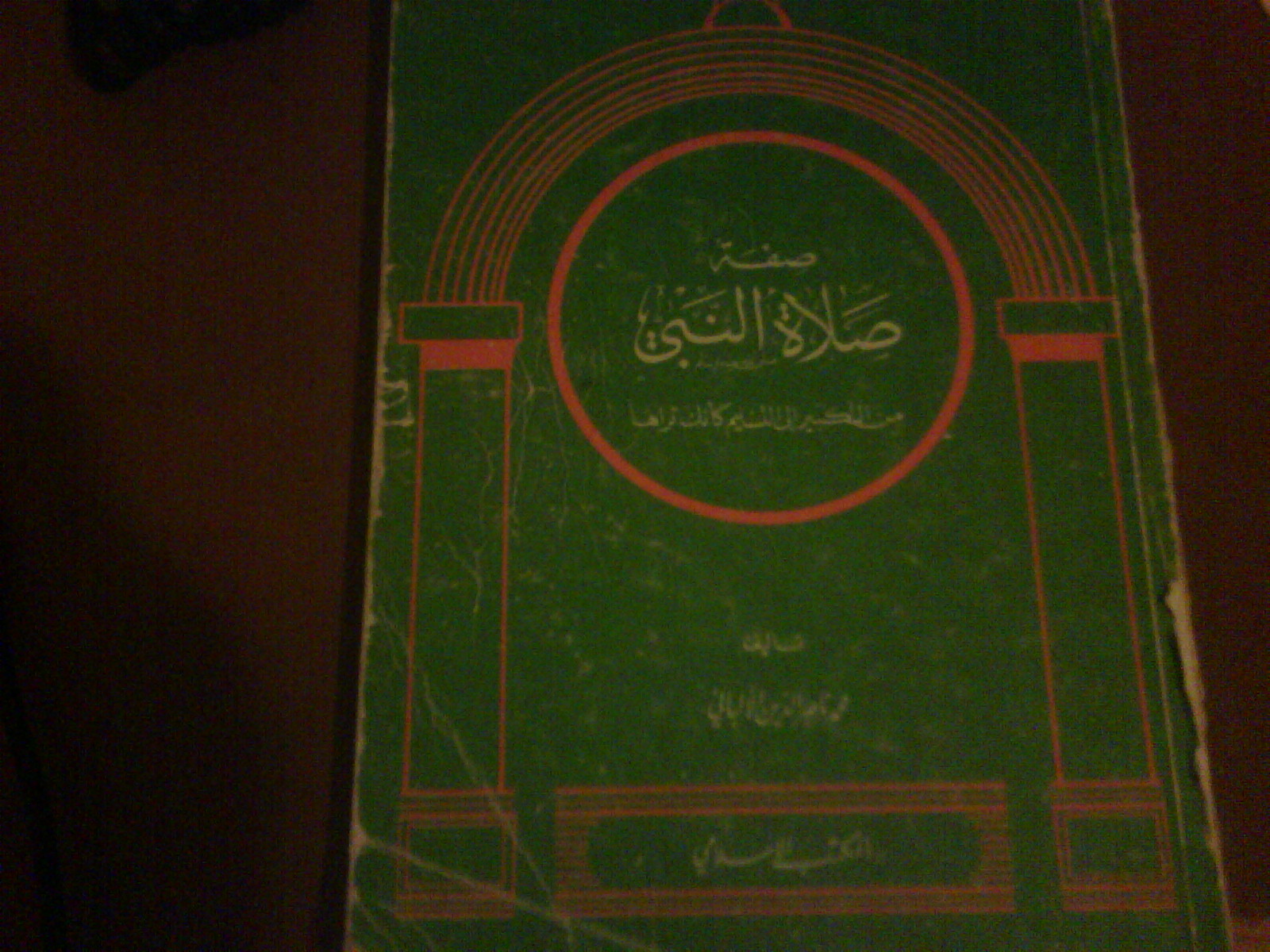
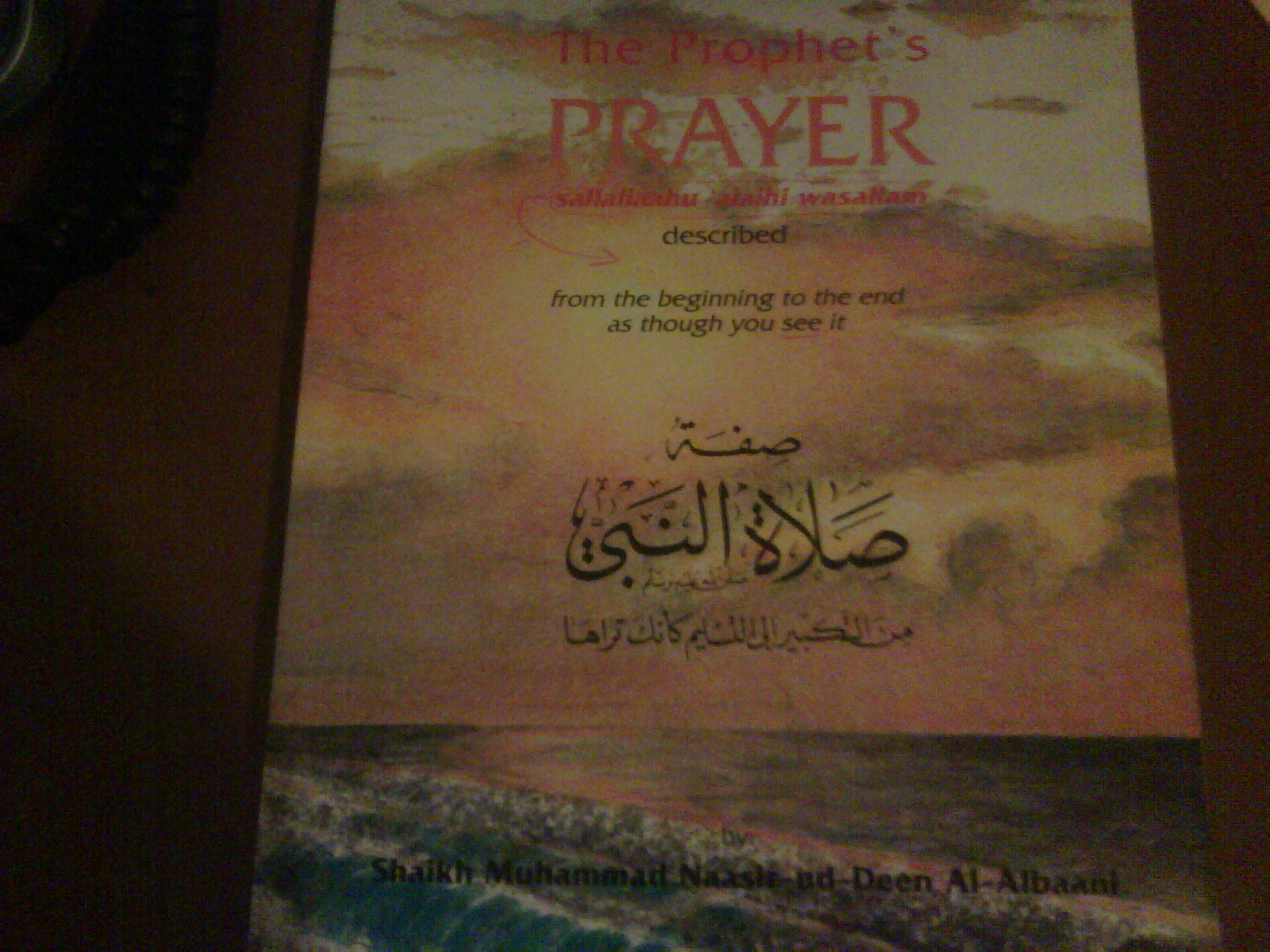
Husam used to pray at Sheikh Albani’s mosque in Damascus as a young man. He once told me that Albani would usually say his dhikr after the fard prayers whilst walking home, where he would pray the sunnah rak’at.  I had come to Cambridge as an ardent Albani-fan (all of us at JIMAS were, at the time, of course, except that JIMAS was called HISAM at the time, a word essentially the same as Husam, meaning “Sword” [of Islam]). It was Husam who, upon discovering that I was a fan of his Sheikh, immediately gave me a brand-new paperback copy of the Sheikh’s book on prayer which I translated into English by the grace of Allah, 1989-90, eventually published by JIMAS in 1993 as The Prophet’s Prayer Described.  That book has had an official print-run since then of about 50,000 plus unauthorised prints, so alhamdulillah, tens of thousands of people have benefited from it, especially from the full range of exquisite Prophetic supplications for every posture in prayer, a feature that I have not seen in any other book, in any language.  Certainly not in such an accessible manner.  The book also raised the ijtihad/taqlid issue and eventually helped to provoke a furious, though erroneous, madhhabist reaction.  The madhhabist/anti-madhhabist debate is still ongoing in English-speaking circles although more and more people are realising how anachronistic it is, as we appreciate the significance of Maqasid theory.  Thus, I hope that the reward for every person who has benefited from that translation, or still does or will benefit from it in the future: the reward will accrue to Husam’s account in the presence of the Almighty.  I don’t think Husam knew that it was his gift to a young student that would become a best-selling book in translation, since we never met after it was published.

Husam always reminded me of the Companion of the Prophet (peace be upon him) who would laugh and joke a lot.  When some of the more austere Companions complained about this to the Prophet, he replied, “da’hu fa innahu yuhibbu’Llaha wa rasulahu – Let him be, for he loves Allah and His Messenger.”

عَنْ أَبِي سَعِيدٍ، عَنْ النَّبِيِّ ﷺ، قَالَ: التَّاجِرُ الصَّدُوقُ الْأَمِينُ مَعَ النَّبِيِّينَ وَالصِّدِّيقِينَ وَالشُّهَدَاءِ. سنن الترمذي، مشكواة، باب المسائلة.

Imam Tirmidhi transmitted the hadith on the authority of Abu Sa’id, who said: The Messenger of Allah (may Allah bless him and grant him peace) said, “The honest trader will be (raised) with the Prophets, the truthful ones and martyrs.”

(Mishkat, Chapter on Mutual Flexibility, hadith nos. 2796-7).

Although Tirmidhi and Albani declared the isnad to be weak, the meaning of the hadith is acceptable: my grandfather included it in his Intikhab-e-Hadith (no. 283) / Way of the Prophet (Islamic Foundation, no. 276) and Yusuf al-Qaradawi quoted it in his Al-Halal wa l-Haram fi l-Islam (The Lawful and the Prohibited in Islam).  My grandfather commented thus:

This Hadith makes it clear that Islam is not merely a few rituals of worship; rather, honesty and integrity in trade are also important parts of the religion, without which the performance of worship rituals have no weight with Allah.

Husam certainly loved God and His Messenger and was a scrupulously-honest trader in our estimation, and only Allah knows everyone’s true state.

I’m pretty sure that the last time I met Husam was on Eid day in 1992: he had invited me up to Cambridge from London to lead the Eid prayer, so I spent Eid night at his house and he drove me to the community centre for prayer in the morning.  There had been some confusion as to whether or not there was anyone available in Cambridge to lead the prayer, and someone else led in the end.  But it means that the last time I saw my dear friend alive in this world, it was a day of immense happiness for both of us and our families and communities.  I pray that we meet in the next life, also in a state of overflowing joy.

May Allah accept Husam Kaikati’s lifetime of love, worship and hard work, forgive his mistakes and draw him near to His Presence in the Gardens of Paradise.  May He bless Sister Julie and the rest of Husam’s family and grant them peace, strength and fortitude.

Usama Hasan, London.  Completed at the breaking of dawn, Saturday 27th March 2010 / 11th Rabi’ II 1431
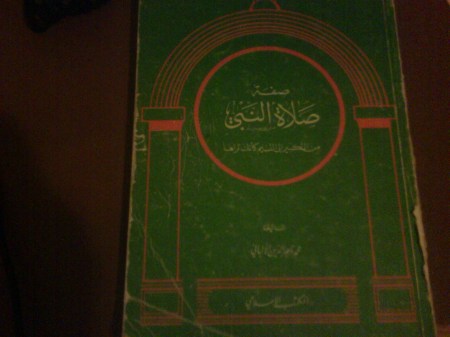
The original 20-year-old copy of Albani's prayer-book that Husam Kaikati gave to Usama Hasan
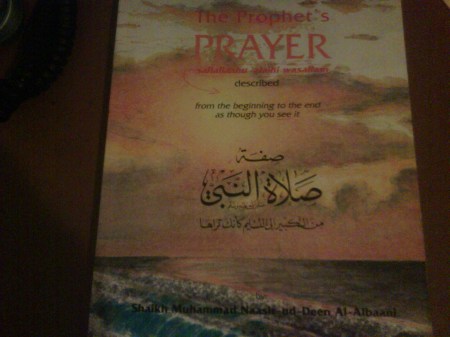
The first English edition of Albani's prayer-book, 1993

Bismillah. Sad news received this morning (Thurs 25th March 2010).

Verily to Allah belongs what He took and to Him belongs what he gave, and everything with Him has an appointed time.

Assalaam alaykum wrwb. It is with great sadness that we announce on behalf of Sister Julie and the Kaikati family that their beloved husband and father, Husam Uddin Kaikati, passed away in Austria early this morning. We will forward on details of the funeral arrangements for those of you who would like to attend as soon as they are received Insha’Allah. Wasalaam.

The Office of Cambridge Muslim Trust
office@cambridgemuslimtrust.org
Website: http://www.cambridgemuslims.co.uk
Registered United Kingdom Charity
Registration Number: 1125964

“O Allah, guide me among those you have guided. Grant me safety among those you have granted safety. Take care of me among those whom you have taken care of. Bless me in what you have given. Protect me from the evil you have decreed, for you decree and nothing is decreed upon you. No one who is in your care is humiliated and there is no honour for the one you take as enemy. Blessed and Exalted are you. O our Lord may you bless the Prophet Mohammed.”
Bone-marrow donation

March 25, 2010

Bismillah. This is a prayer & bone-marrow donor registration request for Andrew McFadden, brother of Rachel North, and for two Afro-Caribbean kids in our local area, as well as for anyone needing a bone-marrow transplant.

Bone-marrow matches are ethnicity-specific, so if you are white you can help Andrew. More Afro-Caribbean and Asian donors are needed anyway, since they are under-represented in the national register.

I am pleased to say that I am a registered donor alhamdulillah and our ANT car bumper sticker advertises for more donors (see above).

Please visit the websites of the Anthony Nolan Trust, the Afro-Caribbean Leukaemia Trust and Ibrahim’s Appeal for more information.

The ACLT recently said that fear of blood samples being used for DNA profiling was discouraging AC and Asian donors. Such fears are unfounded, of course, but illustrate some of our sad social problems. But with the help of Allah Most Generous, we can succeed!

FODIP update

March 24, 2010

Bismillah. From Jane Clements:

Dear friend and supporter,

* FODIP was pleased to be part of the panel at the recent launch of Concordis International Paper VIII. This document – ‘British Churches and the Israeli-Palestinian conflict’ – is an important contribution to the discussion. Arising from a conference at Cambridge held last year, it is a readable collection of a range of different perspectives. Copies can be obtained from:

http://www.concordis-international.org/component/content/article/47-resources/195-papers-viii.html

* The ‘Manchester FODIP group’ was launched last week with an appropriate Middle Eastern meal. This group of Jews, Christians and Muslims comprises some of the participants of the December Study Tour. They are available as a panel for groups and congregations to host at meetings and special events.

* Thank you to those groups who have applied for the ‘Neighbours for Peace’ grants. Applications are now closed and decisions will be communicated shortly.

Jane Clements
Director, FODIP
email:info@fodip.org; http://www.fodip.org

Mathematical structures in mediaeval Islamic art

March 22, 2010

Bismillah. With thanks to Dr. Sabbir Rahman & Abu Ammar Mangoranca for these.

Assalamu `alaikum,

I was delighted to read the following short article, which clearly demonstrates how far ahead of their time Muslim geometers were:

http://www.sciencenews.org/view/generic/id/8270/title/Math_Trek_Ancient_Islamic_Penrose_Tiles

Aperiodic Penrose Tilings are a very modern development yet,”The Darb-i Imam shrine was particularly remarkable because it showed girih tile patterns at two different scales, so that large girih tiles were broken up into smaller girih tiles. In principle, by repeatedly scaling up the tiling in this way, they could have covered an arbitrarily large wall with a Penrose tiling.”

Indeed, as the Wikipedia article on Penrose tilings should make clear, their development and discovery is highly non-trivial, and not something which is likely to be come upon purely by chance:

http://en.wikipedia.org/wiki/Penrose_tiling

The connection of Penrose tilings with the golden ratio is also quite fascinating. Note that the golden ratio has featured in Islamic architecture from the earliest times:

http://www.springerlink.com/content/rv6q10p8x320580l/

http://en.wikipedia.org/wiki/Mosque_of_Oqba

This is a link to the technical paper associated with the first article:

http://www.physics.harvard.edu/~plu/publications/Science_315_1106_2007.pdf

Wassalam,
Sabbir

Salaam:

The research of Dr Peter J. Lu on the Islamic art patterns is also described and with more illustrations at

http://www.saudiaramcoworld.com/issue/200905/the.tiles.of.infinity.htm.

Although this decorative art is found in medieval Muslim structures, especially mosques, the mathematical foundation of these patterns, or girih tiles, is only discovered in the West after 5 centuries.

Abu Ammar Mangorangca

Hasan Charles Le Gai Eaton departs this world

February 27, 2010

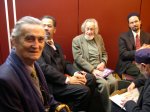
Photo, clockwise from left: Charles Le Gai Eaton, Fuad Nahdi, Martin Lings, Hamza Yusuf, Peter Sanders.  (Photo courtesy of Fareena Alam’s and Abdul-Rehman Malik’s Facebooks.)

Bismillah.  Shaykh Hasan Charles Le Gai Eaton, author of the excellent books King of the Castle and Islam & The Destiny of Man, returned to Allah this morning. His burial is at 1pm later today (Saturday 27th February 2010 / 12th Rabi’ al-Awwal 1431) at the Brockwood Cemetery in Woking, God-willing.  To Allah we belong, and to Him we are returning.

A brief biography can be found here on Wikipedia.

I read his Islam & The Destiny of Man as a teenager.  Imran Khan (the cricket legend) once mentioned this book as the most influential upon a certain phase of his life, and it seems to have also inspired Jemima Khan.

The only time I heard him lecture was in 1989/90 at a Muslim students’ event at Cambridge University, organised by Inam Siddiqui, Massoud Shadjareh, Arzu Merali, Najmuddin Hasan & others.  Eaton was joined on the panel by a Christian priest.  Elyas Patel, the lawyer from Dewsbury, asked him a question relating to the hadith qudsi narrated by Abu Hurayrah from the Prophet S that God says, Ana ‘inda zanni ‘abdi bi or “I am according to My slave-servant’s conception of Me …” (Bukhari).  Eaton’s reply, I think, was about being detached from the world, yet part of it.  I must confess, that is the only thing I remember him saying the whole evening, and even that is blurred, although come to think of it, he did mention “Remembrance of God” as well of course, and that is the title of his third major book.  The problem is that everything he said went way over my head at the time, since I was young and an utter salafi.  But his presence was amazing, and the way he spoke old-fashioned English was lovely.

The only other time I saw him was when he was seated in the front row of Shaykh Hamza Yusuf’s or Martin Lings’ lecture at The Globe Theatre in London during its Shakespeare & Islam season a few years ago (2003 or 2004), organised jointly with the Q-News team, for which alone, may Allah give them all Jannah.  He may have been at both lectures, actually. (Shaykh Hamza lectured on Othello & the Iago Factor – drama, melodrama, etc., whilst Martin Lings lectured for two hours at the age of 96 on Hamlet and themes from his Secret of Shakespeare, with even more lovely English than Eaton’s.)  Fuad Nahdi referred to Eaton in his introduction as his main shaykh in the UK.

I finally read Eaton’s King of the Castle last year – another brilliant book, full of insights.  It was once recommended-reading for Christian priests wanting arguments against atheism and agnosticism.  I made some mental notes of things I wanted to ask Eaton when I would finally have an audience with him, but that will have to wait until the Hereafter iA.  He recently also published his autobiography, entitled A Bad Beginning.

As friends have already said, Eaton is irreplaceable and his death marks the end of what might be called “his era,” which is a massive compliment in itself.  He was an enormous source of inspiration for several generations of people, tens of thousands if not millions.

May Allah shower him with His Mercy.

One Caliph to Rule Them All

February 26, 2010

Bismillah.  Here is a useful article by Rashad Ali, with good quotes from some of the classical jurists that should help in the debate about Islamism (political Islam).  I particularly like the paragraphs from the 18th-19th century Yemeni Imams San’ani and Shawkani, since they are very influential in Salafi circles, and you get Salafi Islamists as well as others (both Sunni and Shi’i, lest we forget).

al-Amir al-San’ani: ” … the implication here is that the Caliph referred to is that of a particular region because the people have never gathered together behind a single Caliph in all the lands of Islam since the time of the Abbasid State. Rather, the people of every region were independent with someone presiding over their affairs. If the hadith was taken to mean the overall Caliph which the people of Islam had united behind, then there would have been no benefit in the saying.” Subul al-Salaam, (volume 3, page 499)

Imam Shawkani also held this view: “As for when Islam spread and its territories expanded and its regions became distant [from each other], then it is known that in all of these regions loyalty was given to an Imam or Sultan… So there is no harm in the multiplicity of Imams and Sultans and it is obligatory for those people in whose land his orders and prohibitions become effective to give obedience to him after having giving bay’ah (a pledge of allegiance) to him. It is the same for the people of all the other regions.” Shawkani goes on to say that someone not understanding this will not benefit from the presentation of the dalil (scriptural evidence) as he will not “be able to comprehend it.” al-Sayl al-Jarraar (volume 4, page 512)

It is also worth reading Ibn Khaldun on the subject, as usual.  Much of the Muqaddimah is devoted to issues of political power but the section on the meaning of the caliphate and imamate is especially relevant (pp. 154-183 or Sections 23-30, Chapter III, of the abridged translation by Rosenthal/Dawood, available online here).

ONE CALIPH TO RULE THEM ALL

© Rashad Ali, 2009

Hizb ut-Tahrir, Jamaat-e-Islami, al-Ikhwan al-Muslimoon and al-Qaeda all have, as a fundamental aim: the establishment of a global dictatorship under the rule of one Caliph, an autocrat who will impose one interpretation of the Shar’iah over the entire globe. They intend to do this through unifying countries where there already exist Muslim majorities, and then launch a worldwide international effort at expanding this state through diplomatic and hostile means, i.e. warfare.

For them, there is a religious duty (fard) in which there is no dispute, that there must be a single caliphate encompassing the whole globe. There is no room for different interpretations, and anyone differing with them – especially with the likes of the Hizb and al-Qaeda, are upon Kufr (unbelief) and apostates from Islam. In fact, they would argue that all the Muslim scholars who have abandoned engaging in political activity for the sake of establishing such a super-state are upon misguidance, and Kufr, even if on the whole the Muslim jurists take the position, that there are different opinions on this issue, which are legitimate opinions – Ijtihadaat – and therefore we cannot start accusing others of being on un-Islamic positions for holding different views.

The fact is that whilst mainstream religious scholarship prefers unity to disunity, and an ideal of unified peaceful relations, it recognizes the practical and political reality that has existed throughout our history, that we have always had different states and empires. Scholarship has always recognized that there differences in all such issues which warrant recognition. Barking on about the obligation of having a leader/caliph/head of state- all of which carry the same meaning according to groups like Hizb ut-Tahrir, is not the same as proving that Muslim scholars historically or presently support the forceful unification of Muslim majority countries or expansionist states in the world. This is a false representation of classical and modern scholarship.

First of all, Muslim scholars have differed over the necessity of having a single political leadership. Rather it was considered acceptable to many scholars to have multiple political leaders.

Secondly, rejecting the concept of having a caliph and Imam or leadership was considered as erroneous (this should be differentiated form the notion of an expansionist state), but not Kufr. In fact, it was considered a form of extremism amongst classical scholars to exaggerate the issue of caliphate as there are many differences upon such issues.

Thirdly, political rebellion in order to remove leaderships by force, coup or militant means or through political agitation was considered to be: heresy and fisq (transgression); an aspect of deviant sectarian cultures such as those of the Khawarij; deemed outside of the way of mainstream Islamic teaching.  This is where the separation from classical tradition and Islamist ideological activism originates.

A question arises though about the apparently clear-cut evidences from prophetic tradition which are often cited to clearly oblige the necessity of one caliph and forbid multiple rulers. It is then claimed that such rules are clear-cut and definitive (Qat’i) permitting no other interpretations.

Methodological principles

The founder of Hizb ut-Tahrir, Taqi ul-Din al-Nabhani explains in volume 3 of Shakhsiya Islamiya page 186, in the chapter titled Mafhoom al-Shart (the concept of the condition or conditional clause):

“The mafhoom al-shart is when the rule depends upon something which has come in any of the forms of the conditional clause such as ‘if/when’ or any meaning implying a condition. It indicates the negation of the ruling when such a condition is not realised or is absent.”

Nabhani also states that absolute and general statements would be restricted by conditional clauses, or in fact more generally by the denotation (mantooq) as well as the connotation (mafhoom) of the speech.

“It is permitted to restrict the the mantooq (the meaning of the denotation of the speech), by the mafhoom (the connotation of the speech), whether this is when it is in the meaning of the statement and in harmony with it (mafhoom al-muwafaqa) or divergent from it (mafhoom al-mukhalafa) [such as the the conditional clause – he gives an example to substantiate this].” (Chapter: Restricting the Mantooq by the Mafhoom, page 255)

Hadiths about one leader and how they have been interpreted

So for example the hadith wherein the prophet is reported to have said as narrated by Sahih Muslim: “Whoever comes to you, and you are united under one man, and seeks to cause political dissention and separate your community (jama’ah), fight him” – would be interpreted as meaning when you are united under a single leadership. This would then restrict the meaning of other general texts which imply a single leadership according to Nabhani’s principles of interpretation, i.e. the specific meaning would be then understood to restrict the general implications of other texts such as, “If the pledge is given to two Caliphs, fight the latter,” as applying under a single leadership, not when there are many different states and leaderships already.

Imam al-Nawawi comments on the above hadith in the chapter: The ruling of dividing the affair of the Muslims when they are united, “Whoever comes to you and you are united …” stating that this refers to “those who rebel (kharaja) against the leader …”(!!) (page 444 of al-Minhaj bi-Sharh Sahih Muslim bin al-Hajjaj, Dar al-Marifa, Beirut – Lebanon)

He also states regarding the second hadith that “generally scholars have agreed that you cannot contract two caliphs… there is however the possibility of the opinion of Imam al-Haramayn [being correct].” (page 445) He explains that there is a possibility of different opinions in this matter. He states, “This is outside of the definitive matters (kharij min al-qawati’). And Maziri (the well-known Maliki commentator on Imam Muslim’s collection of hadith) has narrated this Qawl (opinion) from some of the later scholars of Usul, including Imam al-Haramayn.” So it is the position of Imam al-Haramayn that it is permitted to have multiple political leaders. Imam al-Nawawi is not of this view and he states “though it is an irregular position and conflicts with the views of the early scholars and the apparent, absolute meaning of the text.” (page 435) The important point is that it is not a definitive issue, it is subject to opinion and Ijtihad. Imam al-Haramayn is however one of the most widely accepted scholars agreed upon to reach the position of a Mujtahid Imam, and was the celebrated teacher of the revered Imam al-Ghazali.

What was Imam al-Haramayn al-Juwayni’s point of view? He explained this clearly in his text Ghiyath al-Umam fi Tiyath al-Zulam where he explained, “I do not deny the permissibility of appointing (two leaders) according to the need (haja) and enforcing both of their executive decisions as a religious duty. This however is a time without an overall Imam.” People have misconstrued his words, as implying that this is only when it is impossible. This is absolutely false. Not just from the quotation itself, which is that it is according to the need (not even necessity or darura), but Imam al-Haramayn explains in the following sentence, “if they agree to appoint an Imam over them, it is a right for the two leaders to submit to the decisions of this Imam in a manner he deems appropriate.” He goes on to discuss to Imams in two separate countries: neither would have claim to the leadership of all the Muslims. (pp. 168-169, Muassas al-Rayyan edition)

al-Amir al-San’ani comments on the statement, “Whoever left obedience to the Imam and separated from the community and then died, then his is a death of pagan ignorance,” as follows: “… the phrase, ‘… left obedience …’, means obedience to the Caliph with whom there is agreement. And the implication here is that the Caliph referred to is that of a particular region because the people have never gathered together behind a single Caliph in all the lands of Islam since the time of the Abbasid State. Rather, the people of every region were independent with someone presiding over their affairs. If the hadith was taken to mean the overall Caliph which the people of Islam had united behind, then there would have been no benefit in the saying.” Subul al-Salaam, (volume 3, page 499)

Imam Shawkani also held this view: “As for when Islam spread and its territories expanded and its regions became distant [from each other], then it is known that in all of these regions loyalty was given to an Imam or Sultan… So there is no harm in the multiplicity of Imams and Sultans and it is obligatory for those people in whose land his orders and prohibitions become effective to give obedience to him after having giving bay’ah (a pledge of allegiance) to him. It is the same for the people of all the other regions.” Shawkani goes on to say that someone not understanding this will not benefit from the presentation of the dalil (scriptural evidence) as he will not “be able to comprehend it.” al-Sayl al-Jarraar (volume 4, page 512)

Rejecting Imamate in principle

As for making the issue of political leadership a central aspect of faith, and declaring Kufr on ideas and people on the basis of such ideas, or even for rejecting the whole notion of having any kind of political leadership, this is considered a characteristic of extremists. As Imam al-Ghazali stated: “Know, however that error regarding the status of the Caliphate, whether or not establishing this office is a (communal) obligation, who qualifies for it, and related matters, cannot serve as grounds for condemning people as Unbelievers. Indeed Ibn al-Kaysan denied that there was any religious obligation to have a Caliphate at all; but this does not mean that he must be branded an Unbeliever. Nor do we pay any attention to those who exaggerate the matter of Imamate and equate recognition of the Imam with faith in God and His Messenger. Nor do we pay any attention to those people who oppose these people and brand them Unbelievers simply on the basis of their doctrine of on the Imamate. Both of these positions are extreme. For neither of the doctrines in question entails any claim that the Prophet perpetrated lies.” (On the Boundaries of Theological Tolerance in Islam, Abu Hamid al-Ghazali’s Faysal al-Tafriqa by Sherman A. Jackson, Oxford).

To clarify, it is considered a subsidiary branch of fatawa, not a fundamental aspect of religion. This is why someone denying any aspect of recognising political leaderships is considered by the mainstream scholars to be mistaken, at worst upon a deviant position, but not a non-Muslim or outside the community of believers.

Nihayat ul-Su’al fi-Sharh minhaj ul-Wusul lil-Qadi al-Baydawi ma al-hashiya Salam ul-Wusul li-Sharh al-Nihaya authored by Jamal ul-Din al-Asnawi and commentary by Shaykh Muhammad Bakhit al-Muti’ee, ‘Alam ul-Kutub edition, states:

“The obligation of appointing an Imam is from the branches of religious rulings (al-furu’ al-fiqhiyya), and without a doubt they are not from the fundamentals of religion (usul al-din).” (volume 3, page 92)

Political rebellion in order to forcefully remove leaderships

Imam al-Nawawi explains the orthodox position of the Sunni Muslim scholars: “We should not challenge nor dispute the legitimacy of the political leadership, nor come out in difference to them, unless we clearly see a evil perpetrated by them, definitively violating the principle of Islam. If this is seen then this evil should be denounced and you should speak the truth. As for khurooj (rebellion), this forbidden by consensus of all the Muslims.” (page 532).

So what about those who have decided to undertake military means to remove established rulers, despots and tyrants they may be, based upon their interpretation of such evidences? Well let us return to the writings of Imam al-Asnawi, Qadi al-Baydawi and Shaykh Muhammad Bakhit al-Muti’ee.

“Similarly the Khawarij, those who permit the slaughter of Muslims, taking their wealth and their famillies based upon an interpretation and speculative interpretation of the text; they are transgressors (fussaq) in our eyes, though not in theirs…” (volume 3, page 136)

Ironically Imam al-Nawawi (see above) applies the very same hadith stating that the meaning of the hadith which are politicized for their own ends by the likes of Hizb ut-Tahrir, implies that such people should themselves be fought for their crime of political rebellion!

On Prophetic birthdays and dates of death

February 25, 2010

Bismillah. An ancient Jewish tradition says that Prophets of God die on the same date as their birthday, thus nicely completing a cosmic, spiritual cycle. (I learnt this via a letter from a Jewish reader printed in a Christian newspaper, a couple of years ago).

The tradition certainly fits the last Prophet, Muhammad (peace be upon him).

A detailed fatwa about music and singing – by Sheikh Abdullah al-Judai

February 13, 2010

With the Name of Allah, All-Merciful, Most Merciful

The fatwa is given below, and in PDF format here: Juday – Music and Singing – Conclusions

Some of the Sheikh’s analysis of texts from the Qur’an and Hadith on the subject are found in this presentation here.

A brief biography of Sheikh ‘Abdullah al-Judai can be found here.

Ibn Khaldun on music & singing (pp. 328-331 of the Muqaddimah, abridged translation by Rosenthal/Dawood).

A DETAILED FATWA ABOUT MUSIC & SINGING

by Sheikh ‘Abdullah b. Yusuf al-Juday’

Taken from the author’s al-Musiqi wa l-Ghina’ fi Mizan al-Islam (“Music & Singing in the Balance of Islam”), Al Judai Research & Consultations, Leeds, UK, 1425/2004, pp. 597-601

Translation by Usama Hasan, 13th February 2010

SUMMARY & CONCLUSION

After this detailed presentation of the evidence and legal ruling related to the two issues of music and singing in respective, detailed chapters, I now highlight briefly the main conclusions of this study:

  1. There is no consensus (ijma’) about the legal ruling on music and singing, whether considered together or as separate issues.
  2. There is no unequivocal text (nass) from the Noble, Generous Qur’an that speaks about these two issues.
  3. There is no unequivocal text (nass) from the Sunnah that definitely forbids music or singing.
  4. In the legal positions (madhahib) of the Companions and Successors, there is no clear prohibition of music or singing.  Rather, some of them listened to music and singing and permitted this.  Precursors of the view of prohibition began to appear after them, but without indisputable, clear-cut prohibition.
  5. To claim that the Imams of the four main Sunni Madhhabs agreed on the absolute prohibition of music or singing is inaccurate.
  6. The issues of music and singing return to the basic principle (asl) in matters of habits and objects, and the established position based on evidence in this regard is one of permission (ibahah), which cannot be modified without evidence.
  7. The basic principle (asl) in sounds and speech is the permissibility of making and listening to these, and similarly for humming.  A beautiful voice or sound, in itself, is a blessing (from God).
  8. All that is narrated in condemnation of music and singing, which some hold to, thinking it is legal evidence, includes very little that is clear and indisputable.  The latter is not authentically-narrated, and it is not permissible to base legal judgments on unsound narrations.
  9. Those texts from the authentic Sunnah which the prohibitors of music and singing think is legal evidence, are in reality evidence against them to falsify their claims.  Rather, there are numerous unequivocal texts (nusus) in the authentic Sunnah that confirm the basic principle and necessitate the view that music and singing are permissible.

A Principled Judgment on Music and Singing

  1. Musical instruments were found in Arabian society before Islam and remained afterwards: no clear-cut, authentic, indisputable text (nass) came to forbid these.
  2. Sounds arising from musical instruments are lawful (halal) in principle.  They remain within the sphere of permissibility unless they are used as a means towards disobedience (of God).
  3. The exact definition of permissible singing is: that which involves intrinsically-permissible words or lyrics, whether or not it is accompanied by music.
  4. Use of the permissible for purposes involving vice changes the ruling of permissibility to prohibition in that circumstance, not in general.
  5. There is no distinction between men and women in the ruling of permissibility for music and singing.
  6. Males listening to the singing of females, or vice-versa, is intrinsically harmless: this is authentically-narrated in several evidential texts.
  7. The usage and learning of music and singing are permissible (mubah), since there is no basis to forbid what is permissible in principle.A ruling derived from this is that practising the arts of music and singing, being attracted to these or listening to them, do not by themselves damage the integrity (‘adalah) of a person.
  8. To amuse oneself by songs, whether these are called “Islamic” or “national” or other, is permissible and allowed (mubah ja’iz), whether accompanied by music or not, as long as the lyrics are intrinsically acceptable (mashru’ah).As for the remembrance of Allah Exalted by words of sanctification and praise, and as for prayers of blessing upon His Prophet, may Allah bless him and grant him peace, it is acceptable and encouraged to gather together for such purposes.  It is permissible to do this melodiously (bi l-taghanni), as it is permissible to recite the Qur’an melodiously.  However, it should be noted that all of this is worship (‘ibadah) and not amusement (lahw), and so it cannot be accompanied by music because the latter is a form of amusement, and amusement cannot be a means of worship.  Similarly, it was disliked to use the trumpet or bell to call people for prayer, and the announcement by a human voice (adhan) was legislated instead.
  9. The ruling on music and singing does not differ in our times from previous ages.  Any judgment on what is popular in these matters is based on the individual lyrics.  If these lead to a prohibited matter, then the judgment is one of prohibition (haram).  If it (permissible music and singing) is accompanied by prohibited scenes, such as the uncovering of private parts (‘awrah), the forbiddance would extened to looking at such scenes, but not to the music and singing itself.

I conclude with the following words:

Firstly, music and singing are forms of amusement (lahw), so the basic principle is that they should be used to realise recognised benefits (maslahah mu’tabarah) such as expressing acceptable happiness or warding off boredom and tedium.  If they are used too much, the benefits will be correspondingly obstructed.  The permissible is harmless as long as it does not overcome the obligatory or recommended, or lead to what is prohibited or disliked, in which case it changes from being permissible to being prohibited or disliked.

Secondly, the fact that many people exceed the bounds of permissibility with such amusement does not falsify the basic principle regarding music and singing.  What is rejected of their actions is what is excessive, and it is not allowed to make changing times or improper use into a reason to prohibit the permissible.  Keeping people to the basic principle of the Law is safest for the responsibility of the person of knowledge, even if this agrees with the desires of a person of lust, for the sin is not incurred by doing what is lawful (halal), but by falling into the prohibited (haram).

Thirdly, the way to recognise the lawful (halal), the prohibited (haram) and the major symbols (sha’a’ir) of Islam is the Book and the authentic Sunnah, based upon clear principles and evident rules. It is not by rejected and fabricated ahadith, or by opinions devoid of proof or baseless views.  Otherwise, whoever wished to could say whatever they wanted, and people’s religion would become corrupted for them.  This is just one issue where you can see how far false narrations and weak opinions have played with the views of many people, whilst infallibility is only for the Messenger of Allah, may Allah bless him and grant him peace, in what he conveyed on the authority of his Lord, Most Exalted.

This conclusion to this study will not agree with the wishes of many people, but it is enough for me that I have only arrived at it in the light of the evidence and proof of the Law, following the guidance of the basic principles and proper analysis in matters of disagreement with my opponents.

Thus, if you would like to criticise me in any aspect, let it be with arguments from the Book, the authentic Sunnah or agreed principles, not with mere opinion, for one opinion defeats another by its argument.  The most critical thing that can be said about someone who holds such as a view (as mine), it that he is to be excused according to the extent of his striving (ijtihad) and rewarded for his good intentions. Perfection is neither my attribute nor yours, and I have sought an excuse for you despite my disagreeing with your view and refuting it.

Further, I entreat you by Allah, do not refer the argument to the view of the “minority” or the “majority,” or to the dominant fatwa in a particular country, for these are not the refuges of intelligent authorities but rather, such is the state of those who follow uncritically.  And that is enough for you!

Moreover, I entreat you by Allah, do not say to me, “Your view is a tribulation (fitnah),” for tribulation lies in what opposes the message of the Messenger, may Allah bless him and grant him peace, as Allah Exalted said, “Let those who oppose his command beware that a tribulation or painful punishment may befall them.” (Al-Nur or Light, 24:63)  I have referred both you and me in judgment to what the Messenger, may Allah bless him and grant him peace, brought: I have arrived at a view different to yours.  Tribulation lies in concealing the verdict of the Law and covering it up, imagining that exposing it will mislead the masses.

It is Allah alone whom I ask for forgiveness for slips of the mind and tongue, and excesses of the pen and hand.

I also ask Him, Blessed and Exalted, to accept from me my efforts with this book, and similarly for those who have helped me from my family and brethren.  I ask Him to make this and other studies of mine examples that are followed in analysing many issues for this nation: by referring to principles and not to disagreement.  He is the One Whose Help is Sought, and there is no change of state or power except by Him.

You are Glorified, O Allah, and Praised.  There is no god but You.  I seek Your forgiveness and turn in repentance to You.

May Allah bless our master Muhammad, his family and companions, and grant them peace.