Posts Tagged ‘history’

Shaykh Muhammad Hibban, our Egyptian Ancestor

September 1, 2026

Bismillah. Here is my lineage to our most distant, biological, paternal ancestor known: Shaykh Muhammad Hibban, an Egyptian who settled in Yemen briefly and then for the rest of his life in India.

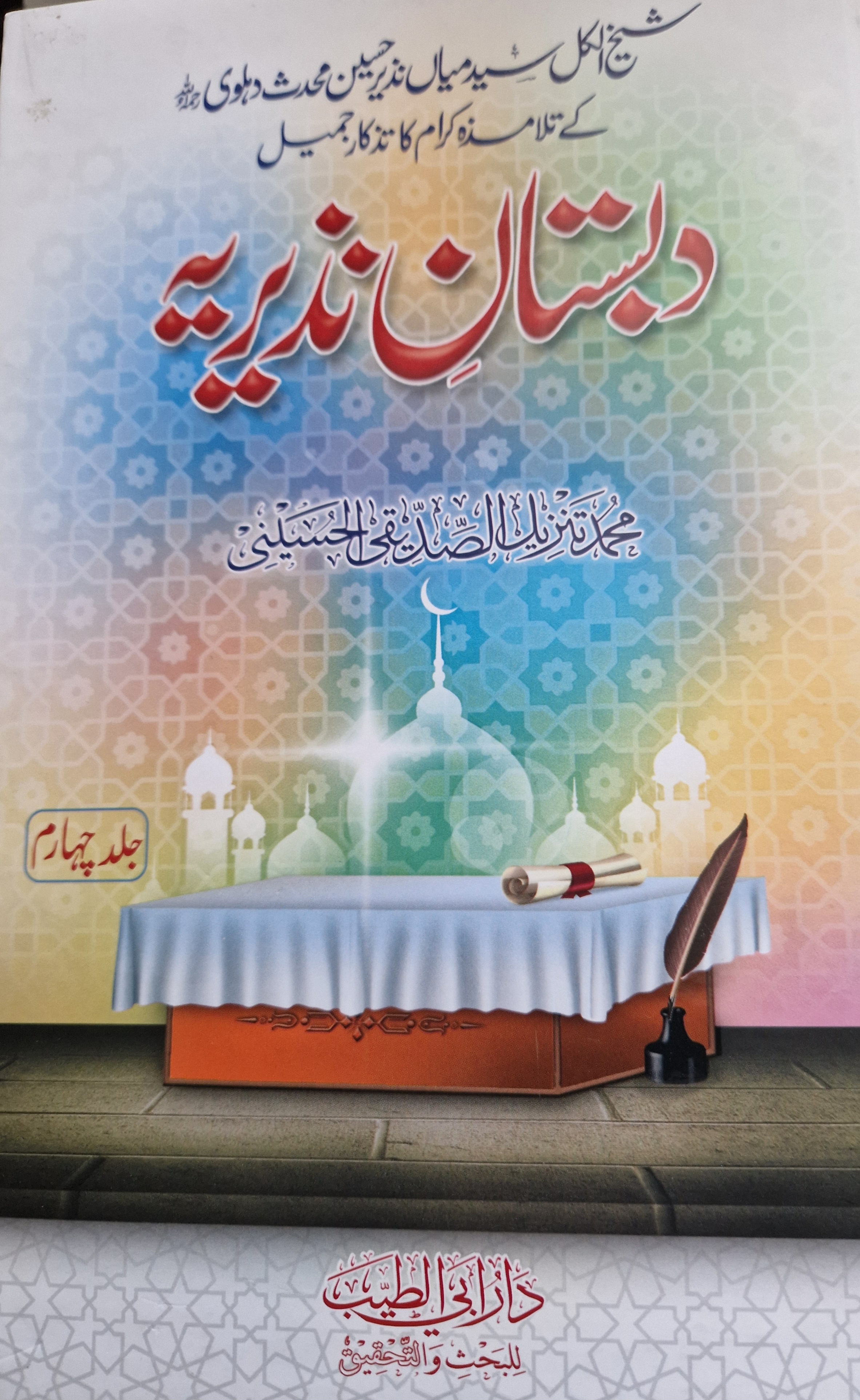
The lineage is taken from pages 153-4, vol. 4, Dabistan-e-Naziriyya (Urdu, Dar Abi Tayyib, Gujranwala, 2026) by Muhammad Tanzil Siddiqi Husaini, a book about the descending lineage of disciples of Sayyid Nadhir Husain of Delhi (1805-1902 CE), one of the towering saints and scholars of the Ahl-e-Hadith movement in India. The vast majority of the lineage is quoted at the beginning of Kitab Marqum Sharh Mathnawi Mawlana Rum [“An Inscribed Tome: Expansion of the Verses of the Mawlana of Rome”], Section 1, Folio 1, Page 2  – a commentary on Rumi’s Mathnawi. This indicates that many of the scholars in this lineage would have been skilled in Persian poetry.

From Shaykh Suhaib Hasan to Shaykh Muhammad Hibbān, they all seem to carry religious/spiritual titles of Shaykh, Mawlana, Munshi, etc. since they were generally scholars of the Qur’an and Hadith. However, these titles have been dropped for the most part, since they are not mentioned in the Dabistan text.

Some of the attributions illustrate the geographical spread, mainly around Northern India: Sarhind (Sirhind), ‘Umarpur. There has also been a strong implicit link to Dehli (Delhi) over the past few centuries, especially through the religious/spiritual order of Shah Waliullah of Delhi, although this is not explicitly reflected in the names below.

From the known birth-years of the first five entries, the gap between generations averages 25-30 years. Extrapolating this over the 33 generations, this genealogy reaches back 750-900 years. It could be 600-900 years. This is consistent with another fact stated in the above sources: one of the ancestors, along with his 2-3 brothers, accompanied Humayun’s army when it marched southwards from Kabul across Northern India in the 16th century CE. We don’t know if these ancestors came as soldiers, traders or scholars: perhaps a combination of these. (The Urdu language, whose name is derived from the Turkish yurdu meaning military barracks, was developed as a mixture of Hindi, Farsi and Arabic by the early Mughals in their army encampments.)

  1. Usama Hasan (1971-)
  2. Shaykh Suhaib Hasan (1942-)
  3. Mawlānā Abdul Ghaffār Hasan ‘Umarpuri (1330-1427 AH ~ 1913-2007 CE), aged 96/93
  4. Mawlānā Abdul Sattār ‘Umarpuri (1310-1335 AH ~ 1892-1917 CE), aged 25
  5. Mawlānā Abdul Jabbār ‘Umarpuri (1277-1334 AH ~ 1861-1916 CE), aged 57/55 (proficient in Arabic, Urdu & Farsi)
  6. Munshi Badr-ud-Deen ‘Umarpuri
  7. Muhammad Afzal
  8. Abdullāh
  9. Muhammad Akram
  10. Muhammad Anwar Shaheed Sāmānwi
  11. Muhammad Ahmad Sāmānwi
  12. Muhammad Haydar Sarhindi / Sirhindi
  13. Muhammad Muazzam Sarhindi / Sirhindi
  14. Muhammad Akram Sarhindi / Sirhindi
  15. Muhammad Tāhir
  16. Muhammad Bāqir
  17. Muhammad Nāzir
  18. Muhammad Qāsim
  19. Muhammad Hāshim
  20. Muhammad Muhsin aka Ibn al ‘Alā’i
  21. Zāhid
  22. Mahdi Abul Hasan
  23. Abu l-Tayyib
  24. Abdul Malik
  25. Abul Qāsim
  26. Abdul Rahman aka Abu Sa’eed
  27. Ahmad Abul Husain 
  28. Yūnus
  29. Abdul A’lā
  30. Mūsā
  31. Maysarah
  32. Hafs
  33. Shaykh Muhammad Hibbān Abul Ma’ārif al-Misri al-Yamani al-Siddīqi al-Qurashi

(Shaykh Muhammad Hibbān Abul Ma’ārif, the Egyptian, the Yemeni, the Qurayshi, the descendant of Abu Bakr al-Siddīq)

He was from Egypt, then based in Yemen for a while. From there, he travelled via the Hijaz and Iran to India, where he settled for the rest of his life. 

May God have mercy upon him and all his descendants. Āmīn / Amen!

Al-Mas’udi: The Meadows of Gold (Muruj al-Dhahab)

January 21, 2014

Bismillah.

The following selections (many paraphrased) are from the traveller and historian Al-Mas’udi “Muruj al-Dhahab” or The Meadows of Gold, translated by Paul Lunde & Caroline Stone, Penguin Great Journeys No. 2, 2007. A good, light read, like all the 15-20 books in this Penguin series.

Mas’udi was from Baghdad and lived c. 276-344 H / 890-956 CE.

ON THE STATE OF ISLAM IN HIS TIME

Islam has weakened and declined. The Hajj is in peril. Jihad has ceased. Islam has always been triumphant until this year 331 H [943 CE].

ON SOME CAUCASIANS

The Kashak [Circassians] are Zoroastrian, most handsome of the Caucasus inhabitants. The women are famous for bedchamber delights.

ON MASUDI’S ENCOUNTERS WITH JEWS & CHRISTIANS

I debated leading Jewish scholars: Abu Kathir and his student Fayyumi (Rabbinical); Yehuda b. Yusuf, student of (the Sabian) Thabit b. Qurra.

All the churches of Syria, Egypt and Byzantium owe their origin to Queen Helena, mother of Constantine. Her Greek name is Elena, having a numeric value of 100.

I met the earliest Christian Arab historian, Ibn Faraj, in Egypt. I debated the Trinity with Dankha (a Christian theologian) in Baghdad and Tikrit in 313/926.

ON THE TRAVELS OF THE GREEK ACADEMY

Athens
Alexandria/Rome (Augustus/Theodosius) Antioch (Umar bin Abdulaziz reign) Harran (Mutawakkil reign).

ON THE MOST LEARNED MEN OF HIS TIME

The most learned men of my time are the philosophers al-Farabi & Ibn Adi (Christian). Ibn Adi has the same Pythagorean philosophical system as Muhammad Zakariyya al-Razi.

ON THE FIRE-TEMPLE AT PERSEPOLIS

The Persian temple at Istakhr (Persepolis) had idols, then just a fire. It has huge stone pillars and horses, and is said by some Muslims to be Solomon’s Temple.

MISCELLANEOUS OBSERVATIONS ON ASIA (FROM EGYPT TO INDIA, CHINA & SE ASIA)

I saw peacocks in India: these have beautiful plumage. Those brought west to the lands of Islam: the plumage is dulled. [Evolution/adaptation]

Oranges were first brought from India c. 912 to Oman, Iraq, Syria, Palestine and Egypt. They lost their original sweet smell and nice colour due to changes in the air, soil and water.

On an Indian war elephant: when his keeper died, he didn’t eat or drink for days, showing grief or sorrow like bereaved man, with constant tears.

The rhinoceros is found in India. Some of its bones are fused, so it is unable to bend its knees and therefore to lie down. So it sleeps standing, leaning against a tree. It chews the cud. Indians, including Muslim, eat its flesh.

Upper Egypt exports dates, raisins, grapes, alum and vitriol. [Alum = potash = potassium aluminium sulfate, KAlSO4. Vitriol = sulfuric acid, H2SO4]

Indians are fond of music and singing. They forbid wine, not due to religion but to protect the mind and reason. If a king drinks wine, they hold that he deserves to be deposed since it is impossible for him to govern with clouded reason.

Most Tibetans are of Himyarite Yemeni origin. Their kings are called Tubba’, a Yemeni title [cf. Qur’an 50:14]. The rest of the Tibetans are Turkic, and there is no more populous group of Turks anywhere in the world.

The Nicobar and Andaman Islands have cannibals and elephants. Descriptions of Sarandib [Sri Lanka], Sumatra, Kalahbar [Kedah, Malaysia], the Spice Islands.

Spices that come from SE Asia include: camphor, aloes, cloves, sandalwood, nutmeg, mace, cardamoms and cubebs.

The Ring of Fire is a series of volcanic islands near China.

The “island of music” is also here [SE Asia]. The sound of drums, flutes, lutes, rhythmic beating of feet and hand-clapping is heard from a distance. Some sailors claim that the Antichrist has taken up residence there.

The people of Qimar [Cambodia] have fresh breath because, like Muslims, they use toothpicks. Qimaris abhor adultery, indecency and alcoholic drinks.

The story of Habbar bin al-Aswad, an Arab notable of Basra who left during the Zanj [black slaves’] rebellion there, is entertaining. He went to China via India. A Chinese king showed his Arab visitor portraits of prophets including Noah, Moses, Jesus and Muhammad. The king stated that Noah’s flood didn’t reach India or China.

He further showed him portraits of Indian and Chinese prophets’ portraits, depicting them as pointing the index finger to the heavens, warning of the power of God, or making a circle with the thumb and index finger, to indicate that creation is a circle.

[Muslims daily indicate the unity of God with the right index finger (cf. Michaelangelo’s famous painting depicting God and Adam). During prayer, they also sometimes make a circle with the thumb and middle finger, following the Prophet Muhammad, peace be upon him.

Furthermore, according to a sound hadith: Umm Salama emigrated to Abyssinia with her first husband Abu Salama as part of the early sacred migration (hijra). In the churches there, she saw images of prophets with index fingers raised (cf. Michaelangelo again), a feature of daily Islamic prayers. See Albani, Sifah Salah al-Nabi or The Prophet’s Prayer Described, for these hadiths. – U.H.]

The people of China are the most skilful in painting and arts. No other nation can compare with them in any craft whatsoever.

China was prosperous due to its justice until the Huang Chao rebellion of 878. He attacked Khanfu, massacring 200,000 Muslims, Christians, Jews and “fire-worshippers.” [Zoroastrians/Parsees]

The “Meadows of Gold” (Muruj al-Dhahab) was completed in 947, during the Buwayhid reign. The book is like a necklace of scattered pearls strung together. I have not sought to support any particular sect or doctrine, but to report human history as it has unfolded.

END

[Categories History]

Usama Hasan, https://unity1.wordpress.com