Posts Tagged ‘Sunnah’

ISLAM & THE SEVEN STAGES OF GRIEF

November 29, 2025
3D Isometric Flat Vector Conceptual Illustration of Stages Of Grief, Denial, Anger, Bargaining, Depression, Acceptance

ISLAM & THE SEVEN STAGES OF GRIEF

Bismillah.

Previously, there were five stages of grief generally accepted amongst psychologists as:
1. SHOCK, 2. DENIAL, 3. ANGER, 4. BARGAINING, 5. ACCEPTANCE/HOPE.

Recently, some people have extended this to seven stages by adding GUILT & DEPRESSION after ANGER. But it varies from person to person: these are not necessarily linear stages: they may be cyclical or iterative.  Hence, the 7 stages of grief are:

1. SHOCK, 2. DENIAL, 3. ANGER, 4. GUILT, 5. DEPRESSION, 6. BARGAINING, 7. ACCEPTANCE/HOPE.

0. GRIEF

0.1 THE PROPHET MUHAMMAD’S YEAR OF GRIEF AND SORROW

The Prophet, peace be upon him, experienced his “year of grief or sorrow” (عام الحزن,  ‘Ām al Huzn) during his tenth year of prophethood, ie 3 years before the Hijra, when his only wife Khadija, his stalwart support for 25 years, died, followed closely by his uncle, Abu Talib, his tribal protector as chief of his clan, the Banu Hashim.

(I’m grateful to the Christian priest, whose name I’ve forgotten, who attended our Qur’an discussion circles c. 2013-14 and wished to co-write with me a Christian-Muslim guide to grief, since he had read about the Prophet’s “Year of Grief.” I didn’t have the time or capacity to work on it at the time, but he gave me an idea that has come to fruition today, God-willing.)

0.2 PROPHET YA’QUB BIN ISHAQ BIN IBRAHIM, aka ISRA’IL (JACOB BEN ISAAC BEN ABRAHAM, aka ISRAEL)

In the Surah named after his 11th son, Prophet Yusuf (Joseph), grief is prominent in the “best of stories.”

قال إني ليحزنني أن تذهبوا به وأخاف أن يأكله الذئب وأنتم عنه غافلون

(Yusuf, Joseph, 12:13)

When his elder 10 sons ask for his permission to take Joseph for a day out, Jacob combines grief (for the past) with fear (of the future):

“It grieves me that you take him away (from me), and I fear that the wolf will devour him whilst ye are heedless of him.”

When his sons lie to him, saying that the wolf had indeed eaten Joseph, Jacob sees through their lies and resigns himself to “beautiful patience” (صبر جميل).

Later, when his first 10 sons manage to come home without the 12th son Binyamin (Benjamin) as well, Jacob expresses extreme sorrow for Joseph, reiterates his commitment to “beautiful patience” and goes blind from grief:

وتولّى عنهم وقال ياأسفى على يوسف وابيضت عيناه من الحزن فهو كظيم 

(Yusuf, Joseph, 12:84)

Although Ibn Kathir quotes the commentator Dahhak as explaining kazeem here to mean ka’eeb: intense grief and broken in spirit, i.e. depressed, the vast majority of commentators agree that Prophet Jacob displayed beautiful patience and did not complain to anyone except God, restraining his sorrow and grief. Others amongst the Salaf said that he waited eighty years to see his beloved son Joseph, for whom his grief equalled that of seventy bereaved parents, but he “was never pessimistic about God.” (Tafsir Tabari)

1. SHOCK

1.1 UMAR BIN AL-KHATTAB: SHOCK, DENIAL, ANGER, ACCEPTANCE

Our Master Umar was in shock, denial and anger upon the news of the Prophet’s death, threatening to kill anyone who said that the Prophet was dead, until Our Master Abu Bakr said the famous words:

“Whoever worshiped Muhammad, he should know that Muhammad has died. Whoever worships God, he should know that God is The Ever-Living, Who Will Never Die.”

Abu Bakr also recited from Surah Āl Imran (The Family of Amram), the verses confirming that Muhammad was mortal and speaking of the possibility of his death, for every soul has a predestined moment of death, praising those who show gratitude. Umar commented: “It was as though I had never heard these verses before!” He rapidly reached the stage or station of Acceptance. 

وما محمد إلا رسول، قد خلت من قبله الرسل، أفائن مات أو قتل انقلبتم على أعقابكم، ومن ينقلب على عقبيه فلن يضرّ الله شيئا، وسيجزي الله الشاكرين

وما كان لنفس أن تموت إلا بإذن الله كتابا مؤجلا، ومن يرد ثواب الدنيا نؤته منها، ومن يرد ثواب الآخرة نؤته منها، وسنجزي الشاكرين

Āl Imran, The Family of Amram, 3:144-5)

3. ANGER

3.1 KHALID BIN WALEED 

Our Master Khalid bin Waleed, the Sword of God, was overcome by grief on his deathbed when he realised he wouldn’t be granted martyrdom on the battlefield (because no human’s sword could defeat the Sword of God). He was especially frustrated at knowing how many people are cowards. Khalid’s last words were:

“I have a wound on every inch of my body, but I’m dying like an aging camel. May the eyes of cowards never (find rest in) sleep!”

ASIDE:

Khalid bin Waleed’s extraordinary life and military genius and career deserve to be immortalised in an epic poem in English. I have written opening and closing stanzas for such a poem. I pray that I or someone else is able to complete it:

OPENING STANZA: THE TALE OF KHALID BIN WALEED 

If your eyes do weep and your heart does bleed

At the state of the Muslim nation, 

Then remember the tale of Khalid bin Waleed:

It is enough as inspiration. 

[…]

CLOSING STANZA: KHALID BIN WALEED’S LAST WORDS

“I’m dying like a camel

(Or like an aging sheep):

May the eyes of cowards 

Never rest in sleep!”

TRIVIUM: THE KHALID BIN WALEED PARK IN PESHAWAR, PAKISTAN

This park goes by its Urdu/Farsi name: Khalid bin Waleed Bagh. The locals are Pathan (Pashtun), and so pronounce it somewhat Farsi style, as follows, making the ‘a’ sound like ‘o’: Kholid bin Woleed Bagh. British Empire troops stationed in Peshawar heard it pronounced like this, switched the syllables around and nicknamed the park, the “Colly-Wolly Bean Bag.”

3.2 TRUE PATIENCE IS ONLY AT THE FIRST BLOW

Anas bin Malik narrated that the Prophet, may God bless him and grant him peace, passed by a woman who was weeping at a graveside, mourning a child she had lost. The Prophet said, “Fear God, and have patience.” She replied, not recognising him, “Get away from me, for you have not been afflicted by my affliction!” She was told that it was the Prophet who had spoken to her, so she came to his door and, finding no doorkeepers, said to him, “I did not recognise you.” He replied, “(True) Patience is only at the first blow.” (Bukhari & Muslim)

TRIVIUM: The Arabic for “blow” here is sadmah, root SDM. The name Saddam is derived from this as an intensive form, thus meaning, “One who delivers crushing blows.”

4. GUILT: JOSEPH’S BROTHERS

The 10 elder brothers of Prophet Yusuf (Joseph) had feelings of grief at the perceived favouritism of their father towards Yusuf. This manifested in Anger when some of them suggested killing him. Others felt guilty about this and suggested throwing him into a well, which is what they did. They must have had some feelings of guilt around this, and around lying to their father about Yusuf being eaten by a wolf. After many years, once they were reunited with Yusuf and his magnanimity, they went through the stages of Bargaining and Acceptance/Hope, admitting their mistakes to both Yusuf and their father Ya’qub. (Yusuf, Joseph, 12:91 & 12:97)

7. ACCEPTANCE/HOPE: NO FEAR, NO GRIEF

The Prophet, may God bless him and grant him peace, endured his Year of Grief with immense patience and acceptance. This is the way of “living in the moment” as “children of the moment in time” (abna’ al-waqt) without fear (of the future) or grief (for the past), the way of the “Friends of God” or saints. The phrase, “There will be no fear upon them, nor will they grieve,” occurs repeatedly in the Qur’an for the People of the Garden in the Hereafter. However, it applies to certain, select people in this world also:

أَلَآ إِنَّ أَوْلِيَآءَ ٱللَّهِ لَا خَوْفٌ عَلَيْهِمْ وَلَا هُمْ يَحْزَنُونَ
ٱلَّذِينَ ءَامَنُوا۟ وَكَانُوا۟ يَتَّقُونَ

Lo! Truly, the Friends of God:

There is no fear upon them, 

Nor do they grieve:

Those who have achieved faith (inner security)

And were always saving themselves (taqwa).

(Yunus, Jonah, 10:62-63)

In Imam al-Qushayri’s Treatise on Tasawwuf (Sufism), the first topic he discusses after brief biographies of early Sufis is that of Time (Waqt), where he says that “the Sufi is the son of his time,” i.e. that he lives in the moment. Shaykh Hamza Yusuf linked this to the above Qur’anic verse during a conversation in Abu Dhabi, 2022.

It is narrated from the Prophet, may God bless him and grant him peace, that this applies to people in this world “who did not fear when the people had fear, and did not grieve when people grieved.” They will be surrounded by Light in the Hereafter, and made to sit upon pulpits of Light: even the Prophets and the Martyr-Witnesses will be amazed by their station. (Tafsir Tabari, #17,730 & #17,731)

Usama Hasan

London, UK

8th Jumada al-Thani 1447

28th November 2025

WHO ARE THE MU’ALLAFATU QULUBUHUM (THOSE WHO ARE GIVEN ZAKAT TO BRING THEIR HEARTS NEAR) ?

April 22, 2024

WITH THE NAME OF GOD, ALL-MERCIFUL, MOST MERCIFUL

WHO ARE THE MU’ALLAFATU QULUBUHUM
(THOSE WHO ARE GIVEN ZAKAT/ALMS TO BRING THEIR HEARTS NEAR) ?

Allah (God) says in the Qur’an:

إِنَّمَا الصَّدَقـٰتُ لِلفُقَراءِ وَالمَسـٰكينِ وَالعـٰمِلينَ عَلَيها وَالمُؤَلَّفَةِ قُلوبُهُم وَفِى الرِّقابِ وَالغـٰرِمينَ وَفى سَبيلِ اللَّهِ وَابنِ السَّبيلِ ۖ فَريضَةً مِنَ اللَّهِ ۗ وَاللَّهُ عَليمٌ حَكيمٌ

Truly, the [compulsory] alms are only for: the poor; the needy;
those who work upon them (in alms-collection);
those whose hearts are brought near;
those whose necks are under the yoke;
those who have taken on a major debt;
in the path of God; and the child of the path [i.e. the traveller]:
an obligation from God: for God is Knowing, Wise.

(Surah al-Tawbah, Repentance, 9:60 Hafs)

TAFSIR TABARI ON THIS VERSE (SUMMARISED)

Imam Tabari (224-310 H / 839-923 CE) said:

As for “those whose hearts are brought near”: they were a group of people who were brought closer to Islam (through the incentive of being given wealth), who could not be (openly) supported. The alms benefited themselves and their close families. Such people were: Abu Sufyan bin Harb, ‘Uyaynah bin Badr, Aqra’ bin Habis and similar heads of tribes.

Similar to what we have said, has been said by the People of Interpretation.

Mention of those who said that: Ibn ‘Abbas, Yahya bin Abi Kathir, Zuhri, Mujahid, Hasan [Basri] and Qatadah. Yahya bin Abi Kathir said that such heads of tribes were given a hundred she-camels[1] each by the Prophet, may God bless him and grant him peace; a few others were given fifty each. Zuhri added that this phrase includes Jews and Christians who submit to God (via Islam), even if they are rich.

The people of knowledge differed about whether or not this category exists today, and whether anyone today may be given charity to bring them closer to Islam?

Some of them said: The category of “those whose hearts are brought together” is invalid today: there is no share in the compulsory alms except for those in need, those in the path of God and those who work upon them (in alms-collection).

Mention of those who said that: Hasan [Basri], ‘Amir [bin Sharahil al-Sha’bi] and ‘Umar bin al-Khattab.

When ‘Uyaynah bin Hisn came to [Caliph] ‘Umar bin al-Khattab [seeking to be given alms], ‘Umar said, “The Truth (has come) from your Lord: so whoever wishes to, may have faith; and whoever wishes to, may deny!” [Surah al-Kahf, The Cave, 18:29 Hafs] That is, there is no bringing near today.

‘Amir [bin Sharahil al-Sha’bi] said: Those whose hearts were brought near, were only during the time of the Prophet, may God bless him and grant him peace: when Abu Bakr, may God Exalted’s Mercy be upon him, came to power, incentives stopped.

Others said: “Those whose hearts are brought near” exist in every age, and they have a right to some alms.

Mention of those who said that: Abu Ja’far [i.e. Imam Muhammad bin ‘Ali al-Baqir].

Abu Ja’far [i.e. Imam Tabari, who had his own, independent Madhhab] said:

The correct saying from amongst those, in my view, is that God has made alms to serve two purposes. One of them is to fill any gaps (of need) amongst the Muslims. The other is to aid and strengthen Islam. Whatever charity is to aid Islam and strengthen its means, this is given to both rich and poor. This is because it is not given to a person due to his need for it, but is given to him in order to aid the religion. This is just like what is given to a person for the sake of sacred war (Jihad) in the way of God, for that is given to him whether he is rich or poor, and not to fill his gap (of need). Similar are those whose hearts are brought near: they are given that charity even if they are rich: such giving to them seeks to benefit the matter of Islam and seeks to strengthen and fortify it.

The Prophet, may God bless him and grant him peace, gave to whomever amongst those whose hearts were to be brought near, after God opened the victories for him: Islam spread and its people increased in honour. Thus, there is no proof in the argument of the one who says that “Today, no-one is to be brought near to Islam (via alms), because the people of Islam, by their great number, are prevented from being reached by anyone who wishes to give them alms.” The Prophet, may God bless him and grant him peace, gave to those whom he gave whilst they were in the condition that has been described.

TAFSIR IBN KATHIR ON THIS VERSE (SUMMARISED)

Imam Ibn Kathir (700-774 H / 1300-1373 CE) said:

As for “those whose hearts are brought near”:

[1] Some were those who were given (alms) that they may submit (in Islam).

An example is that the Prophet, may God bless him and grant him peace, gave to Safwan bin Umayyah out of the spoils (of war) at Hunayn, a battle that the latter had witnessed as a polytheist. Imam Ahmad, Muslim and Tirmidhi narrated that Safwan bin Umayyah said, “The Messenger of God, may God bless him and grant him peace, gave me (wealth) on the Day of Hunayn whilst he was the most hated of people to me, but he continued giving me (wealth) until he became the most beloved of people to me.”

[2] Some were given (alms) in order that they improve their Islam (having already submitted) and for their hearts to become firm.

An example is that he distributed (wealth), on the Day of Hunayn, to a group of tribal chiefs and nobles amongst the released captives: a hundred camels each. He said, “Truly, I give to a man whilst another is more beloved to me, fearing that God will upend him (the former) on his face in the Fire of Jahannam.”

In the two Sahihs (of Bukhari and Muslim), there is on the authority of Abu Sa’id that ‘Ali sent a small nugget of gold, (encased) in its rock, to the Prophet, may God bless him and grant him peace, from Yemen: he divided it amongst four people: Aqra’ bin Habis, ‘Uyaynah bin Badr, ‘Alqamah bin ‘Ulathah and Zayd al-Khayr, and said, “I bring them near.”

[3] Some were given (wealth) because of the hope that their peers would submit (in Islam).

[4] Some were given (wealth) in order to elicit alms from those around them, or

[5] To ward off harm from the border lands around the territory of the Muslims.

The place for detailed explanation of this is the books of jurisprudential rulings (furu’).

And God knows best.

Can alms be given to those being brought closer to Islam, after the (time of) the Prophet, may God bless him and grant him peace ?

There is difference of opinion in this matter.

It is narrated from ‘Umar, ‘Amir al-Sha’bi and a group (of authorities) that they are not to be given (alms) after his time, because God has honoured Islam and its people, established them firmly in the land and made the necks of others subservient to them.

Others said: Rather, they are to be given (alms) because he, Blessings and Peace be upon him, gave to such people after the Opening of Mecca [i.e. when Islam had already become established] and the Breaking of (the Tribe of) Hawazin [at Hunayn]: this was a situation where alms might be needed, so these could be diverted to them.

IMAM ABU BAKR AL-JASSAS (HANAFI) & QADI ABU BAKR IBN AL-‘ARABI (MALIKI)[2]

Imam Abu Bakr al-Jassas (305-370 H / 917-981 CE) said in his Ahkam al-Qur’an (Rulings of the Qur’an), whilst discussing the premise that alms are essentially for the poor:

If it is said that “those whose hearts were brought near” would receive alms without being poor, it would be said in reply: they would not receive it as alms; rather, alms would be collected for the poor, but some of it would be given to those whose hearts are brought near, in order to repel their harm against the poor amongst the Muslims, and that the former might submit in Islam, thus strengthening the poor amongst the Muslims. Thus, they would not receive it as alms; rather, alms were collected and used for the benefit (masalih) of the Muslims. This is because wealth given for the poor may be diverted for their benefit (masalih) if the Imam [i.e. the Caliph] rules over them and decides about matters beneficial to them (masalih).

[Summarised] Qadi Abu Bakr ibn al-‘Arabi (468-543 H / 1076-1148 CE) said in his Ahkam al-Qur’an (Rulings of the Qur’an):

THE NINTH ISSUE [regarding this verse of the Qur’an]

About “those whose hearts are brought near,” there are four views:

  1. They were given alms because of the weakness of their certainty, until this became strong. Those who said that they were Muslims, cited the examples of Abu Sufyan bin Harb, Aqra’ bin Habis and ‘Abbas bin Mirdas. Those who said that they were non-Muslims, cited the example of ‘Amir bin Tufail. Those who said that they were polytheists with an inclination towards Islam, cited the example of Safwan bin Umayyah.

  2. Yahya bin Abi Kathir named them as leaders of the following [ten] tribes or clans: Banu Umayyah, Banu Jumah, Banu ‘Amir, Banu Asad, Banu Hashim, Banu Fazarah, Banu Tamim, Banu Nasr, Banu Sulaym and Thaqif.

  3. Ibn Wahb narrated from Malik that he said: Safwan bin Umayyah, Hakim bin Hizam, Aqra’ bin Habis, ‘Uyaynah bin Badr, Suhayl bin ‘Amr and Abu Sufyan were amongst “those whose hearts were brought near,” and that on the day [of Hunayn] when Safwan was given alms, he was a polytheist.

    Asbagh said, on the authority of Ibn al-Qasim: “Those whose hearts were brought near” were Safwan bin Umayyah and certain men of Quraysh.

  4. The Shaykh Abu Ishaq named them to be forty men of the Quraysh and other tribes, including leaders and others.

THE TENTH ISSUE

There has been a difference of opinion as to whether [the category of] “those whose hearts are brought near” persisted.

Some of them said: They [i.e. this category of people] disappeared. This view was expressed by a group (of authorities), and was held by Malik.

Some said: They remain, because the Imam [i.e. the Caliph] may need to bring people near to Islam. [Caliph] ‘Umar discontinued them [i.e. this category of people] because of what he saw of the might of the religion.

My view is that if Islam is strong, this category disappears; but if such people are needed, they are given their share, just as the Messenger of God, may God bless him and grant him peace, used to give the share. For it is narrated in the Sahih (authentic hadiths): “Islam began as a stranger, and will return as a stranger, as it began.” [Sahih Muslim]

THE ELEVENTH ISSUE

If we say that this category of people has disappeared, then their share returns to all the (other) categories, or to whichever (category or categories) the Imam decides, according to the previous explanation regarding the root of the disagreement.

Zuhri said: Half of their share is to be given to those who frequent the mosques. There is no evidence for this view. The first view (mentioned above) is more correct.


[1] A hundred camels represents a lot of wealth: it is the same as the diyah (blood-money) for murder. In today’s financial terms, it would approximate up to a hundred thousand US dollars or UK pounds, or even more. (AQS)

[2] The Hanafi and Maliki schools are complementary, in the sense that they represent the schools of Reason (Ahl al-Ra’y) and Tradition (Ahl al-Hadith) respectively. A holistic approach to the Sunnah combines these complementary approaches, as per Imam Shatibi (cf. Al-Shanqiti, On Madhhabs & Taqlid, AQS, 1445/2023)

DO WE FOLLOW THE AUTHENTIC HADITH, OR THE CONTRARY VIEWS OF IMAM, ABOUT FASTING SIX DAYS OF SHAWWAL, THE MONTH THAT FOLLOWS RAMADAN ?

April 11, 2024

Imam Nawawi said in his Commentary upon the hadith of Sahih Muslim about fasting the six days of Shawwal:

“In it is a clear indication to support the position of Shafi’i, Ahmad, Dawud and those who agreed with them in recommending the fasting of these six days. Malik and Abu Hanifah said that it is disliked. Malik said in al-Muwatta’ , ‘I never saw any of the people of knowledge fasting these days … They said: It is disliked, in case people think it is obligatory.’ The evidence of Shafi’i and those who agree with him is this clear, authentic hadith: if the Sunnah is established, it is not to be abandoned because some people abandon it, and not even if most or all of them abandon it. Their saying, ‘in case people think it is obligatory’ is disproven by the fast of ‘Arafah, ‘Ashura and other recommended fasts.”

Shaykh Muhammad al-Amin al-Shanqiti said:

There is no doubt that in the compiled Madhhab of Imam Malik, there are derived rulings (furu’) that oppose some texts of the revelation. It is apparent that some of these texts did not reach him, may Allah have mercy upon him: had they reached him, he would have acted upon them. Other texts did reach him, but he chose not to act upon them due to another indication that he believed was stronger evidence.

An example of a text not reaching him is the hadith about fasting six days of Shawwal, after the fast of Ramadan. He, may Allah have mercy upon him, said in his Muwatta’ (The Well-Trodden Path),

“Truly, I never saw any of the people of knowledge and understanding fasting these days, and nothing has reached me regarding this on the authority of the predecessors (Salaf). The people of knowledge dislike this practice and fear that it is an innovation, and that ignorant and coarse people will add to Ramadan what is not part of it if they see the people of knowledge allowing it and practising it.”

Here, Malik says explicitly that fasting six days of Shawwal reached him neither on the authority of the Prophet, nor on that of any of the Salaf. There is no doubt that had encouragement from the Prophet, may Allah bless him and grant him peace, to fast these days reached him, he would have fasted them and recommended others to fast them – it goes without saying that he would not have disliked the practice. This is because Malik would not have doubted that the Prophet, may Allah bless him and grant him peace, was more kind and merciful towards the community than he was, for Allah has described the Prophet in the Qur’an as being kind and merciful.

If fasting those six days necessitated the problem because of which Malik disliked the practice, the Prophet would not have encouraged it and he would have considered the problem that Malik identified. But the Prophet, may Allah bless him and grant him peace, avoided and dismissed the problem because he knew that the month of Ramadan is too well-known to be confused with any of Shawwal. This is similar to the recommended prayers before and after the obligatory prayers: none of the people of knowledge ever disliked them for fear that the ignorant would add to the obligatory prayers. This is due to the five compulsory prayers being well-known and not confused with others.

Anyhow, it is not for any Imam to say that a matter that has been approved by the Prophet, may Allah bless him and grant him peace, is disliked for fear of the ignorant thinking that it is obligatory. Fasting of the aforementioned six days, and the Prophet’s encouragement of this, is established authentically from him. The hadith was transmitted by Ahmad, Muslim, Abu Dawud, Tirmidhi and Ibn Majah via several Companions, including Thawban, Jabir, Ibn ‘Abbas, Abu Hurayrah and Bara’ bin ‘Azib, as explained by [Imam Shawkani,] the author of Nayl al-Awtar.

(Shaykh Muhammad al-Amin al-Shanqiti, Lights of Eloquence: Commentary on Qur’an, Surah Muhammad, 47:24)

NB: Both the Hafiz Ibn ‘Abdul Barr and Imam Nawawi, leading Hadith scholars from the Maliki and Shafi’i schools of jurisprudence respectively, approved fasting six days of Shawwal due to the authentic hadith, and preferred this over the view of Imam Malik.

On Following Madhhabs – Shaykh Muhammad al-Amin al-Shanqiti

September 16, 2023

CONTEMPLATING THE QUR’AN

FOLLOWING THE QUR’AN AND SUNNAH:
BENEFITING FROM THE MADHHABS HOLISTICALLY
AND NOT FOLLOWING ONE MADHHAB RIGIDLY

Shaykh Muhammad al-Amin al-Shanqiti

An abridged translation of the author’s tafsir of
an ayah of the Qur’an (Surah Muhammad, 47:24)
from his Adwa’ al-Bayan (Lights of Eloquence)

with an

INTRODUCTION

by

Shaykh Suhaib Hasan

1st Rabi’ al-Awwal 1445 H / 16th September 2023

© Al-Qur’an Society, 1445 H / 2023 CE – All rights reserved.

Contemplating the Qur’an is a treatise on following the Qur’an and the Sunnah, benefiting from the codified Madhhabs holistically whilst not following any one Madhhab rigidly or blindly, by Shaykh Muhammad al-Amin al-Shanqiti (1325-1393 H / 1907-1973 CE) of Mauritania and Saudi Arabia, one of the greatest authorities on the Qur’an of the 20th century CE and the 14th Islamic century. The treatise is an abridged translation of the author’s tafsir of an ayah of the Qur’an (Surah Muhammad, 47:24) from his monumental tafsir, Adwa’ al-Bayan (Lights of Eloquence).

In this treatise, the author covers the following topics:

  • Muslims must contemplate the Qur’an, learn it, understand it and act by it
  • There is no basis for those who say that the above is only for the mujtahids 
  • A muqallid is not an ‘alim: a follower of opinions does not have knowledge
  • Saying that we cannot follow the Qur’an and Sunnah but must follow the codified Madhhabs, is one of the greatest falsehoods
  • A critique of Sawi’s view that holding to the apparent meanings of the Book and the Sunnah is one of the principles of kufr (blasphemy)
  • On Ijtihad, Taqlid and Madhhab; permissible and impermissible taqlid

He concludes with eleven “Important Notes About This Issue,” including:

the Four Imams were united in forbidding their blind taqlid;

Haram/Halal cannot be stated on the basis of taqlid;

the difference between taqlid & ittiba’;

our stance towards the Imams;

every Imam has been criticized for going against the Sunnah in particular matters (with examples);

muqallids must distinguish between their Imam’s actual views and those added to his Madhhab after him;

it is impermissible for a Muslim to believe that the era of ijtihad is closed, and that only four Madhhabs must be followed;

turning away from the Qur’an and Sunnah in favour of the Four Madhhabs is one of the greatest problems that has beset Muslims over recent centuries.

We have added five important Appendices.

Firstly, an earlier, concise fatwa from the Shaykh about following Madhhabs, given in 1385 H (1964/5 CE). The Shaykh moved on from this fatwa somewhat, but we include it for the sake of integrity.

Secondly, we mention the Shaykh’s broadening out from his basis of the Maliki Madhhab after becoming exposed in Mecca and Medina to diverse views and schools from around the Muslim world.

Thirdly, we correct a contemporary misquote from Imam Ibn al-Qayyim, whom the Shaykh quotes extensively in his full discussion.

The misquote attempts to portray Ibn al-Qayyim as saying the opposite of his actual position, so we are happy to set the record straight.

Fourthly, we show how Imam Shatibi also presented a holistic approach to the Madhhabs.

Finally, we include Zamakhshari’s classic, educational and entertaining poem about Madhhabi sectarianism.

THE AGE OF AISHA AT MARRIAGE

September 26, 2021

With the Name of God, All-Merciful, Most Merciful

THE AGE OF AISHA AT MARRIAGE

Abridged translation from Islam Bahiri, Aisha’s marriage to the Prophet aged nine – a big mistake in the books of Hadith (in Arabic), Al-Yawm al-Sabi’, 15th July 2008. With additions from Salahi (2013).

Translation and editing by Usama Hasan

ABSTRACT

Aisha was about 18 years old when her marriage to the Prophet was consummated, and not nine.  The narrations of Bukhari and Muslim saying otherwise are dubious in their texts and chains of transmission.  They contradict the law (Sharia), the intellect, authentic hadiths, and the customs, habits and ethos of the age of Prophethood.  Furthermore, they are completely incongruous with the timeline of the Prophetic mission.

1   The hadith of Bukhari about the age of Aisha at marriage

Imam Bukhari included this hadith with five slightly-different chains of narration in his Sahih:

Aisha said: The Prophet, may God bless him and grant him peace, married me when I was six years old. We then came to Medina and I gave myself to him: I was nine years old then.

2         Timeline of the Prophetic Mission

The foundational sources of Islamic history and of the life of the Prophet overwhelmingly agree on the following timeline of the Prophetic mission:[1]

570-1 CE: Birth of the Prophet

610: Beginning of the Prophetic mission (aged 40)

623: Migration (Hijrah) to Medina, after 13 years of the mission in Mecca

632-3: Death of the Prophet in Medina, after 10 years of his mission there.

3         Historical critique of the narration of Bukhari

According to the narration of Bukhari, the Prophet married Aisha in 620 when she was six, and the marriage was consummated in 623 when she was nine. This would mean that she was born in 614, four years into the Prophet’s mission. This is a glaring error, as we shall now show.

3.1        Comparing Aisha’s age to that of her older sister Asma

The above historical sources are unanimous that Asma was 10 years older than Aisha, and that Asma was born 27 years before the Hijrah, i.e. in 596.

Thus:

Asma was born in 596: she was 14 when the Prophetic mission began and 27 at the time of the Hijrah.

Aisha was born in 606: she was 4 when the Prophetic mission began and 17 at the time of the Hijrah. She was married at 14; the marriage was consummated when she was 17, or 18 if we allow for a few months after the Hijrah.

The historical sources are unanimous that Asma died soon after a famous historical incident, the death of her son Abdullah bin Zubayr at the hands of Hajjaj bin Yusuf in 73 H, when she was aged 100.

Thus, she was born in 596 and died c. 693-696.[2]

3.2        Tabari: all of Abu Bakr’s children were born before the Prophetic mission

The previous point is in agreement with Tabari’s statement that all of Abu Bakr’s children, including Asma and Aisha, were born before the Prophetic mission.

When the Prophetic mission began, Asma was 14 and Aisha was 4. This further confirms the weakness of Bukhari’s narration.

3.3        Comparing Aisha’s age to that of Fatima, the Prophet’s daughter

Ibn Hajar, author of the premier commentary on Bukhari, mentions a narration in his Al-Isabah that Fatima was born in the year of the rebuilding of the Ka’bah, when the Prophet was 35 years old, and that she was 5 years older than Aisha.

According to this, Aisha would have been born around the time of the Prophetic mission. She would then have been 13 at the time of the Hijrah, and not 9 as the narration of Bukhari says.

This again illustrates that the narration of Bukhari is unreliable and suffers from what is known as idtirab (inconsistency) in Hadith terminology.

[NB: Ibn Hajar does not appear to have noticed this inconsistency, because in his same work Al-Isabah, he repeats that Aisha was born four years into the Prophet’s mission, even though other narrations, some of which he himself mentions, indicates that she was born several years before this. – U.H.]

3.4        Aisha’s age when she accepted Islam

Ibn Kathir mentions in Al-Bidayah wa l-Nihayah that “amongst the females who accepted Islam during the first three years of the Prophetic mission were Asma and Aisha. This was whilst the Prophet’s preaching was covert. Then, in the fourth year of his mission, God commanded him to announce his mission publicly.”

This again contradicts the original narration of Bukhari, since the latter implies that Aisha was born in the fourth year of the Prophetic mission.

However, according to the correct calculation, Aisha was born 4 years before the Prophetic mission began and so was 7 when she accepted Islam, being just about old enough to do so.

[Salahi (p. 204) further adds that Aisha is mentioned in Ibn Ishaq’s Sirah, the earliest book on the biography of the Prophet, amongst the first fifty people to accept Islam.  She is nineteenth on the list. There are no children on the list, although Ibn Ishaq mentions that she was young.  Salahi estimates that she must have been at least ten, making her 18 at the time of her marriage. – U.H.]

3.5        Aisha’s early memories of Islam

Imam Bukhari himself narrates in a chapter, “Abu Bakr’s neighbouring the Prophet” that Aisha said:

“My earliest memories are of my parents already practising Islam. The Prophet would visit us daily, morning and evening. When the Muslims were persecuted, Abu Bakr left, intending to migrate to Abyssinia.” [He was persuaded to return from the outskirts of Mecca. – U.H.]

The historical sources are unanimous that the first Muslim migration to Abyssinia was in Year 5 of the Prophetic mission. If Aisha was born in Year 4 of the Prophetic mission, there is no way she could have remembered her father heading towards Abyssinia. But the correct date for her birth is 4 years before the Prophetic mission: this is consistent with her remembering her father’s attempted journey, when she would have been around 9 years old.

3.6        The appropriate age of marriage

In his Musnad, section on Aisha, Imam Ahmad narrates that when the Prophet’s first wife Khadijah bint Khuwaylid died, Khawlah bint Hakeem, wife of Uthman bin Maz’oon, came to the Prophet and suggested that he should remarry. When the Prophet asked to whom, she said,

“A virgin or a matron, as you wish.”

The Prophet replied, “A virgin.”

Khawlah then recommended Aisha.

This establishes that Aisha was ready for marriage at this time, and that the Prophet did not need to wait for a few years.

The Qur’an (Women, 4:6) confirms that the minimum age of marriage is the same as that for financial responsibility.

Therefore, there is no way that Aisha could have been only 6 years old at this time.

3.7        Aisha’s previous engagement

In his Musnad, Imam Ahmad also narrates from Khawlah bint Hakeem that Abu Bakr had already agreed with Mut’im bin Adi that Aisha would marry the latter’s son, Jubayr bin Mut’im.  Abu Bakr then called off this engagement so that she could marry the Prophet.

Now, there is no way that Abu Bakr would have engaged her to Jubayr after the beginning of the Prophet’s mission, because Mut’im and his family were polytheists; Jubayr even fought against the Muslims at the Battles of Badr and Uhud.  Thus, this engagement must have been when Jubayr and Aisha were both children, before the Prophet’s mission began.  This again confirms that Aisha could not have been born four years into the Prophet’s mission; in fact, she was born four years before it began, as we have established above.

3.8        Aisha remembering the revelation of a Qur’anic verse as a child

Imam Bukhari narrates that Aisha said: “I was a little girl playing when this verse was revealed to Muhammad: Nay, the Hour is their appointed time; the Hour is more calamitous and more bitter.[3]

Now, it is established that Surat al-Qamar was revealed c. 614 CE, around four years into the Prophet’s mission.  This again is consistent with the correct view that Aisha would have been around 8 years old at this time: this fits with her saying, “I was a little girl playing then.”

3.9        A virgin must not be married without her permission

Imam Bukhari also narrates from the Prophet that he said, “A virgin must not be married without her permission.” 

It is impossible that the Prophet could say such a thing and do the opposite, for if the original hadith is to be believed, Aisha was six years old and playing with her friends and dolls when she got married – there is no mention of her permission being asked.  And even if it had been, it would have no Sharia acceptability, since it was before her age of responsibility, puberty and intellectual maturity.

3.10    Aisha nurses the wounded at the Battle of Uhud

[Salahi reminds us that Imam Bukhari also quotes that Aisha, along with Umm Salamah, nursed the Muslim soldiers at the Battle of Uhud, which took place 18 months after her marriage.[4]  Had she been nine upon marriage, she would have been only eleven at this time.  The Prophet did not allow anyone under 15 to join the army as a soldier – would he have allowed a girl of 11 to come along?  (Abdullah bin Umar turned 15 between the Battles of Badr and Uhud: he was not allowed to participate at Badr, but was allowed at Uhud.)]

4         Criticism of the chain of transmission

The original hadith has five routes of narration in Sahih Al-Bukhari.

4.1        The narrations in Bukhari are all suspect, because they are those of Hisham bin ‘Urwah to the people of Iraq

The five different chains of transmission (isnad) given by Imam Bukhari all have two narrators between him and Hisham bin ‘Urwah, who narrates from his father ‘Urwah from Aisha.  Thus, the hadith is singly-narrated by Hisham, Urwah and Aisha.  The two narrators between Bukhari and Hisham in each case are all people of Iraq:

  • Farwah bin Abi l-Mighra’ and Ali bin Mishar
  • ‘Ubayd bin Isma’il and Abu Usamah
  • Mu’alla bin Asad and Wuhayb
  • Muhammad bin Yusuf and Sufyan [bin ‘Uyaynah]
  • Qabisah bin ‘Uqbah and Sufyan [bin ‘Uyaynah]

Hisham appears to be the weak link in this chain.  Ibn Hajar narrates in his Hady al-Sari as well as in his Tahdhib that Imam Malik did not approve of Hisham’s narrations to the people of Iraq. Imam Malik said that Hisham went to Kufa in Iraq three times to narrate hadiths: the first time, he said: “My father narrated to me that he heard Aisha …” The second time, he said: “My father informed me on the authority of Aisha …”  The third time, he said: “My father, on the authority of Aisha …”

In other words, Imam Malik did not accept Hisham’s narrations in Iraq, since he went there to narrate in his old age when his memory had faltered somewhat, and he practised tadlis, i.e. obscuring or omitting the mode of transmission, making the narration suspect. 

4.2        Hisham never narrated these hadiths in Medina: the Muwatta omits them completely

Furthermore, Imam Malik learnt hadiths directly from Hisham in Medina for many years, but the age of Aisha at marriage is not mentioned in the Muwatta at all.  Thus, Hisham never mentioned this narration at all in Medina, but only in Iraq where his narrations are suspect anyway.  These considerations strengthen the earlier historical ones, confirming that the hadith about the age of Aisha is seriously flawed.

5         Conclusion

Islam Bahiri concludes:

Aisha was about 18 years old when her marriage to the Prophet was consummated, and not nine.  The narrations of Bukhari and Muslim saying otherwise are textually corrupt and dubious in their chains of transmission.  They contradict the law (Sharia), the intellect, authentic hadiths, and the customs, habits and ethos of the age of Prophethood.  Furthermore, they are completely incongruous with the timeline of the Prophetic mission.

Thus, we are not obliged to revere Bukhari and Muslim more than the Prophet, peace be upon him.  We have the right to reject what they accepted and accept what they rejected.  Islam is neither confined to the scholars of Hadith and Fiqh, nor to their time.  Thus, we are able to critique, correct and evaluate the books of Hadith, Fiqh, Sirah and Tafsir.  We are able to reject the numerous mistakes and fabrications found in them. In the end, these books are a purely human heritage: we are not obliged, and in fact it does not befit us, to imbue them with sacredness or divinity.  We are equal human beings to the people of our history.

6         References

  1. Islam Bahiri, Aisha’s marriage to the Prophet aged nine – a big mistake (or lie) in the books of Hadith (in Arabic), Al-Yawm al-Sabi’, 15th July 2008. Reproduced in Jamal al-Banna, Tajrid al-Bukhari wa Muslim min al-ahadith allati la tulzim [Expunging Bukhari and Muslim of non-binding hadiths], Da’wah al-Ihya’ al-Islamiyyah, Cairo, Dhu l-Qi’dah 1429 / November 2008.

  2. Adil Salahi, Muhammad – His Character and Conduct, Islamic Foundation, Markfield, 2013, pp. 203-5

[1] Al Kamil fi l-Tarikh by Ibn al-Athir; Tarikh Dimashq by Ibn ‘Asakir; Siyar A’lam al-Nubala’ by Dhahabi; Tarikh by Tabari; Al-Bidayah wa l-Nihayah by Ibn Kathir; Tarikh Baghdad by Khatib Baghdadi; Wafayat al-A’yan by Ibn Khillakan and many others.

[2] The three years’ uncertainty in her date of death is simply due to uncertainty between the pre-Islamic lunisolar Arabian calendar and the Islamic lunar calendar: over a century, the two differ by three years. – U.H.

[3] Qur’an, Surat al-Qamar, The Moon, 54:46

[4] Bukhari, Sahih, Kitab al-Jihad wa l-Siyar (Book of War and Military Expeditions), Dar al-Kutub al-‘Ilmiyyah, Beirut, 1423/2002, p. 530, no. 2880.

Laylat-ul-Qadr (The Night of Majesty and Destiny) and simple astronomy – some reflections

May 22, 2020

Laylat-ul-Qadr (The Night of Glory and Destiny)

& simple astronomy – some reflections

Bismillah.

Laylat-ul-Qadr (LQ – The Night of Glory, Majesty, Decree and Destiny, etc.) is in one sense the climax of the month of Ramadan / Ramzan (R).

* Some of the hadiths about its exact date, even the allegedly authentic ones, are mutually contradictory, which is why scholars try to reconcile them.

* It is night-time for half the earth at any moment; the other half is in daytime. Day and night are relative to each person’s location on earth.

* It is presumably possible for the Angels & the Spirit to descend around the half of the earth that’s in night-time for a period of exactly 24 hours, thus giving a specific date for LQ. Presumably, this would start at sunset for the first location on earth from where the new crescent moon was visible.

* Since Muslims have differed for decades about the beginning of R, and hence about its odd nights, this presents a difficulty in finding LQ in the last 5 odd nights. One solution is to look for it throughout the last 10 nights. But what if LQ falls just before your last 10 nights or just after, i.e. on your Eid night whilst others are still observing R?

* Do the Angels & the Spirit descend throughout the last 10 nights?

* MY SOLUTION: Due to considerations like these, I follow the view of the Companion, Abdullah bin Mas’ood: LQ can be on any night of the year. Or we could say: it is on every night of the year. Every night is LQ!

* This is why the hadiths say: SEEK IT in the last 10 nights of R, etc., because it would be too difficult to seek it all year long. We are prepared with fasting & worship for a whole month to help find LQ during the last 10 nights, preferably in i’tikaf (spiritual retreat). Remember, the Prophet pbuh once did i’tikaf for the whole month of R in order to find LQ.

* These are some of the many wisdoms behind the spiritual practice of Ramadan/Ramzan. May ours have been blessed, and may we have found our Night of Powerful, Glorious Destiny, had all our prayers answered and been illuminated by The Light for at least another year!

PS “Better than a thousand months” means “Better than all of time.”

(khayrun min al-dahri kullihi – Tafsir Qurtubi)

In other words, Laylat-ul-Qadr is an opportunity to transcend Time, or experience Eternity or Timelessness.

I alluded to some of these lessons about Ramadan (Ramzan) & LQ in this poem, based on the famous opening of William Blake’s Auguries of Innocence:

To break your fast with a wholesome date
And recite noble verses of Light.
To seek Infinity in your unfolding Fate
And Eternity in One Night.

Usama Hasan

22 May 2020 / 28 Ramadan 1441

Tadworth, UK.

ليلة القدر و علم الفلك:

الليل والنهار أمران نسبيان لمكان كل شخص في الأرض، وهما آيتان من آيات الله تعالى.

والأحاديث في تحديد تاريخ ليلة القدر متناقضة، حتى الصحيحة منها، ولذالك حاول علماء الحديث الجمع بينها دائماً.

فنصف الأرض في أي وقت في ظلمة اليل، والنصف الآخر في ضوء النهار.

قد تنزّل الملائكة والروح لمدة ٢٤ ساعة كل عام، فتكون لليلة القدر تاريخ معيّن. ولكن عندنا مشكلة: الاختلاف في بداية شهر رمضان يؤدي الى اختلاف في اليالي العشرة الأخيرة.

من أجل هذه الاعتبارات وغيرها، أرى برأي عبد الله بن مسعود رضي الله عنه أن ليلة القدر قد تقع في أي ليلة في السنة. ولذالك جاء في الأحاديث «إلتمسوا ليلة القدر في العشرة الأخيرة من شهر رمضان» لأن إلتماسها طول العام أمر محرج وصعب جداً على المسلمين.

فشرع شهر العبادة من صوم وصلاة وزكاة وإطعام المساكين وإعتكاف وغيرها من أعمال الخير ليسهل إلتماس الليلة العظمى في العام:

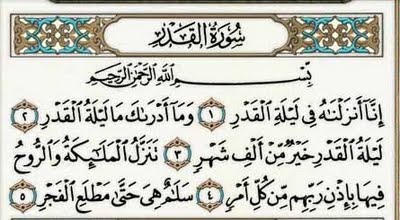
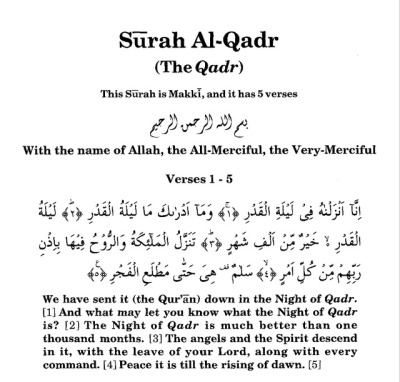
إنا أنزلناه في ليلة القدر، وما أدرىٰك ما ليلة القدر؟ ليلة القدر خير من ألف شهر، تنزّل الملائكة والروح فيها بإذن ربهم من كل أمر، سلام هي حتى مطلع الفجر.

ومعنى «خير من ألف شهر» يعنى: «خير من الدهر كله» كما ذكره الإمام القرطبي في تفسيره. فإن وجدت ليلة القدر، فكأنما خرجت من حدود الزمان ولمست قدسية الدهر وذقت معنى الخلود في جنات النعيم.

اللهم بارك لنا في شهرنا و أيامنا وليالينا، آمين.

APPENDIX: A GLIMPSE OF SOME OF THE VIEWS ABOUT THE DATE OF LQ, TO SHOW THE IMMENSE DIVERSITY ABOUT THIS IN THE ISLAMIC TRADITION

NB: where “[odd nights of the] last 10” is mentioned, even this was disagreed about, e.g.: Ibn Hazm stated that if the month has 30 days, then these odd nights are 21, 23, 25, 27 & 29 but if the month has 29 days, then the last 10 nights are nights 20-29 and hence the odd nights are 20, 22, 24, 26 & 28! This was another argument for seeking LQ in all of the last 10 nights, because in the past, we were unable to know for sure in advance how many days the month would have.

IBN KATHIR

Hadith (Tayalisi): 27 or 29

Hadith (Ahmad): LQ in last 10, odd nights: 29 or 27 or 25 or 23 or the last night of the month.  The hadith has other details.  IK: the isnad is hasan, but the matn has strange, weak content (gharabah) and in some versions, rejected (nakarah) content or meaning.

Hadith (Ibn Abi Asim): LQ in last 10.

Hadith (Ahmad): Seek it in the first 10 or last 10 … Seek it in the last 10 … Seek it in the last 7.

Narration: from Ibn Mas’ood and those who followed him of the people of knowledge of Kufa that it is found throughout the year, and is hoped for in every month equally. (IK disagrees with this view)  Ibn Mas’ood used to say, “If you stand in prayer at night all year long, you will find LQ.”

Hadith (Abu Dawud): LQ may be throughout R.

Narration: from Abu Hanifa: LQ is hoped for throughout R.  This is also a view quoted by Ghazzali [i.e. in the Shafi’i madhhab? – UH] Rafi’i declared this to be an extremely strange view.

LQ is the 1st night of R: Abu Razin.

LQ is 17th R, because it was the night before the Battle of Badr, described as being on the “Day of Decision” (Yawm al-Furqan) in the Qur’an, hence it relates to LQ as the night of decision, decree and destiny: narrated from the Prophet, Ibn Mas’ood, Zayd bin Arqam, ‘Uthman bin Abil-‘Aas, Imam Shafi’i & Hasan Basri.

LQ is 19th R: narrated from ‘Ali & Ibn Mas’ood.

LQ is 21st R: Hadith of Abu Sa’id al-Khudri in Bukhari & Muslim.  Imam Shafi’i said that this was the most authentic narration on the subject.

LQ is 23rd R: Hadith of Abdullah bin Anees in Sahih Muslim – it is a very similar narration to the previous hadith (21 R).

LQ is 24th R: Hadith of Abu Sa’id al-Khudri in Tayalisi. IK: the narrators are trustworthy.  Also narrated as a hadith by Bilal, but a weak isnad. Also contradicted by the next consideration:

LQ is in the first 7 of the last 10 nights: more authentic view of Bilal rA, narrated by Bukhari.  Also narrated as the view of Ibn Mas’ood, Ibn Abbas, Jabir, Hasan, Qatadah & Ibn Wahb, and from the Prophet by Wathilah bin al-Asqa’.

LQ is 25th R: based on the hadith of Bukhari from Ibn Abbas from the Prophet: Seek it in the last 10 nights: in the 9 remaining, 7 remaining, 5 remaining.

IK: Most people of knowledge understood this to mean the odd nights, but others understood it to mean the even nights, e.g. Abu Sa’id (Sahih Muslim). IK: Allah knows best.

LQ is 27th R: narrated from the Prophet, several Companions, a group of the Salaf, the preferred view in the madhhab of Imam Ahmad and quoted also from Imam Abu Hanifa.

LQ is the 7th of last 10 (i.e. 27) or with 7 remaining (i.e. 22 or 23): narrated from Ibn Abbas.

LQ is 21, 23, 25, 27, 29 or last night of the month: Hadith of Imam Ahmad.

LQ is 27 or 29: Hadith of Imam Ahmad.

LQ is the last night of R: Hadith of Ahmad, Tirmidhi, Nasa’i.


TEN TRUTHS ABOUT JIHAD

November 10, 2019

With the Name of God, All-Merciful, Most Merciful


TEN TRUTHS ABOUT JIHAD


Bismillah. During the Islamic lunar month of Rabi’ al-Awwal [originally, the “first month of spring”], when the Prophet Muhammad, peace be upon him, was born and died, thus fulfilling an ancient Jewish or Israelite prophecy about the Prophets being born and dying on the same date, thus completing a cosmic cycle, I am moved to republish this article that I wrote in 2017, since the Prophet and his name continues to be praised and vilified around the world.  I suggest that it may be useful as a basis for Friday sermons (Jumu’ah / Jumma khutbahs) about Jihad, for those who agree with this content.

Within those last two years, some more things have happened:

(1) I was reminded that there are narrations in the Sirah tradition saying that the Prophet’s birth name was not Muhammad, but Qutham, and that Muhammad (“The Oft-Praised One”) was a title given to him later.  If these are true, then “Muhammad” would be much like “Christ” or “Buddha,” i.e. a title originally, not a name, although of course many titles become names later, and vice-versa, as with Caesar.

(2) Sheikh Hamza Yusuf Hanson recommended to me the book by Juan Cole, Muhammad: Prophet of Peace Amid the Clash of Empires (Hachette USA, 2018).  I’ve read a few chapters, and it is a very interesting read.  And it tends to confirm my own conclusions that I wrote on 1st August 2017 for the Muslim Reform Movement, and that are republished here as: Ten Truths About Jihad.  In particular, see the quote from Ibn Sa’d via Ibn al-Qayyim on the context of Qur’an, Repentance, 9:29, that appears to be the most militant verse in the Qur’an, but the context again suggests a meaning of self-defence!

(3) A modified version of this article was included by me and my friend, Sheikh Dr Salah al-Ansari al-Azhari in our Tackling Terror (Quilliam, 2018), a rebuttal of ISIS’ Fiqh al-Dima’ or Jurisprudence of Blood.

(4) I also discussed some of this with Prof. Rabbi Dan Cohn-Sherbok and Dr. George Chryssides in our chapter on “War and Peace” in our People of the Book – How Jews, Christians and Muslims Understand Their Sacred Scriptures (Jessica Kingsley Publishers, 2018)

But here we are, back to my original article [with a few additions in square brackets]:


TEN TRUTHS ABOUT JIHAD

With the Name of God, All-Merciful, Most Merciful

[Note: the Meccan period of the Prophet’s mission represented peaceful preaching under persecution; the Medinan period represented city-state-power and included war. Hence the reference to Meccan & Medinan verses, to understand context.]


  1. THE ESSENTIAL QUR’ANIC TEACHING ABOUT JIHAD IS THAT IT IS A LIFELONG, NONVIOLENT STRUGGLE FOR GOODNESS, JUSTICE AND TRUTH AGAINST EVIL, INJUSTICE AND FALSEHOOD

The essential Qur’anic teaching about Jihad is that it is a non-violent struggle for goodness of all kinds, and against evil of all types.  This is clear from the following Meccan verses of the Qur’an:

“Struggle in God, as the struggle (jihad) deserves …” (Pilgrimage 22:78); and

“Obey not the concealers (of truth), and struggle against them with it (the Qur’an): a great struggle (jihad).” (The Criterion 25:52)


  1. DURING HIS 13 YEARS’ MISSION IN MECCA, THE PROPHET AND HIS FOLLOWERS WERE SUBJECTED TO PERSECUTION, BUT WERE ORDERED TO REMAIN PATIENT & NONVIOLENT

This is clear from verses such as the following:

“Withhold your hands (from violence in self-defence): establish prayer and give in charity” (Women 4:77)

Note that during this time, the Prophet’s followers were persecuted, tortured and killed. He himself was the subject of assassination attempts and plots (Spoils of War 8:30), but the Muslim response remained peaceful and nonviolent.


  1. DURING THE PROPHET’S 10-YEAR MISSION IN MEDINA, MILITARY JIHAD IN SELF-DEFENCE WAS EVENTUALLY PERMITTED

This is clear from Medinan verses such as the following:

“Permission has been given to those who were fought (to fight back), because they have been oppressed … those who were unjustly expelled from their homes, only for saying: ‘Our Lord is God’.” (Pilgrimage 22:39-40)

“Fight, in the way of God, those who fight you, and transgress not: truly, God does not love transgressors.” (The Heifer 2:190)


  1. MILITARY JIHAD MAY ONLY BE DECLARED BY A LEGITIMATE AUTHORITY

An example of such an authority was the Prophet Muhammad, undisputed leader of the city-state of Medina – see the Medina Charter, an agreement between the Prophet and the non-Muslim, largely Jewish, tribes of Medina, for clauses relating to mutual defence of Medina against external aggression.

Several Qur’anic verses that speak of fighting and concluding peace are addressed in the singular to the Prophet, e.g. Women 4:84 and Spoils of War 8:61. This is because only he, as the legitimate ruler of the city-state of Medina, had the authority to declare a state of war or peace.

Throughout the centuries of Islamic jurisprudence on warfare ethics, the jurists have agreed that only a legitimate authority can declare a state of war or military jihad. In modern times, this means that only legitimate states have the authority to declare a state of war or military jihad: vigilante or non-state actors such as terrorist groups have no Islamic authority whatsoever to issue a call to arms in the name of jihad. This is why we stated in the Muslim Reform Movement Declaration that “we reject violent jihad.” [i.e. by non-state actors]


  1. EVEN THE MOST APPARENTLY-BELLIGERENT VERSES ABOUT JIHAD ARE IN SELF-DEFENCE

For example, the eighth and ninth surahs or chapters of the Qur’an, al-Anfal (Spoils of War) and al-Tawbah (Repentance):

In Surah al-Anfal, the command to “Prepare against them your strength to the utmost …” is followed by the exhortation to accept overtures of peace from the enemy: “If they incline towards peace, then also incline towards it, and trust in God.” (Spoils of War 8:60-61)

Thus, the preparation of utmost strength is largely a deterrent, to encourage any enemies to sue for peace.

In Surah al-Tawbah, the command to “Fight them: God will punish them at your hands …” was preceded by the cause: “They violated their oaths and … attacked you first.” (Repentance, 9:12-15)

Thus, as in The Heifer 2:190 and Pilgrimage 22:39, fighting was ordered in self-defence. Note that in the Medinan era, the pagan, polytheistic Meccan armies attacked the Muslims in Medina several times, aiming to wipe the latter out, e.g. at the Battles of Uhud and the Trench. Thus, the Prophet and the Muslims in Medina were utterly justified in waging military jihad to protect themselves. The numerous Qur’anic verses dealing with military jihad against the Meccan polytheists must be understood in this context.

Finally, the verse of jizya (Repentance 9:29) was revealed when the Byzantines and their allies under Emperor Heraclius threatened the northern regions of Islamic Arabia from Syria, resulting in the Tabuk expedition that ended without any fighting.[1]

The jizya protection- and poll-tax, the name itself deriving from Persian [according to a narration by Imam al-Qurtubi under 9:29], was always a political tax, not religious. This is evident in the fact that some Islamic jurists later advised Muslims under the Reconquista in Andalusia to pay jizya to their Christian conquerors. Furthermore, the Ottoman Caliph abolished the jizya and the associated category of dhimma in the mid-19th century CE, with the agreement of his most senior Islamic scholars, recognising that it was no longer relevant to the modern world of the time.[2]

Thus, although early Muslim armies did take part in expansionist campaigns, at least partly motivated by the war strategem that ‘Offence is the best form of defence’, Muslim authorities, both political and religious, have recognised for at least two centuries that this kind of military jihad has no place in the modern world that is governed by treaties, peace agreements and international collaboration.


  1. MILITARY JIHAD WAS ALSO LEGISLATED TO PROTECT & PROMOTE RELIGIOUS FREEDOM

This is clear from the following Qur’anic verse:

“Permission has been given to those who were fought (to fight back), because they have been oppressed … those who were unjustly expelled from their homes, only for saying: ‘Our Lord is God’.

And were God not to check some people by means of others, then monasteries, churches, synagogues and mosques, where God’s name is mentioned often, would surely be demolished.” (Pilgrimage 22:39-40)

Thus, military Jihad was also legislated to protect the religious freedom of Muslims, Jews and Christians, according to the explicit text of the Qur’an. Muhammad bin Qasim, the 8th-century CE Muslim commander who first brought Islam to India, extended this religious protection to Zoroastrian and Hindu temples.[3]

Note that this religious protection also originally extended to the idolatrous polytheists of Mecca and Medina – the latter were included in the Medina Charter, and both were covered by the Qur’anic dictum, “To you, your religion: to me, my religion.” (The Concealers of Truth, 109:6) It was only when the Meccan polytheists refused to be peaceful and violently persecuted the Muslims, attempting genocide, that they were fought. Even then, the Hudaybiya peace treaty was concluded with them later.


  1. MILITARY JIHAD WAS ALWAYS CONDITIONED BY STRONG ETHICAL RESTRICTIONS

Numerous hadiths speak of the obligation of avoiding the killing of women, children, old people, peasants, monks and others in war – in the 7th-century CE, these were advanced, civilised teachings. Further hadiths forbid the chopping down of trees, burning of orchards or poisoning wells or other water supplies as part of war tactics. These teachings may be seen as Islamic forerunners of modern warfare ethics, such as the Geneva Conventions, that are also Islamic in spirit and must be seen as binding upon Muslims worldwide.

The 12th-13th century CE Andalusian philosopher and jurist, Ibn Rushd (Averroes), in his short ‘Book of Jihad’, part of his Bidayat al-Mujtahid (available in English as ‘The Distinguished Jurist’s Primer‘), discusses ten issues related to the philosophy and ethics of war or military jihad. Thus, Islam has a long tradition of warfare ethics.


  1. TO REITERATE, JIHAD IS A STRUGGLE FOR GOOD AGAINST EVIL

This may take many forms: jihad bil-mal is charitable spending; jihad bil-lisan is speaking truth or goodness against evil and injustice. Thus, all forms of social, intellectual and political struggle with noble aims are a type of jihad, in traditional Islamic terminology.  An example of this is the hadith or Prophet’s teaching, “The best jihad is to speak a word of truth before a tyrant ruler.”

However, this teaching does not privilege so-called ‘Islamic political parties’ or islamist groups that wrongly claim to monopolise interpretations of Islam in the social and political realms.

Jihad is a universal struggle for good against evil. The verse, “Struggle in God, as the struggle (jihad) deserves …” (Pilgrimage 22:78) also includes the teachings, “… This is the path of your father Abraham … Establish prayer, give charity and hold to God: He is your Protector  …”


  1. THE OUTER JIHAD IS ALWAYS UNDERPINNED BY INNER JIHAD

Inner jihad or jihad al-nafs (struggle against the self’s base desires) has always been understood as a prerequisite for taking part in the outer jihad, or struggle for goodness and truth in the world.

This is reflected in the Qur’anic promise of heaven to whoever fears standing before God and “forbids their self from base desires” (The Snatchers 79:40-41). Furthermore, a hadith states, “The true mujahid (holy warrior) is the one who struggles against their own self for the sake of God.”

Ibrahim bin Abi Ablah, an early ascetic of Islam, once remarked after a military expedition, “We have returned from the lesser jihad to the greater jihad,” i.e. from the lesser, military jihad to the greater jihad of lifelong struggle against evil. This teaching was also attributed to the Prophet himself and widely favoured by the Sufis, who were keen to preserve the spiritual dimensions of Islam during the early centuries of astonishing Islamic military conquests and worldly success. [Although many Hadith scholars did not accept this as a saying of the Prophet, they accepted its meaning, since it came from someone regarded as a holy main or saint (wali). Such scholars include Ibn Hajar al-‘Asqalani.]


  1. JIHAD TODAY

As shown above, Islamic teachings about jihad are essentially spiritual and non-violent. All charitable efforts or struggles by Muslims today for goodness, truth and justice against evil and injustice may be termed jihad. For example, the Prophet termed “struggling to help widows and orphans” and “struggling to serve elderly parents” as types of jihad. [Sound hadiths of Bukhari & Muslim, etc.]

Armed or military jihad is the strict preserve of legitimate authority such as modern nation-states engaging in ethical warfare: this is why the Muslim Reform Movement firmly rejects ‘violent jihad’ carried out by non-state actors or vigilante groups such as terrorist organisations.

What we really need is a jihad for universal human rights, dignity, equality, peace and justice, tempered by the mercy and compassion that are the essential spirit of Islam and the Qur’an.


Imam Dr Usama Hasan (briefly an armed mujahid alongside the anti-communist mujahideen in Afghanistan, 1990-1)

London, UK, 1st August 2017

Modified & republished: 10th November 2019 / 12th Rabi’ al-Awwal 1441


NOTES:


[1] Ibn Sa’d said, “It reached the Messenger of God, may God bless him and grant him peace, that the Romans [Byzantines] had gathered large multitudes in Syria, and that Heraclius had prepared provision for his men for a year. He had brought with him the tribes of Lakhm, Judham, ‘Amilah and Ghassan. They had sent an advance party to al-Balqa’.” – cf. Ibn al-Qayyim, Zad al-Ma’ad, Al-Matba’ah al-Misriyyah wa Maktabatuha, n.d., vol. 3, p. 2

[2] cf. Usama Hasan, From Dhimmitude to Democracy, Quilliam, 2015

[3] Al-Baladhuri, as quoted by Ihsanoglu. cf. Usama Hasan, From Dhimmitude to Democracy, Quilliam, 2015, p. 26


INNER AND OUTER ASPECTS OF ISLAMIC RITUAL PRAYER (SALAT)

June 26, 2015

Bismillah. This is about some of the beautiful symbolism and meaning behind the salat or ritual prayer, one of the five pillars of Islam and to be performed at least five times a day.  When the salat is reduced to pure ritual without any understanding of the Arabic words or of the symbolism of the actions, many inward and outward problems arise, God forbid!  But the salat is the believer’s daily ascension (mi’raj) and communion with God: it is up to us to deepen this daily experience of ours. It is the Muslim’s daily practice of mindfulness, meditation and remembrance, to develop a deep wellspring of love, faith and humility to equip us for life’s individual, social and political challenges. May God continue to bless our journeys!

All italicised phrases are from the Qur’an and Sunna; references are omitted for ease of reading and clarity: this is not an academic article, but an attempt to elucidate certain indications and symbols, with the hope of helping people on their own journeys.

With the Name of God, All-Merciful, Most Merciful

INNER AND OUTER ASPECTS OF ISLAMIC RITUAL PRAYER (SALAT)

  1. Prayer times: Time is sacred (God says, I am Time); we offer each prayer within its time in order to share in the sacredness of every part of the day and night, and to give thanks for that portion of sacred time.
  2. Washing (ablutions) before prayer: we cleanse our limbs and hearts of wrongdoing.
  3. Ablutions are nullified by toilet or sexual acts: these represent our basic animal natures, so we wash again to symbolise recovering our angelic natures in order to stand before God.
  4. Facing Mecca: The Ka’bah, as the House of God, symbolises the heart, which is also the House of God. Whilst facing Mecca outwardly, we turn inwardly to face the home of God at the centre and core of our being. So turn your face towards the Sacred Mosque!
  5. Standing in straight rows: we are in fellowship, equal before God, and imitating the ranks of the angels. The hearts of the people of Paradise beat as one … By Those Who Stand in Ranks!
  6. Raising the hands at the beginning of the prayer: symbolises the “lifting of the veil” between us and God. In prayer, we are talking directly to our Lord.
  7. Standing before God in prayer: facing up to life as a journey to God; a foretaste and preparation for standing before God on Judgment Day.
  8. Keeping the eyes open, rather than closed, in prayer: do not be veiled by multiplicity from Unity, nor by Unity from multiplicity.
  9. Lowering the head and looking at the ground (if practised): humility before God.
  10. Keeping the chin up and looking straight ahead towards Mecca (if practised): facing life, and one’s inward reality, directly.
  11. Folding the arms across the body (if practised): the servant’s pose before the Master.
  12. Reciting the Opening Chapter of the Qur’an (Surat al-Fatiha): we are sharing in a communion with God. God says, I have divided the prayer between Me and My servant …
  13. Praise be to God, Lord of the Worlds; All-Merciful, Most Merciful; Master and King of the Day of Judgment: God says, These belong to Me, as our glorification is of God.
  14. You alone we worship; You alone we ask for help: God says, This is (shared) between Me and My servant; the God-human relationship.
  15. Guide us to the Straight Path; the path of those whom You have favoured, who neither receive (Your) anger nor stray: God says, These belong to My servant, and My servant shall have whatever he or she requests.
  16. Reciting further from the Qur’an: the remembrance of God continues; God and the angels bear witness to it. Truly, the recitation at dawn was witnessed.
  17. Bowing: humility before God; bearing life’s hardships, followed by standing tall again.
  18. Prostration, with forehead, nose, hands, knees and feet pressed to the ground: ultimate humility before God; one is closest to God in this posture, which is outwardly humiliation, inwardly elevation; our hearts are higher than our brains, whilst the rest of the time, our brains are higher than our hearts; Pray hard, for your prayers are most likely to be accepted in this position; death.
  19. The second prostration, after a brief sitting: the second death, at the blowing of the Horn. Our Lord! You caused us to die twice, and to live twice …
  20. In prayer, do not sit like a dog, peck like a cockerel or squat like a monkey: throughout prayer, we must rise above our animal natures and try to inhabit our angelic natures.
  21. Standing, bowing, prostration: the body forms the Arabic letters Alif (A), Dal (D) and Mim (M) respectively, hence spelling Adam during the prayer; we are seeking our original Paradisal, primordial humanity before the Fall through our communion with God.

    [In Hebrew and Arabic, the Aleph/Alif (A) also signifies the number 1, so “Adam” is identical to “1 dam” meaning “one blood”: humanity is united; we have different skin colours, but we bleed the same colour. Red blood cells have no DNA (although white ones do), so in a sense blood represents our common humanity – much of it does not have our unique, genetic fingerprints that are found in every other of the trillions of cells of our body.]

  22. Standing, bowing, prostration: the body forms a straight line, right angle and (semi-)circle respectively, the bases of all geometry and form; we are signifying that we are at one with Nature and its beautiful forms. God is Beautiful, and loves Beauty.
  23. Sitting in remembrance of God at the end of the prayer: a foretaste of the eternal rest in Paradise.
  24. The prayer ends with the greeting of peace (salam): Their greeting on the Day they meet Him is Peace; Their greeting there (in the Garden) is Peace; they hear no vain or sinful talk, only the words, Peace, Peace!

Usama Hasan

London, Ramadan 1436 / June 2015

Islam and the Veil – Opening Up the Discussion About Hijab

February 3, 2014

Bismillah.  With the global discussion about the veil due to “World Hijab Day” on 1st February, 2014, this is a good time to re-publish here a detailed, academic paper from 2011.  It is from the following book: http://www.amazon.co.uk/Islam-Veil-Theoretical-Regional-Contexts/dp/1441187359/ – one of the editors was kind enough to say that mine was the best paper in the collection, which was quite a compliment since other authors include Javaid Ghamidi and other experts.

Please click here to download the full paper: Islam and the Veil – Usama Hasan

I also suggest the following questions as a guide to study/discussion sessions about this topic:

STUDY/DISCUSSION QUESTIONS ABOUT VEILING (FOR A HETEROSEXUAL CONTEXT)

1. Distinguish between the terms hijab (veil), khimar (headscarf) and jilbab (covering).  Are these religious or cultural aspects of dress/clothing, or a mixture of the two, i.e. religio-cultural?

2. God is veiled from humanity.  What is the nature of the veil(s), and what is meant by the veil being lifted for the believers’ Vision of God?  How did veiling (of women, caliphs – who had a hajib, etc.) symbolise the above truths?

3. What is the significance, if any, of the fact that in Surah al-Nur, men are instructed before women to “lower their gaze and guard their chastity” ?

4. Surah al-Nur: women were instructed to draw their headscarves (khimar) over their bosoms.  Is this a command to cover the head and hair, or to cover the breasts, or all of the above?

5.  Surah al-Nur: What is meant by the “ordinarily-apparent adornment” (zinah zahirah) that may be displayed by women? Is it parts of the body, the top layer of clothing, jewellery, make-up or a combination of these?  What would then be the implied “hidden beauty/charms” (zinah batinah) that men and women would only reveal to close family, spouses, etc. ?

6. Some Companions insisted that women must be covered top to toe in public, including the face; others excepted the face and hands, as did the majority of early authorities; others excepted the forearms, half-way to the elbows (Tabari) or all the way to the elbows (Qadi Abu Yusuf, for women who worked in bakeries and thus had to roll up their sleeves – mentioned by Imam Sarakhsi in Al-Mabsut); others excepted the feet also (Abu Hanifah); some even excepted the head and hair (minority view mentioned by Ibn ‘Ashur).  Some female Companions gathered their skirts when nursing warriors in battle such that their ankles or shins were visible (‘Aisha & Hafsa – Sahih al-Bukhari).  How are these views to be understood from the text?  Do the above views indicate that the context and ‘urf (social custom) is influential in what constitutes modest and appropriate dress?

7. Is the hadith of Asma about “covering up except face and hands” genuine or weak?  If the latter, does that support the niqab-obligation view or the khimar-not-necessary view?

8.  Is a woman to be regarded as “naked” and “sinful” if her face, hands, head, hair, feet, ankles, shins and/or forearms are visible in public, as per the above views? Or should the onus be on men to restrain lustful glances, as they are ordered to do so beforehand in Surah al-Nur?

9.  Surah al-Nur: In terms of the males “having no sexual desire” before whom a woman doesn’t need to worry about veiling, the commentators have extended this to several categories.  How should this be understood in modern societies?  What is your view about the classical view that obliged women to cover in front of their fathers and brothers to prevent the latter having incestuous thoughts?

10. Surah al-Nur: About “their women” before whom women can unveil, does this apply only to Muslim women or to all women (both views are classical) ?  Does it matter about the morality of such female company, i.e. is the matter related to appropriate dress and behaviour?

11. Surah al-Ahzab (hijab meaning curtain or screen): Does this verse imply gender-segregation?  If so, is that a general principle or was it only for the Prophet’s wives and family?

12. Surah al-Ahzab: what is meant by the jilbab?  Is it simply a shawl (Ibn al-Arabi & Ibn Kathir), any dress that reasonably covers the body, an outer garment or cloak on top of usual clothes, or a cloak with a hood that must go on top of a khimar (Albani’s view) ?

13. Surah al-Ahzab: The jilbab is explicitly “that they may be recognised (as noble women) so they are not harassed.” How is that to be understood and practiced in the modern world? Is it true that traditional clothing, i.e. khimar/jilbab/niqab protects Muslim women from sexual harassment in various societies?

14.  How does fiqh al-ma’al (jurisprudence of consequences, cf. Sheikh Abdullah bin Bayyah) apply to issues of gender-segregation and veiling/unveiling in the modern world?  In particular, what implications do veiling/unveiling have for working or professional women in Muslim/non-Muslim societies?

15.  Is the khimar or headscarf (mistakenly called hijab) a normal part of clothing in some cultures, analogous to a hat or cap, or a symbol of faith, modesty, purity, identity, or some combination of these?

16.  What are the psycho-spiritual effects of wearing a headscarf and/or jilbab and/or niqab for women?  Do these lead to confidence, subjugation, control, spirituality, modesty, pride, purity, ostentation, humility, holier-than-thou attitude or a combination of these?

17.  What are the psycho-spiritual effects upon men of women wearing a headscarf and/or jilbab and/or niqab?  In men, do these lead to feelings of purity, increased/decreased/repressed desire, a positive/negative attitude towards veiled/unveiled women, or a combination of these?  How does all this affect the attitudes of Muslim/non-Muslim men towards Muslim/non-Muslim women, whether veiled or unveiled, and their perceptions of beauty, attractiveness, sexuality and desire?

18.  What is all the fuss really about, and are men and women equal in this whole discussion?  Do the notions of gender-equality and women’s liberation have any bearing on the whole issue?

19. Who should ultimately decide what is appropriate dress and behaviour for men and women in a given society?  Is it men, or women, or male religious scholars, or female religious scholars, or panels of religious scholars, or society as a whole including parents, families, religious/spiritual authorities, etc.?

20. And finally, how does God, with the 99 Names of Beauty (jamali) and Majesty (jalali), to Whom we are all returning, relate to all of this in our lives?

Usama Hasan

London, 3rd February 2014 / 3rd Rabi’ al-Thani 1435

NO COMPULSION IN RELIGION: ISLAM AND THE FREEDOM OF BELIEF

September 5, 2013

Bismillah.  Here is the full text of a publication from July 2013, available with better formatting here.  It is an updated version of an earlier text from October 2012, but with the addition of an Appendix discussing the death penalty for apostasy in Sharia: http://www.quilliamfoundation.org/wp/wp-content/uploads/publications/free/no-compulsion-in-religion-islam-and-the-freedom-of-belief.pdf


NO COMPULSION IN RELIGION:
ISLAM & THE FREEDOM OF BELIEF

Dr. Usama Hasan, Senior Researcher in Islamic Studies, Quilliam


Introduction

Following the international furore in 2012 over the amateurish, inflammatory and offensive film, Innocence of Muslims, there were calls around the world to introduce[1] or strengthen rules that would become akin to global blasphemy laws.[2]  Dozens of people were killed during violent protests in Muslim-majority countries, including US Ambassador Stevens in Libya by a terrorist attack under cover of anti-film protests, and a Pakistani minister placed a $100,000 bounty on the head of the film-director.


For many of us, this felt like a case of “Here we go again.”  From books and films to cartoons, teddy bears and desecration of copies of the Qur’an by a handful of American fundamentalists and soldiers, the story is the same: instead of ignoring material insulting and offensive to Islam, or forgiving their authors as the Prophet Muhammad (peace be upon him) would have done, some immature Muslims resort to violence that ends up killing people who had done more than most to actually help Muslims or Muslim-majority countries.  Furthermore, the poor-quality “offending” material receives far more publicity than it deserved, and the image of Islam is dragged through the mud yet again, to the exasperation of the vast majority of ordinary, decent Muslims.


In the 1980’s, Salman Rushdie’s The Satanic Verses, an expletive-laden, largely-unreadable book was catapulted, along with its author, into international fame by an Islamist campaign of “raising awareness” by publicising its satirical insults towards holy figures of Islam, culminating in Ayatollah Khomeini’s notorious fatwa ordering Rushdie’s murder.  The same story was repeated, two decades later, with the Danish cartoons satirising the Prophet Muhammad (peace be upon him): these were largely unknown when first published, until a Denmark-based Egyptian cleric began a campaign publicising them.  Surely, to love the Prophet and his disciples means not to publicise gross insults directed at him.  If people insult our loved ones, such as parents, children or siblings, would we broadcast those offensive comments or depictions to the whole world?


In all these cases, dozens of ordinary people died in riots and protests around the world: this is extremely ironic, when the Prophet himself is said to have taught that the destruction of the Ka’bah, the holiest site of Islam, is lighter in the sight of God than the taking of a single life.  The following represent particularly horrific incidents during 2011:


a)      a number of UN staff who had endured much hardship to help Afghanistan, an overwhelmingly-Muslim nation, were beheaded after a violent mob protest against the burning of the Qur’an by a negligible handful of US evangelicals.[3]

b)      Salman Taseer, Governor of Punjab province in Pakistan, was murdered by one of his own bodyguards who later accused Taseer of “insulting the Prophet” by intervening to secure a presidential pardon in the case of Asia Bibi, a Pakistani Christian woman sentenced to death under blasphemy laws in a situation suspected of involving neighbourly feuds with Muslims.


The Case for Freedom of Belief and the Relaxation of Blasphemy Laws


It is important to condemn attempts to provoke religious or anti-religious hatred and bigotry, violence in response to provocation and mindless violence and rioting upon the pretext of taking offence.   However, this paper outlines an Islamic case for Freedom of Belief, opposes the idea of strengthening blasphemy laws and supports the reconsideration of such laws around the world, based on the following arguments:


  1. Blasphemy is difficult to define in a global context: one person’s blasphemy may be another’s freedom of belief
  2. Blasphemy laws are notoriously open to abuse, and are used by repressive governments to enforce discrimination against religious minorities
  3. From an Islamic perspective, the prohibition of compulsion in religious matters is a fundamental Qur’anic principle: true faith is based on free will and free choice 
  4. Religious faith and practice under coercion is clearly not genuine, and therefore counter-productive 
  5. There is no explicit sanction in the Qur’an and Sunnah (teachings of the Prophet Muhammad) for the criminalisation and punishment of blasphemy: in fact, the opposite is the case; the few scriptural texts that are misquoted in this regard all refer to wartime situations, and the harsh, mediaeval Islamic jurisprudence on blasphemy was developed centuries after the Prophet himself
  6. The Islamic scriptures promote faith and respect for sacred symbols; any penalties for violations of these are spiritual and other-worldly, and not the business of worldly legislation and punishment
     
  7. The Qur’anic spirit is to freely discuss and debate matters of faith and religion to enable people as free, moral agents to make informed choices about such matters
     
  8. Debate and discussion should ideally be polite, respectful and civilised: when it is not, the Muhammadan character is to respond to insults, uncivilised behaviour and violence with patience, forbearance, forgiveness and compassion


The above considerations are now discussed in more detail:


1.      The difficulty of defining blasphemy

Blasphemy is difficult to define in a global context: one person’s blasphemy may be another’s freedom of belief.


Due to the nature of religious belief, one person’s faith often implies that another’s is wrong and perhaps even offensive, constituting blasphemy.  For example, the major world religions often have very different formulations and beliefs concerning God, Muhammad, Jesus, Buddha and the Hindu deities, as well as about various ethical and social matters.  There are intellectual and religious approaches to reconciling the major world religions, such as via mystical traditions and perennialist philosophies, but these tend to be marginalised from public discourse.


Critics of a particular religion or of religion in general, as well as converts from one religion to another, may thus be easily accused of blasphemy and discriminated against on that basis, perhaps even being subject to criminal codes.[4]


Ironically, Muslims are often the worst offenders when it comes to blaspheming against other religions, yet the most vociferous in taking offence when their sacred symbols are insulted.  For example, offensive tirades against Jews are commonplace in Egyptian society and media, whilst incitement of hatred against Christians has directly led to violent, mob attacks in Egypt[5], Pakistan and Indonesia.[6] 


Another example of this is the Qur’anic story about an Israelite community tested with regard to Sabbath law: the tolerant Islamic tradition has always read this introspectively, drawing lessons for Jews, Christians and Muslims.  However, Muslim fundamentalist hate-preachers regularly misquote this story to justify referring to Jews (and occasionally, Christians) as “apes and pigs.”[7]


It should be noted that inconsistent behaviour like this is condemned in the Qur’an:


Woe to those that deal with double standards: those who, when they are owed by others, exact full measure but when they have to reciprocate, give less than due.  Do they not think that they will be called to account? On a Mighty Day, a Day when all humanity will stand before the Lord of the Worlds! (83:1-6)


2.      The prevalent abuse of blasphemy laws


Blasphemy laws are notoriously open to abuse, and are used by repressive governments to enforce discrimination against religious minorities.


There are numerous documented cases of these.  A recent report by a human rights NGO details examples of how blasphemy laws:


(i) stifle discussion and dissent in the public sphere,

(ii) spark outbreaks of mob violence,

(iii) violate freedom of religion, thought, or belief and

(iv) are used as a weapon to settle private disputes.[8]


The vast majority of the dozens of cases documented in the above report involve allegations of blasphemy against Islam in Muslim-majority countries, although there are a handful of exceptions to this dominant pattern.


3.      The Qur’anic principle of “No Compulsion in Religion”

From an Islamic perspective, the prohibition of compulsion in religious matters is a fundamental Qur’anic principle: true faith is based on free will and free choice.


(i)                 The Qur’anic verse, “Let there be no compulsion in religion” (2:256) is proverbial and regarded as expressing a fundamental Islamic value, especially as it occurs immediately after the “Verse of the Throne” (2:255) that is devoted to the majesty of God and was described by the Prophet Muhammad as “the greatest verse in the Qur’an.”

Significantly, Ibn ‘Abbas, a cousin and disciple (Companion) of the Prophet Muhammad and one of the foremost authorities in Qur’anic commentary, explained that this verse (2:256) was revealed regarding examples where the Companions had children who had converted to Judaism and Christianity; the Companions were forbidden, on the basis of this verse, from forcing their children to convert to Islam.[9]  Thus, this verse not only prohibited converting people to Islam by coercion, it also allowed people to leave the faith of Islam voluntarily.

(ii)               Another crucial and clear Qur’anic verse in this regard is the following, addressed to the Prophet Muhammad, “If your Lord wished, everyone on earth would have faith: all of them, together.  Will you then force people to become believers?” (10:99)

Ibn Kathir, a leading commentator, explains this verse with reference to many others affirming that matters of faith are between individuals and God: no other person can intervene.[10]

(iii)             A similar verse quotes Prophet Nuh (Noah) rhetorically asking his people, “Shall we force you to accept this message unwillingly?” (11:28)

The traditional commentators confirm that this verse means, again, that there is no compulsion in religion.  Tabari and Ibn Kathir also quote Qatada, an early authority, as saying, “By God, if Noah was able to force his people to have faith, he would have done so, but that was not within his power.”[11]


4.      Faith under coercion is invalid

Religious faith and practice under coercion is clearly not genuine – this has been noted by Islamic theologians and jurists over the centuries since the early days of Islam.


This obvious consideration follows logically from the previous one.  Ghazzali, one of the most famous theologians of Islam, emphatically asserted that faith and non-faith involve active belief or unbelief, rather than a passive state or coercion.[12] 


Therefore, it is never in the public interest to attempt to force belief and faith on other people and restrict their right to question, criticise and explore.  Incitement to hatred and violence is a different matter, of course, but that is not limited to religious settings and can be covered by general, civil laws.


5.      The scriptural sources of Islam do not criminalise blasphemy

There is no explicit sanction in the Qur’an and Sunnah (teachings of the Prophet Muhammad) for the criminalisation and punishment of blasphemy: in fact, the opposite is the case; the few scriptural texts that are misquoted in this regard all refer to wartime situations, and the harsh, mediaeval Islamic jurisprudence on blasphemy and apostasy was developed centuries after the Prophet himself.

As noted earlier, the Qur’an affirms freedom of faith and religion[13], with some verses revealed specifically to safeguard this principle for Jews and Christians, even though some of the latter’s beliefs would constitute blasphemy (kufr or unbelief) from a Muslim viewpoint: e.g. rejection of the Prophethood of Muhammad, rejection of the Christhood of Jesus and deification of Christ. 


Some of the verses in this regard are as follows:


(i)                 Those who believe, and those who follow the Jewish scriptures, and the Christians and the Sabians,- any who believe in God and the Last Day, and work righteousness, shall have their reward with their Lord; on them shall be no fear, nor shall they grieve. (2:62 & similarly 5:69)

This verse has a clear universal message that favours inclusivist interpretations, where salvation is open through a variety of sincere religious endeavours, over exclusivist ones, where the criteria for salvation are understood to be fulfilled only by faithful Muslims.

(ii)               Those who believe, those who follow the Jewish scriptures, and the Sabians, Christians, Magians, and Polytheists,- God will judge between them on the Day of Judgment: for God is witness of all things. (22:17)

This verse does not guarantee salvation to all the religious groups mentioned, but reiterates that Divine Judgment amongst them will be manifested in the afterlife.  It suggests an obvious, reasonable, practical and pragmatic Islamic approach to peaceful coexistence amongst different religious groups: each religious community is entitled to follow its own path without harming others, perhaps believing and arguing that it is better than others, and God will judge between them all in the Hereafter.


The often-misquoted verse, “Kill them wherever you find them” (2:191, 4:89 & 4:91) refers to pagan enemies and treacherous Muslims in wartime.  It does not refer to Jews, despite the repeated false claims of writers such as Melanie Phillips. This is clear from preceding verses such as “Fight, in the way of God, those who fight you but do not transgress: God does not love transgressors.” (2:190)


It is true that, according to Islamic tradition, one or two pagan poets were killed for mocking the Prophet, but these were in the context of war: in the 7th-century Arabian culture dominated by an oral tradition, poetry was used for propaganda and psychological warfare, and was indeed employed effectively by the Prophet Muhammad himself, with Hassan bin Thabit and Abdullah bin Rawaha amongst his most skilful composers of verse: “Your verses hurt them far more than our arrows,” as the Prophet observed to Hassan.[14]


6.      God alone can judge and punish sacrilege

The Islamic scriptures promote faith and respect for sacred symbols; but any penalties for violations of these are described as spiritual, other-worldly and reserved for the life after death: they are not the business of worldly legislation and punishment.


This is true even for mocking God, the Prophet Muhammad and the Qur’an that entails blasphemy against Islam.  There are many verses that make this point, for example:


(i)                 Say, “Mock! But God will bring to light all that you fear.”  If you question them, they declare, “We were only joking and playing.” Say, “Was it God, His Signs and His Messenger that you were mocking?”  Make no excuses: you have rejected Faith after you had accepted it. If We pardon some of you, We will punish others amongst you, for that they are in sin. (9:64-66)

For mocking faith, this verse mentions both divine forgiveness and punishment: the latter is understood to occur in the hereafter, as stated by classical commentators.

(ii)               God and His angels send blessings on the Prophet: O believers! Send blessings on him, and salute him with all respect.   Those who annoy God and His Messenger – God has cursed them in this World and in the Hereafter, and has prepared for them a humiliating Punishment.  And those who annoy believing men and women undeservedly, bear on themselves a calumny and a glaring sin. (33:56-58)

These verses have always inspired the dignified Muslim response in the face of provocation: to worship God and revere the Prophet, but to leave offensive behaviour against God, Muhammad and the believers to God to deal with in the Hereafter.  The only exception to this is criminal violation of the life, property and honour of living people, for which laws are required to facilitate just redress.


7.      The Qur’anic spirit is to freely discuss and debate matters of faith

The Qur’anic spirit is to freely discuss and debate matters of faith and religion to enable people as free, moral agents to make informed choices about such matters.


Important but lesser-known Qur’anic verses in this regard are:


(i)                 Announce the Good News to My Servants!  Those who listen to the Word and follow the best meanings in it: those are the ones whom God has guided, and those are the ones endued with understanding. (39:17-18)

The renowned commentator Zamakhshari confirms that this verse may be interpreted as follows: people are entitled to different interpretations of scripture (and therefore, of Islam and religion in general), and to follow whatever makes most sense to them.[15]  Qurtubi quotes Ibn Abbas as widening the meaning of this verse further, by explaining “the word” to mean all speech, not just the Divine Speech recorded in scripture.[16]  This Qur’anic principle, where people listen to each other and follow what they regard as best, provides a further Islamic basis for peaceful coexistence amongst different religious communities and sects.

(ii)               Whatever you disagree about, its judgment belongs to God (42:10)

One traditional view of this verse is that it refers to the Day of Judgment, similar to 22:17 that was discussed above[17], i.e. that humans need to defer judgment on their disagreements to God in the Hereafter.

(iii)             Say, “Who gives you sustenance, from the heavens and the earth?” Say, “It is God. Truly, either we or you are on right guidance or in manifest error!” (34:24)

This verse, as is clear from its Meccan context, is part of a debate between Islam and the pagan idolatry and polytheism prevalent in Arabia during Muhammad’s lifetime.  The Qur’an reiterated on numerous occasions that Islamic monotheism was far superior to the primitive, Arabian idolatry.  However, in this verse, for the sake of argument, the Prophet was instructed to adopt a neutral stance: let’s present our arguments – either of us may be right or wrong.  This Qur’anic principle was one of the inspirations for the rich Islamic tradition of free thought, debate and discussion.


Free debate in Islamic history


In Islamic history, some of the caliphs actively encouraged high-level, interfaith, theological debates about core issues of belief.  Some of these debates were held in the courts of the caliph himself with leading Rabbis, Bishops and Islamic theologians.  Furthermore, leading Muslim thinkers, philosophers and poets openly expressed “heretical” views without facing prosecution.  For example, the greatest Muslim scientists and philosophers such as Al-Kindi, Al-Razi, Al-Farabi, Ibn Sina (Avicenna) and Ibn Rushd (Averroes) were denounced as heretics and accused of blasphemy by “orthodox” Sunni Muslim theologians such as Ghazzali and Ibn Taymiyyah.  In fact, the leading “orthodox” figures were often denounced as heretics and accused of blasphemy in their own lifetimes by others, and even subjected to imprisonment, flogging and mob violence: this is true, for example, of some of Sunni Islam’s greatest figures such as Abu Hanifa, Ahmad bin Hanbal, Ashari, Bukhari, Ghazzali, Qadi Abu Bakr, Ibn Arabi, Ibn Taymiyyah, Subki and Ibn al-Qayyim.


The state-sponsored rationalist (Mu’tazilite) mihna or inquisition (827-847) instituted by the Abbasid Caliph al-Mamun against traditionalist beliefs and teachings such as those of Ahmad bin Hanbal was eventually abandoned by later caliphs after two decades.  Mainstream Islam generally learnt from this experience about the folly of attempting to enforce religious beliefs upon others, given the wide diversity of traditional, jurisprudential, legal, rational, intellectual, philosophical and theological interpretations of Islamic scripture that had blossomed within two centuries of the Prophet Muhammad.  According to one contemporary Christian academic, this explosion of thought within such a short time-span was unparalleled in human history.[18]


Other examples of free thought, including satirising contemporary religious practice, are provided by Muslim poets.  For example, a leading poet during Abbasid times was Abul Atahiya (748-828), who famously commented, less than two centuries after the Prophet, that:


There are only two types of people amongst mankind:

Those of mindless faith, and those of faithless mind.


Atahiya was accused of heresy but never prosecuted for this: he was only imprisoned for upsetting a caliph by writing love poems about one of the caliph’s concubines.


Another example is the 12th-century poet Omar Khayyam, whose Rubaiyat has been known and loved throughout the English-speaking world ever since the 19th-century publication of its translation by the Victorian poet Edward Fitzgerald.  In the Rubaiyat, Khayyam famously pours scorn on following religious paths or worrying about mysteries such as heaven and hell, life after death and fate, and sings the praises of drowning one’s confusion by regularly getting drunk on wine. 


Although devout Muslims still abhor some of the sentiments expressed by Atahiya and Khayyam, it is a fact of Islamic history that they were commonly expressed by poets during their times, i.e. 900-1200 years ago.


8.      Forbearance in the face of provocation

Debate and discussion should ideally be polite, respectful and civilised.  When it is not, the Muhammadan character is to respond to insults, uncivilised behaviour, provocation and violence with patience, forbearance, forgiveness and compassion.  Those who claim to be following Islam and the Prophet Muhammad should be showing such characteristics rather than being provoked into mindless acts of violence and bloodshed, or into attempts to close down freedom of thought and expression.


The following Qur’anic verses are just some of those that extol the virtues of forbearance and forgiveness in response to provocation and insult:


(i)                 Hold to the path of forgiveness; enjoin goodness; turn away from the ignorant. (7:199)

(ii)               The servants of the All-Merciful are those who … when addressed by ignorant people, they reply, “Peace!” (25:63)

(iii)             We know indeed the grief which their words do cause you (O Muhammad). It is not you they reject: it is the signs of God that the unjust deny. Rejected were the messengers before you: with patience and constancy they bore their people’s rejection and wrongdoings, until Our victorious help did reach them.  There is none that can alter the words and decrees of God. Already, there have come to you some stories of those messengers. (6:33-34)

(iv)              We do indeed know how your heart is distressed at what they say. But celebrate the praises of your Lord, and be of those who prostrate themselves in adoration. And serve your Lord until there comes to you the Hour that is Certain. (15:97-99)


The following incidents from the life of the Prophet, taken from the most authentic Hadith literature that represents canonical Islamic tradition, illustrate how Muhammad practically manifested the sublime teachings of the Qur’an about patience, restraint, forbearance and forgiveness:


(i)                 The Prophet’s enemies in Mecca referred to him as Mudhammam (“the oft-cursed”), an inversion of Muhammad (“the oft-praised”).  The Prophet simply stated, “Their words do not apply to me, for they are using a false name, whereas I am Muhammad.”[19]

(ii)               When the Prophet went to the mountainous town of Taif to preach his message, its people rejected him and incited their youth to throw stones at him, leaving his feet bleeding.  The Archangel Gabriel came to him and offered to crush the people of Taif between the mountains, having the power to do so.  Muhammad replied, “Don’t do that: I hope that one day, their descendants will worship the One God.”  Within a decade or two, the entire population of Taif had converted to Islam.

(iii)             The Prophet was asked repeatedly to curse his enemies who had persecuted, tortured and killed Muslims and were trying to obliterate them.  He replied, “I was sent as a mercy to people, not as one who curses them.”

(iv)             A group of people came to the Prophet’s house and greeted him with as-samu alaykum (“Death be upon you”) rather than as-salamu alaykum (“Peace be upon you”).  Aisha was provoked by this and replied, “May the curse of God be upon you!” Muhammad reprimanded her saying, “God is gentle, and loves gentleness.”

(v)               The Prophet owed a Bedouin some money.  The latter came to angrily ask for repayment and pulled the Prophet’s cloak violently in such a way that his neck was bruised.  When his disciples demanded retaliation, he replied, “Leave him alone, for a creditor is entitled to have his say.”

(vi)             The Prophet once distributed some spoils of war amongst the Muslims.  One of them accused of him of not being just, and of showing favouritism.  Although the Prophet rebuked him verbally, he took no further action against him, despite the fact that accusing the Prophet of injustice is tantamount to blasphemy.

(vii)           The Prophet taught, “The strong person is not the one who throws his opponent during a wrestling match: the strong person is one who controls himself when angry.”

(viii)         A man came to the Prophet and repeatedly requested him, “Please advise me.”  The Prophet replied every time, “Do not become angry.” Muslim scholars have explained that this advice includes avoiding any situation that is likely to make a person unnecessarily angry.  This certainly applies to viewing offensive films, cartoons or books about the Prophet or other sacred symbols.

(ix)             Abdullah bin Ubayy was the leader of the Hypocrites of Madina: they had converted to Islam because of its dominant position there compared to the Jewish, Christian and polytheist communities.  However, the hypocrites constantly betrayed the Muslims, including their last-minute withdrawal from the Muslim army on the eve of the Battle of Uhud.  After yet another incident of treachery, Umar bin al-Khattab and others insisted that the traitors should be executed, a step that was well within the rules of war at the time.  However, the Prophet famously replied, “Leave them alone, lest other people say that ‘Muhammad kills his companions’.”

This incident shows that the Prophet was extremely concerned about the reputation of Islam and Muslims.  Today’s angry fanatics who scream “blue murder” at every insult to Islam, real or imagined, would do well to learn from the Prophet’s example of restraint, especially when there is now a significant difference: the calls for revenge often break the laws of the societies where these are made.


Conclusion


Islam historically had a strong tradition of tolerance and freedom of thought and debate, even regarding fundamental aspects of faith.  Discussions of faith, and even religious belief itself, necessarily entail statements that may be offensive to others and interpreted as blasphemy.  The Islamic response to provocation is based on spirituality, dignity and forgiveness.  This tradition of openness and generosity desperately needs to be revived in Muslim-majority countries and societies today, especially given the appalling amount of violence generated by religious intolerance and bigotry.


APPENDIX: The Mediaeval Sharia Law on a Death Penalty for Apostasy from Islam


Regrettably, mediaeval interpretations of Sharia law are dominated by the idea that apostates from Islam, i.e. Muslims who leave their faith and/or convert to another, must be killed.  This rule, found in all the major texts of mediaeval jurisprudence that are still taught in Islamic seminaries and universities around the world, blatantly contradicted the Qur’anic principle that “There is no compulsion in religion,” and was based on a few hadiths (traditions ascribed to the Prophet Muhammad, rightly or wrongly) found in the major, canonical Hadith collections. 


Analysis of major hadiths cited to support a death penalty for apostasy


There now follows a brief discussion of the two most well-known hadiths in this regard:


A. The first of these hadiths is especially well-known due to its inclusion in the popular, short collection of fundamental Prophetic traditions, the Forty Hadith by Imam al-Nawawi (1234-1278).  The text of this hadith is as follows:

Abdullah bin Mas’ud narrated that the Messenger of Allah (peace be upon him) said, “The blood of a Muslim may not be legally spilt other than in one of three [instances]: the married person who commits adultery; a life for a life; and one who forsakes his religion and abandons the community.”[20]

Note that the primary sources of this hadith, Bukhari and Muslim, are regarded as the two most authentic hadith collections in Sunni Islam, and numerous commentaries have been written on these. 

In a representative example of classical scholarly views, the 13th-century Syrian scholar Imam Nawawi comments on the relevant part of this hadith thus: “It applies generally to every apostate from Islam, whatever the type of apostasy, such that it is obligatory to kill him if he does not return to Islam.  The people of knowledge say that this also includes everyone who leaves the community through heresy [bid’ah], rebellion [baghy] or such like.  It also includes the Rebels [Khawarij].”[21]

Similarly, the 15th-century Egyptian scholar Ibn Hajar al-‘Asqalani approvingly quotes both Nawawi and his contemporary Ibn Daqiq al-‘Id, who said, “There is consensus that apostasy legalises the killing of a man; the case of the woman is disputed.”[22]

As expanded upon below, contemporary Muslim thinking has rejected this view, reading the “abandonment of community” in the hadith as placing a condition of serious treason for any punishment to be applied in earlier times.  In such ancient times, faith-allegiance often equated to political allegiance and therefore, leaving one’s faith was akin to political treason, especially in situations when different faith communities lived effectively in a state of war.


B. Abdullah bin ‘Abbas related that the Prophet (peace be upon him) said, “Whoever changes his religion, kill him.” (man baddala dinahu fa’qtuluhu) – related by Bukhari and others

The context of this hadith will be discussed later.  In an extreme example of traditional jurisprudence, Imam Nawawi, in the commentary on Hadith A above under his own Commentary on the Forty Hadith, quotes Hadith B to defend his Shafi’i school’s literalist position that anyone who changes their religion must be killed, including “a Jew who converts to Christianity and vice-versa”!  This literalist position holds that all converts from one religion to another must be killed, except for converts to Islam.  The 20th-century scholar, Muhammad Rashid Rida, in his notes to the Commentary on the Forty Hadith, criticized Nawawi for supporting this position.  In Rida’s view, Hadith B must be understood in the light of Hadith A, which clearly applies only to converts from Islam.

Both Rida and Nawawi take a literalist approach: the problem with such an approach is highlighted by the extreme conclusions drawn by Nawawi and other Shafi’i authorities.  Contemporary Muslim thinking would agree with Rida that Hadith B should be understood in the light of other texts such as Hadith A, and that the changed modern context as well as the original Islamic spirit necessitates the abolition of any death penalty or punishment for apostasy.  Contemporary Muslim thinking thus seeks to reconcile these hadiths with the Qur’anic passages quoted earlier.  Reconciling texts is a traditional principle of jurisprudence.

Context of the hadith

The contemporary scholar Taha Jabir al-‘Alwani disputes the authenticity of this hadith but also argues that, even if it is authentic, it referred to treacherous plots by non-Muslim enemies of Islam to pretend to convert to Islam and then leave the faith in the hope of persuading some believers to follow suit, as mentioned in the Qur’an (3:72).[23]

Traditional and mediaeval jurists’ views on a death penalty for apostasy[24]


1)      The Hanafi school held that that adult, male (but not female) apostates from Islam must be put to death on the basis of the second hadith discussed above.

2)      The Maliki school held that all adult apostates, male or female, are to be put to death due to the danger that they may take up arms and wage war against the Muslim community.  This is after they have been given an opportunity to repent.  For example, Ibn ‘Abd al-Barr claimed that “There is no disagreement over the death penalty for apostasy.”[25]

3)      The Shafi’i school held that apostates are to be put to death since polytheism and unbelief (kufr) are sufficient reason to kill people; the only exception to this is dhimmis, non-Muslims who are protected by Muslim authority in return for payment of a per-capita tax, the jizya.[26]

4)      The Hanbali school held, similarly to the Malikis and Shafi’is, that male and female apostates are to be put to death after giving them three days to repent.

5)      The Imami (Twelver Shia) school held that born Muslims who apostasise are to be executed without being given an opportunity to repent.  Apostates who previously converted to Islam from another faith are to be given an opportunity to repent.  Unrepentant female apostates are not to be killed, but imprisoned.

6)      The Zahiri (Literalist) school, represented by Ibn Hazm, held that all apostates are to be executed.  Ibn Hazm declared that the Qur’anic verse, “There is no coercion in religion,” is either abrogated or only applies to specific people.  The contemporary scholar Alwani describes Ibn Hazm’s discussion and stance as intransigent, self-contradictory and embroiled in confusion.

7)      The Zaydi and Ibadi schools held that all apostates, male and female, are to be executed since their apostasy amounts to a potential or actual declaration of war on the Muslim nation.[27]


Modern Muslim jurisprudence on apostasy


The mediaeval jurisprudence on apostasy has been developed significantly and progressively in more recent times, although many contemporary traditionalist Muslims appear to be unaware of such developments, of which the following are examples:


1)      Ottoman reforms:  The Ottoman Sultanate is regarded by all modern Islamists as the only legitimate Caliphate of its time.  The Gulhane Decree (Hatt-i-Sharif) of 1839 promised many reforms, including the total abolition of jizya or any other poll-tax on non-Muslims and giving equal citizenship status to Jews, Christians and Muslims.  This was followed by a new penal code in 1843 that attempted to follow the rest of Europe in modernizing and updating its mediaeval religious heritage.  In 1844, the death penalty for apostasy from Islam was abolished.  The Ottoman Penal Code of 1858 was based on the 1810 Napoleonic code, and put aside traditional Islamic punishments.[28]

Sheikh Abdal Hakim Murad (aka Dr. Tim Winter), a prominent British Muslim scholar, comments on the Ottoman reforms thus, “The Ottoman Caliphate, the supreme representative of Sunni Islam, formally abolished this penalty in the aftermath of the so-called Tanzimat reforms launched in 1839. The Shaykh al-Islam, the supreme head of the religious courts and colleges, ratified this major shift in traditional legal doctrine. It was pointed out that there is no verse in the Qur’an that lays down a punishment for apostasy (although chapter 5 verse 54 and chapter 2 verse 217 predict a punishment in the next world). It was also pointed out that the ambiguities in the hadith (the sayings of the Prophet) suggest that apostasy is only an offense when combined with the crime of treason.”[29]

2)      In the second half of the 20th century, Al-Azhar of Egypt, the millennium-old institution that is currently one of the Islamic world’s most influential religious authorities, followed the Ottomans regarding a death penalty for apostasy.  “The debate triggered by the Ottoman reform was continued when al-Azhar University in Cairo, the supreme religious authority in the Arab world, delivered a formal fatwa (religious edict) in 1958, which confirmed the abolition of the classical law in this area.”[30]

3)      Even the European Council for Fatwa and Research, a contemporary body of traditionalist jurists including some leading Islamists, has endorsed the understanding of the hadiths quoted above to mean that only apostasy accompanied by political treason is punishable.[31]


Implications of these developments include:


(i)         The claim that there is a consensus on a death penalty for apostasy is false.

(ii)        Those who claim that changing such a death penalty is “kufr (blasphemy)” contradict themselves by recognising the Ottoman Caliphate as “Islamic.”

(iii)       This debate was settled by the Ottomans as well as al-Azhar, only to be re-opened by modern fundamentalists and Islamists who thus rebelled against tradition, rather than reviving it.  In April 2013, Morocco’s Supreme Council of Religious Scholars reportedly called for the death penalty to be reintroduced for apostates from Islam.[32]


Key points


1)      The mediaeval death penalty for apostasy is clearly opposed to the Qur’anic principle, “There is no coercion in religion.”

2)      This was eventually recognised by leading Islamic authorities such as the Ottoman Caliphate and Al-Azhar, who repealed this death penalty in the 19th and 20th centuries, respectively.

3)      The popular Forty Hadith of the 13th-century scholar, Imam Nawawi, is taught worldwide to beginners as well as advanced students of Islam.  However, it contains a hadith that is often used to justify a blanket death penalty for apostates.  It is a duty of all current teachers of the Forty Hadith to explain that the basic, universal Qur’anic principle of freedom of religion and belief overrides all other interpretations, and that the mediaeval death penalty for apostasy has been formally abolished by the Shaykh al-Islam of the Ottoman Caliphate as well as by al-Azhar of Egypt.


[1] e.g. Anglican Bishops in the Middle East wrote to Mr. Ban Ki-Moon, Secretary General of the United Nations, asking for a declaration that outlaws “intentional and deliberate insulting or defamation of persons (such as prophets), symbols, texts and constructs of belief deemed holy by people of faith.” (Anglican Communion News Service, Anglican leaders condemn anti-Islam film and violence, 19th September 2012,  http://www.anglicancommunion.org/acns/news.cfm/2012/9/19/ACNS5185 )


[2] Cf. Statement by The Permanent Representatives of the OIC Member States to the United Nations, OIC Group in New York Condemns the Release of the Anti Muslim Video, and Calls for Collective Action against Provocations and Systematic Incitement to Hatred, 22nd September 2012, http://www.oic-oci.org/topic_detail.asp?t_id=7189 )

[3] “UN staff were hunted down and slaughtered in Afghanistan,” The Daily Telegraph, 3rd April 2011 http://www.telegraph.co.uk/news/worldnews/asia/afghanistan/8424805/UN-staff-were-hunted-down-and-slaughtered-in-Afghanistan.html

[4] For examples, see Compass Direct, ‘Blasphemy’ Laws in Egypt, Sudan Threaten Converts, May 2011, http://www.compassdirect.org/english/country/egypt/article_112328.html

[5] Ibid.

[6] Human Rights First, Blasphemy Laws Exposed: The Consequences of Criminalizing “Defamation of Religions”, Updated March 2012, http://www.humanrightsfirst.org/wp-content/uploads/Blasphemy_Cases.pdf

[7] See Usama Hasan, When Words Are Immutable, The Guardian’s Comment Is Free, 2010, http://www.guardian.co.uk/commentisfree/belief/2010/feb/26/quran-translation-tafsir for more details

[8] Human Rights First, Blasphemy Laws Exposed: The Consequences of Criminalizing “Defamation of Religions”, Updated March 2012, http://www.humanrightsfirst.org/wp-content/uploads/Blasphemy_Cases.pdf

[9] See the commentaries on Qur’an 2:256 by Tabari, Qurtubi and Ibn Kathir, also available online at http://quran.al-islam.com

[10] Ibn Kathir’s commentary on the Qur’an, 10:99

[11] See the commentaries on Qur’an 11:28 by Tabari, Qurtubi, Ibn Kathir and Jalalayn, also available online at http://quran.al-islam.com

[12] See Hamza Yusuf, Who are the Disbelievers?, Seasons Journal, Zaytuna Institute, USA, Spring 2008, pp. 30-50.  Available to read online at http://sandala.org/wp-content/uploads/2011/04/Who-are-the-Disbelievers.pdf

[13] The only exception to this, according to many authorities, was the case of the Arabian mushrikun (idolaters or polytheists) because they continuously persecuted the Muslims and waged war on them with a view to eliminating them entirely.  That particular historical rule has long been obsolete since the Islamic conquest of Arabia in the 7th century CE.

[14] Sahih Muslim

[15] Zamakhshari’s commentary on the Qur’an 39:17-18, Al-Kashshaf, Dar al-Kutub al-‘Arabi, n.d.

[16] See the commentary on Qur’an 39:18 by Qurtubi, also available online at http://quran.al-islam.com

[17] See Tafsir al-Jalalayn, commentary on Qur’an 42:10, also available online at http://quran.al-islam.com.  See also Zamakhshari’s commentary on the same verse.

[18] Wael Hallaq, Introduction to Ibn Taymiyya Against the Greek Logicians, Clarendon, 1993.

[19] In The Satanic Verses (1988), Salman Rushdie used a mediaeval, anti-Islamic Christian corruption of the Prophet’s name for the main figure in his novel: Mahound.  The above hadith suggests an obvious Prophetic answer that may be paraphrased as, “Don’t worry, since that is not my name anyway!”

[20] An-Nawawi, Forty Hadith, trans. D. Johnson-Davies & E. Ibrahim, Islamic Texts Society, 1997, Hadith No. 14.

[21] An-Nawawi, Sharh Sahih Muslim (Commentary on Sahih Muslim), under the hadith under discussion, Kitab al-Qisas wal-Diyat (Book of Retaliation and Blood-Money), no. 1676; also available at http://hadith.al-islam.com/Page.aspx?pageid=192&BookID=34&TOCID=772.  The original Khawarij were devout but extremist Muslims whose excessive piety led them to excommunicate and kill other Muslims, including Imam Ali, the fourth Caliph of Islam.  The term is often used to describe extremist political and religious sects that emphasise rebellion against “un-Islamic” authority and indulge in the excommunication (takfir) of Muslims who do not agree with them.  Ironically, Imam Nawawi here endorses the killing of anyone whom “orthodox Muslims” deem to have left the faith of Islam.

[22] Ibn Hajar al-‘Asqalani, Fath al-Bari (Commentary on Sahih Bukhari) under the hadith under discussion – Bukhari, Kitab al-Diyat (Book of Blood-Money) no. 6878; also available at http://hadith.al-islam.com/Page.aspx?pageid=192&BookID=33&TOCID=3788

[23] For more details, see T.J. al-Alwani, Apostasy in Islam – A Historical & Scriptural Analysis, The International Institute of Islamic Thought, London/Washington, 1432/2011, Chapter 4

[24] Al-Alwani, Chapter 5

[25] Al-Alwani, pp. 77 & 101-4

[26] Al-Alwani, pp. 104-9; see also Recep Senturk, Sociology of Rights: Human Rights in Islam between Communal and Universal Perspectives, Emory University Law School, 2002 for a brilliant exposition of the fundamental differences between the communal (Shafi’i) and universal (Hanafi) approaches to human rights in Islam, as well as a history of the Ottoman developments regarding human rights and democracy based on the universalist Hanafi approach.

[27] For the last five schools summarised, see al-Alwani, pp. 109-116

[28] Ishtiaq Hussain, The Tanzimat (1839-1876): Secular Reforms in the Ottoman Empire, Faith Matters, 2011, also available at: http://faith-matters.org/images/stories/fm-publications/the-tanzimat-final-web.pdf

[29] Abdal Hakim Murad, On Faith: Muslims Speak Out – What Islam Really Says About Violence, Human Rights and Other Religions, Washington Post / Newsweek, July 2007, reproduced at: http://ageofjahiliyah.wordpress.com/2007/09/01/abdal-hakim-murad-on-jihad-apostasy-rights-of-muslim-women/

[30] Murad (2007)

[31] Fatawa al-Majlis al-Urubbi lil-Ifta’ wal-Buhuth (Fatwas of the European Council for Fatwa and Research), available in printed form as well as online at http://www.e-cfr.org/