Fatwa against ISIS

September 11, 2014

Bismillah.  – Please add a comment if you’re a religious scholar and would like to add your name to the list of signatories.  Female scholars are especially welcome.

WITH THE NAME OF GOD, MOST GRACIOUS, MOST MERCIFUL

FATWA ON THE SO-CALLED “ISLAMIC STATE” (FORMERLY “ISLAMIC STATE IN IRAQ & SYRIA”)

30th August 2014

Praise be to Allah, Lord of the Worlds. Peace and blessings be upon His final messenger Muhammad.

Due to recent events in the Middle East and their impact on some people in Britain, we as imams and scholars based in the UK, would like to issue the following clarifications in the form of a fatwa:

  1. There is no doubt that President Assad’s regime in Syria is oppressive, unjust and brutal, and has committed numerous atrocities against its own people.
  2. The same is true of the so-called “Islamic State” (IS) or self-styled “Caliphate,” formerly known as “The Islamic State in Iraq and Syria”: it is an oppressive and tyrannical group.
  3. By murdering prisoners of war, journalists and civilians, including mosque imams who refused to endorse their campaign, and by enslaving the women and children of their opponents, ISIS has violated international agreements such as the Geneva Conventions and conventions on slavery that everyone, including Muslims, have signed up to. God says in the Qur’an, “Believers, fulfil your covenants!” (5:1)
  4. The IS persecution and massacres of Shia Muslims, Christians and Yazidis is abhorrent and opposed to Islamic teachings and the Islamic tolerance displayed by great empires such as the Mughals and Ottomans.
  5. Based on all of the above: IS is a heretical, extremist organisation and it is religiously prohibited (haram) to support or join it; furthermore, it is an obligation on British Muslims to actively oppose its poisonous ideology, especially when this is promoted within Britain.
  6. British and other EU citizens are bound by their duties to their home countries according to Islamic theology and jurisprudence: it is therefore prohibited (haram) to travel to fight with any side in Syria, including non-state actors, since this is forbidden by laws in EU countries.
  7. It is a moral obligation upon British Muslims to help the Syrian and Iraqi people without betraying their own societies: “If they ask for your help in religion, you must help, except against a people with whom you have a treaty.” (Qur’an 8:72)


SIGNATORIES (as of 11th September 2014)

  1. Sheikh Mohammad Shahid Raza OBE, Executive secretary of the Muslim Law (Shariah) Council of UK; Head Imam at Leicester Central Mosque
  2. Sheikh Qamaruzzaman Azmi -Secretary General of the World Islamic Mission; Head Imam at Manchester Central Mosque
  3. Sheikh Muhammad Manwar Ali, founder and CEO of JIMAS, Ipswich
  4. Sheikh Dr Qari Mohammad Asim MBE, Head Imam at Makkah Masjid, Leeds
  5. Mufti Abu Layth, founder of The Islamic Council UK, Birmingham
  6. Sheikh Paul Salahuddin Armstrong, Co-Director of The Association of British Muslims, Birmingham
  7. Sheikh Dr Usama Hasan, Author of the fatwa, Head Theologian at Quilliam and Former Imam at Al-Tawhid Mosque, London
  8. Dr Musharraf Hussain Al-Azhari OBE DL, Chief Imam, Karimia Institute, Nottingham
  9. Sheikh Dr Hafiz Ather Hussain al-Azhari – Imam, Leicester
  10. Cllr Yakub Hanif al-Naqshbandi – Imam, Luton
  11. Sheikh Irfan Chishti al-Azhari MBE – Imam, Greater Manchester
  12. Sheikh Dr Irfan al-Alawi – Executive Director, Islamic Heritage Research Foundation, Birmingham
  13. Sheikh Osman Saeed Dar al-Azhari, Imam, Greater Manchester

The Black Flags of Khurasan

September 1, 2014

Bismillah al-Rahman al-Rahim

With the Name of God, All-Merciful, Most Merciful

PROPHECIES ABOUT THE ARMIES OF THE BLACK FLAGS OR BANNERS FROM KHURASAN AND THE EAST
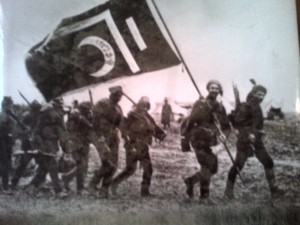
Ottoman soldiers carry a black military flag or banner during the First World War

Ottoman soldiers carry a black military flag or banner during the First World War

Usama Hasan

1st September, 2014

(minor updates: 26/10/2014)

 The Black Flags of Khurasan (PDF)

Contents

1       SUMMARY. 2

2       Fabricated hadiths: pro- and anti- ‘Abbasid propaganda. 3

2.1         Pro-Abbasid fabrications. 3

2.2         Anti-Abbasid fabrications. 4

3       Weak hadiths about the black flags or banners from Khurasan. 5

3.1         Shawkani’s brief analysis. 7

3.2         Albani’s analysis of this hadith. 7

3.2.1          [Ibn Taymiyya on the allegedly blasphemous nature of the term, “caliph of God”]. 8

3.3         Conclusion. 9

4       Contemporary propaganda about black flags. 10

4.1         The Ottomans. 10

4.2         Bin Ladin. 10

4.3         The Taliban. 10

4.4         Harmajdun (Armageddon). 10

4.5         Hizb-ut-Tahrir (HT). 10

4.6         The Boston Bombers. 11

4.7         The Ahmadiyya. 11

4.8         Contemporary Jihadist groups. 11


1. SUMMARY

  1. Several hadiths or traditions in Sunni Muslim sources speak of the appearance of an army carrying black flags or banners from the East, specifically Khurasan (Khorasan), in support of an apocalyptic messianic figure, the Mahdi, at the end of time.
  2. Historic Khorasan is largely in modern-day Afghanistan, but parts of it are in modern-day Iran and Turkmenistan.[1] According to another author, Khurasan is a term for a historical region spanning northeastern and eastern Iran and parts of Turkmenistan, Uzbekistan, Tajikistan, Afghanistan, and northwestern Pakistan.[2]
  3. These traditions are attributed as prophecies to the Prophet Muhammad himself, peace be upon him, thus giving them a powerful resonance in the minds of many devout Muslims who hear them; in particular, modern extremist and terrorist groups regularly quote them.
  4. The traditions were first written down around the 3rd/9th century.
  5. From the earliest times until today, most Hadith scholars regarded these traditions as fabricated Abbasid propaganda that was never uttered by the Prophet. Some Hadith scholars, ignoring their historical context, accepted them as authentic teachings of the Prophet.
  6. During the century-long period of Umayyad rule, the idea of a messianic Mahdi became popular amongst rival Alid and Abbasids (descendants of Ali and Abbas, respectively) and their supporters. Abbasid propaganda in favour of their eventual overthrow of Umayyad rule included many references to the Mahdi, including fabricated hadiths claiming him as an Abbasid in response to the widespread view of him being Alid.
  7. The main Abbasid military commander who led the overthrow of the Umayyads in the 2nd/8th century, was from Khorasan, as his name signifies: Abu Muslim al-Khurasani (c. 700-755).[3] History records that his armies carried black flags or banners, cf. the histories by Tabari, Ibn Kathir, Dhahabi, Ibn Khaldun, Suyuti, etc.
  8. Based on traditional scrutiny of the hadiths’ chains of transmission (isnadsriwayah) as well as rational considerations of history (dirayah), it is the author’s firm conclusion that these hadiths were Abbasid propaganda fabricated 100-150 years after the Prophet Muhammad, peace be upon him, and are in no way true Muhammadan prophecies.
  9. The author was preceded in this view by his father, Sheikh Dr. Suhaib Hasan, who took this view in his PhD thesis: The Concept of the Mahdi amongst Ahl al-Sunna (Sunni Muslims), including a translation of the chapter on the Mahdi from Nu’aym bin Hammad’s Kitab al-Fitan (Book of Tribulations).  Nu’aym bin Hammad is generally agreed to be a weak authority by Hadith scholars, so it is unfortunate that some contemporary writers, speakers and preachers are uncomprehendingly-quoting clearly-fabricated “prophecies” from the Kitab al-Fitan and applying them to current events in Iraq and the Levant! (These fabrications repeatedly mention the “Sufyani” i.e. Umayyad, the Mahdi and real historical figures such as Saffah.)  Rather than dealing with the very real religious, ideological, political and social causes of the current crisis, it is much easier to say, “These are the end times.  This was all prophesied.”
  10. Contemporary Muslim preachers and activists should acknowledge and explain that these hadiths are at the least doubtful and disputed, if not clear fabrications, especially when they are often misused by contemporary extremist and terrorist groups.


2. FABRICATED HADITHS: PRO- AND ANTI- ABBASID PROPAGANDA

There are numerous fabricated (mawdu’) hadiths both in favour and against the Abbasid armies from Khurasan that appeared with black flags in the second century of Islam. This illustrates how hadiths were fabricated for use as propaganda by both sides.

2.1        Pro-Abbasid fabrications


  1. Fabrication, falsely attributed to the Prophet: “The Mahdi will be a descendant of my uncle ‘Abbas.” – related by Daraqutni[4]
  2. Fabrication, falsely attributed to the Prophet: “O ‘Abbas! God opened this matter by me and will seal it by a young man from your descendants who will fill the world with justice as it had been filled with tyranny. He is the one who will lead Jesus in prayer.” – related by Khatib Baghdadi in Tarikh Baghdad [“The History of Baghdad”][5]
  3. Fabrication, falsely attributed to the Prophet: “Should I not give you good tidings [O ‘Abbas]? God opened this matter by me and will seal it by your descendant.” – related by Abu Nu’aym in Hilyah al-Awliya’ [“Adornment of the Saints”][6]
  4. Khatib Baghdadi transmitted a fabrication, falsely attributed to Ibn Abbas: “When the black flags emerge, bid the Persians well, for our rule [dawlah, also meaning ‘state’] will be with them.”[7]
  5. Fabrication, falsely attributed to the Prophet: “O Abbas! When year thirty-five comes, it [the rule] will be for you and your descendants. Amongst them will be the Slayer (al-Saffah), and amongst them will be the One Helped to Victory (al-Mansur), and amongst them will be the Guided One (al-Mahdi).”[8]

2.2        Anti-Abbasid fabrications


  1. Fabrication, falsely attributed to the Prophet: “The flags of the descendants of Abbas have come from Khurasan, signifying the death of Islam. Whoever marches under their banner will not benefit from my intercession on the Day of Resurrection.”[9]
  2. Fabrication, falsely attributed to the Prophet: “When the black flags appear from the east: their beginning is strife, their middle period is killing, their end period is misguidance.”[10]
  3. Fabrication, falsely attributed to the Prophet: “Woe to my nation from the descendants of Abbas! … Their destruction will be at the hands of one of her household [the Umayyads],” pointing to Umm Habiba [daughter of Abu Sufyan and sister of Mu’awiya, the first Umayyad caliph][11]


3. WEAK HADITHS ABOUT THE BLACK FLAGS OR BANNERS FROM KHURASAN

[Below, I use the following notation for hadith isnads, first introduced by my father in his PhD thesis on Hadith: == denotes a strong mode of transmission, such as haddathana (he narrated to us) or akhbarana (he informed us), whilst – denotes a weak mode such as ‘an (“on the authority of”)]

  1. Sunan Ibn Majah, Kitab al-Fitan (Book of Tribulations), Chapter: Emergence of the Mahdi (Guided One), Hadith no. 4082[12] Ibn Majah == ‘Uthman b. Abi Shaybah == Mu’awiyah b. Hisham == ‘Ali b. Salih – Yazid b. Abi Ziyad – Ibrahim [al-Nakh’i] – ‘Alqamah – ‘Abdullah [b. Mas’ud], who said: Whilst we were with the Messenger of God, may God bless him and grant him peace, some young men of Banu Hashim arrived. When the Prophet, may God bless him and grant him peace, saw them his eyes flooded with tears and his colour changed. I asked, “Why do we continue to see something undesirable in your face?” He replied, “Truly, we the People of the House:[13] God has chosen the Hereafter for us over this world. The people of my house will face calamity, dispersal and exile after me until a group of people come from the east with black banners. They will ask for goodness [i.e. authority] but will not be granted it, so they will fight and achieve victory. They will then be given what they asked for [i.e. authority] but will not accept it until they assign it to a man of my house who will fill the earth with justice as others had filled it with tyranny. Whoever amongst you is alive at the time should go to them, even if he has to crawl over snow.” Albani declares this hadith to be weak.[14] Sindi, the commentator on this hadith, states: Ibn Kathir said that this indicates the kingdom of the Banu ‘Abbas [Abbasids]. However, this is precluded by his saying, “He will fill it with justice,” clearly referring to the promised Mahdi, which is why the author included this hadith in this chapter, and God knows best what is correct. [Haythami states] in al-Zawa’id, “Its chain of narration is weak because of the weakness of Yazid b. Abi Ziyad of Kufa, although he was not alone in narrating it from Ibrahim, for Hakim has related it in al-Mustadrak via ‘Umar b. Qays – Hakam – Ibrahim.”[End of quote from Sindi]
  2. Sunan Ibn Majah, Kitab al-Fitan (Book of Tribulations), Chapter: Emergence of the Mahdi (Guided One), Hadith no. 4084[15] Ibn Majah === Muhammad b. Yahya and Ahmad b. Yusuf === ‘Abd al-Razzaq [al-San’ani] — Sufyan al-Thawri — Khalid al-Hadhdha’ — Abu Qilabah — Abu Asma’ al-Rahbi — Thawban, who said:The Messenger of God, may God bless him and grant him peace, said, “Three people, each of them the son of a caliph, will fight over your treasure. It will go to none of them. Then, the black flags will appear from the east: they will kill you with a slaughter not meted out (or faced) by any people.” He then mentioned something that I do not remember. Then he said, “When you see him [their leader], pledge allegiance to him, even if you have to crawl over snow, for he is the vicegerent (caliph of God), the Guided One [al-Mahdi].”Sindi, the commentator on this hadith, says:“Over your treasure,” i.e. “over your kingdom.” Ibn Kathir said, “The apparent meaning of the treasure mentioned is that it is the treasure of the Ka’bah.”“Then, the black flags will appear”: Ibn Kathir said, “These [armies with] black flags are not the ones that Abu Muslim of Khurasan brought, by which he toppled the Umayyad state. Rather, they are other black flags that will accompany the Mahdi, whose appearance is one of the Conditions of the Hour [i.e. Signs of the end of the world and the Day of Judgment].”[Haythami states] in al-Zawa’id, “Its chain of narration is sound; its narrators are reliable. Al-Hakim narrated it in al-Mustadrak and said: It is authentic (sahih) according to the conditions of the two shaykhs [i.e. Bukhari and Muslim].”[End of quote from Sindi]
  3. Sunan al-Tirmidhi, Kitab al-Fitan (Book of Tribulations), Hadith no. 2269[16] Tirmidhi == Qutaybah === Rishdin b. Sa’d — Yunus — Ibn Shihab al-Zuhri — Qabisah b. Dhu’ayb — Abu Hurayrah, who said:The Messenger of God, may God bless him and grant him peace, said, “From Khurasan will emerge black flags: nothing will repulse them until they are planted in Jerusalem.” This is a strange (gharib) hadith. Thus, Imam Tirmidhi declared it to be a weak hadith by describing it only as gharib (“strange”, having links as narrow as one narrator in its chain). Albani also declared its chain of narration (isnad) to be weak (da’if). Mubarakpuri, in his commentary on Tirmidhi, confirms that the black flags refer to military banners at the heads of armies. He also elaborates on Tirmidhi’s statement, “This is a strange (gharib) hadith” as follows: “In its chain is Rishdin b. Sa’d, who is weak. In the chain of the hadith of Thawban in Musnad Ahmad [i.e. the hadith of Ibn Mas’ud, below] there is Shurayk b. Abdullah the Qadi, whose memory declined after he took the position of judge in Kufah. It also contains Ali b. Zayd, who would appear to be Ibn Jud’an, and there is some talk about him.”

3.1        Shawkani’s brief analysis[17]


Al-Azadi related from Ibn Mas’ud from the Prophet, “When the black flags come from Khurasan, go to them, for truly amongst them is the caliph of God, the Mahdi.”


Ibn al-Jawzi said, “It has no basis,” and mentioned it amongst the fabricated traditions.


Ibn Hajar said in al-Qawl al-Musaddad [fi l-Dhabb ‘an Musnad al-Imam Ahmad, The Accurate Word in Defence of the Musnad of the Imam Ahmad], “Ibn al-Jawzi was not correct, for Ahmad has transmitted it via ‘Ali bin Zayd bin Jud’an who is weak but was not an intentional liar such that the hadith should be classified as fabricated when he alone narrates it. How more so, then, when his narration has been supported via a different route? This has been transmitted by Ahmad and by Bayhaqi in Dala’il [al-Nubuwwa, Indications of Prophethood] from the hadith of Abu Hurayra from the Prophet, ‘Black flags will come from Khurasan, that will not be stopped until they are planted in Jerusalem.’ In its chain of narration is Rishdin bin Sa’d, who is weak.”


3.2        Albani’s analysis of this hadith[18]


In another narration of this hadith: “When you see that the black flags have come out of Khurasan, go to them even if you have to crawl …” to the end of the hadith.[19] These narrations were transmitted by Ahmad, Ibn Majah and Hakim.


Ibn al-Jawzi included the hadith in his collection of fabricated (mawdu’) hadiths; Dhahabi said that it was rejected (munkar). Imam Ahmad’s isnad includes ‘Ali b. Zayd b. Jud’an: Ahmad, Ibn Hajar, Munawi and others agreed that he is a weak narrator. Ibn Hajar said about Ibn al-Jawzi’s judgment, “He is not correct, because none of the narrators is accused of lying.” Albani agrees with Dhahabi that the hadith is rejected (munkar).


Ibn al-Jawzi’s isnad for this hadith is via ‘Amr b. Qays — Hasan — Abu ‘Ubaydah — ‘Abdullah [b. Mas’ud] — the Prophet (pbuh). Ibn al-Jawzi stated, “This has no basis: ‘Amr is nothing, and did not hear hadiths from Hasan; Hasan did not hear hadiths from Abu ‘Ubaydah.” Albani adds, “And Abu ‘Ubaydah did not hear hadiths from his father, Ibn Mas’ud … Haythami said in al-Zawa’id (249/2), ‘Its chain is authentic; the narrators are reliable.’ Hakim said, ‘It is authentic according to the conditions of the two shaykhs [Bukhari and Muslim].’ Dhahabi agreed with Hakim, although he said in the Mizan [al-I’tidal] that the hadith is rejected (munkar); the latter is correct. Those who authenticated this hadith overlooked its subtle defect, which is the ‘an’anah (ambiguous mode of reporting) of Abu Qilabah – he was known to conceal some of his authorities (tadlis), as is quoted from Dhahabi and others.”


Albani goes on to say, “However, the hadith is correct in meaning apart from the statement, ‘… for amongst them is the vicegerent of God [khalifat Allah], the Mahdi,’ for it has been transmitted by Ibn Majah (2/517) via ‘Alqamah from Ibn Mas’ud from the Prophet (pbuh), similarly to Thawban’s second narration. Its chain of narration is good (hasan), and does not include the phrase ‘vicegerent of God [khalifat Allah]’.”


3.2.1        [Ibn Taymiyya on the allegedly blasphemous nature of the term, “caliph of God”]


Albani continues:


This addition, ‘vicegerent of God [khalifat Allah],’ does not have an established route of narration, nor a supporting one. Thus it is rejected (munkar – a weak narration that contradicts authentic ones) as follows from Dhahabi’s statement quoted earlier. Part of its abhorrence is that it is not permissible in religion to refer to someone as ‘vicegerent of God’ [khalifat Allah] because that implies a shortcoming and incapacity that does not befit God the Exalted. The Shaykh of Islam Ibn Taymiyyah, may God Exalted have mercy upon him, explained this in his Fatwas (2/461):


‘Some mistaken commentators, such as Ibn Arabi, thought that the vicegerent [the function of khalifah attributed to Adam in Qur’an 2:30] is a vicegerent on behalf of God, like God’s deputy. But God Exalted cannot have a vicegerent, and that is why when they said to Abu Bakr, “O caliph (vicegerent) of God!” he replied, “I am not the caliph (vicegerent) of God, but the caliph (vicegerent) of the Messenger of God – that is sufficient for me.”[20] Rather, it is He, may He be glorified, Who is the vicegerent of others: the Prophet, may God bless him and grant him peace, prayed, “Dear God! You are the Companion during a journey, and the vicegerent amongst family. Dear God, please accompany us during our journey and deputise for us amongst our families!” This is because God is the Living, Ever-Present Witness, Guardian, Self-Subsisting, Observer, Safeguarder, Independent of the Worlds, needing no partner or supporter, and none can intercede before Him except by His permission. A vicegerent or deputy only occurs when the one whose place is taken is non-existent due to death or absence, such that a deputy called a vicegerent is required … all of these meanings are impossible regarding God the Exalted, and He is absolved of them, for He is the Living, Self-Subsisting, Ever-Present Witness who does not die or become absent … It is not possible for anyone to deputise for Him or to take His place, for He has no equal or anyone worthy of His name: whoever attributes a deputy or vicegerent to Him is associating a partner with Him.’[21]

3.3        Conclusion

Note that none of the hadith scholars quoted above took the historical record into account, basing their discussions purely on the chains of narrators and thus reaching opposite conclusions, with some authenticating these traditions and others doubting them severely. From the history of the Abbasid armies from the east, specifically Khurasan, led by black banners, it would appear to be obvious that all these supposedly prophetic traditions are in fact fabrications.


4. CONTEMPORARY PROPAGANDA ABOUT BLACK FLAGS

The use of black flags is an ancient Eastern, Arab and Islamic tradition. Its significance has changed over the centuries. Below is a summary of recent developments.

4.1        The Ottomans

Some people believe that one of the Prophet’s original banners, known as the Uqab, was black, that it eventually passed to the Ottomans and that remnants of it are housed at the Topkapi Palace in Istanbul.[22]

4.2        Bin Ladin

Usama bin Ladin often signed his name with the location, “Khurasan, Afghanistan” at the end of his messages whilst a guest of the Taliban. His organisation, Al-Qa’ida, also specifically adopted black flags from the 1990s. Reading between the lines, it is obvious that Bin Ladin saw Al-Qa’ida as fulfilling a sacred prophecy, bringing armies led by black flags towards Damascus and Jerusalem, in preparation for the coming of the messianic figure, the Mahdi.

4.3        The Taliban

According to one contemporary writer, “Very interestingly, the Taliban hail from the Pashtun ethnicity and have traditionally used two flags, a white flag with a black Shahada (Kalma) embossed for their government and diplomatic purposes and a reversal of this i.e. a black flag with a white Shahada embossed for their military. These types of black flags are also vividly seen across the tribal Pashtun areas that are now reportedly under the control of Pakistani Taliban.”[23]

4.4        Harmajdun (Armageddon)

This influential, populist book authored by an Egyptian Azhari sheikh in 2001 quoted some of these fabricated hadiths.[24] One in particular that begins, “There will be strife at the death of a caliph …” was interpreted to refer to the impending death of King Fahd of Saudi Arabia. Furthermore, the black flags were taken to refer to the black turbans of the Taliban. The book also claimed to be based on recently-discovered manuscripts of hadith, some of which were said to predict the 1990-1 war between Iraq and the US over Kuwait: the hadiths were said to mention a place called “little Kut” which is the literal meaning of “Kuwait.” Although popular amongst the masses, this book was dismissed by serious scholars of hadith and history.

4.5        Hizb-ut-Tahrir (HT)

HT adopted a black flag with the Islamic declaration of faith, possibly from its inception. Recently, this has led to confusion between HT flags and ISIS flags.[25] On one of HT’s public, international discussion forums, there is a lengthy discussion between October 2009 and October 2010 about the authenticity of the hadiths of the black flags, the coming of the Mahdi and the re-establishment of the caliphate, with a suggestion that the black flags refer to the Taliban.[26]

4.6        The Boston Bombers

Four months before carrying out the Boston bombings of 2013 along with another suspect, Tamerlan Tsarnaev appears to have “liked” and shared a video on YouTube entitled, The Emergence of Prophecy: The Black Flags From Khorasan (https://www.youtube.com/watch?v=uJknGtKV34I).[27] This video claims about the hadiths mentioned in it that “majority of scholars say is authentic and others say is weak [sic].”

4.7        The Ahmadiyya

Some of the Ahmadiyya refer these hadiths to their founder, Mirza Ghulam Ahmad of Qadian, due to his Persian ancestry. One of their writers says, “Black Flag of Khorasan … Thawban (ra) narrated that the Prophet (sa) said: ‘If you see the black banners emerging from Khurasan (Persia), seek to join their supporters even if creeping, because among them will be caliph Al-Mahdi.’ (Sunan Ibn Majah, Vol. 3, 4084) This flag is the flag of the Ahmadiyya Muslim Community today (contrary to popular belief it is not the flag of any Jihadist groups since this flag would be for the followers of the Mahdi).”[28]

4.8        Contemporary Jihadist groups

In the modern era, black flags with the Islamic declaration of faith have become very popular amongst Jihadist and other Islamist groups. For example: Al-Qaeda, al-Shabab in Somalia, Boko Haram in Nigeria, Jabhat al-Nusra in Syria, al-Tawhid wal-Jihad in Iraq, Jihadist fighters in Chechnya and of course the self-styled “Islamic State,” formerly “The Islamic State in Iraq and Syria” (ISIS) have all adopted black flags, with white Arabic writing consisting of the basic Islamic declarations of faith (the shahadatayn), as their emblems. The extremist but non-Jihadist international group, Hizb al-Tahrir, also employs a black flag with white shahadatayn, as its emblem. All these groups occasionally reverse these colours: a black flag for war; a white flag for peace. A white flag with black shahadatayn was especially adopted by the Taliban in Afghanistan for peacetime.

ISIS have recently adopted a black flag with white writing: an ancient-looking script for the first shahada, with the second shahada in the form of a seal, based upon the hadiths mentioning the Prophet’s own seal and ring. No-one knows for sure what the script on this seal looked like, but the form adopted by ISIS (and al-Shabab and Boko Haram) has ironically been popularised over the past two decades by populists such as the unscientific Turkish writer, Harun Yahya (Adnan Oktar).

Minor article edits: 11th September, 2014

FOOTNOTES

[1] http://en.wikipedia.org/wiki/Khurasan (accessed 9 Sep 2013)

[2] See Charles Cameron, Ali Soufan: AQ, Khorasan and the Black Banners, http://zenpundit.com/?p=4322

[3] http://en.wikipedia.org/wiki/Abu_Muslim_Khorasani (accessed 9 Sep 2013)

[4] Albani, Silsilah al-Ahadith al-Da’ifah, 4th ed., al-Maktab al-Islami, Beirut/Damascus, 1398, vol. 1 p. 108, no. 80

[5] Albani, Silsilah al-Ahadith al-Da’ifah, 4th ed., al-Maktab al-Islami, Beirut/Damascus, 1398, vol. 1 p. 109, no. 81

[6] Albani, Silsilah al-Ahadith al-Da’ifah, 4th ed., al-Maktab al-Islami, Beirut/Damascus, 1398, vol. 1 pp. 109-110, no. 82

[7] Shawkani, al-Fawa’id al-Majmu’ah fi l-Ahadith al-Mawdu’ah [Collected Insights about Fabricated Traditions], Book of Praiseworthy Qualities, Chapter: Virtues of the Four Caliphs, the Prophet’s Household and the Rest of the Companions, Generally and Specifically, may God be pleased with them, and Virtues of Other People –hadith no. 1010, http://library.islamweb.net/hadith/display_hbook.php?indexstartno=0&hflag=1&pid=530423&bk_no=1015&startno=167

[8] Shawkani, al-Fawa’id al-Majmu’ah fi l-Ahadith al-Mawdu’ah [Collected Insights about Fabricated Traditions], Book of Praiseworthy Qualities, Chapter: Virtues of the Four Caliphs, the Prophet’s Household and the Rest of the Companions, Generally and Specifically, may God be pleased with them, and Virtues of Other People –hadith no. 1015, http://library.islamweb.net/hadith/display_hbook.php?indexstartno=0&hflag=1&pid=530423&bk_no=1015&startno=172 This is a very clear fabrication, since the three titles mentioned were adopted by the first three Abbasid caliphs.

[9] Shawkani, al-Fawa’id al-Majmu’ah fi l-Ahadith al-Mawdu’ah [Collected Insights about Fabricated Traditions], Book of Praiseworthy Qualities, Chapter: Virtues of the Four Caliphs, the Prophet’s Household and the Rest of the Companions, Generally and Specifically, may God be pleased with them, and Virtues of Other People –hadith no. 1009, http://library.islamweb.net/hadith/display_hbook.php?indexstartno=0&hflag=1&pid=530423&bk_no=1015&startno=166

[10] Shawkani, al-Fawa’id al-Majmu’ah fi l-Ahadith al-Mawdu’ah [Collected Insights about Fabricated Traditions], Book of Praiseworthy Qualities, Chapter: Virtues of the Four Caliphs, the Prophet’s Household and the Rest of the Companions, Generally and Specifically, may God be pleased with them, and Virtues of Other People –hadith no. 1011, http://library.islamweb.net/hadith/display_hbook.php?indexstartno=0&hflag=1&pid=530423&bk_no=1015&startno=168

[11] Shawkani, al-Fawa’id al-Majmu’ah fi l-Ahadith al-Mawdu’ah [Collected Insights about Fabricated Traditions], Book of Praiseworthy Qualities, Chapter: Virtues of the Four Caliphs, the Prophet’s Household and the Rest of the Companions, Generally and Specifically, may God be pleased with them, and Virtues of Other People –hadith no. 1014, http://library.islamweb.net/hadith/display_hbook.php?indexstartno=0&hflag=1&pid=530423&bk_no=1015&startno=171

[12] http://hadith.al-islam.com/Page.aspx?pageid=192&BookID=35&TOCID=1534

[13] Ahl al-Bayt: a phrase referring to the Prophet’s immediate family and descendants

[14] Ibn Majah, Sunan, ed. Albani & Mashhur Hasan Salman, Maktabah al-Ma’arif, Riyadh, 1417 H, hadith no. 4082. According to Shawkani (hadith no. 1013), a very similar hadith is transmitted by Hakim and Abu l-Shaykh, and includes the addition describing the flags or banners as “flags of guidance.” http://library.islamweb.net/hadith/display_hbook.php?indexstartno=0&hflag=1&pid=530423&bk_no=1015&startno=170

[15] http://hadith.al-islam.com/Page.aspx?pageid=192&TOCID=1534&BookID=35&PID=7508

[16] Tirmidhi, Sunan, ed. Albani & Mashhur Hasan Salman, Maktabah al-Ma’arif, Riyadh, 1417 H, hadith no. 2269; http://hadith.al-islam.com/Page.aspx?pageid=192&TOCID=1532&BookID=37&PID=4328

[17] Shawkani, al-Fawa’id al-Majmu’ah fi l-Ahadith al-Mawdu’ah [Collected Insights about Fabricated Traditions], Book of Praiseworthy Qualities, Chapter: Virtues of the Four Caliphs, the Prophet’s Household and the Rest of the Companions, Generally and Specifically, may God be pleased with them, and Virtues of Other People – Mention of Mu’awiya, hadith no. 1012 http://library.islamweb.net/hadith/display_hbook.php?indexstartno=0&hflag=1&pid=530423&bk_no=1015&startno=169

[18] Muhammad Nasir al-Din al-Albani, Silsilah al-Ahadith al-Da’ifah wa l-Mawdu’ah wa atharuha l-sayyi’ fi l-ummah, al-Maktab al-Islami, Beirut/Damascus, 4th ed., 1398 H, vol. 1, hadith no. 85, pp. 119-121

[19] This narration is also mentioned by al-‘Ajluni, Kashf al-Khafa’, no. 241 – where he simply says, “Related by Ahmad and Hakim on the authority of Thawban.”

[20] Related by Ahmad similarly in the Musnad (1/10-11)

[21] Although Ibn Taymiyya was responding to what he saw as the neo-incarnationist Sufi notions of Ibn Arabi, the same critique has been applied since the 20th century to the over-politicisation of the Qur’anic term “caliph/vicegerent” by the ideologues of political Islam such as Mawdudi and Qutb, cf. Jaafar Sheikh Idris, IS MAN THE VICEGERENT OF GOD? Journal of Islamic Studies (1990) 1 (1): 99-110, Oxford

[22] See e.g. The Wake-Up Project, Ukab- banner of our Prophet Muhammad (saas), http://wup-forum.com/ukab-banner-of-our-prophet-muhammad-saas-t12620.html. See also a YouTube video featuring a supposed still of this banner accompanied by Islamic songs, and tellingly uploaded by “Abu Muslim Khurasani” at https://www.youtube.com/watch?v=rg8XkGzaMcI

[23] Black Banners From Khurasan: The Bilad-e-Khurasan in Making, Research Paper by Bilal Khan, March 30th, 2008 http://www.grandestrategy.com/2009/06/research-paper-by-bilal-khan-paper-is.html

[24] For an Urdu translation of this book, see https://archive.org/details/Harmajdoon

[25] See Seth Frantzman, A SHORT HISTORY OF THE ISLAMIC ‘BLACK FLAG’ IN JERUSALEM, 10th August 2014, http://sethfrantzman.com/2014/08/10/a-short-history-of-the-islamic-black-flag-in-the-holy-land/

[26] See discussion thread, Black flags In Khorasan, http://forum.hizbuttahrir.org/showthread.php?2599-Black-flags-In-Khorasan

[27] For more information, see Adam Serwer, Did Boston Bombing Suspect Post Al Qaeda Prophecy on YouTube?, Mother Jones, 19th April 2013, http://www.motherjones.com/mojo/2013/04/boston-bombing-suspect-posted-video-al-qaeda-prophecy-youtube

[28] SIGNS OF MIRZA GHULAM AHMAD (AS) AS THE MAHDI AND MESSIAH, 28th June 2014, http://mysticscientist.wordpress.com/2014/06/28/signs-of-mirza-ghulam-ahmad-as-as-the-mahdi-and-messiah/

Fatwa on fasting in Ramadan during the UK summer

June 30, 2014

UPDATE 1st Ramadan 1436 / 18 June 2015: Bismillah al-Rahman al-Rahim

1. There seems to be unnecessary fuss and controversy about this scholarly and practical discussion: disagreement is not disunity; a healthy discussion is not “fitnah.” A reminder: this is not a new fatwa – it was issued by Sheikh Muhammad Abduh 100 years ago, and re-iterated by Sheikh Mustafa al-Zarqa’, a leading 20th-century jurist.  The fatwa also applies to most of Europe – see below.

2. A senior Hanafi UK mufti informed me recently that medieval Hanafi jurists gave a similar fatwa, after Muslims travelled to Northern Europe including Rus (Russia).  Ibn Fadlan (Hollywood’s “Thirteenth Warrior”) famously travelled to Scandinavia, so Muslims were aware of these issues going back centuries.

3. A junior UK mufti has recently claimed that previous fatwas only applied to places where sunrise and sunset do not occur, i.e. “lands of the midnight sun.” This is simply not true: Sheikh Zarqa’ explicitly stated that the fatwa applies to lands with a latitude higher than 45 degrees (which includes most of Europe and all of Canada, Alaska and some Northern US states – as a quick glance at a map will show; it only excludes Spain, Portugal, Southern France (roughly, Bordeaux or further south), Italy etc.), whilst the “lands of the midnight sun” begin at 66.5 degrees (in the Arctic and Antarctic Circles, during their respective summers).  This is because of the earth’s tilt of 23.5 degrees, first measured by the Abbasid astronomers at the Bayt al-Hikma (House of Wisdom) in Baghdad, 11-12 centuries ago: 23.5 degrees away from the Equator gives us the Tropics of Cancer and Capricorn; whilst 23.5 degrees away from the poles (90 – 23.5 = 66.5) gives us the Arctic and Antarctic Circles.

Have a happy and blessed Ramadan, with positive and pure thoughts, words and deeds!

ORIGINAL ARTICLE:

Bismillah.

1. A number of people have asked me since last year about the excessive length of fasting during UK summer months.

2. This has included those new to the practice of fasting, elderly and middle-aged people, who wish to fast but simply cannot manage the very long days. Since last year, I’ve heard reports of such people in hospital, as well as of children falling seriously ill, due to fasting more than 18 hours per day.

3. The day length in London during a midsummer Ramadan is almost 17 hours *sunrise-sunset*. Since there is no agreed beginning of dawn, the dawn-sunset timings vary from 19 to 20.5 hours.

4. The day length increases as we go further north, especially in Scotland and Northern Ireland.

a) E.g. I visited Dublin in June 2000: sunset prayers at the Dublin Islamic Centre (Clonskeagh Mosque) were held at 10.30pm, followed by night prayers at 12am and dawn prayers at 2am. Assuming dawn at 1am, this gives a 21.5-hour dawn-sunset fast.

b) On the other hand, I visited Stockholm in December 1999: sunrise was at 10.30am and sunset at 3.30pm. In winter there, the dawn-sunset fast is barely 6-7 hours, whereas it is 9-10 hours in the southern UK.

5. To reduce the fasting length, note that some of the Sahaba (Prophet’s Companions), including Hudhayfa bin al-Yaman, and Successors ate until sunrise or just before. Tabari and Ibn Kathir mention numerous narrations proving this under Qur’an 2:187, although both of them reject the practice based on a literalist reading of the verse (they lived in moderate climes). Ibn Hazm also approves the practice in his Al-Muhalla.

6. The jurists have discussed this matter for high latitudes (anything over 45 degrees, being halfway between the equator and poles, according to Mustafa Zarqa’.). As Sheikh Muhammad Abduh, Grand Mufti of Egypt, mentions in Tafsir al-Manar, classically they mentioned two possibilities to follow more moderate timings:

a) follow timings of the lands of revelation, viz. Mecca and Medina (Hijaz) – throughout the year, the dawn-sunset fast here is 12-15 hours

b) follow timings of the nearest “moderate land”

Abduh adds, “Both of these are valid, since it is a matter of judgment (ijtihad), and there is no unequivocal text (nass) about it.”

7. Note that following timings of the nearest “moderate land” is similar to following timings of the nearest “moderate time” in your own land, e.g. spring or autumn timings, when the days and nights are approximately of equal length.

8. Abduh is not alone in the above fatwa: he is quoting from centuries of earlier jurists. After him, his fatwa has been echoed by Muhammad Hamidullah, Mustafa Zarqa, Sayyid Tantawi, Jad al-Haqq, and Ali Gomaa amongst others. Texts and discussions of these fatwas may be found on the internet, e.g. see http://alrukn.com/long-fasts-fiqh/

9. The above fatwa implies partially decoupling fasting from dawn/sunset.

10. The spirit of fasting is clearly “from morning until evening” and to focus on its inner aspects, without hair-splitting about external matters.

11. The famous Qur’anic passage about fasting 2:183-7 begins and ends with taqwa (God-consciousness), and includes the memorable wisdom, “God wishes ease for you, not hardship … that you complete the course, magnify God for guiding you, and that you give thanks.”

This verse is in fact the basis of the numerous hadiths about making matters in religion relatively easy and not difficult, of the classical Hanafi principle of istihsan (attaining goodness, even if opposed to analogical reasoning) along with 39:17-18, cf. the first page of Kitab al-Istihsan in Al-Mabsut of al-Sarakhsi, and of contemporary jurists’ emphasis on taysir (easing matters), part of the Prophetic spirit and one of the principles of jurisprudence.

12. In exceptional circumstances, the Prophet (peace be upon him) understood that “morning” and “evening” were relative to people’s habits and culture.

Hadith: Safwan bin Mu’attal, who as a virgin was caught up with Aisha, Mother of the Believers, in the scandalous rumours that rocked Medina after the Mustaliq expedition, eventually got married. His wife once came to the Prophet and complained about her husband on three counts. (The Prophet defended and made excuses for him regarding all three matters.) One of these was that “he does not get up for the dawn prayer, and only offers it after sunrise when he rises.” When the Prophet asked him about this, he replied that his people or tribe customarily rose after sunrise, and not at the crack of dawn. The Prophet’s wise answer was, “In that case, pray when you wake up.” (Fa idha-stayqazta fa salli, a sound hadith in the Sunan, rated as authentic by Albani in his evaluation of the hadiths of Mishkat al-Masabih.)

Thus, for example, those who work night-shifts, working throughout the night and sleeping during the day, should fast during the night. This is because night has become day for them and vice-versa. The Qur’an that encourages fasting during the day also states that night is for sleep whilst the day is for work (e.g. 78:9-11).

13. An Azhari sheikh recently suggested to me that 12 hours’ fasting was sufficient, based on the average length of a day over a whole year: this is true of the sunrise-sunset day, for every place on earth. If we use dawn-sunset instead, we get 13-14 hours’ fasting. Note that this approach implies keeping a similar-length fast irrespective of the season in which Ramadan falls: in the winter, fasting would be much longer than the dawn-sunset timing, and some of us do follow that approach. This has an element of “continuous fasting” (sawm al-wisal, where fasting continues by night) about it: the Prophet practiced this regularly for several days at a time, but disallowed it for his followers, unless they were sure they could manage it.

14. I am reliably informed that Muslims in Norway use a 14-hour fasting timetable in the summer.

15. A case may be made for 16-hour fasts, based on Imam Ghazzali’s view that the maximum a person should sleep at night is a third of the day and night, i.e. 8 hours.

16. Insisting that those unable to complete long fasts should make them up at another time is practically equivalent to moving Ramadan out of the summer and into the seasons of autumn, winter or spring.

CONCLUSION / FATWA

All Praise belongs to God. Peace and Blessings be upon the Messengers of God.

1. Those who wish to follow dawn-sunset timings of 18-21 hour fasts and can do so safely, are free to do so.

2. Those who find this genuinely unbearable, or are convinced of the non-literalist approach of “morning to evening” rather than the literalist “dawn to sunset”, may wish to fast for 12 or preferably 14-16 hours, beginning from dawn, sunrise or even their usual morning meal (breakfast!). Such moderate timings are based on the fatwas of jurists over many centuries for high latitudes.

3. Whatever length a person fasts, they should not feel superior to others. The spirit of Ramadan and fasting includes God-consciousness, patience, perseverance, gratitude, prayer, worship, charity, generosity, humility, self-purification, self-development, helping others, mercy, compassion, forgiveness, lowering the gaze (of the eyes from lustful glances and of the heart from other than God)  and the remembrance and love of God.

May Allah, the One and Unique having Infinite Beautiful Names, bless all of humanity during this month, and shower upon us its internal and external grace.

Sheikh Dr. Usama Hasan (London, UK)

1st Ramadan 1435 / 29th June 2014 (updated: 4th Ramadan 1435/ 2nd July 2014; 11th June 2015)

Download a 2-page PDF of this fatwa here: Fasting in the UK summer

When does Ramadan start? 1435 / 2014

June 21, 2014

Bismillah. Please refer to the UK Moon Watch project: http://astro.ukho.gov.uk/moonwatch/nextnewmoon.html

Astronomical new moon (conjunction) occurs on Friday 27 June 2014 at around 8am UT (GMT), God-willing.

The first naked-eye visibility of the new crescent moon, apart from a few Pacific islands, is over Australasia on Saturday 28 June, followed by Asia (partial), Africa and the Americas on the same date. The rest of the world follows on the next day.

Hence, the first day of Ramadan 1435 in the UK occurs on the following date, depending on which method you use:

1) Conjunction-based methods: 27 or 28 June

2) Global crescent-visibility method: 29 June

3) Local (UK) crescent-visibility method: 30 June

The corresponding possible dates of Eid al-Fitr are:

1) 26 or 27 or 28 July

2) 28 or 29 July

3) 29 or 30 July

Of these methods, I prefer no. 2.

Praying for all of humanity to gain blessings of Ramadan,

Sheikh Dr. Usama Hasan (imam & astronomer), 21 June 2014

Usama Hasan, https://unity1.wordpress.com

A Good Friday? Protests, Prayers and Peace at the Park – 18 April 2014

April 20, 2014

Bismillah. We often go as a family to Regent’s Park Mosque (RPM aka London Central Mosque) for prayers around Easter, since it’s a rare Friday with schools and offices shut, no congestion charge for driving around the city centre and the car parking in the park being at holiday rates: just over half the normal rate at £1.40 per hour rather than £2.40, significant when you wish to stay the whole day.

Approaching the mosque from inside the park, we noticed several police vans parked around the corner. Unusual, since there are normally only a couple of police officers outside the main entrance of the mosque in Park Rd.

Being a public holiday, the mosque congregation was much larger than usual, perhaps by 50%. We could only find parking near London Zoo and walked back, past the usual armed officers guarding Winfield House, the US Ambassador’s residence, literally a stone’s throw from the mosque’s rear entrance. On the way, I told my 7-year-old son about the Islamic tradition that spiritual reward earned for travelling to mosque is proportional to the effort required, even measured by the footsteps taken: several hadiths speak of this in a literal commentary on Qur’an (Surat Y.S. 36:12), “We write down their traces: everything have We recorded in a Clear Source.” When a particular tribe in Medina wished to move closer to the Prophet’s Mosque since they walked daily to it five times a day for prayers, he (pbuh) had replied, “Stay in your homes: your footsteps are written in tomes.” (Diyarukum, tuktabu atharukum) Ibn ‘Uthaymin once commented that the equivalent of a footstep for a car or bike was a wheel revolution.

The mosque was full, so we listened to the sermon after squeezing into the main courtyard, also full, all the way back to the car park: I counted about 40 rows, with about 40 people per row, hence over 1500 males here. The main hall holds at least 2000 males, plus the women’s sections and basement halls were all full, so I estimate at least 5000 worshippers. It’s always nicer to pray in the open air when the weather is nice, as it was on Friday: God’s wonderful dome beats any man-made one, even if it’s golden. As the Prophet (pbuh) said, “The entire earth has been made a place of worship.”

Islamic tradition demands that worshippers listen to the imam’s Friday sermon in absolute silence, which is why we easily heard the sounds of protesters, who must have been close to the main entrance. The Azhar-trained imam, Sheikh Khalifa Ezzat, had chosen his topics carefully, and probably in response to some of the protests, about which the mosque must have been informed by police: in both Arabic and English, he preached about justice (quoting Ibn al-Qayyim: “God upholds just societies and destroys or allows the self-destruction of unjust ones”) and condemned the evil crimes of sexual grooming gangs, although the latter wasn’t a great topic for a very family-oriented congregation. Listening to an Egyptian imam preaching about just society in a courtyard with one or two thousand people, I thought of Tahrir (Liberation) Square.

Straining to hear the imam’s soft-spoken voice, even through the loudspeakers, was made more difficult by the loud chants of “E, E, EDL” and rendition of “Jerusalem” (accompanied by music) by William Blake coming from the other side of the main gates. I spotted one leader of a Muslim fascist group in the courtyard, and feared trouble. The irony was that many of us British Muslims would be quite happy to sing “Jerusalem,” although not in mosque, where the ascetic atmosphere is quite rightly one of worship and devotion that transcends even spiritual music and song. Furthermore, Blake is possibly England’s greatest mystical poet (as well as Shakespeare, judging by Martin Lings’ phenomenal book about the latter), and arguably would have felt at home with the Remembrance of God in a beautiful mosque inside one of London’s prettiest Royal Parks. As the Prophet (pbuh) said, “God is beautiful and loves beauty.”

Prayers after the sermon were also disturbed by chants and another musical score that my teenage son told me later was something called “Hearts of Courage” that he liked from school.

I have uploaded short video extracts of the sermon accompanied by the sound of protest, here: and here:

Others have uploaded videos of their protests. Had I been alone, I would have gone over to see the rival protests, but there was potential for serious trouble and we took no chances with our 7-year-old twins. Furthermore, we had come to mosque for inner and outer peace, not for childish, angry protests. Police sirens also disturbed prayers, but their helicopter crew had the courtesy to only bring their noisy flying machine over once prayers were over. The chopper slowly flew above Park Rd later towards Baker St – we learnt afterwards that this to police those marching for a mediaeval Caliphate and Sharia, dutifully protected by Western freedom of expression and the “kufr (infidel) law” that they so despise providing dozens of police to keep the peace at our collective taxpayers’ expense. (The truth is, of course, that Western and Islamic law have the same basis: justice and mercy, so such protests are misplaced.)

Of the 5000 Muslims at mosque, no more than about 1% joined this march. We are the 99%. Alhamdulillah.

As ever with Friday prayers at RPM, hundreds of families streamed into the park afterwards. My wife told me about journalists trying to interview worshippers. There were a couple of Orthodox Jewish families also in the park, no doubt fresh from celebrating Passover and enjoying the sunshine before the Sabbath later. I hope they didn’t feel intimidated by the hundreds of Arabs and Muslims – I don’t think they were.

There were long queues for cake, ice-cream and boating lake tickets. Tulips were in full bloom in a gorgeous array of colours. We saw a heron amongst the ducks and swans, and came across a RSPB stall with birdspotting telescopes (spotting scopes), and got to see two different triplets of baby heron chicks nesting in the trees of the boating lake. We also saw a number of delightful ducklings snuggling up to their Mother Duck. We imagined the excitement of these herons and ducks at their new arrivals, remembering our own when our babies were born. “Every crawling creature in the earth, and every bird flying with its two wings, comprise communities and nations like your human ones. We have not omitted anything from the Record: then, to their Lord, shall they be gathered.” (Qur’an, 6:38)

We joined the RSPB as a family: they have no fixed fee, only a suggested donation of £5-10 per month: you get a membership pack with gifts and benefits including free entry to their nature reserves around the country. I encourage others to do so also, here: http://www.rspb.org.uk

After a 3-hour walk around the park, we came across a young, well-intentioned masked Muslim man on a bicycle, wearing a Che Guevara t-shirt. He was from “London Anti-Fascists” and had been riding around in an anti-EDL op, and asked whether we had had any trouble. Nice of him. I should have asked him why LAF don’t take on Muslim fascists who avowedly want a global totalitarian theocracy and to execute any dissident or non-conformist.

So come on please, EDL-ers and Caliphaters: please stop being at each other’s throats and let’s have civilised interaction rather than offending each others’ sacred symbols, such as by disturbing prayers or abusing the bases of Britishness. And let’s all help with forming trust, mediation and reconciliation, that we may yet build Jerusalem and Medina in England’s green and pleasant land.

Usama Hasan, https://unity1.wordpress.com

Saliba lecture: “Late Arabic Scientific Commentaries” (includes online link)

April 17, 2014

Public lecture event organised by Al-Furqan Islamic Heritage Foundation on Friday 4th April 2014.
After the reception and the opening words, Mr. Sharaf Yamani, member of the Al-Furqan Board of Directors, gave a short brief on Al-Furqan’s work and efforts in uncovering and studying the Islamic written heritage.
The keynote speaker at this public event was Professor George Saliba, Professor of Arabic and Islamic Science at Columbia University in the city of New York. His lecture on “The Role and Originality of Late Arabic Scientific Commentaries” was very well received.
In his lecture, Professor Saliba gave an insightful view on the scientific importance of the commentaries – with a special focus onthe field of astronomy – produced between the thirteenth and the sixteenth century, the period considered to be “the Late Classical Period” of Islamic civilisation. He demonstrated that particular commentaries that were produced during this period, did not only produce new scientific thinking, but also produced a level of astronomical mathematical sophistication that could outmatch any of the earlier works that were produced within the Islamic civilisation, and could, in some instances, even outmatch the contemporary scientific works that were produced in Europe at the time.
According to Professor Saliba, the main reasons why late commentaries have not received the scholarly attention they deserve and are still wrongly considered to be mere copies of previous works, are:

1. Late commentaries are very difficult to read: the text on the page is often very dense and small.

2. They often lack illustrations: it is very difficult to find a scribe (nasikh) that was also an illustrator (naqqash). Today there are very few examples of manuscripts where the illustrator and the copyist are the same person.

3. There is still an imposed traditional misconception that considers that, after the classical or golden age of Islam, there is nothing worth studying in terms of cultural products.

The lecture was followed by several questions from the specialised and distinguished audience regarding various aspects covered by Professor Saliba.

To watch the recorded lecture, please click on the following link:
Thank you once again for coming to the event. We will inform you of future Al-Furqan events and hope that you will be able to join us.
Best wishes,
Sali Shahsivari, Managing Director
Al-Furqan Islamic Heritage Foundation

Usama Hasan, https://unity1.wordpress.com

Ramadan in the summer at high latitudes – by Sheikh Ahmad Kutty

April 15, 2014

Bismillah. An interesting fatwa published last Ramadan (July 2013). Parts of Ramadan will be in midsummer for the next few years, so this discussion will continue.

I’d add the following notes:

1) According to Ibn Kathir, in his Tafsir under 2:187, Tabari narrated from several Successors (Tabi’in) that fasting only becomes obligatory at sunrise. (In my view, this is based on, and a logical extension of, the difficulty of defining “dawn” precisely – when the sun appears, there is no argument!) Ibn Kathir adds that in his view, “No person of knowledge can remain stable on this view, since it contradicts the unequivocal text of the Qur’an.”

2) Does anyone have the text of Mustafa al-Zarqa’s fatwa cited below? As quoted, it says that fasting at high latitudes in the summer can follow clock timings from more temperate latitudes, ie to end fasting before local sunset.

U.H.

http://www.onislam.net/english/shariah/contemporary-issues/islamic-themes/453299-sunnah-and-determining-the-times-of-fajr-and-imsak.html

Determining the Times of Fajr and Imsak
By Sheikh Ahmad Kutty, Senior Lecturer, The Islamic Institute of Toronto

Conclusion

(Since the day hours are excessively long, such rigidity when determining imsak can be viewed as only dampening one’s spirit about fasting.)

In light of the above incontrovertible evidence, it should be rather easy for us to conclude that relying on astronomical dawn to determine the time of imsak is unwarranted, and that we cannot go wrong if we consider the nautical dawn, if not the civil dawn, as the starting time of imsak and beginning of fajr. Furthermore, there is no basis for compelling people to start the imsak way before fajr, for, as it has been clearly demonstrated, the companions were in the habit of standing up for fajr soon after finishing their suhur.

Furthermore, it has been clearly demonstrated from the Sunnah and the practices of the pious generations that the time of imsak and fajr is not determined by minutes, seconds, or degrees, but by sufficient latitude, ease, and flexibility. Hence, there is no compelling reason for us to insist on the astronomical definition of dawn.

Still another point to note: When we consider the above statements and reports carefully, it is clear that their approach to the issue unravels another fundamental principle of jurisprudence. This has been often phrased as “That which is certain cannot be removed by doubts.” When we apply this principle to the issue at hand, since the night precedes dawn, that is a certainty, as such, it cannot be ruled out until we can clearly determine that the dawn has arrived.

Closely allied with the above is the importance of taking into account our own times and circumstances. No one can doubt we are living at a time where Muslims are showing increasing complacency and are slipping away from the practice of Islam. Moreover, since the day hours are excessively long, such rigidity when determiningimsak can be viewed as only dampening one’s spirit about fasting.

We saw all of the above leniency and latitude as pointed out above were demonstrated in standard time zones like those of Makkah and Madinah. So one might legitimately ask: By applying a far more stricter rule in calculating the time of imsak, are we trying to prove to be more pious than the Prophet’s companions and successors, and end up causing greater and greater hardship for people, who reside in less than standard time zones?

In this regard, therefore, let us recognize that the juristic traditions in all of the acceptable schools of jurisprudence have taken into account the circumstances of people and countries, for they knew too well that Shari`ah is based on tangible maqasid (higher purposes) and masalih (benefits). They also understood that the function of an `alim (scholar) is to render ease where there is difficulty. Long ago, Imam Sufyan Ath-Thawri said, “A true scholar is one who finds (based on sound principles) an easier way for people, because as far as making things difficult is concerned, one need not have any knowledge to do that!”

It is perhaps pertinent to mention here that, according to one of the great jurists of the Hanafi school of the twentieth century, the late Shaikh Mustafa Az-Zarqa, Muslims living in time zones where daylight hours are unusually long may base their times for imsak and iftar on the regular timetables followed in Makkah and Madinah.

If this is the inference of an eminent Hanafi jurist, coming as he is from a long lineage of authentic representatives of the Hanafi school, how can we be faulted for going by a time-table which calculates the Fajr in a slightly flexible manner?

As a final word, it would be wise to remind ourselves of the dire warning of the Prophet (peace and blessings be upon him), “There are among you those who simply drive people away from Islam.” (Bukhari and Muslim).

I pray to Allah to guide us to the straight path, make us instruments of guidance and gather us all under the banner of the seal of prophets and messengers.

Usama Hasan, https://unity1.wordpress.com

Hadiths on Female Circumcision (FGM)

March 19, 2014

Bismillah. Further to Quilliam’s press release last week against the call to reintroduce female circumcision (FGM) in the Maldives, here are further thoughts on the issue, including a discussion of hadiths about the subject:

1. FGM is a cultural practice that was known in pre-Islamic Arabia. It is also found in parts of Africa.

2. FGM has no religious Islamic sanction – there are just two traditions on the subject, both of which are strongly disputed, with many jurists throughout history discounting them as having nothing to do with the Prophet of Islam.

There are two hadiths in the Sunan collections (medium-level authenticity) relevant here. To paraphrase, these two hadiths say, “Cut, but don’t cut too much” and “Female circumcision is a way of honouring (!) women.”

The isnads (chains of narration) of these two hadiths are acknowledged to be weak, including by the Sheikh Albani. However, regrettably, Albani judged that the two hadiths support each other and that they are therefore sound (hasan). This judgment is quoted by many writers, including the influential Saudi scholar al-‘Arifi/’Urayfi in his “Etiquettes of Welcoming the Newborn in Islam” (Adab Istiqbal al-Mawlud fil Islam), to support FGM. [Note that thousands of copies of the latter book in Arabic were distributed for free in the UK by salafist organisations.]

However, the UK-based British-Iraqi Sheikh Abdullah al-Judai vehemently disagrees with Albani about this, declaring these hadiths to be seriously weak and FGM to be a custom not approved by Islam. [See Postscript below for more details.]

Here, it is worth analysing three claims made in the recent Lapido Media article on Maldives FGM (http://www.lapidomedia.com/node/3987):

(a) “the four Sunni schools approved of female circumcision”

This may well be the case, because of the above hadiths being accepted by jurists without scrutiny, although many Hadith scholars pointed out their weakness. Like the blasphemy and apostasy laws of medieval Islam, FGM became a theoretical juristic position even though it was rarely practiced. These issues need to be addressed by the proponents of so-called “traditional Islam” (that is actually mediaeval Islam), of both the madhhabist and salafist varieties.

(b) “one reason for this was to reduce women’s sexual appetite”

Ibn Taymiyyah certainly says so, and endorses it. He goes on to claim that “non-Muslim women, being uncircumcised, have excessive sexual desire.” (Ibn Taymiyyah, Fatawa al-Nisa’ or Jurisprudential Pronouncements relating to Women.) Other mediaeval jurists, also known for their xenophobia and misogyny notwithstanding positive qualities in other aspects, probably agreed with him.

(c) [A Maldivian cleric] quotes a hadith of the collection by Prophet Mohammed’s wife, Aisha, as saying, ‘A bath becomes obligatory if one sleeps with your wife and the circumcised parts touch each other.’ The cleric concludes: ‘The word circumcision has been applied to both men and women here. The hadith demonstrates that women must be circumcised as well.’

This hadith may be more sound but, as Sheikh Judai states, it contains no approval of (male or female) circumcision, merely providing a factual description. To claim that this hadith obliges FGM (“women must be circumcised”) is an example of very poor and flawed logic and juristic reasoning.

3. The fact that FGM is cultural, not religious, is obvious from two matters: (i) it is/was known in non-Muslim communities in Arabia and parts of Africa; (ii) female circumcision is a very rare practice in the Muslim world, unlike male circumcision that is universal in Muslim societies.

4. The hadith (of 40 Nawawi) and fundamental Sharia principle of outlawing harm (la darar wa la dirar), that is based on numerous Qur’anic verses, dictates a total Islamic ban on FGM today, now that the medical, physiological, sexual, emotional and psychological harms are indisputable. This is the position of Al-Azhar and other institutions.

5. We should welcome the recent tougher legislation and enforcement against FGM in the UK and commend the campaign of the young British-Somali woman from Bristol in this regard. We should note also that there a number of British clerics who are stuck in a mediaeval mindset and poor understanding of the hadiths and fiqh (jurisprudence) who openly promote FGM and regard it as “preferable” because of what is written in centuries-old human texts. I hope that these clerics will reconsider their positions, both intellectually and societally.

6. The literalist, fundamentalist thinking behind this call in the Maldives has also given rise to the same cleric’s insistence on the reintroduction of ancient hudud punishments such as amputation and flogging, that have no place in modern society. These punishments were abolished by the scholars and sultans of the Ottoman Empire in the 1850’s, but have been reintroduced in Muslim-majority countries by literalists in the 20th and 21st centuries.

7. An example of the danger of the above is the case of the 15-year old Maldivian girl who was sentenced to flogging for fornication, even though she was the victim of rape and sexual abuse by her stepfather. This sentence under the regressive hudud laws was only overturned after a year-long international uproar and campaign (eg https://www.amnesty.org/en/news/maldives-girl-rape-victim-be-spared-outrageous-flogging-sentence-2013-08-21), in which I served as Avaaz’s consultant on Islamic law in 2013. And, of course, there have been many similar contemporary cases under hudud laws in Pakistan, Nigeria, Saudi Arabia, Iran, Afghanistan and other countries.

Usama Hasan
London, UK
19th March 2014

Postscript: In 2004 I attended some sessions near Watford (UK) of the European Council for Fatwa and Research, as an observer. The scholars present included Sheikhs Ibn Bayyah, Qaradawi, Judai, Faysal Mawlawi, Qarahdaghi, Anas Abu Ghuddah, Suhaib Hasan and others.

The FGM issue came up. A French-Arab cleric had written in his submission that FGM was recommended, based on the hadiths discussed above (no. 2). Sheikh Judai disagreed vehemently, stating that FGM is not a sunnah and declaring that “These hadiths are utterly weak, even though Sheikh Albani, whom I venerate in Hadith studies, authenticated them!” No other scholar contradicted Judai in that session. I asked him afterwards about the “circumcised parts meeting” hadith: he immediately replied that it contains no promotion of FGM, being merely a description (cf. 2c above).

As Imam Ghazzali said, as quoted by Ibn Bayyah, nine-tenths (90%) of juristic understanding is to understand society and other contextual realities. Even total mastery of the scriptural texts (Qur’an and Hadith) comprises no more than one tenth (10%) of jurisprudence.

Muslim clerics and jurists need to develop deeper understanding of scripture as well as human nature and society before pronouncing on critical issues and promoting harmful rules and laws for entire populations in the name of God.

Sent from my BlackBerry® smartphone http://www.blackberry.com

Islam and the Veil – Opening Up the Discussion About Hijab

February 3, 2014

Bismillah.  With the global discussion about the veil due to “World Hijab Day” on 1st February, 2014, this is a good time to re-publish here a detailed, academic paper from 2011.  It is from the following book: http://www.amazon.co.uk/Islam-Veil-Theoretical-Regional-Contexts/dp/1441187359/ – one of the editors was kind enough to say that mine was the best paper in the collection, which was quite a compliment since other authors include Javaid Ghamidi and other experts.

Please click here to download the full paper: Islam and the Veil – Usama Hasan

I also suggest the following questions as a guide to study/discussion sessions about this topic:

STUDY/DISCUSSION QUESTIONS ABOUT VEILING (FOR A HETEROSEXUAL CONTEXT)

1. Distinguish between the terms hijab (veil), khimar (headscarf) and jilbab (covering).  Are these religious or cultural aspects of dress/clothing, or a mixture of the two, i.e. religio-cultural?

2. God is veiled from humanity.  What is the nature of the veil(s), and what is meant by the veil being lifted for the believers’ Vision of God?  How did veiling (of women, caliphs – who had a hajib, etc.) symbolise the above truths?

3. What is the significance, if any, of the fact that in Surah al-Nur, men are instructed before women to “lower their gaze and guard their chastity” ?

4. Surah al-Nur: women were instructed to draw their headscarves (khimar) over their bosoms.  Is this a command to cover the head and hair, or to cover the breasts, or all of the above?

5.  Surah al-Nur: What is meant by the “ordinarily-apparent adornment” (zinah zahirah) that may be displayed by women? Is it parts of the body, the top layer of clothing, jewellery, make-up or a combination of these?  What would then be the implied “hidden beauty/charms” (zinah batinah) that men and women would only reveal to close family, spouses, etc. ?

6. Some Companions insisted that women must be covered top to toe in public, including the face; others excepted the face and hands, as did the majority of early authorities; others excepted the forearms, half-way to the elbows (Tabari) or all the way to the elbows (Qadi Abu Yusuf, for women who worked in bakeries and thus had to roll up their sleeves – mentioned by Imam Sarakhsi in Al-Mabsut); others excepted the feet also (Abu Hanifah); some even excepted the head and hair (minority view mentioned by Ibn ‘Ashur).  Some female Companions gathered their skirts when nursing warriors in battle such that their ankles or shins were visible (‘Aisha & Hafsa – Sahih al-Bukhari).  How are these views to be understood from the text?  Do the above views indicate that the context and ‘urf (social custom) is influential in what constitutes modest and appropriate dress?

7. Is the hadith of Asma about “covering up except face and hands” genuine or weak?  If the latter, does that support the niqab-obligation view or the khimar-not-necessary view?

8.  Is a woman to be regarded as “naked” and “sinful” if her face, hands, head, hair, feet, ankles, shins and/or forearms are visible in public, as per the above views? Or should the onus be on men to restrain lustful glances, as they are ordered to do so beforehand in Surah al-Nur?

9.  Surah al-Nur: In terms of the males “having no sexual desire” before whom a woman doesn’t need to worry about veiling, the commentators have extended this to several categories.  How should this be understood in modern societies?  What is your view about the classical view that obliged women to cover in front of their fathers and brothers to prevent the latter having incestuous thoughts?

10. Surah al-Nur: About “their women” before whom women can unveil, does this apply only to Muslim women or to all women (both views are classical) ?  Does it matter about the morality of such female company, i.e. is the matter related to appropriate dress and behaviour?

11. Surah al-Ahzab (hijab meaning curtain or screen): Does this verse imply gender-segregation?  If so, is that a general principle or was it only for the Prophet’s wives and family?

12. Surah al-Ahzab: what is meant by the jilbab?  Is it simply a shawl (Ibn al-Arabi & Ibn Kathir), any dress that reasonably covers the body, an outer garment or cloak on top of usual clothes, or a cloak with a hood that must go on top of a khimar (Albani’s view) ?

13. Surah al-Ahzab: The jilbab is explicitly “that they may be recognised (as noble women) so they are not harassed.” How is that to be understood and practiced in the modern world? Is it true that traditional clothing, i.e. khimar/jilbab/niqab protects Muslim women from sexual harassment in various societies?

14.  How does fiqh al-ma’al (jurisprudence of consequences, cf. Sheikh Abdullah bin Bayyah) apply to issues of gender-segregation and veiling/unveiling in the modern world?  In particular, what implications do veiling/unveiling have for working or professional women in Muslim/non-Muslim societies?

15.  Is the khimar or headscarf (mistakenly called hijab) a normal part of clothing in some cultures, analogous to a hat or cap, or a symbol of faith, modesty, purity, identity, or some combination of these?

16.  What are the psycho-spiritual effects of wearing a headscarf and/or jilbab and/or niqab for women?  Do these lead to confidence, subjugation, control, spirituality, modesty, pride, purity, ostentation, humility, holier-than-thou attitude or a combination of these?

17.  What are the psycho-spiritual effects upon men of women wearing a headscarf and/or jilbab and/or niqab?  In men, do these lead to feelings of purity, increased/decreased/repressed desire, a positive/negative attitude towards veiled/unveiled women, or a combination of these?  How does all this affect the attitudes of Muslim/non-Muslim men towards Muslim/non-Muslim women, whether veiled or unveiled, and their perceptions of beauty, attractiveness, sexuality and desire?

18.  What is all the fuss really about, and are men and women equal in this whole discussion?  Do the notions of gender-equality and women’s liberation have any bearing on the whole issue?

19. Who should ultimately decide what is appropriate dress and behaviour for men and women in a given society?  Is it men, or women, or male religious scholars, or female religious scholars, or panels of religious scholars, or society as a whole including parents, families, religious/spiritual authorities, etc.?

20. And finally, how does God, with the 99 Names of Beauty (jamali) and Majesty (jalali), to Whom we are all returning, relate to all of this in our lives?

Usama Hasan

London, 3rd February 2014 / 3rd Rabi’ al-Thani 1435

Al-Mas’udi: The Meadows of Gold (Muruj al-Dhahab)

January 21, 2014

Bismillah.

The following selections (many paraphrased) are from the traveller and historian Al-Mas’udi “Muruj al-Dhahab” or The Meadows of Gold, translated by Paul Lunde & Caroline Stone, Penguin Great Journeys No. 2, 2007. A good, light read, like all the 15-20 books in this Penguin series.

Mas’udi was from Baghdad and lived c. 276-344 H / 890-956 CE.

ON THE STATE OF ISLAM IN HIS TIME

Islam has weakened and declined. The Hajj is in peril. Jihad has ceased. Islam has always been triumphant until this year 331 H [943 CE].

ON SOME CAUCASIANS

The Kashak [Circassians] are Zoroastrian, most handsome of the Caucasus inhabitants. The women are famous for bedchamber delights.

ON MASUDI’S ENCOUNTERS WITH JEWS & CHRISTIANS

I debated leading Jewish scholars: Abu Kathir and his student Fayyumi (Rabbinical); Yehuda b. Yusuf, student of (the Sabian) Thabit b. Qurra.

All the churches of Syria, Egypt and Byzantium owe their origin to Queen Helena, mother of Constantine. Her Greek name is Elena, having a numeric value of 100.

I met the earliest Christian Arab historian, Ibn Faraj, in Egypt. I debated the Trinity with Dankha (a Christian theologian) in Baghdad and Tikrit in 313/926.

ON THE TRAVELS OF THE GREEK ACADEMY

Athens
Alexandria/Rome (Augustus/Theodosius) Antioch (Umar bin Abdulaziz reign) Harran (Mutawakkil reign).

ON THE MOST LEARNED MEN OF HIS TIME

The most learned men of my time are the philosophers al-Farabi & Ibn Adi (Christian). Ibn Adi has the same Pythagorean philosophical system as Muhammad Zakariyya al-Razi.

ON THE FIRE-TEMPLE AT PERSEPOLIS

The Persian temple at Istakhr (Persepolis) had idols, then just a fire. It has huge stone pillars and horses, and is said by some Muslims to be Solomon’s Temple.

MISCELLANEOUS OBSERVATIONS ON ASIA (FROM EGYPT TO INDIA, CHINA & SE ASIA)

I saw peacocks in India: these have beautiful plumage. Those brought west to the lands of Islam: the plumage is dulled. [Evolution/adaptation]

Oranges were first brought from India c. 912 to Oman, Iraq, Syria, Palestine and Egypt. They lost their original sweet smell and nice colour due to changes in the air, soil and water.

On an Indian war elephant: when his keeper died, he didn’t eat or drink for days, showing grief or sorrow like bereaved man, with constant tears.

The rhinoceros is found in India. Some of its bones are fused, so it is unable to bend its knees and therefore to lie down. So it sleeps standing, leaning against a tree. It chews the cud. Indians, including Muslim, eat its flesh.

Upper Egypt exports dates, raisins, grapes, alum and vitriol. [Alum = potash = potassium aluminium sulfate, KAlSO4. Vitriol = sulfuric acid, H2SO4]

Indians are fond of music and singing. They forbid wine, not due to religion but to protect the mind and reason. If a king drinks wine, they hold that he deserves to be deposed since it is impossible for him to govern with clouded reason.

Most Tibetans are of Himyarite Yemeni origin. Their kings are called Tubba’, a Yemeni title [cf. Qur’an 50:14]. The rest of the Tibetans are Turkic, and there is no more populous group of Turks anywhere in the world.

The Nicobar and Andaman Islands have cannibals and elephants. Descriptions of Sarandib [Sri Lanka], Sumatra, Kalahbar [Kedah, Malaysia], the Spice Islands.

Spices that come from SE Asia include: camphor, aloes, cloves, sandalwood, nutmeg, mace, cardamoms and cubebs.

The Ring of Fire is a series of volcanic islands near China.

The “island of music” is also here [SE Asia]. The sound of drums, flutes, lutes, rhythmic beating of feet and hand-clapping is heard from a distance. Some sailors claim that the Antichrist has taken up residence there.

The people of Qimar [Cambodia] have fresh breath because, like Muslims, they use toothpicks. Qimaris abhor adultery, indecency and alcoholic drinks.

The story of Habbar bin al-Aswad, an Arab notable of Basra who left during the Zanj [black slaves’] rebellion there, is entertaining. He went to China via India. A Chinese king showed his Arab visitor portraits of prophets including Noah, Moses, Jesus and Muhammad. The king stated that Noah’s flood didn’t reach India or China.

He further showed him portraits of Indian and Chinese prophets’ portraits, depicting them as pointing the index finger to the heavens, warning of the power of God, or making a circle with the thumb and index finger, to indicate that creation is a circle.

[Muslims daily indicate the unity of God with the right index finger (cf. Michaelangelo’s famous painting depicting God and Adam). During prayer, they also sometimes make a circle with the thumb and middle finger, following the Prophet Muhammad, peace be upon him.

Furthermore, according to a sound hadith: Umm Salama emigrated to Abyssinia with her first husband Abu Salama as part of the early sacred migration (hijra). In the churches there, she saw images of prophets with index fingers raised (cf. Michaelangelo again), a feature of daily Islamic prayers. See Albani, Sifah Salah al-Nabi or The Prophet’s Prayer Described, for these hadiths. – U.H.]

The people of China are the most skilful in painting and arts. No other nation can compare with them in any craft whatsoever.

China was prosperous due to its justice until the Huang Chao rebellion of 878. He attacked Khanfu, massacring 200,000 Muslims, Christians, Jews and “fire-worshippers.” [Zoroastrians/Parsees]

The “Meadows of Gold” (Muruj al-Dhahab) was completed in 947, during the Buwayhid reign. The book is like a necklace of scattered pearls strung together. I have not sought to support any particular sect or doctrine, but to report human history as it has unfolded.

END

[Categories History]

Usama Hasan, https://unity1.wordpress.com